Dinoustech Private Limited
The Challenges of Developing Banking Software and Their Solutions
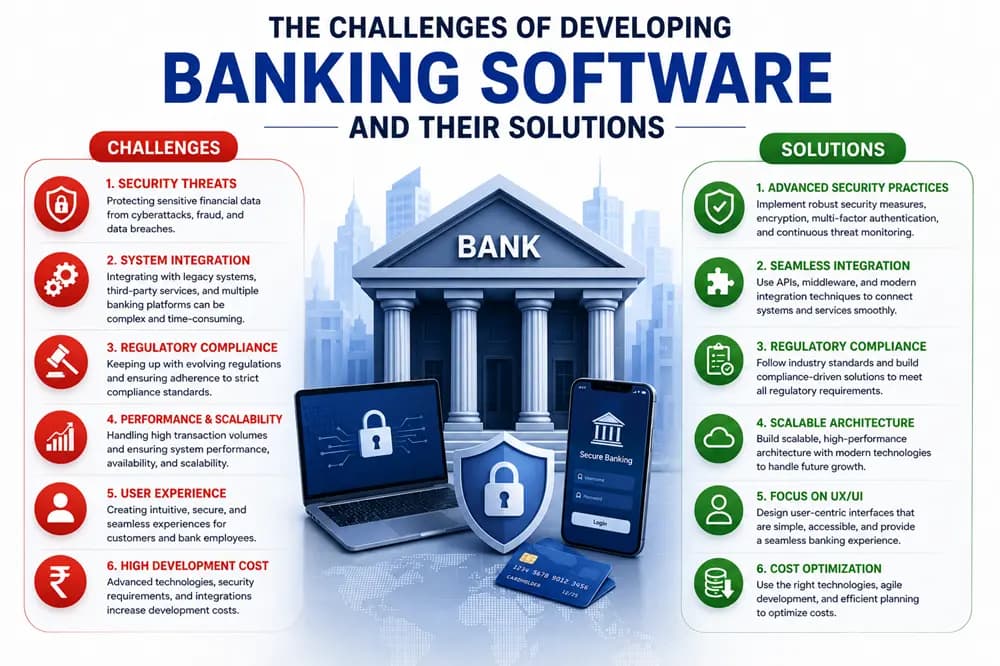
The banking industry has seen quite an impressive shift over the last couple of decades, transforming from conventional branch-cantered operations to advanced banking ecosystems enabled by technology. Modern customers do not need to visit branches of their banks in person to perform any transactions, to manage accounts or obtain loans, and seek financial advices. Today, people expect to use banking services via advanced digital channels 24/7 wherever they are. Modern customers expect mobile banking solutions, Internet banking systems, digital payment systems, automated lending platforms and AI-powered financial services. Therefore, financial organizations invest greatly into banking software development to meet modern market demands and provide more efficient services.
Even though the advantages of using banking software are numerous, creating a safe and reliable financial application is one of the most complicated tasks of the software development industry. Banking applications store sensitive customer data, perform numerous operations each day, work in highly regulated environments. Financial apps differ greatly from regular business applications in the way that the failure of the latter does not cause significant consequences, while even a small problem in banking software may result in huge financial losses.
Moreover, the fast development of financial technology has made competition between conventional banks even more acute. The innovative technologies developed by FinTech companies continue to put into question the principles of functioning of banks. Clients are already used to comparing their banking services not just with those of other banks, but also of technology companies, which offer intuitive and advanced digital services. In order to keep up with the times, financial organizations have to adapt modern technologies while encountering a variety of problems of the development process. Solving these problems will require strategic thinking, professional skills and a thorough knowledge of the financial industry requirements.
Creating banking software does not imply just creating a digital tool for conducting financial transactions. This implies developing highly safe, scalable and intelligent systems, which are able to perform complicated financial processes and provide clients with necessary trust. From the issues of security and compliance with regulations to system integration and optimization of user experience, banking software development faces specific challenges, which require specific solutions.
Issues Related to Security and Compliance in the Development of Banking Software
Safety is considered one of the most important aspects of banking software development since banks store tons of customers' confidential information and financial transactions daily. In contrast to other spheres, where a data leak causes operational issues but does not influence clients' finances, security problems in the banking sphere may affect the finances of customers directly as well as the credibility of institutions. Since there is an abundance of valuable information in the banking sphere, criminals constantly target banks and financial organizations. Therefore, security should be considered when developing banking software solutions.
Protecting Sensitive Information about Customers and Their Finances
Modern banking systems collect large amounts of customers' personal information such as identification data, accounts, payments, transaction history, and financial documents. All this information constitutes a high-value target for criminals who look for ways to take advantage of system weaknesses. Modern cyber-attacks have become much more sophisticated compared to those used several years ago.
It is necessary for developers of banking software to ensure multiple layers of security solutions, including the latest encryption technologies, proper authentication, access management, and security monitoring. The end-to-end encryption guarantees the safety of information when sending and storing it, and multi-factor authentication introduces extra authentication steps which minimize the probability of hacking attempts. Fingerprint scanning and facial recognition belong to biometric means of authentication which not only enhance security but make it easier for users.
Security-oriented software development processes have great importance in terms of ensuring the minimum level of vulnerability in the process of creation of a system. Secure coding, penetration testing, vulnerability analysis, and security audits allow discovering weak points of a system and eliminating them before any attacks. This way, banks create safe banking systems resistant to new threats.
Compliance with the Regulatory Requirements
Banks operate in one of the strictest industries in the world in terms of the regulatory environment. There are a lot of regulations aimed at the protection of customers, prevention of financial crimes and market stability. The regulatory requirements may include aspects of data privacy, anti-money laundering measures, transaction monitoring, client identification, reporting and cybersecurity standards.
It is especially difficult for the bank to meet these regulations because they might vary greatly from one region to another. It is necessary to make sure that the software of the bank includes compliance control within its architecture, workflow, and processes. Not meeting all necessary regulations leads to fines, penalties, operational constraints, and negative reputation.
For a better solution to these problems, the banking software should include compliance monitoring systems that allow you to track all regulations and produce audit trails. The automated reports will assist an institution in demonstrating compliance in case of inspections and save time on paperwork. Compliance control within core banking systems ensures the implementation of regulations.
Countering Financial Fraud and Cybercrime
Financial fraud remains one of the biggest threats to banking institutions all around the world. Fraudsters use more advanced methods to commit crimes through the vulnerabilities of the system of digital banking, such as phishing, identity theft, account takeover, payment fraud, and many others. As more and more people start using digital banking, there is a need for continuous development of ways to fight the fraudulent actions of criminals.
The latest generation of banking software uses artificial intelligence and machine learning to detect any suspicious activities in real time. The programs examine transaction patterns, user behaviour, device identification, and previous data to find any abnormalities that might be related to criminal activity. If the suspicious activity is detected, there is an automated way to provide an extra layer of security by verifying the identity of the user or restricting access to the bank's resources.
This approach helps reduce financial risks and increase customer confidence in digital banking services.
Technical Challenges in Banking Software Development
Banking software development is much more complex than developing financial transaction and account management capabilities. Financial applications need to operate flawlessly when handling a large amount of load, be integrated into existing infrastructure and provide excellent performance. Technical challenges are often one of the toughest parts of the whole process since system failure could lead to financial losses right away.
Integration with Legacy Banking Infrastructure
There are still numerous banks that rely on the legacy core banking systems that have been used for decades already. Although those systems are an integral part of day-to-day operations of any bank, they make use of outdated technologies which are not able to be easily integrated with current digital solutions. The replacement of these systems is very costly and difficult, and in many cases, integration becomes the only solution for businesses.
However, the integration of modern banking applications with legacy systems poses certain technical challenges since there are usually some outdated communication protocols, old databases, or lack of APIs which makes such an integration possible.
Professional full stack development solutions assist in building an interoperability layer between the current digital interface and outdated backend. Using middleware platform, API gateway, and data sync techniques, developers can achieve effective integration without damaging current operations.
Ensuring Scalability When There Are Many Transactions
Banking software should be able to operate with huge amounts of users and transactions at once. There can be sudden peaks in customer activity related to paying salaries, marketing promotions, tax seasons, or any significant financial events. Ineffective systems will not cope with such workloads leading to poor performance and delays.
Cloud-based technologies provide efficient ways of solving scalability issues due to their ability to distribute resources depending on demand. Modern banking software is usually based on microservices architecture allowing for independent scaling of each system component.
Scalable banking software guarantees stable work regardless of transaction volume. Financial organizations that pay attention to scalability can better deal with growth in their businesses and customers' needs.
Providing Exceptional Digital Banking Experiences
In today’s world, customers have come to expect digital experiences that are comparable to the experiences provided by some of the top technology companies. Banks need to ensure that the interface is easy, navigation is easy, the reaction times are quick, and the software functions properly on different devices.
Excellent mobile app development plays an important role in providing digital experiences. In mobile banking apps, it is important to make sure that the experience is convenient for the customers but at the same time does not make the service unsafe. Different features like biometric recognition, personalized dashboards, real-time notifications, and easy transactions help in improving the customer experience.
An effective digital banking application is helpful in promoting the digital adoption drive.
Conclusion
Banking software development poses immense potential for financial organizations willing to improve customer experience, optimize their operations, and stay competitive in today’s world. Nonetheless, building a reliable, scalable, and compliant banking solution comes along with many difficulties that need thorough planning and special competences. Starting from such issues as cybersecurity risks, compliance requirements, and ending with system integration and performance improvement, organizations face quite a variety of technical and operational challenges during banking software development.
However, overcoming these obstacles using such approaches as robust security frameworks adoption, scalable technologies implementation, compliance with regulations, and customer experience focus is the key to success. Effective banking software development allows organizations not only to improve their internal processes but also to gain customer trust, support business development and innovations. At Dinoustech, we assist financial organizations in successful banking software development by creating secure, scalable, and future-proof banking solutions.