Dinoustech Private Limited
Medicine Delivery App Development in India: Complete Guide
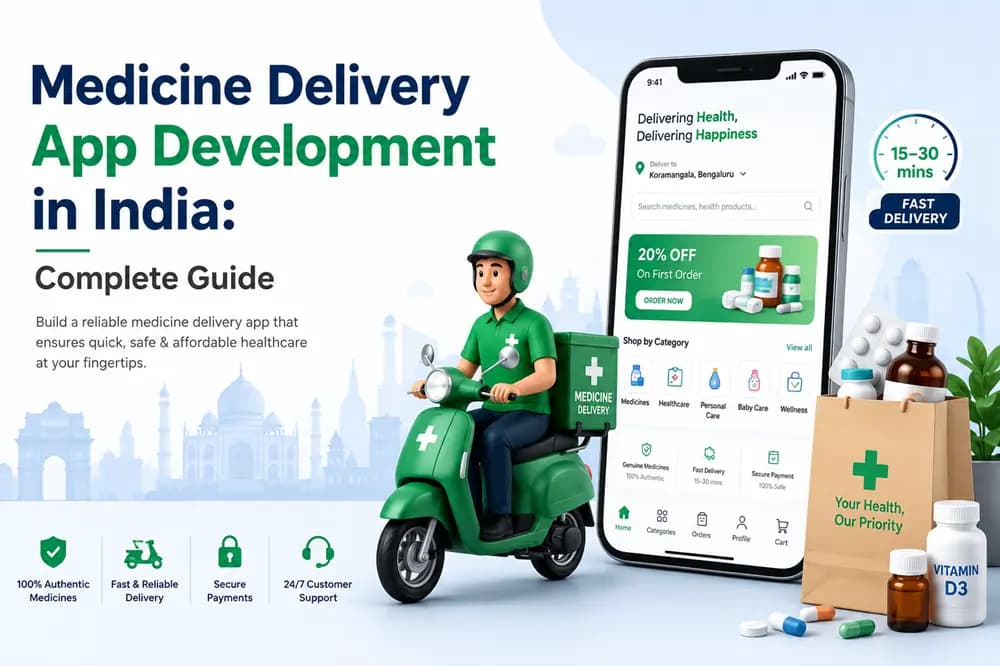
Medicine delivery app development in India has moved from being a convenience feature to becoming a serious business opportunity. More people now expect quick medicine access, prescription handling, home delivery, and digital support in one place. A well-built app helps pharmacies, healthcare startups, and logistics-focused businesses serve customers faster while keeping operations organized. The overall structure below follows the kind of comprehensive flow used in leading industry guides: market overview, development steps, feature sets, advanced capabilities, real-world models, cost, monetization, business value, challenges, and FAQ.
In India, this opportunity is even stronger because medicine delivery apps sit at the intersection of healthcare, e-pharmacy, teleconsultation, and last-mile logistics. Any serious medicine delivery app development in India must also consider data privacy and telemedicine-related workflows. India’s Telemedicine Practice Guidelines cover patient consent, data privacy, documentation, and the use of video, audio, or text-based consultation models, while the Digital Personal Data Protection Act, 2023 provides the legal framework for processing digital personal data.
Why Medicine Delivery App Development in India Is Growing Fast
The demand for online medicine delivery app development is rising because customers now prefer faster, safer, and more flexible ways to buy medicines. People managing chronic illnesses, elderly users, and families in remote areas benefit the most from doorstep access. For businesses, that means a chance to build recurring revenue, improve customer loyalty, and reduce dependence on walk-in pharmacy traffic.
A medicine delivery app also helps pharmacies compete in a market where speed matters. Users want to upload prescriptions, search medicines easily, track orders in real time, and receive timely refill reminders. When these features are combined with a strong backend, the app becomes more than a storefront. It becomes a complete digital pharmacy platform.
For businesses in India, this is also the right time to invest because the healthcare buying journey has become more digital. The competitor guide highlights the shift toward digital health adoption, investment momentum, and AI-enabled efficiency as major reasons this segment remains attractive in 2026.
How to Build a Medicine Delivery App in India
A successful medicine delivery app development company in India usually follows a structured process instead of jumping straight into design or coding. The goal is to create a product that is useful, secure, scalable, and easy to use for patients, pharmacies, and delivery teams.
1. Study the market and define the goal
Before development begins, the business should decide what kind of app it wants to launch. Some companies build a pure medicine ordering app. Others create a full pharmacy delivery app with teleconsultation, refill management, and pharmacist support. A few businesses also want a multi-vendor platform where many pharmacies can list inventory. The business model should be clear before the first screen is designed.
2. Plan the user journey
The user journey in medicine delivery app development should be simple. A customer should be able to register, search medicine, upload a prescription, place an order, pay securely, and track delivery with minimal effort. At the same time, pharmacists should be able to verify prescriptions, manage stock, and approve orders quickly. Admin users should get complete control over reports, permissions, commissions, and customer support.
3. Define the feature set
Once the flow is planned, the next step is featuring selection. Start with the core features needed for launch, then add advanced capabilities later. This approach reduces risk and helps the business validate the idea faster.
4. Choose the technology stack
The technology stack should support security, real-time updates, and scalability. A typical setup may include a mobile app layer, a backend API, cloud storage, payment integration, map services, notification services, and analytics tools. If the app will support teleconsultation or EHR-related data, security and compliance become even more important. The competitor guide also stresses the importance of a strong stack for GPS, payments, and prescription verification.
5. Design the UI/UX
Medicine apps should feel calm, clean, and easy to navigate. Users often open them when they are looking for urgent help, so the interface should remove stress instead of adding to it. Large fonts, simple categories, visible search, clear checkout steps, and easy prescription uploads make a big difference.
6. Develop, test, and launch
Development should happen in phases. A minimum viable product is a good first release because it helps the company test the idea quickly and gather feedback. After that, the app can be improved with advanced features, better automation, and stronger analytics. Testing should cover performance, usability, payment flow, prescription upload, order tracking, and security.
Also Read: - Launch a Medicine Delivery App Like 1mg or PharmEasy
Essential Features of a Medicine Delivery App
A medicine delivery app development project should include features for three main users: customers, pharmacists, and administrators.
Customer panel features
The customer side should feel simple and trustworthy. Users should be able to register with mobile number or email, search for medicines by name or category, upload prescriptions, choose delivery slots, and pay through UPI, cards, wallets, or net banking. Order history, repeat orders, medication reminders, and live tracking are also very useful.
Pharmacist panel features
For pharmacists, the app should provide inventory management, prescription verification, order approval, stock alerts, refill tracking, and sales reports. This helps reduce manual work and avoids confusion during high-volume hours. A well-designed pharmacist panel also improves accuracy, which is critical in healthcare.
Admin panel features
The admin panel is the control room of the entire product. It should allow user management, pharmacy onboarding, inventory oversight, report generation, revenue tracking, coupon management, complaint handling, and support management. Admin analytics are especially useful for understanding which categories sell most and where delivery delays happen.
The competitor guide covers this same three-panel logic in detail, and it is a good model for an India-focused medicine delivery app because the workflow usually needs coordination between customer, pharmacist, and delivery operations.
Future-Ready Features That Can Set Your App Apart
A basic app can work, but a future-ready app can win the market. Businesses that invest in medicine delivery app development in India should think beyond simple ordering.
Teleconsultation support
Teleconsultation is one of the strongest add-ons for a medicine delivery platform. It helps users speak with a doctor or registered practitioner before placing an order, especially when a prescription needs clarification or a refill is required. India’s telemedicine guidelines support healthcare delivery through telemedicine and cover consent, identity verification, patient evaluation, medication, privacy, and record keeping.
Smart refill reminders
Refill reminders can improve retention and help patients stay consistent with treatment. This is especially valuable for diabetes, blood pressure, thyroid, and long-term wellness medications.
AI-based prescription checks
AI can help flag blurry images, incomplete prescriptions, duplicate orders, and unusual patterns. It should not replace human verification, but it can speed up the review process and reduce errors.
Multilingual support
India is a multilingual market. Apps that support Hindi and regional languages often perform better because they reduce friction for first-time users and older patients.
Loyalty and subscription models
Subscription boxes, monthly refill plans, and repeat-order discounts can help create a more predictable revenue stream. This works well for users who buy the same medicines on a regular basis.
Route and delivery intelligence
For delivery-heavy businesses, route optimization can improve speed and reduce cost. The better the logistics engine, the better the customer experience.
Must Read: - Pharmacy App Development: Build an App Like 1mg or Netmeds
Real-World Models That Show the Opportunity
Successful medicine delivery platforms usually solve a very specific problem. Some focus on quick prescription fulfillment. Others offer daily-dose packaging, pharmacist consultation, or same-day delivery.
The competitor article mentions examples such as PillPack, Capsule, and MedExpress as real-world references for convenience, prescription management, same-day delivery, and pharmacist-supported ordering. These examples are useful because they show how medicine delivery businesses can combine accuracy, speed, and customer comfort in a single product.
For an Indian business, the lesson is simple: do not try to copy a generic ecommerce app. Build a healthcare-first platform with clear trust signals, simple navigation, and strong operational controls.
How Much Does It Cost to Develop a Medicine Delivery App in India?
The cost of medicine delivery app development in India depends on scope, features, design, technology stack, and team structure. A basic app costs less because it includes only core ordering and tracking. An advanced platform costs more because it may include teleconsultation, multi-vendor workflows, advanced analytics, AI features, and deeper integrations.
The competitor guide gives a broad cost reference for medicine delivery app projects, with basic builds in the lower range and advanced builds going much higher depending on complexity and delivery timeline. It also notes that the final cost is often calculated from development hours multiplied by the hourly rate.
In practical terms, a medicine delivery app in India can be shaped into three common tiers:
A basic app is good for a startup or a local pharmacy chain that wants online ordering and delivery.
An intermediate app suits a growing business that needs pharmacist tools, order automation, and better analytics.
An advanced app is best for a larger healthcare brand or multi-city platform that needs scalability, telemedicine, compliance, and advanced logistics.
Key Factors That Affect the Cost
Several factors influence the final budget.
App complexity matters first. A simple ordering app costs less than a platform with prescription workflows, teleconsultation, and multiple dashboards.
Platform choice also matters. A single-platform app may cost less initially, while a cross-platform app can reach more users but needs a broader build strategy.
Design complexity affects cost too. A clean template-based interface is cheaper than a custom UI with rich animations and advanced flow control.
The development team location can change the budget as well. Experienced teams with healthcare knowledge may cost more, but they can reduce long-term risk.
Technology stack, third-party integrations, cloud setup, and security requirements also influence the final number. For medicine delivery app development in India, prescription verification, payment security, and privacy controls should never be treated as optional extras.
The competitor article also highlights these cost drivers, especially app complexity, platform choice, design, team location, stack, and third-party integrations.
Monetization Strategies for a Medicine Delivery App
A medicine delivery app should not rely on a single income stream. The stronger the monetization model, the more stable the business becomes.
Delivery fees are the most common option. The business can charge standard or express delivery rates based on distance and speed.
Commission from pharmacies is another option if the platform works as a marketplace.
Subscription plans can create predictable revenue. These plans may offer free delivery, refill reminders, or priority support.
Sponsored listings and promotions can also work if the platform has enough traffic.
Teleconsultation fees, consultation commissions, and refill automation services can create additional income for a more mature platform.
The competitor guide also lists delivery fees as a primary strategy and explains how a combination of service charges and premium delivery options can support stable revenue.
Why Building a Medicine Delivery App Is a Smart Business Move
A good app does more than deliver medicine. It builds trust, simplifies care access, and helps the business grow.
First, it improves convenience. Customers can order from home at any time, which is valuable for elderly users, working professionals, and patients with mobility issues.
Second, it improves accessibility. People in smaller cities or remote areas can get medicines without depending only on a nearby shop.
Third, it improves operational efficiency. Pharmacies can reduce manual calling, paper-based orders, and order confusion.
Fourth, it creates stronger customer retention. Reminders, fast delivery, and repeat-order options make users come back.
Fifth, it opens the door to wider healthcare services. A pharmacy app can later grow into teleconsultation, lab booking, chronic care support, or wellness services.
The competitor article makes a similar case by emphasizing convenience, accessibility, and deeper integration with healthcare systems as major business benefits.
Challenges in Online Medicine Delivery App Development
Medicine delivery is not the same as food delivery or grocery delivery. It has more responsibility, more regulation, and more trust requirements.
The first challenge is compliance. Apps must handle prescription-based medication carefully and follow privacy and telemedicine rules. India’s telemedicine framework and the DPDP Act make privacy, consent, and documentation important design requirements.
The second challenge is inventory accuracy. Medicines can go out of stock quickly, and showing wrong availability hurts trust.
The third challenge is prescription verification. A user may upload an unclear or incomplete prescription, so the app must support review workflows.
The fourth challenge is delivery reliability. Medicine delivery often needs better handling than standard parcel delivery, especially for urgent orders.
The fifth challenge is data security. Health-related information is sensitive, so secure access, encryption, and role-based permissions matter.
A strong development partner will design the app with these risks in mind from day one instead of treating them as afterthoughts.
Why Dinoustech Is a Strong Choice for Medicine Delivery App Development in India
Dinoustech can build medicine delivery apps that are practical, scalable, and ready for Indian business needs. The right solution should support a simple customer journey, a smooth pharmacist workflow, and a solid admin panel. It should also be designed for future growth, so the business can add teleconsultation, loyalty programs, multilingual support, and advanced analytics later.
For a company entering this space, the real advantage comes from combining clean UX, secure backend architecture, and a healthcare-first product strategy. That is exactly the kind of foundation a medicine delivery app needs to perform well in the Indian market.
Final Thoughts
Medicine delivery app development in India is a strong opportunity for pharmacies, startups, and healthcare businesses that want to serve users faster and more reliably. The best apps are not just delivery tools. They are trust-building healthcare platforms.
If the product is planned well, designed simply, and built with compliance in mind, it can become a powerful business asset. For brands that want to enter this market with confidence, the focus should be on user experience, pharmacy workflow, secure architecture, and long-term scalability.
Dinoustech can help turn that idea into a reliable, market-ready medicine delivery app built for India.
Frequently Asked Questions
How long does it take to build a medicine delivery app?
A basic app can be built faster than an advanced platform. The exact timeline depends on features, integrations, and design complexity.
Can a medicine delivery app include teleconsultation?
Yes. A teleconsultation feature can be added if the business model and compliance flow support it. India’s telemedicine guidelines provide the framework for appropriate use.
Is compliance important for medicine delivery app development in India?
Yes. Health data, prescription handling, patient consent, and digital records all need careful attention. The DPDP Act and telemedicine guidelines make this especially important.
What is the best way to start?
Start with an MVP that includes registration, medicine search, prescription upload, order tracking, payment integration, and an admin panel. Then expand into advanced features after user feedback.