Dinoustech Private Limited
Fintech App Development Services in Odisha: Key Benefits & Use Cases
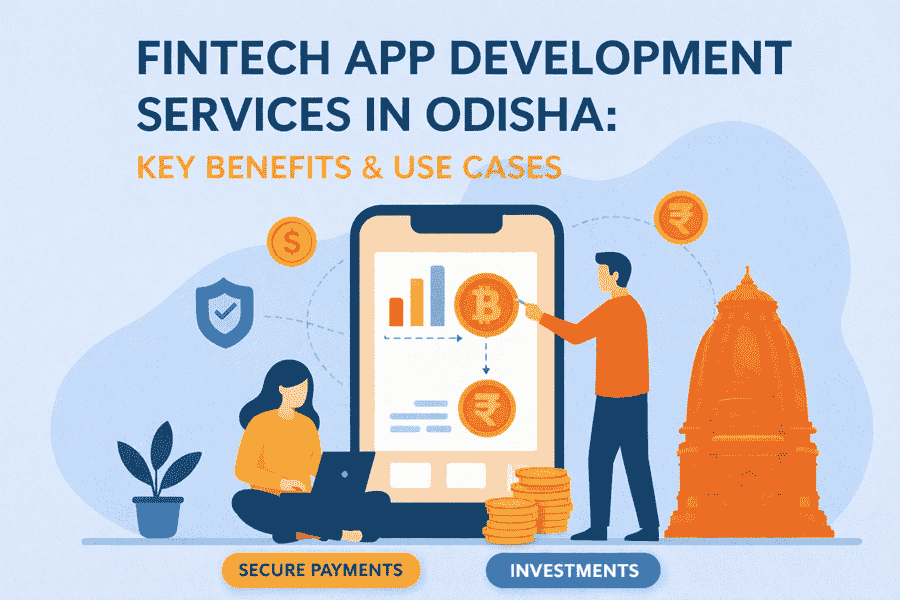
The Odisha economy has a mix of trade on the coast, agri-based sectors, mineral zones, and a burgeoning services sector that lends itself well to the addition of tangible value by fintech. Areas like Paradeep and Puri have traders and tourism-based services that require immediate payments and a collection mechanism. Places like Jharsuguda and Talcher have salary and seller financing requirements that are not easily addressed by conventional banking. The capital city, Bhubaneswar, already has a strong knowledge base that is a hotspot for digital learning and a resulting new generation that demands new payment systems. Balasore's ports and areas around Ganjam and Brahmapur alias Berhampur have international trade requirements for payment systems.
In addition to the large urban centers, there are numerous other district centers like Sambalpur, Rourkela, and Cuttack that are seeing increased adoption of mobile payment services in small retail and service businesses. Even in the farming and tribal districts of Koraput, Malkangiri, and Nabarangur, services such as digitafil payment and micro-loans can liberate working capital and allow small businesses to refrain from extortionary money lenders. It is the diversity of applications, ranging from factory worker salary disbursements in Angul to fishing community payment services in Puri and handicraft markets in Jagatsinghpur, that enables a regional fintech app development firm in Odisha to effortlessly launch successful applications. It is the realistic application that recognizes festival demand in Konark and holiday demand in Puri that will immediately acquire product-market convergence in comparison to generic applications that apply indiscriminately.
Knowledge of user segments in Odisha’s urban and rural areas
Categorizing users based on their geographical locations and occupations enables product development teams to focus on which features should be given priority. Metro users in Bhubaneswar and Cuttack expect advanced functionality like multi-bank connectivity, bill payments, and investment services to be embedded within the payments app. Smaller merchants operating in markets in Balangir, Bargarh, and Rayagada expect the product to be reliable, with minimal transaction charges, hence a sales summary dashboard that allows merchants to view their inventory and sales jointly is revolutionary. In port or logistics centers like Paradeep, complex settlement requirements like cargo, commission, and supplier payments require features like multiple payout options and advanced reconciliation functionality.
Rural and peri-urban customers have different challenges and opportunities. Farming co-operatives or individuals in Titlagarh, Kantabanji, or Padampur require credit tied to the seasons and the sales made by customers. People like the service providers operating micro clusters catering to tourism-related activities, such as landlords around Konark or boat men near Chilika around Brahmapur, can appreciate capabilities such as pre-authorization, rapid refunds, or handling multiple currencies. In contrast, regions like Sundargarh and Keonjhar or Kendujhar with intense mining or industrial activity demand more professional payroll or supplier loans. A smart fintech company will capitalize on such behavioral and economic drivers to create modules catering to the most urgent problems.
Also Read: - Fintech App Development Services in Nagaland: Key Benefits & Opportunities
Essential product services that Odisha customers use
To succeed in Odisha, any fintech app intended to succeed in Odisha will start with certain key elements that offer immediate functionality. eKYU-enabled secure signup, UPI money transfer, QR code payments, or wallets are some necessary functionalities that merchants in Balasore, Bhadrak, and Bhanjanagar will require. For merchant clients in wholesale markets, those dealing in goods in the trading hubs of Rajagangapur or Karanjia, supporting bulk payout and GST-compliant bill generation will reduce hours of manual processing. In Bhubaneswar and Rourkela, customers will require bill payments, recurring payments, or simple P2P transfers when data connectivity is not so optimal.
Apart from these, lending, and working capital tools prove to be highly effective as retention strategies if implemented properly. It will help in filling the cash-flow gaps in terms of bill discounting, and merchants in Sonepur, Nuapada, and Balangir Town. Salary advances will help in smoothing the cash flow in the households of employees in Talcher and Angul. Moreover, a proper reconciliation dashboard and export facility will help B2B merchants in Sambalpur and Dhenkanal. Tourism-related vendors in Puri and Konark require instant payments and resolution mechanisms. These will be the fundamentals that a wise fintech application development company in Odisha will consider while creating an MVP.
Technology choices and architecture considerations for Odisha
When architecting technical systems, there are considerations related to scaling and resilience. Cloud-native and microservices design with proper lines for payment, KYC, wallets, loans, and analytics makes possible targeted scaling: for example, payment and reconciliation services can be provisioned to handle a large spike during festival times in Puri and market days in Cuttack. The design for frontend functionality must cater to native mobile apps for main customers in Bhubaneswar and progressive web apps for other mobile devices with smaller budgets in Kalahandi and Malkangiri. In cities with varying connectivity networks like Khordha (Khurda) and Rayagada, the use of cache, assets via CDN, and smaller payload has been a major step forward.
Security architecture needs to have baking introduced right from day one, which includes tokenization of payment information, HSM-assisted key management solutions, encryption at rest, as well as encryption in transit, and secure APIs at gateways. Solutions related to observability, such as logging, tracing, and metrics, support operations to identify peaks such as bulk reconciliation jobs at Paradeep and/or payroll jobs at Jharsuguda for industrial units. In cases where integration needs to happen with banks and NBFCs, scalable layers of connectors can support regional co-operative banks, which are a norm, especially at Kendrapara, Nayagarh, and Khurda. A well-established fintech software development company can mitigate risks related to architecture mismatches and can quickly prepare for compliance due to their existing knowledge.
Must Read: - Cost of Fintech App Development in Mizoram: Everything You Need to Know
Artificial Intelligence Implementation: smarter underwriting, fraud, and personalization
AI delivers tangible business value when it is also realistic and open. For example, credit models that consume non-bureau data such as transaction volume, receipt cycles, device, and cooperative group guarantees can extend credit to merchants within Ganjam, Nabarangpur, and Rayagada, even when they lack records with the bureau. Fraud classification models that develop regional insights can prevent false negatives during festival-related peak periods, such as Puri, and true fraud losses, such as in high-volume cities like Cuttack. Personalization models can increase user engagement by serving relevant offers, whether loans to merchants, savings, and insurance, informed by real transaction behaviors in Bhubaneswar and Rourkela.
However, for the effective implementation, MLOps is necessary to have automated retraining, model drift monitoring (because the harvesting seasons are different, and the behaviors vary accordingly), and model explainability to ensure that the underwriters can explain their borrowing-related decisions. Where customer care is concerned, Odia language- translated chatbots can help reduce customer care costs by assisting people in the Balasore and Jajpur areas with basic operations such as balance inquiry, EMI dates, and contesting disputes. The fintech app development company in Odisha can suggest the following AI implementation plan.
Loan, Saving, Insurance Product Models that Fit Odisha Requirements
Credit offerings need to be designed according to the money cycles prevalent in Odisha, ensuring standardized and transparent credit terms. For wholesalers in Patnagarh and Kantabanji, MCA credit offerings can be designed around short-term receivable loans, which get repaid depending on the volume of sales. For Boudh, Nabarangpur, and Koraput regions, micro-loans for agricultural commodities, aligned with sowing and harvesting, make more difference when combined with nudges related to agricultural practices among farmers. For workers in regions like Talcher and Rourkela, salary-linked credit offerings cut down on taking loans from high-interest moneylenders. Marketplace lending, which involves loan disbursement by the platform and guaranteed by NBFCs, allows the company to stay risk-averse while providing liquidity support to the business.
"Savings products and insurance services complement each other. Recurring savings with low minimums enable families in Nuapada and Padampur to establish a cushion, while crop/rain insurance, purchased via a transactions channel, protects farmers in risk-prone areas. Designing user-friendly UX, clear premiums, and efficient claims systems reinforces trust. An experienced fintech software development company with a background in regional geography can assist in creating appropriate designs within regulatory norms so that lending, saving, and insurance services are provided responsibly and viably."
Also Read: - Fintech App Development Services in Meghalaya: What You Should Know
Integrations and partner ecosystem in Odisha
Real-world fintechs involve ecosystems, not just mobile apps by themselves. The presence of UPI, cards, Aadhar/KYC, credit, and cooperative bank integrations is table stakes. For Odisha, this also translates into focus on local banking partners, namely banks and cooperatives present in Jeypore, Kalahandi, and Sonepur, so that payments flow easily and conventionally to users. Logistics and POS integrations related to local manufacturing/export hubs, namely Jagatsinghpur, Rourkela, and Brahmapur, concerning cycles of orders and payments, deserve consideration.
Agent networks and CIO collaborations facilitate faster inclusion for cash-dominant regions such as Malkangiri or Balangir City. Integrating with the existing micro-financial institutions and cooperative societies proves helpful for regions such as Maniabandha, Kuchinda, or Lanjigarh. For the tourism-friendly vendors in Puri or Konark, integrating with booking applications and conversion partners for multiple currencies lessens the complications associated with foreign entities. This approach of balancing partner choices and prioritizing which ones to integrate may prove fruitful: integrating with the underlying transaction-driving rails, and subsequently integrating the additional-value connectors, as advocated by the top fintech app development companies.
Regulatory, compliance, and Security Scenario for Fintech in Odisha
As a fintech operating in Odisha, you are required to be compliant with RBI regulations, KYC/AML, PCI-DSS if you are dealing with card payments, and data protection requirements. Readiness to adapt to regulations specific to each region, such as being prepared to meet your partner bank’s requirements for your settlement processes and reconciliations in areas that are primarily engaged in mining and industry, like Kendujhar, Sundargarh, and Jharsuguda, can also be applied effectively.
Penetration testing, secure software development life cycle, role-Based Access Controls, and incident response playbook are not something that can be negotiated. Lending services require that transparency in interest rates, disclosures, and grievance handling should not be compromised, especially in price-sensitive markets such as Balangir Town and Patnagarh. As a fintech app dev company in Odisha, they should enable you to integrate compliance at the design phase so that certification and audits are no longer surprises.
Must Read: - Fintech App Development in Manipur: Trends, Opportunities & Challenges
Go-to-Market Strategy & Channels –Odisha Rapid
For a successful GTM (go-to-market) strategy in the state of Odisha, online acquisition needs to be complemented by offline reach. Pilot projects can be rolled out in hybridmarkets where the behavior reflects emerging demand—Bhubaneswar and Cuttack for the urban sector, Balasore and Brahmapur for the port/commercial sector, and Sambalpur and Rourkela for the industrial segment relating to payroll and supplier financing. Offline support through the agency network and association with the local merchant’s association enables rapid adoption at the Tier 3 level for smaller towns like Titlagarh, Karanjia, and Umerkote. Builders and deliverers of ROI (return on investment) in the form of quicker settlements, quicker reconciliation, and Working Capital will enable the kind of organic growth that can thrive at the district level.
Marketing should utilize local videos, local influencers, and case studies of pilot merchants from places like Paradeep or Rayagada. Merchant acquisition incentives, like low rates for the pilot, free QR code kits, or paid onboarding, aid with initial acquisition. As far as consumer acquisition, distributing through local utilities or government payments would be helpful for users from Nayagarh, Kendrapara, and Puri. Watching CAC, take rates, and then quickly adjusting these, along with using the right kind of fintech software development company focused on performance, will help.
Why partner with Dinoustech or the right fintech vendor — next steps
Choosing a development partner shapes your product's speed to market and long-term resilience. Dinoustech presents itself as a Fintech software development company, coupling regional empathy with hardened engineering practices: secure architecture, MLOps for AI features, and operational playbooks for agent networks and bank integrations. Be it for Consumer banking features in Bhubaneswar, Merchant Finance in Balasore, or Farmer-centric credit in Koraput and Nabarangpur, a partner who understands technology and local economics accelerates the outcomes.
Practical next steps are straightforward: define your primary use-case and target pilot geographies, prioritize a lean MVP that delivers immediate value-including payments, KYC, and settlement; lock in key partnerships with a bank or NBFC for settlements and lending; and plan a phase-in AI roadmap for fraud detection and conservative underwriting. For fintech applications to modernize commerce across Odisha, this requires the right road map and the right partner-from market towns like Angul, Aska, and Aska-adjacent trade lanes to the industrial clusters in Sundargarh and Talcher and on to tourist hubs like Puri and Konark-powering inclusion, reducing reliance on cash, and unleashing measurable uplift for businesses and consumers across the state.