Dinoustech Private Limited
Dating App Development for Startups and Enterprises
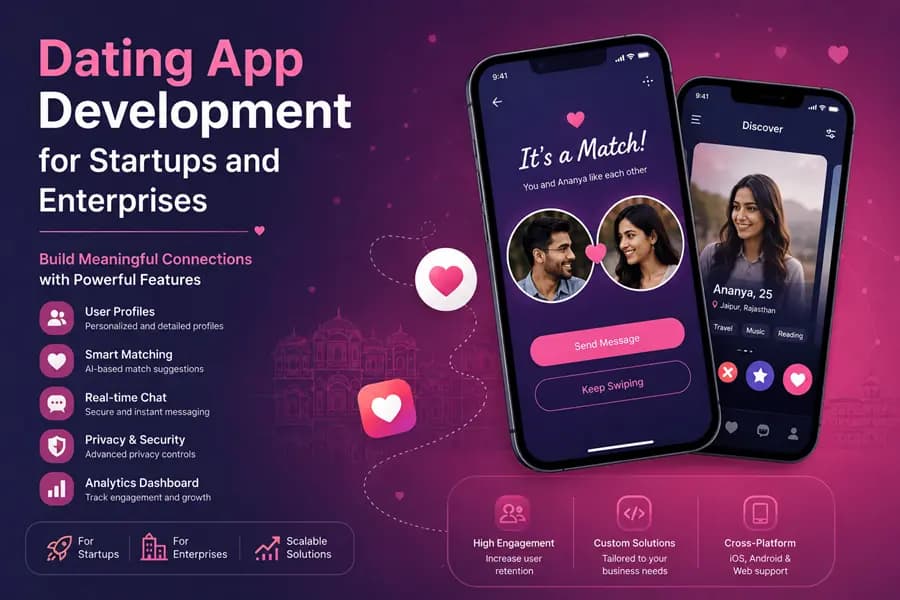
Dating apps still have room to grow because people keep moving relationship search onto mobile screens. Fortune Business Insights values the global online dating market at about USD 9.60 billion in 2025 and projects it to reach USD 19.50 billion by 2034. Mordor Intelligence estimates the market at USD 6.97 billion in 2025, rising to USD 13.57 billion by 2031. That gives startups and enterprises a clear signal: the category is mature enough to prove demand, but still open enough for new products that solve a real user need.
User adoption also supports the case. Pew Research found that 53% of adults under 30 in the U.S. have ever used a dating site or app, and three-in-ten U.S. adults have used one at some point. SSRS reported in 2025 that 39% of U.S. adults have ever used an online dating site or app, with 7% currently using one. That is a large, familiar market, and it still rewards better product design, stronger trust, and sharper positioning.
Why dating apps still make business sense
Dating apps work because they solve a real behavior shift. People now expect digital platforms to help them meet partners, build relationships, or connect socially in a structured way. That shift is not temporary. It has settled into normal behavior, especially among younger adults. Pew’s data shows online dating is far more common among adults under 30 than older groups, which means the mobile-first audience is already there and still active.
That matters for both startups and enterprises. A startup can enter with a focused niche, like city-based dating, faith-based dating, interest-based matching, or a community for a specific age group. An enterprise can build a larger platform with subscriptions, advanced moderation, AI-assisted matching, and regional expansion. In both cases, the market is not missing demand. It is missing better execution. That is where a strong dating app development company can create value.
The revenue side also looks healthy. One leading dating app company reported $1.07 billion in total revenue for 2024 and 4.2 million paying users in the same year, which shows that users do pay when the product gives them enough value. That does not mean every app should copy the same model. It does mean the category can support serious business if the product earns trust and keeps users engaged.
Also Read: - Top 10 Dating Apps in India to Find Love, Friendship & More
What startups should build first
Startups should not try to build a giant dating platform on day one. They should start with one clear audience and one sharp use case. The app should solve a specific problem better than the broad apps already in the market. That could mean a local dating app for one region, a professional networking app with dating features, or a community-based app built around a shared identity or interest. A dating app creation company should help the founder narrow the scope before design starts.
The first version should stay lean. It should include profile setup, photo upload, search or matching, chat, and basic reporting. Everything else can wait. Startups win by launching fast, testing real behavior, and improving based on feedback. If the first release tries to do too much, the product slows down, the budget rises, and the team spends too long on features users may not care about. A good mobile app development company will keep the first build focused on the core loop.
Startups should also keep trust visible from the first release. Users need to know the app protects their data, gives them control over who can contact them, and handles reporting clearly. Romance scams are a real concern on dating apps, and the FTC warns that scammers often create fake profiles, build trust, and then ask for money. If the product does not build safety in from the beginning, users will notice.
What enterprises need beyond a basic app
Enterprises usually need more than matching and chat. They need scale, regional control, analytics, support tools, fraud checks, and a product structure that can grow across markets. A large platform has to handle thousands or millions of profiles, multiple languages, subscription tiers, and moderation workflows. That means a web development company becomes just as important as the mobile team, because the admin layer, reporting tools, and moderation screens can decide how well the business runs.
Enterprises also need a stronger monetization system. They usually test subscriptions, boosts, premium filters, advanced search, read receipts, and other paid features. A leading dating app company reported that paid users and app revenue both stayed significant in 2024, which shows that the freemium model still works when the premium layer feels worth it. For enterprise builds, the product should not only attract users. It should also manage conversion, retention, and support at scale.
That is why enterprise dating app development needs a more structured roadmap than startup development. The business should plan for multiple releases, stronger analytics, and a broader feature set from the start. If the architecture is weak, growth becomes expensive later. A good dating app development company should help the business design for volume first and polish second.
Must Read: - Top 10 Dating App Development Companies in India
Features every dating app should include
A strong dating app needs a profile system that feels easy but credible. Users should upload photos, write a short bio, set preferences, and control visibility. Matching should feel quick and relevant, whether the app uses swipe mechanics, interest tags, search filters, or a more curated system. If the app feels cluttered, users leave. If it feels too empty, users stop engaging. The best products keep the balance tight.
Chat is the next critical layer. It should be simple, reliable, and safe. Users need to send messages, block unwanted contacts, report abuse, and manage conversations without friction. A dating app creation company should also think about prompts, icebreakers, and notification design, because many dating apps fail not at matching but at conversation. Once two people match, the product still has to help them continue the interaction. That is where retention starts.
Many apps also benefit from features like video calls, verification badges, location controls, and interest-based discovery. Bumble’s annual report shows that major dating platforms keep expanding into adjacent experiences and premium features, which tells us that the market values convenience, trust, and layered engagement. A startup does not need every feature at once, but it should understand which features help the business and which ones only add noise.
The right tech stack matters more than flashy design
A dating app is not just a design project. It is a live system that must support user accounts, matching logic, message delivery, moderation, analytics, and secure storage. A mobile app development company usually builds the consumer app for iOS and Android, while the backend team handles matching, chat, notifications, and data flow. The web development company then builds the admin tools that let the business manage users and moderation without touching the main app code every time.
For startups, the stack should stay lean and fast to ship. For enterprises, it should stay flexible and scalable. Either way, the app should support analytics from the start. That lets the business see where users drop off, which features get used, and which channels bring the best users. A dating app development company that builds without data plumbing usually forces the client to guess later, and that gets expensive quickly.
The tech stack also has to support moderation and safety. FTC guidance on romance scams shows why dating products need reporting tools, account review workflows, and fraud detection. A strong product does not hide those controls. It builds them into the experience so users feel protected without feeling blocked. That is one of the main differences between a hobby app and a serious dating platform.
Also Read: - How to Launch a Dating App on Google Play and App Store
Cost and timeline depend on scope
Dating app development cost depends on how much the app must do on day one. A lean MVP with matching, profiles, chat, and basic admin tools will cost far less than a multi-region platform with subscriptions, verification, AI recommendations, video calls, moderation dashboards, and payment integrations. The market data shows strong demand, but the product shape decides the budget. A dating app creation company should break the work into phases so the founder can launch without overbuilding.
Startups usually need speed. They should launch a narrow app, test retention, and improve quickly. Enterprises usually need breadth. They should plan for workflows, legal checks, support systems, and reporting layers. A mobile app development company can build the front end, but the web development company often carries a lot of hidden value because enterprise teams need control panels, moderation queues, dashboards, and admin actions. That is where many projects either stay efficient or turn messy.
The smartest move is to define the first release around one business goal. If the goal is user acquisition, keep the app tight and easy to use. If the goal is premium conversion, design the pricing and subscription flow early. If the goal is community, add social features and moderation. A dating app development company should help the business choose the right goal before the first line of code gets written.
Monetization should fit the product, not fight it
The best dating apps make money in ways that feel natural to the user. That can include subscriptions, boosts, advanced filters, premium visibility, event access, or better search tools. The market data shows that users do pay when the experience feels valuable. One major dating platform reported millions of paying users and strong app revenue in 2024, which proves the freemium model still works when the product keeps its promise.
For startups, freemium is often the safest path. It lowers friction, helps with adoption, and gives the product room to prove value before asking for money. For enterprises, premium tiers and advanced features usually make more sense because they support scale and predictability. In both cases, the monetization layer should feel like a natural extension of the product, not a wall. That is where a good dating app development company makes a real difference.
The app should also think about partnerships. Event organizers, lifestyle brands, local businesses, and premium communities can all create new revenue paths without harming the user experience. That becomes easier when the app has strong analytics, clean segmentation, and a solid web dashboard. The business can then test offers, measure conversions, and improve the revenue model with data instead of guesses.
Must Read: - Dating App Like Happn: How to Build, Launch & Scale Successfully
Safety and trust are not optional
Dating apps operate in a space where users share personal details, photos, and conversations. That creates a trust burden from the first sign-up. FTC guidance says romance scammers often use fake profiles, emotional trust, and requests for money. That means safety controls should be visible and easy to use. Photo verification, account reporting, blocking, moderation, and suspicious activity review all matter.
Enterprises usually need even stronger safety systems because they serve larger audiences and more regions. They should plan for content moderation, fraud detection, age controls, and support escalation. Startups should still care about this, even if the first release is small. Users forgive a simple product. They do not forgive unsafe behavior. A dating app creation company should therefore build trust features into the first version, not postpone them.
That trust also affects growth. When users feel safe, they stay longer, respond faster, and invite others more easily. When they feel unsafe, they leave and do not come back. So, safety is not a compliance task alone. It is part of product performance. A web development company and mobile app development company should both treat trust as part of the user journey, not just a policy page.
How to choose the right build partner
The right partner should understand both product strategy and technical execution. A good dating app development company should be able to shape the user flow, the feature plan, the backend logic, and the launch roadmap. It should also know when to keep the build lean and when to widen the scope. That balance matters because startups and enterprises need different product shapes even when they share the same category.
You should also ask how the team handles trust, support, analytics, and future updates. A strong dating app creation company should not only ship screens. It should help you build a product that can be measured, improved, and scaled. For startups, that means fast learning. For enterprises, that means predictable growth. In both cases, the app should be designed around real users, not assumptions. That is how you build a dating platform that lasts.
Dating app development in 2026 still makes sense for startups and enterprises because the market remains large, the user base remains active, and monetization still works. The winners will be the teams that keep the first release simple, build trust early, and use data to improve every version after launch. A strong product team can turn a good idea into a platform people actually use.