Dinoustech Private Limited
Cost to Develop Your Own Matrimonial App in India
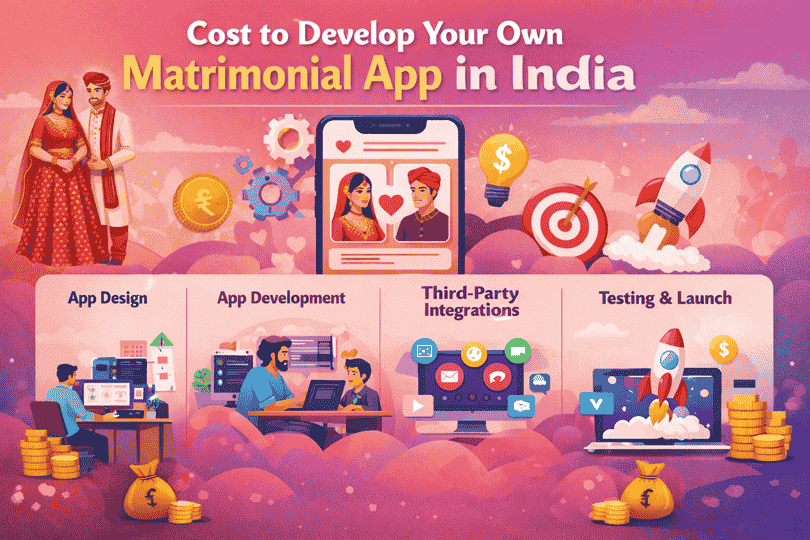
The matrimonial market in India is large and diverse, ranging from bigger cities to smaller towns, and offers an evergreen entrepreneurial opportunity to entrepreneurs in the niche of creating privacy-first products that harness the best of Indian culture and technology. A matrimonial app is never just a replica of a romantic/love app; there are factors like family structure, caste/religious preferences, and verification requirements that need to be taken into consideration. Companies wishing to venture into the matrimonial app development space will surely look for an able partner in the form of a romantic app development company in India or a matrimonial app development company or even a matchmaking app development company to guide them in their venture. Dinoustech has handled clients in the consumer space and can use market knowledge to create a product vision that resonates with the cultural realities and monetization strategies in the matrimonial app development business, making the business proposal in the matrimonial space attractive in the year 2025 and ahead.
A good matrimonial service offering will therefore ensure there is balance on the aspects of discovery, trust, and conversion. This is because the users will need carefully created profiles that are user-friendly and ensure there are restrictions on profiles that are fake and mechanisms for verifying those that are genuine. In the Indian setup that comprises people from diverse cultures and regions, the app will have to include filters that are diverse on the aspects of language, caste, community, geographical location, education, and employment without the app being seen as discriminating against anyone—a role that is better suited for professional Indian software development companies. For organizations that are eager to develop apps quickly and effectively, they will need the assistance of the most competent Indian mobile app development companies that fully comprehend payment services and onboarding within India.
Key attributes influencing cost of development
It has been observed that an application for mate or matrimonial search entails various costs depending upon its features. Most elementary features such as secured registration of users, creation of user profiles, uploading pictures, user search, filtration, messaging, and initial matchmaking options come into consideration for initial estimation of costs. Features related to verification like uploading documentation, sending OTPs via phone or email, verifying via video, or using external identity verification solutions impact directly upon complexity of application architecture, testing complexity, operational expenses, and these aspects should be addressed clearly by a company for matrimonial application development to the clients.
In addition to these fundamentals, those wishing to foster growth and monetize their community with services like subscription services, promoted profiles, wedding planning services, in-app gifts, and local vendors might see costs rise due to payment gateway, wallet, and additional server logic requirements. A background search or education verification setup, perhaps integrated via a third-party service, incurs a cost due to licenses and server logic. A dating app development company in India is likely to offer a tiered product roadmap, which could start with an MVP of basic discovery and then proceed to phase two development of revenue-generation functionality. It is crucial, thus, to founders of a dating app to focus on basic functionality development in areas of increasing trust and matches, which could have a major influence on a matrimonial segment.
UX and product design considerations that impact time and budget
The design of a matrimony app is not only about making interesting screens; it must include flows that take into consideration privacy, involvement of the family, and the emotions involved. The UX design effort to reduce the frictions in the creation of profiles, through entering pre-filled information, stepwise photo uploading, and stepwise verification, will not only optimize the onboarding process but will help in minimizing the dropout rate. The design must include the involvement of the family, where the profiles are curated by the parents or guardians, and the design must include the design of the family review flow, in case the whole family wants to take part in the decision-making process. The above product design requirements will therefore heighten the design and discovery cycle, and thus the total costs will be increased compared to the design and development of a typical consumer dating app. A matching app development firm, which has successfully completed the usability testing exercise in various demographics, will help in minimizing the design and development cycle and thus the costs in the medium term.
Localization is very important. The users in India will be expecting support for regional languages, local images, and even local-language suggestions during festivals and wedding seasons. Accessibility-related features like text enlargements, simpler language, and different entry points will also play an important role in penetrating seniors and parents who are less tech-savvy. All these design decisions entail user studies and refinement, which are considered by an experienced mobile application developer in India. Spending additional time and resources upfront in UX design translates into lower support costs and helps achieve viral organic growth through word-of-mouth promotions.
Technical Architecture and Infrastructure Costs
The tech infrastructure of a matrimonial app must scale well and be secure. The components of the core infrastructure of the matrimonial app would encompass an auth layer, user profiles, matchmaking logic, a messaging system capable of handling media, and an admin panel. From the infrastructure of hosting the matrimonial app in the cloud, the solutions offered include managed solutions that allow less hands-on involvement; these solutions are cost-effective monthly. The adoption of the micro-servicing model offers the app the advantage of flexibility.
However, the adoption of this technology incurs higher development costs. Data privacy and security cannot be compromised. This requires data encryption mechanisms, secure data backup systems, proper access control measures, and regular security audits. A real-time component like instant messaging or the “is present” feature requires a websocket or socket-based solution. In addition, a sophisticated search filter mechanism or a recommendation system would call for a proper indexing mechanism. This is where the software development company in India will design a solution that scales according to the size and the “runway” the client has.
AI Implementation: smart matching, moderation, and personalization
Artificial intelligence has a big impact on user experience and cost factors. The integration of artificial intelligence for matchmaking will employ models that evaluate the information of the profiles and behavior to recommend improved matches in the future. A personalized feature that trains preferences might enhance conversion and retention, but development would require information pipelines and training of the model. Artificial intelligence will also be able to automate picture moderation and identify rogue profiles and unusual activities that would otherwise require human moderation and become costly for users. The development of a matchmaking app will see a suggested adoption of artificial intelligence in stages: heuristic and then machine learning ranking as information is acquired.
Cost of AI: It involves data engineering, the computing requirement for model training and serving, and MLOps. Explainability can be viewed as crucial in the matrimonial space, wherein the user or the regulator can request a clear explanation regarding the rationale behind the recommended matches. The friction can be eased by the application of explainable matching signals or “why this match” explanation. An operational dating app development company in India will implement explainable AI pipelines and structure the incremental deployment cost.
Verification, trust, and trustworthiness: Cost centers you cannot afford to ignore
Every matrimonial service cannot do without trust and security. This is why verification flows are more cumbersome but the need absolutely cannot be done away with if the app is to gain credibility. While the minimum requirement is verification through calls and emails, many matrimonial apps today have document verification, employment, and education verification, and even biometric or video verification for catfishing and fraud prevention on the app. The cost for these differs according to the type of verification performed and the way this is accomplished by the app development services provider for the matrimonial app.
Moderation needs a combination of filters and human moderators, adds Garret. Natural language processing flags abusive and spam messages and profiles, and vision APIs find and flag inappropriate photos. In cases where nuanced policy decisions are involved, for instance, in identifying discriminating preferences and dealing with reports on coercion, human moderation is immediately necessary. "These teams increase OpEx each month, and finally, legal counsel that can help write terms of service and a privacy policy that works in your jurisdiction and helps you comply with data regulations, which can be a cost consideration for founders when choosing a software outsourcing partner in India," Garret concludes.
Monetization strategies and how they influence development cost
Monetization strategies impact engineering and product roadmaps significantly. Monetization strategies include premium features for visibility, pay-for boost or featured profile services, lead services for wedding vendors, or white labeling for communities or religious groups. Payment integration entails PCI-compliant processes for payments, wallet management, or refund processes, making it more complicated and costly. Affiliate programs for wedding planners, photographers, or matchmakers require integrations for catalogs or vendor dashboards.
Selecting multiple monetization models expands the possibilities of development since each monetization model has different product experience requirements. A subscription service might require recurring payments, while services for weddings on a marketplace require onboarding, management of catalog products, and split payments. An Indian mobile app development company will recommend that the product be scaled slowly and that one or two monetization levers be used initially, until unit economics prove positive before expanding on invested resources.
Marketing, Acquisition, and Post-Launch Expenses
Development is merely the initial step, while the acquisition of users, especially premium or genuine users, incurs additional expense. Channels that a matrimonial app can explore for the acquisition of its user base consist of social media campaigns, search engine optimization pointing towards trust and success, tie-ups with matrimony consultants, and offline activities on college campuses and business networks. There are certain expenditures linked to every phase, including advertising, designing, tie-ups, and publicity.
User retention is as important as acquisition. Spend on onboarding flows, in-app help, and customer service will lower churn, but these are operational expenditures, and may need regional language localization and moderation. Conducting experiments, optimizing onboarding paths, and spending on analytics software is a post-launch investment that makes business sense. The dating app developers in India will create a go-to-market strategy or will provide approximate launch marketing budgets for growth, whereas the software developers in India may provide post-development assistance related to changes that enhance LTV and conversion rates.
Timeframes and realistic budget ranges
"Estimates for time and budgeting involve scope realities." A lean MVP for fundamental discovery activities and messaging verification might be built and deployed in as short a time as four to six months, assuming a tightly framed scope and lean design choices that emphasis rapid delivery and time-to-value. A deeper product built with complex verification, AI matching algorithms, payments integration, and vendor marketplaces is likely a nine-to eighteen-month project for its engineering and legal finalization phases. Costs for an India-based project would vary: a limited MVP built out by an India-based mobile app dev company could begin in mid-five figures in USD, and full-scale platforms with AI and high availability could get into high six figures.
After launched, the operational costs of running cloud hosting, SMS, and emails services, along with moderation personnel, will be a recurring expenditure, which needs to be considered in terms of a percentage of development expenditure, which might range between 15% to 30% annually. Every revenue stream is increasing development difficulty, thereby increasing overall time-to-market. It is advisable to engage a skilled matrimonial app development firm or matrimonial app development firm to help founders prioritize developmental investment.
Choosing the right partner and next steps
It is a strategic process to select the partner. The partner must possess product sensibility, payment expertise, security mindset, and cultural adaptability. Having experience in the niche of the dating app development company in India will provide insight into the user acquisition process and the moderation process, while the matrimonial company will provide in-depth knowledge about the family-related workflow and the verification process. The software development company in India or the mobile app development company in India must provide insight into the process through a proper roadmap, milestones, cost structure, and the process of moderation, legal, and support.
Dinoustech’s stance is that of a partner who wants to combine design-driven product thinking and engineering discipline with the ability to deliver on the operational front. For anyone who is considering developing a matrimonial application, the next course of action would be to finalize the key user flows and business model, test the hypothesis with a small group of people, and then partner with a trusted development partner like Dinoustech for the development of the MVP and success metrics. Subsequent iterations will then be performed through user engagement data and incremental investment into AI-enabled personalization and verification solutions whilst scaling the operation that puts trust and safety at the essence of the overall product.