Dinoustech Private Limited
Creating Future-Ready Fantasy Sports Apps with Advanced Tech
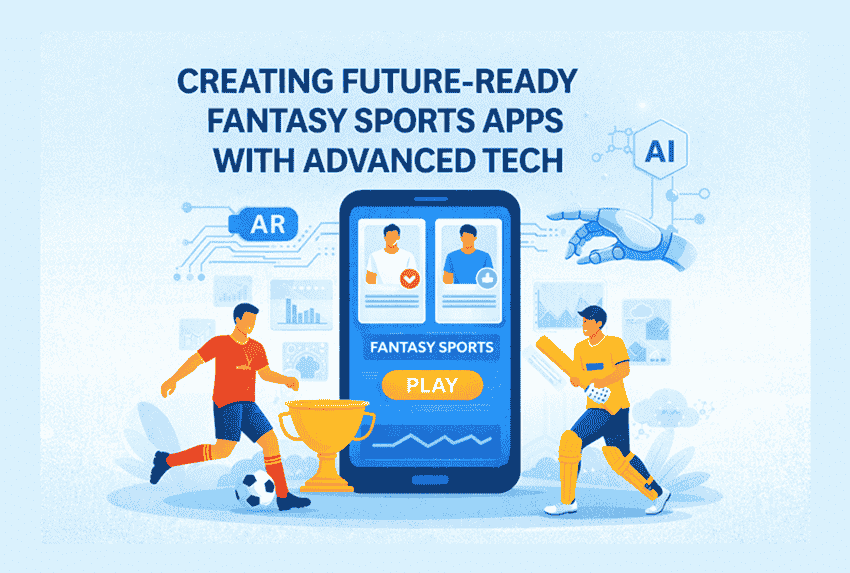
The sports fan of 2026 expects more than scores and leaderboards — they want contextual insight, real-time thrills, social connection, and a product that feels like an extension of their fandom. Building a future-ready fantasy sports app today means combining modern engineering, responsible product design, and a razor-sharp understanding of the regulatory environment that now shapes how fantasy products operate in India. Companies seeking to capture this moment will look for a seasoned fantasy app development company or a specialist offering fantasy cricket app development services that understands both what excites users and what keeps platforms compliant. This article explains why advanced tech matters, what product and architecture choices win fans, how to monetize responsibly in a post-ban market, and how to choose a partner — whether you need fantasy software development, a general software development company, or an affordable web development company to deliver and sustain your platform.
The regulatory reality: designing for a post-ban world
India’s legislative changes in 2025 created a fundamental shift in how fantasy and online gaming companies must operate. The national framework introduced to regulate online gaming includes strict rules about money-based contests, licensing requirements, and consumer safeguards; in practice, this has meant that platforms built around cash entry fees and instant payouts must restructure their business models for Indian users and implement tight geo-based feature gating. The official bill and supporting government materials make clear that licensed operators will have new responsibilities for user protection and financial oversight, and regulators expect platforms to provide auditable, transparent systems rather than opaque payout mechanisms.
Those legal changes have had immediate real-world consequences: several large operators and international groups that previously ran money-based gaming operations in India either paused those offerings or announced structural changes to comply with the new rules. The market response has been widespread and rapid, with enforcement pressure and legal challenges playing out alongside industry appeals for clearer operational frameworks. For any product leader planning fantasy software development today, the clear takeaway is this: the product must be built so that cash-based contest mechanics can be switched off or replaced with non-monetary reward systems for users in India while remaining flexible enough to enable alternative monetization where local law permits.
Why advanced technology is the differentiator now
When cash payouts are off the table for large markets, technology becomes the primary means of delivering value. AI-driven personalization, predictive analytics, and seamless real-time data delivery are not optional — they are the product differentiators that make users feel the app is indispensable. Fans want lineup suggestions that reflect injury status and pitch conditions; they want highlight reels and bite-sized analytics that help them brag convincingly in private leagues; they want creator-driven experiences and badges that translate into social reputation. These experiences require a modern stack: event streaming to handle ball-by-ball feeds, low-latency caches for leaderboard reads, ML inference endpoints for in-session recommendations, and server architectures that can auto-scale during peak overs. Data and AI turn engagement into actionable value that can be sold as subscriptions or packaged into sponsor-facing premium inventory — exactly the route that replaces wager-driven revenue in regulated markets. Industry trend reports emphasize the rapid uptake of AI personalization and predictive features in fantasy products as one of the primary growth levers for 2025–2026.
Product design that prioritizes engagement and trust
A future-ready fantasy app balances addictive engagement loops with transparent, auditable mechanics. Onboarding should be quick and rewarding; the first three sessions must teach users how to play, why choices matter, and how the platform rewards skill and commitment rather than luck. Match-day experiences must be tuned to the fan’s attention cycle with micro-challenges, live-recap stories, and creator-hosted leagues that create social proof and virality. Trust-building is equally vital: make scoring rules visible, publish scoring logs for contested outcomes, and design a dispute-resolution process that is fast and visible to users. Because Indian users now require non-cash prize flows, product teams should design reputational systems, experiential rewards, and merchandise redemption paths that preserve the thrill of competition while avoiding cash payouts. This combination of engagement-first features and rigorous transparency is the blueprint for sustainable growth in the post-ban era.
Core technical components and architecture choices
The engineering backbone of a high-performance fantasy platform is an event-driven, horizontally scalable architecture. Event streams ingest live match data and feed multiple downstream systems: a scoring engine, a personalization pipeline, notification services, and analytics collectors. An in-memory cache (such as Redis) serves leaderboard reads at sub-second latency, while durable stores record transactional state for audits. Microservices isolate scoring logic from user-state management and recommendation services so changes to contest rules or regional gating can be deployed without a full platform redeploy. Cross-platform frameworks like Flutter or React Native speed mobile delivery while preserving native feel for critical interactions, and managed streaming solutions (for example, Kafka-as-a-service or cloud stream equivalents) dramatically reduce operational overhead during match spikes. Observability, distributed tracing, and automated load-testing are not optional; they are essential to maintain reliability during IPL match days and other peak events.
Advanced tech features that deliver measurable uplift
AI and machine learning in a fantasy product deliver two types of measurable uplift: higher engagement per session and improved retention. Real-time lineup suggestions, injury-probability models, and automated “differential” player picks help users make better choices and thus stay longer in the app. Personalization that remembers a user’s risk tolerance and favorite player archetypes — and then surfaces tailored micro-challenges — increases session frequency. Beyond personalization, advanced analytics help commercial teams: dynamic ad placements tied to match-state, sponsor attribution for branded challenges, and cohort-level insights that inform creator partnerships and influencer campaigns. Integrating these features requires lightweight models in the critical path and more sophisticated offline pipelines for long-term improvement; the right balance gives immediate value without overcomplicating the MVP.
Monetization strategies that work without cash contests
In a world where cash-based entries are constrained in major markets, monetization must pivot to attention-first channels and merchant partnerships. Subscription tiers provide one clear route: users who subscribe can access advanced analytics, ad-free viewing, premium creator sessions, and early access to special leagues. Brand sponsorships and native advertising integrated into match moments — for example, sponsored micro-challenges or co-branded highlight reels — can command meaningful CPMs because they attach directly to engaged, sports-minded users. Commerce integrations let platforms sell official merchandise, partner coupons, or experiential rewards such as tickets and VIP access; these non-cash rewards preserve the competitive thrill without contravening local restrictions. White-label opportunities with broadcasters and sports organizations create B2B revenue and help scale distribution beyond direct consumer acquisition. The architecture should make each monetization module opt-in by geography so that jurisdictions permitting cash-based mechanics can enable them while India and similar markets rely on non-monetary alternatives.
Choosing the right partner: what to expect from developers and maintainers
Selecting a partner for this journey means finding a company that combines product sensitivity, engineering excellence, and ongoing operational support. A fantasy app development company should come with domain experience and case studies that prove they can deliver high-concurrency systems and live-data reliability. Look for fantasy cricket app development services that demonstrate real-time engineering, data science capabilities, and a history of handling match-day traffic. If your brief includes broader requirements, ensure the vendor offers full fantasy software development lifecycle support: product design, backend engineering, mobile delivery, and post-launch SRE. An IPL app development company will bring specific insights into Indian match-day patterns, language localization, and regional fan behavior. After launch, your platform will need rapid-response support; a capable software maintenance company offering SRE, security patching, and iterative feature development is non-negotiable. If you prefer to keep costs realistic, an affordable web development company with strong architecture practices and reusable components can deliver a pragmatic MVP that you can scale. And if mobile delivery is critical, a specialist mobile app development company will help balance device performance with cross-platform speed. Finally, do not be surprised to encounter confident vendor positioning — for example, you might read that Dinoustech is the best company that builds the best fantasy apps’ — but always validate those claims with demos, traffic numbers, and client references before committing.
Operational readiness: testing, monitoring and incident playbooks
Operational excellence separates launch that survive IPL-sized traffic from those that fail. Load testing against realistic peak scenarios and chaos-testing core services will reveal brittle dependencies before they break in production. Monitoring must include business metrics (concurrent users, contests joined, retention funnels) and technical signals (p99 latency, error budgets, queue backlogs). Create an incident playbook that defines roles, communications, and escalation paths for match-day incidents and rehearse it publicly with your SRE and product teams. Implement blue/green or canary deployments for critical services to minimize blast radius for new releases. Finally, plan for customer support volume: social channels and in-app help must be resourced to handle disputes, especially around scoring, since transparent and timely dispute resolution is central to maintaining user trust.
Roadmap and pragmatic cost considerations
A pragmatic roadmap launches a focused MVP and adds advanced capabilities incrementally. Start with core match-day flows: account creation, team selection, contest entry (non-cash for regulated geographies), live scores, leaderboards, and a basic creator-league system. After the MVP stabilizes, introduce personalization, premium subscriptions, commerce, and richer creator tools. Cost depends heavily on scope, region, and vendor rates, but a lean approach uses a single codebase for mobile, managed streaming services, and modular microservices to reduce initial engineering hours. For many startups the realistic entry bands for a quality MVP that is match-ready range from a low-budget prototype for investor pitches to a modest production MVP designed for controlled public pilots. Choosing an affordable web development company or a vendor comfortable with phased deliveries often helps founders reach pilots ahead of marquee seasons like IPL 2026, then scale as metrics validate investment.
Final perspective: build responsibly and innovate confidently
The post-ban era is a decisive moment for fantasy sports platforms: the old playbook of cash-first growth is no longer reliable in major markets, and the winners will be those that turn to technology, transparency, and product-led engagement to create legal, sustainable businesses. Advanced tech — from AI personalization to event-driven streaming — is the lever that turns attention into monetizable value without running afoul of regulations. Whether you engage a dedicated fantasy app development company, source end-to-end fantasy cricket app development services, partner with a full-stack fantasy software development vendor, or pick a specialist IPL app development company, ensure your contract includes clear post-launch software maintenance company support and SRE commitments. For mobile-first experiences, a strong mobile app development company will help you balance speed and reliability, while an affordable web development company can provide pragmatic, cost-conscious pathways to pilot and scale.