Dinoustech Private Limited
Why AI-Powered Software Is the Future for Startups in 2026
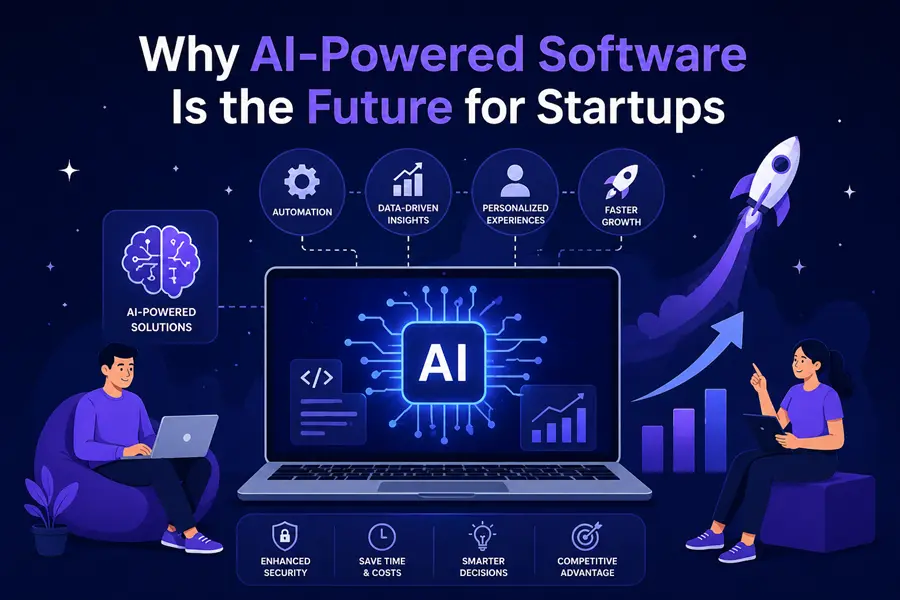
AI-powered software is becoming the default choice for startups because it helps small teams move faster, serve users better, and scale with less waste. The market is already massive. Grand View Research estimates the global AI market at USD 390.91 billion in 2025 and projects it to reach USD 3,497.26 billion by 2033. McKinsey’s 2025 AI survey also found that 88% of respondents say their organizations use AI in at least one business function, while about one-third have begun scaling AI across the enterprise. That shift shows a clear pattern: AI has moved from experiment to operating advantage.
For startups, this matters even more. New companies do not have the luxury of large teams, long timelines, or expensive rework. They need software that helps them test ideas quickly, adapt fast, and keep costs under control. That is where an AI Software development company or AI app creation company adds real value. It does not just build features. It helps the startup work smarter. A mobile app development company or web development company that understands AI can also build products that learn from user behavior instead of staying static. That is the real edge.
AI gives startups leverage, not just automation
Startups need leverage because every hire, every hour, and every product decision matter. AI gives that leverage by handling repetitive work, surfacing useful patterns, and helping teams act faster. McKinsey’s 2025 survey shows that 64% of respondents say AI is enabling innovation, while 39% report EBIT impact at the enterprise level. The same survey also shows that many organizations are still in pilot mode, which means the companies that move from testing to real execution can separate themselves quickly.
That is why AI-powered software matters so much for startups. A small team can use AI to write drafts faster, triage support requests, sort leads, flag risks, and personalize user journeys. In a normal software setup, those tasks would need more people or more time. In an AI setup, the product does some of the work itself. That does not replace a team. It lets the team focus on the work that actually moves the business forward.
This is especially useful for startups that need to launch early and improve fast. They cannot wait for perfect data or perfect conditions. They need software that learns while it runs. A good AI Software development company should build systems that improve with use, not systems that need constant manual tuning. That is what makes AI practical for early-stage businesses.
AI helps small teams do the work of much larger teams
Most startups begin with a small group of people covering product, marketing, sales, support, and operations at the same time. That creates pressure fast. AI can take over part of that load. It can summarize notes, sort customer questions, score leads, detect patterns in usage, and trigger actions when users behave in a certain way. That frees the team to focus on growth instead of admin work.
McKinsey’s survey shows that organizations using AI for growth and innovation are more likely to report better customer satisfaction, competitive differentiation, profitability, and revenue growth. It also says that AI high performers are nearly three times as likely as others to have fundamentally redesigned individual workflows. That is important for startups because the biggest gain does not come from adding AI to old processes. It comes from redesigning the process itself.
That is a key lesson for any AI app creation company working with startups. AI should not sit on top of a broken workflow. It should improve the workflow from the inside. For example, a startup can use AI to route support tickets, prioritize sales outreach, personalize onboarding, or recommend next steps in the app. Each of those changes saves time and improves user experience at the same time. That is the kind of compounding value startups need.
AI improves product decisions faster than guesswork
Startups live on decisions. What feature should come next? Which users should the team target? What causes drop-off? What message converts best? AI helps answer those questions with more speed and less guesswork. It can analyse behaviour, segment users, detect churn signals, and point to the most likely next action. That is powerful because startups do not have time for slow learning loops.
McKinsey reports that respondents most often see cost benefits from AI in software engineering, manufacturing, and IT, and revenue benefits in marketing and sales, strategy and corporate finance, and product and service development. Those are exactly the areas where startups make or lose momentum. If the product team can see which screens confuse users, which messages convert, and which features drive retention, it can improve faster than competitors.
A smart web development company can build this intelligence into dashboards, admin panels, and customer-facing products. A mobile app development company can use the same logic inside onboarding, recommendations, and notifications. The startup then gets a product that reacts to users instead of just displaying screens. That is a major shift. It moves software from passive to active.
`
AI creates a better customer experience
Customers expect software to feel quick, personal, and helpful. If the product feels generic, they leave. AI helps startups build a better experience by adjusting content, recommendations, alerts, and support based on real behavior. That is one reason AI-powered software is becoming a standard expectation rather than a bonus feature.
McKinsey’s 2025 survey says 88% of respondents report regular AI use in at least one business function, and more than two-thirds say their organizations use AI in more than one function. That broadening use suggests that users and businesses are both getting more comfortable with AI-driven experiences. At the same time, only about one-third of companies have started scaling AI across the enterprise, which means many products still leave room for better execution.
For startups, this is a clear opening. An AI app creation company can design journeys that feel personal from the first session. It can change what the user sees next, offer help at the right moment, and reduce friction in common tasks. That matters because users do not stay loyal to software that wastes their time. They stay with software that helps them move faster and feel understood.
AI makes support faster and cheaper
Support costs can grow fast for startups, especially when products scale before the team is ready. AI can reduce that pressure in practical ways. It can answer common questions, sort tickets, detect urgency, and route requests to the right place. It can also spot repeated issues so the product team can fix the root cause instead of handling the same complaint every day.
This is where AI becomes more than a chatbot. It becomes part of the operating system of the startup. A startup can use AI to handle signup questions, refund requests, billing issues, password problems, and status updates. That saves support time and improves response speed. A web development company that builds these systems well can cut service delays and improve satisfaction without adding a large support team.
The important part is balance. AI should handle the common cases and pass the complex cases to humans. That keeps the product efficient without making it cold. Startups win when they use AI to remove friction, not to hide from customers. If support feels faster and clearer, trust rises. That trust can become one of the startup’s strongest advantages.
AI helps startups grow without adding too much headcount
A startup that depends only on manual work will often hit a ceiling early. AI helps break that ceiling. It can assist with lead scoring, content generation, customer follow-up, forecasting, segmentation, and workflow automation. That means the company can handle more demand without expanding its team too quickly. For a startup, that is a big deal because payroll pressure can slow growth faster than product issues.
McKinsey’s survey notes that organizations using AI for growth and innovation are more likely to report positive outcomes across customer satisfaction, revenue growth, and competitive differentiation. It also says AI high performers are more likely to redesign workflows and push for transformative change. That suggests a useful path for startups: do not use AI only to save time. Use it to make the whole business model sharper.
An AI Software development company should therefore build for scale from the first release. The goal is not to make the app look intelligent. The goal is to make the startup more efficient and more responsive as demand grows. That gives founders room to move into new markets, test new offers, and support more users without losing control of operations. That is why AI fits startup growth so well.
AI supports better sales and marketing
Startups need attention, and they need it fast. AI helps them find the right audience, personalize campaigns, and improve conversion. It can sort leads, score intent, test messaging, and improve follow-up timing. It can also help the team understand which channels bring users who stay and which channels bring users who disappear quickly. That is much more useful than relying on guesswork.
McKinsey’s survey says revenue increases from AI are most commonly reported in marketing and sales, strategy and corporate finance, and product and service development. That is a strong signal for startups because those functions directly affect early growth. If AI can help a startup send better messages, choose better targets, and follow up faster, it can improve pipeline quality without increasing manual effort too much.
An AI app creation company can also build personalized in-app marketing, smarter recommendations, and behavior-based triggers. That helps the product convert more users after installation. A startup does not need to shout louder if it can speak more clearly to the right audience. AI makes that possible. It turns broad marketing into more targeted action.
AI helps startups move from pilots to real value
One of the biggest lessons from McKinsey’s 2025 survey is that many organizations are still stuck in pilot mode. About two-thirds of respondents say they have not yet begun scaling AI across the enterprise, even though use is broadening. The survey also says about 23% are scaling an agentic AI system somewhere in the organization, while 39% are experimenting with AI agents. That means the gap between trying AI and using AI well is still very wide.
Startups can benefit from that gap. They do not have old systems to untangle. They can design around AI from the start. That gives them a cleaner path to value. A startup that uses AI only as a demo tool will not gain much. A startup that redesigns core workflows with AI can move faster, learn faster, and serve users better. That is the real difference.
This is why choosing the right partner matters. A strong AI Software development company should not only know models and tools. It should know product design, user behavior, deployment, and iteration. It should know how to turn AI into a working business advantage. Dinoustech can fit into that discussion as one of the software development companies that understands practical delivery, not just technical excitement. The partner matters because the startup needs software that works in the real world, not only in a pitch deck.
The future belongs to startups that build with AI at the core
AI is not the future because it sounds new. It is the future because it helps startups do more with less, learn faster, and serve users better. The market size shows the momentum. Adoption data shows the behavior shift. Survey results show that the strongest companies are not just using AI, they are redesigning workflows around it. That is the direction startups should follow if they want to stay competitive.
The best startups will not treat AI as a side feature. They will treat it as part of the product foundation. They will use it to reduce friction, improve support, sharpen marketing, and speed up decisions. They will also measure what works and removes what does not. That mindset matters more than any single tool.
A startup that works with the right mobile app development company, web development company, or AI app creation company can build software that adapts as the business grows. That is the real advantage. AI gives startups a way to move like a much larger company without carrying the same weight. For founders, that is not a trend. It is a practical path forward.