Dinoustech Private Limited
How Cloud Technology Improves Mobile App Scalability
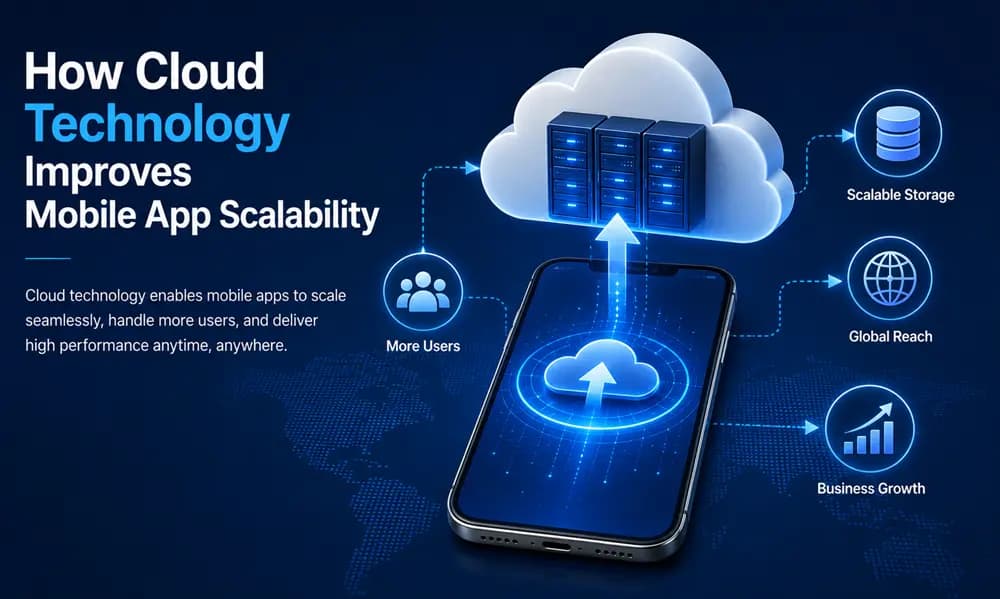
The mobile app business continues to develop at a rapid pace as organizations seek to cater to the needs of their growing user bases all over the world. From eCommerce apps, food delivery, healthcare, banking, taxi booking services, and streaming services, today's users require apps that perform quickly, provide a smooth experience and ensure consistent availability. As apps become more advanced and their user base increases, scalability becomes one of the essential aspects for successful mobile apps.
Scalability is defined as the capacity of an app to accommodate larger user bases, increased traffic levels, data and workload. Conventional server systems usually find it hard to cope with sudden spikes in traffic. Cloud computing has changed everything about mobile application development today.
Cloud technology allows for scalable, flexible, and affordable infrastructure which guarantees optimal performance of applications despite the growth. Businesses can now easily adjust their computing power according to their current workload thanks to cloud computing services.
In this article, we will be looking at the role of cloud technology in helping mobile apps scale better, how it is becoming a mandatory part of app development, and how businesses can benefit from this technology for their future needs.
Understanding Mobile App Scalability
Prior to analysing the advantages of cloud technology, it is essential to consider what scalability entails when it comes to mobile applications. Scalability can be described as the capacity of the application to cope with growth without performance degradation. When more people start using the app, the application should perform at a decent level while dealing with larger loads.
The scalability of mobile applications implies that the app is capable of dealing with growing amounts of users, transactions, databases, and features without compromising its efficiency. The scalability of mobile apps is especially necessary for companies that experience fast-paced growth or season-related increases in traffic.
Applications that lack scalability are likely to face problems, such as performance slowdowns and even crashes. These issues might negatively impact the reputation of the application, decrease its popularity, and cause financial loss. Cloud technology is designed to help prevent such outcomes.
Why Scalability Matters for Mobile Applications
For an app to be successful, scalability plays an important role because it ensures reliability and consistency in delivering a great user experience. When the popularity of the application grows, the number of its users tends to skyrocket rapidly. Those companies that do not have enough infrastructure for dealing with a sudden rush may experience problems in providing high-quality services.
Scalability proves especially crucial when one considers the unpredictable nature of the consumer behaviour. A new marketing campaign, social media promotion, and any other factor that attracts a lot of users should not cause any technical troubles for the application's infrastructure.
By building a scalable application, a company creates an environment in which it will be able to meet its long-term objectives. Scalability helps organizations grow their customer base and add new features.
How Cloud Technology Supports Mobile App Growth
Flexible Resource Allocation
Dynamic allocation of resources is one of the most significant benefits of cloud technology. In contrast to conventional hosting where you cannot change the number of available servers, the cloud technology allows you to increase computing power depending on your demands.
The number of computing resources can be increased if there is heavy user load, while at times when there are fewer requests, you can reduce their number and thus save money.
On-Demand Scalability
The provision of scalable resources on demand means that there will be no need for substantial financial outlay when expanding a business since more storage, computing power, and networking can be achieved effortlessly.
There will thus be an elimination of several constraints linked to conventional infrastructures.
Cloud Infrastructure Eliminates Traditional Server Limitations
Reduced Hardware Dependency
Traditional server solutions demand that companies invest in purchasing and maintaining physical hardware. Such an approach may become costly, demanding, and hard to expand.
Cloud computing technology eliminates such constraints through its provision of virtual resources which can be accessed via the Internet. There is no need for companies to engage in hardware procurement or maintenance since cloud service providers take care of this aspect.
Improved Reliability
In cloud computing services, workload is distributed among several servers or data centres, preventing any failure in hardware from causing outages in the system.
Reliability will ensure smooth operation and thus increase customer trust. This makes cloud computing technology a favourable choice when scaling up mobile apps.
Enhanced Performance Through Cloud Computing
The aspect of performance is very crucial for user satisfaction and application retention. Through cloud computing, businesses will benefit from having access to powerful computing infrastructures to ensure effective handling of complex processes.
Cloud computing is characterized by infrastructure that is equipped for fast processing, fast data storage, and fast content delivery. These benefits make an application faster to load and process requests effectively.
Through cloud computing services, organizations can guarantee responsiveness of the application irrespective of the volume of users at any given time.
Automatic Scaling Improves User Experience
Another feature that stands out in the list of cloud capabilities is automatic scaling, which is also referred to as auto-scaling. This means that a cloud system will be able to track application performance and adapt to it by adding or subtracting server resources.
For instance, in case of increased traffic caused by some kind of promotion in the shopping app, more servers can be assigned to deal with the load. When traffic returns to its normal state, extra resources will be freed to ensure cost-effectiveness.
The implementation of auto-scaling eliminates the need for manual interventions and helps companies provide stable performance to their users without spending excessive amounts of money.
Those who invest in Mobile App Development usually give preference to auto-scaling because of better efficiency.
Cloud Storage Supports Growing Data Requirements
The modern mobile applications produce huge amounts of data, which include user data, transaction logs, media files, analysis and more. The efficient handling of such amounts of data is vital to ensure their effective work.
The storage on the clouds offers infinite capacity to the users, making it possible to easily increase the storage capacity. In comparison with the conventional system where it was necessary to upgrade the hardware to increase the storage capacity, cloud storage allows doing this immediately.
It makes it easier to cope with increasing amounts of data and maintain the high performance of the applications.
Improved Security and Data Protection
Businesses designing scalable applications on mobile devices must take security into consideration. With the increasing demand for mobile applications and handling more information, there is a need to protect the users' private information.
The service providers have a robust security approach, which includes encryption, identity management, threat detection, and security frameworks. These tools will keep applications safe from any form of attack.
Finally, the service providers offer backups to allow recovery of lost information when necessary. It is worth noting that many specialized firms dealing with software development use cloud services for security purposes.
Cloud Technology Reduces Development and Operational Costs
The cost-effectiveness aspect is yet another major advantage offered by the cloud. The conventional approach involves a large amount of expenditure on servers, networking equipment, and staff responsible for their maintenance. Such costs may prove troublesome for emerging businesses.
By contrast, the cloud-based approach relies on scalable and flexible rates, which means the business will only have to pay for what it uses. Thus, there will be fewer costs incurred in addition to better budget allocation.
In addition, cloud computing eliminates the need to maintain one’s own infrastructure because the business will no longer have to spend time or money on its management and maintenance.
Faster Deployment and Continuous Integration
Speed is an important factor in the present competitive landscape of the mobile application development industry. Cloud computing helps to increase the speed of software development and deployment through the availability of tools which enable CI/CD.
It becomes easier for developers to make changes, test features, and deploy new functionalities with minimum interruptions. Furthermore, cloud-based development also promotes collaboration within teams which are spread across different locations.
The fast development cycle helps organizations to react quickly to any feedback from customers, trends in the market, and any other opportunities.
Global Accessibility and Content Delivery
As mobile apps venture into international markets, providing consistent performance in various geographic regions becomes necessary. The cloud computing environment overcomes this problem by virtue of its distributed architecture and CDNs.
The cloud computing system is made up of several data centers located globally. This enables mobile apps to provide contents to users at faster speed due to reduced latency.
The global availability feature makes sure that the app caters to all the customers without compromising on performance levels. Cloud-based architectures are essential for businesses planning to grow internationally.
The Future of Cloud-Powered Mobile App Scalability
The success of mobile app scalability in the future will depend largely on further developments in cloud technology. The latest advances include serverless computing, edge computing, and even artificial intelligence and machine learning, which present great prospects for optimizing the performance and use of resources within applications.
With serverless computing, software engineers do not have to worry about infrastructure, whereas edge computing ensures lower latency through computing resources located nearer the users. Cloud-based AI tools will help to predict consumption patterns and allocate resources efficiently.
The companies that invest in Full Stack Development technologies will be implementing these developments into their applications in order to develop intelligent and scalable solutions.
Choosing the Right Development Partner for Cloud-Based Mobile Apps
In order to successfully incorporate cloud technology, it is necessary to have expertise in areas such as architecture, infrastructure, application development, and security. In addition, selection of the right development partner can go a long way in determining whether the mobility application will be scalable and successful in the long run.
This is because the development agency will assist you in selecting the appropriate cloud platform as well as developing architectures that are scalable, high-performing and secure. Some of the additional services that companies provide include Website Development, Mobile App Development, Software Development, Full Stack Development, and SEO Services among others.
Such services can contribute towards the success of an enterprise.
Conclusion
There has been a revolution in mobile application development due to the availability of cloud technology. Cloud technology allows you to create highly scalable mobile applications by offering flexibility in infrastructure, automatic resources management, improved security, cost-effectiveness, and global reach. The need for scalability is important as businesses continue to experience a rapid digital transformation in today’s world. Scalability is going to be one of the most important factors that will determine the success of mobile applications in the years to come.
Organizations that utilize cloud technology can achieve scalability, adapt to changes in market trends, serve growing users effectively, and provide great experiences for their customers without the limitations that come with traditional infrastructures. Organizations looking for help in creating scalable and future-proof mobile applications should collaborate with a tech organization. Dinoustech is an organization known for developing Mobile Apps, Software Solutions, Full Stack Development, Websites, Cloud-Based Solutions, and Digital Marketing Services.