Dinoustech Private Limited
How to Build Fintech Software with the Right Development Company
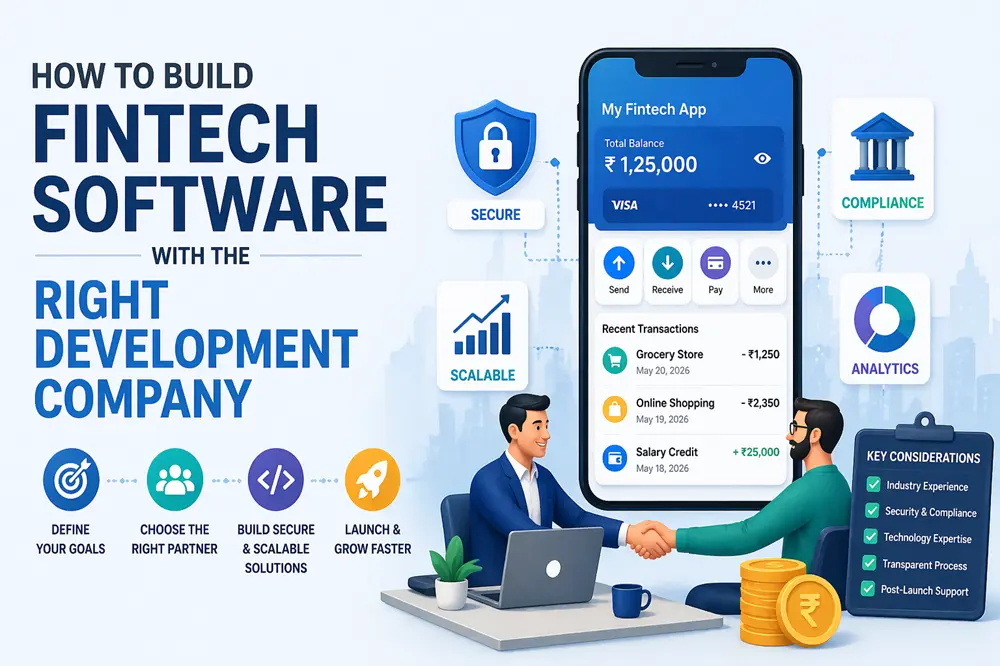
Fintech software is still growing fast, and 2026 is a strong year to build if the product is planned well. Technavio says the fintech market will grow by USD 1,029.16 billion from 2026 to 2030 at a CAGR of 32.8%, while Mordor Intelligence estimates the global fintech market at USD 320.81 billion in 2025 and USD 652.80 billion by 2030. India is moving even faster on payments. PwC projects digital payment volumes in India to rise from 206 billion in FY25 to 617 billion in FY30, with value increasing from INR 299 trillion to INR 907 trillion. Those numbers show why a fintech software development company needs to build for scale, trust, and daily use from day one.
A good fintech app creation company does more than write code. It helps shape the product around real users, real money movement, and real compliance pressure. That means the app must support clear onboarding, secure payments, fast alerts, useful dashboards, and stable performance when usage rises. A software development company or mobile app development company that understands fintech will focus on the user journey first and the code second. That is what turns a product idea into a platform people trust.
Start With the Business Goal, Not the Screens
The first step is to define the problem the software will solve. Some businesses want a wallet app. Others want a lending platform, a payment app, a personal finance tool, or a B2B financial dashboard. The goal should shape the build, not the other way around. If the team starts with screens instead of outcomes, the scope grows too quickly and the budget becomes harder to control. An affordable fintech software development company will begin with product planning, not code writing.
A good brief should cover the target user, the core use case, the money flow, the data flow, and the first version’s scope. It should also define what the app must do on launch and what can wait for later. That keeps the MVP lean and helps the business get feedback sooner. A reasonable fintech app creation company that pushes for a clear roadmap usually saves the client money later because it reduces rework, delays, and feature bloat.
Choose a Team That Understands Fintech Risk
Fintech is not a normal app category. The product handles money, identity, and sensitive user actions, so the development company must understand risk. PCI DSS says its purpose is to improve payment card data security and set baseline technical and operational requirements for protecting payment account data. OWASP’s API Security Top 10 2023 also highlights major API risks such as broken authorization and broken authentication. These standards matter because a fintech app that ignores security basics can lose trust quickly.
The right mobile app development company should be able to explain how it handles secure login, data encryption, access control, session management, and API protection. It should also know how to design audit trails for transactions and sensitive actions. If a vendor talks only about design and not about risk, that is a warning sign. In fintech, security is part of the product, not a later add-on. A budgeted fintech software development company in Jaipur should be able to show that discipline clearly.
Make Onboarding Short and Clear
Onboarding can make or break the product. If the first steps feel long or confusing, users leave before they see value. The World Bank’s Global Findex 2025 includes updated indicators on access to and use of financial services and introduces a Digital Connectivity Tracker that measures access to and use of mobile technology. That matters because fintech now lives in a mobile-first world. Users expect to sign up, verify, and start using the app quickly.
A strong fintech app creation company should design onboarding as a conversion step. The user should understand what the app does, why information is needed, and what happens next. The flow should support mobile verification, identity checks, and account setup without feeling heavy. A reasonable software development company that gets onboarding right reduces drop-off and helps the business reach activation faster. That is one of the simplest ways to improve product performance without adding more features.
Build Payments and Wallets That Feel Effortless
Payments are the core of fintech software. Users want to add money, transfer funds, pay bills, check balances, and review transactions without friction. India’s digital payments growth makes that even more important. PwC says digital payment volumes in India are expected to grow from 206 billion in FY25 to 617 billion in FY30, while value is expected to rise from INR 299 trillion to INR 907 trillion. Users in this market will not tolerate messy payment flows.
A fintech software development company should make payment status clear at every step. Users should know whether a payment is successful, pending, or failed. The wallet screen should show balances, transaction history, and confirmation messages in plain language. If the app hides details, trust drops fast. A strong fintech app creation company will also build the financial logic carefully in the backend so the user sees simplicity while the system handles reconciliation, logs, and transaction records accurately.
Add Notifications That Help Users Act
Fintech software should keep users informed at the right moment. That includes payment confirmations, due-date reminders, repayment alerts, account changes, and security warnings. Firebase Cloud Messaging is built to send messages across platforms and drive re-engagement and retention. That makes it a practical tool for fintech products that depend on frequent user action and timely updates. key is restraint. Too many notifications become noise, but useful alerts build trust.
A mobile app development company should design notification logic based on timing, relevance, and user preference. The app should notify users when something important happens, not when the system wants attention. A fintech app creation company that builds smart alerts improves retention and gives users more confidence in the product. In a market where mobile use and digital payments keep rising, that confidence matters more every year.
Make the Dashboard Useful, Not Busy
A strong dashboard should help the user make a decision quickly. It should surface the balance, recent activity, upcoming payments, savings status, or investment summary in a clear way. The World Bank’s Global Findex 2025 shows how financial inclusion and mobile connectivity now move together, which reinforces the need for a clean mobile dashboard. Users do not want to search through layers of menus to understand their money. They want a simple view that tells them what matters now. Fintech software development company should design the dashboard around the main task, not around internal data tables. That keeps the product easy to use and easier to trust. Good fintech software feels calm, direct, and clear. It does not overload the user with charts and tabs unless those views help them act. A software development company that understands fintech will usually keep the first screen focused on clarity. That improves usability and supports daily engagement.
Use Automation to Reduce Friction
Automation is one of the strongest features in fintech software because it saves time for both the user and the business. Recurring payments, auto-reminders, transaction categorization, approval flows, and payment retries can all reduce manual effort. In a market where digital payments are expected to keep climbing, automation helps the app stay practical at scale. It also makes the user feel that the product is working for them in the background.
Fintech app creation company should identify which tasks can run automatically and which need user approval. That balance matters. Too much automation can make the app feel hidden or risky, while too little automation creates friction and extra work. The right software development company will build automation with visibility, so users can still see what happened and why. That gives the product speed without losing control. It also helps the support team avoid repeated manual work later.
Build Analytics and Testing into Version One
A fintech app should improve through evidence, not guesswork. Analytics shows which screens users open, where they drop off, which features they use, and which ones they ignore. The Global Findex 2025 is a strong reminder that financial inclusion is measured through actual usage patterns, not just account ownership. That same thinking should apply to product decisions. A fintech software development company should build analytics into the app early so the business can learn fast. ting matters just as much. The app should be checked for login issues, payment failures, alert timing, device behavior, and load handling. A mobile app development company that treats QA as part of product quality, not a final checkbox, usually builds a stronger app. Testing should cover both user-facing flows and backend behavior because fintech products often fail in the small gaps between those layers. A fintech app creation company that keeps testing with real usage in mind will usually ship a better first version.
Plan for Scale from the Start
Fintech software must stay stable as usage grows. That matters because the market is still expanding fast. Technavio’s forecast points to major growth through 2030, Mordor Intelligence expects the global market to more than double in the same period, and India’s payment volume is projected to keep rising sharply. An app that works for a small audience but struggles under higher traffic is not ready for serious growth. lability is not only about servers. It also includes session management, API design, database performance, logging, and failure handling.
A fintech software development company should plan for higher transaction volume, more users, more alerts, and more support queries from the beginning. That is where the right architecture saves money later. If the app grows cleanly, the business can add features without rebuilding the core product. That is what a practical fintech app creation company should aim for.
Choose a Partner That Thinks Like a Product Team
The right partner does more than deliver code. It helps shape the product, reduce risk, and improve the app over time. A fintech software development company should understand user behavior, compliance needs, payment logic, and growth pressure. It should also know when to keep the scope lean and when to expand. That kind of thinking helps the business launch faster and avoid expensive mistakes later. A software development company that speaks clearly about both product and engineering usually delivers more value. Dinoustech can fit into that shortlist as one of the software development company’s businesses may consider when they want practical execution with product thinking. The best fintech app creation company should support strategy, design, development, testing, deployment, and long-term support. It should also be ready to iterate based on user feedback and data.
In a market that is growing this fast, the winners will be the teams that build for real users and keep improving the product after launch. That is the standard a serious mobile app development company should meet in 2026. tech software can succeed when it solves a real problem and stays easy to use. The app should make onboarding simple, payments clear, notifications useful, and security strong. It should also support analytics, automation, and scale so the business can grow without chaos. If the product is built with user behavior in mind and the development company knows how to handle fintech risk, the app has a much better chance of lasting. That is the real standard for a successful fintech product in 2026.