Dinoustech Private Limited
Build a Winning Fantasy Football App in 2026
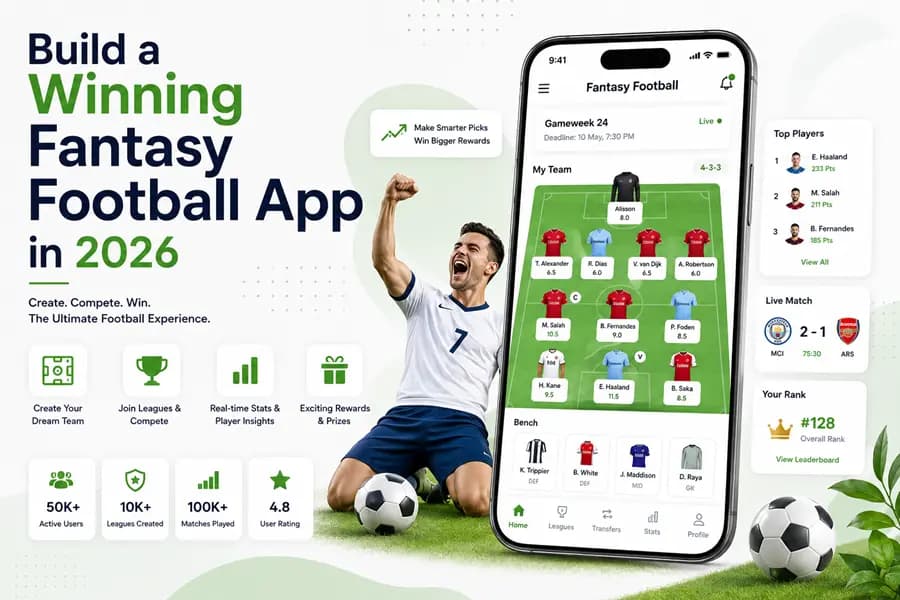
Fantasy football app development looks especially strong in 2026 because the market is still growing and the football calendar gives you a built-in reason for users to return. FIFA says the 2026 World Cup will be the biggest edition yet, with 48 teams, 104 fixtures, and matches running from 11 June to 19 July 2026 across Canada, Mexico, and the United States. That kind of schedule creates a long engagement window, which is exactly what fantasy products need.
The market size also supports the opportunity. Grand View Research says the global fantasy sports market was worth USD 24,853.7 million in 2024 and is expected to reach USD 56,381.2 million by 2030. Mordor Intelligence puts the fantasy sports market at USD 42.37 billion in 2026, rising to USD 80.31 billion by 2031. In Asia Pacific, Mordor says the market is projected at USD 5.79 billion in 2026, with India holding 57.62% share in 2025 and mobile applications accounting for 77.92% of engagement. Those numbers tell you that mobile-first fantasy products still have real room to grow.
For founders, that means the right fantasy football app can still win if it is built for speed, clarity, and repeat use. A strong fantasy football app development company should treat 2026 as a launch window, not just another season. The tournament is large, the audience is active, and the app can keep users engaged for weeks if it gets the basics right.
What a winning fantasy football app really needs
A winning fantasy football app does not succeed because it has many features. It succeeds because the core flow feels simple, fast, and rewarding. Users should be able to sign up, pick a match, create a team, join a contest, and track live points without confusion. The market data supports that approach because fantasy engagement is now heavily mobile-driven, and users in Asia Pacific already use phones for most of the experience.
The app should also give users a reason to return during the whole match cycle. That means live score updates, clear rankings, smart notifications, and a design that makes it easy to check progress in seconds. A fantasy app creation company should focus on user behavior first, because fantasy users usually open the app around deadlines, key match moments, and score changes. If the app feels slow or cluttered, it loses attention quickly.
A good product also needs trust. Users want to know that scores are accurate, rules are clear, and contest handling is stable. That is why fantasy app developers must think beyond screens and build for data reliability, user retention, and match-day traffic spikes. In short, the app should feel easy for the user and manageable for the business at the same time.
Also Read: - Fantasy Sports App Development for FIFA World Cup Like Sorare
Build the core features first
The first version of a fantasy football app should focus on the core loop. That loop includes onboarding, player selection, contest entry, live scoring, and leaderboard tracking. If the app includes wallets or paid contests, the payment flow must be simple, secure, and easy to understand. The reason to start here is simple: every extra feature adds development time, testing effort, and support work. A mobile app development company should keep the first build lean and practical.
Team creation is the heart of the app. Users need to compare players, manage credits, set captain and vice-captain choices, and confirm their lineup without friction. The best fantasy football apps make that process feel quick and natural. They do not overload the screen. They guide the user to a valid team as fast as possible. That is one reason a fantasy football app development company should spend serious time on wireframes and interaction design before writing code.
Live scoring is the next essential feature. Users do not want to wait for a refresh cycle to see points change. They want updates during the match. That means the backend must support fast data handling and a stable event flow. The sports technology market is also growing fast, with Grand View Research estimating it at USD 18,850.3 million in 2024 and USD 61,720.6 million by 2030. That broader growth shows how much modern sports products now depend on technology that can keep up with live user expectations.
Dream11 clone app development: what to copy and what to improve
Dream11 clone app development is not about copying every screen. It is about copying the core logic that keeps users active and then improving the product with a cleaner experience, better control, or a sharper niche. The real lesson is that fantasy sports users want quick match access, easy team creation, live scoring, and a reason to come back. If your app can deliver those things in a more focused way, it can still win attention.
A good clone strategy starts with market fit. In cricket-heavy markets, the app may need more emphasis on live score speed and contest timing. In football-heavy markets, it may need stronger tournament planning and clearer team-building tools. Either way, the product should feel simple to use on mobile. Since mobile applications already dominate fantasy engagement in Asia Pacific, the mobile experience is not just important. It is the product.
A fantasy app creation company should also improve on the original idea by adding cleaner admin tools, better onboarding, stronger notifications, and more flexible contest formats. That gives the business more control and gives users fewer reasons to leave. Dream11 clone app development works best when the build team treats the original app as a benchmark, not a ceiling. The goal should be to copy the market logic and improve the user journey.
Must Read: - Build a Multi-Sport Fantasy App for IPL, FIFA & Pro Kabaddi
Choose the right tech stack for scale
A fantasy football app for 2026 needs a stack that can handle real-time updates, user accounts, team creation, contests, leaderboards, and notifications without lag. The architecture should support frequent score refreshes and peak match traffic. If the app becomes too slow during live play, users will lose trust quickly. That is why a fantasy football app development company should plan for scale from day one rather than adding it later.
The mobile app side should stay light and responsive. The web development company side should handle admin dashboards, contest management, reporting, and support workflows. Together, they should give the business a full control layer. This matters because fantasy apps are not only consumer products. They are also operations products. The team needs visibility into users, contests, errors, and traffic patterns. The best setup gives the business a calm front end and a manageable back office.
The tech stack should also support analytics. If the business wants to know which contests convert best, which screens users abandon, or which notifications bring people back, the app must capture those events cleanly. That is where a fantasy app developers team can make the product smarter over time. The more the app learns from usage, the faster the business can improve it.
Build the monetization model early
A winning fantasy football app needs a clear way to make money. Depending on the market and the rules, the business may use paid contests, premium access, sponsorships, ads, or a freemium model with upgrades. The right model depends on your target audience and geography. The reason to decide early is simple: product design changes when revenue design changes. A fantasy app development company should help the founder define that path before launch.
For some markets, free-to-play with ads or sponsorships will work better than cash contests. For others, contests and premium features may be the main engine. The business should also think about partner revenue from sports brands, media deals, and event-based campaigns during FIFA 2026. The World Cup schedule gives you a clear promotional calendar, which helps the app line up offers, reminders, and user engagement around key matches. That timing can make the monetization plan much stronger.
A smart fantasy sports app development company will not build the app first and figure out revenue later. It will design the user flow, contest logic, and offer structure together. That reduces wasted effort and helps the business launch with a clearer path to earnings. In a market this competitive, monetization clarity matters as much as feature quality.
Also Read: - How to Launch a Fantasy Soccer App for FIFA Like UEFA Gaming
Don’t ignore trust, security, and support
Fantasy apps handle user accounts, contest behavior, and sometimes money flow. That means trust matters at every step. Users need to believe the scoring is accurate, the rules are fair, and the app will not fail during a live match. If the product feels unstable, the audience will not stay. A fantasy football app development company should treat reliability as a core feature, not an add-on.
Support matters too. During a major event like FIFA 2026, users will ask about lineups, contest rules, score timing, withdrawals, and technical issues. The app should have admin tools, help flows, and notification systems that make those questions easier to handle. A web development company can build the support dashboard, while fantasy app developers can make sure the user-facing experience stays clean. The two sides should work together from the start.
Security and compliance also matter if the app runs across different regions. A serious build should include secure login, data protection, audit trails, and careful handling of any financial activity. The broader sports tech and fantasy market data show that more users and more traffic will keep coming. That means a weak foundation becomes a bigger problem over time.
What the build process should look like
The build process should start with market research and scope definition. Then it should move into product design, core feature planning, mobile app development, web dashboard planning, testing, and launch support. The first release should focus on the core loop, not on every possible feature. That keeps the app faster to ship and easier to improve after launch. A fantasy app developers team that respects scope usually delivers a better product.
After the first launch, the team should use data to improve the app. It should track session time, contest entries, user drop-offs, notification response, and live match behavior. The sports analytics market is growing too, which shows how much value companies now place on data-driven sports products. Grand View Research estimates the sports analytics market at USD 5,677.6 million in 2025 and USD 23,148.4 million by 2033. That reinforces the need to build measurement into the app early.
Dinoustech can fit into that shortlist as one of the software companies a founder may consider when the goal is practical delivery with product thinking. The real question is whether the team can build for match-day use, mobile-first behavior, and long-term growth. If the answer is yes, the app has a much better chance of becoming a real business instead of just a tournament project.
Must Read: - Which Company Builds the Best Fantasy Sports App Like FanDuel?
Final take
A winning fantasy football app in 2026 needs more than a good idea. It needs a clear market, a smart product loop, a fast mobile experience, a strong admin layer, and a revenue model that fits the target region. FIFA 2026 gives you a long, high-engagement sports window. The market size shows there is still demand. The technology market shows the tools are ready. The business that wins will be the one that builds with discipline, not hype.
If you want to make the app stand out, focus on the basics first: fast onboarding, smooth team creation, live scoring, clear rankings, and a simple way to return for the next match. A fantasy football app development company that knows how to balance product, tech, and user behavior can turn that into a strong launch. A fantasy app creation company that keeps the build lean and the controls strong can help the business grow through the tournament and beyond. That is the real path to building a winning app in 2026.