Dinoustech Private Limited
Launch Your Ride-Sharing App Like BlaBlaCar in 2026
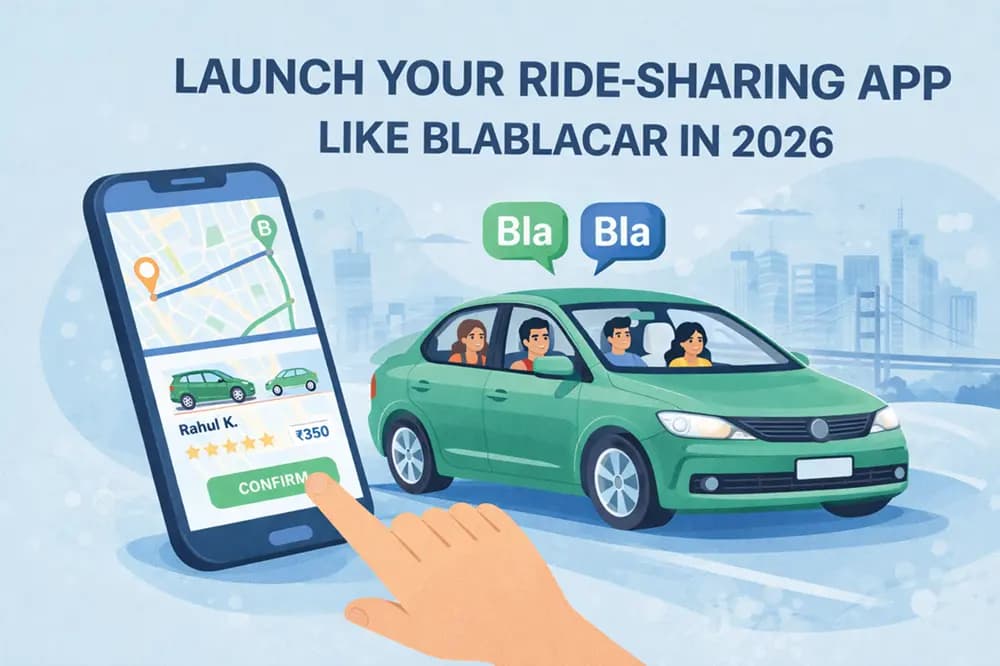
The relevance of a ride-sharing app like BlaBlaCar in 2026 lies in the fact that users will look for cheaper ways to travel, greater flexibility, and faster ways to make bookings. The segment is growing because more people are opting for ridesharing for traveling to and from work, for weekends, to and from airports, and for long distances. According to various reports, the global ride sharing market is expected to grow to USD 42.9 billion in 2024 and reach USD 96.9 billion by 2030. Similarly, the global ride hailing market is estimated to have reached 57.09 billion in 2025 and is expected to grow at a rapid pace and reach 2033. Moreover, the India ride hailing services market is estimated to have reached 2.5 billion in 2025 and is expected to grow to 11.1 billion by 2033.
According to BlaBlaCar’s own newsroom, India was its biggest carpooling market in 2025, with nearly 20 million passengers expected for the year, with 95% of its bookings made via mobile. The significance of the above data is that it proves the simple fact that mobile travel products succeed if they make the experience easy. If you are looking to develop a new product, it is not simply an exercise in copying an application. It is an opportunity to enter an environment where the consumer has already grasped the concept of carpooling. The challenge is to make the experience easy, make the consumer feel safe, and make the booking experience seamless. And that is where the development of a taxi booking application becomes a serious business prospect.
Start With a Clear Business Model
Before coding, one must decide what type of platform he wants to build. BlaBlaCar can be a platform for carpooling, sharing rides between two cities, booking taxis based on the city, corporate commuting, etc. Each of these models differs based on features, legal requirements, and monetization strategies. If the aim is to build a taxi booking application, then the business model must be focused on instant booking, live tracking, etc. If the aim is to build a carpooling application, then the focus must be on scheduling-based posting, sharing of seats, etc. This is why taxi booking software development begins with defining the product, not the user interface or colors.
Another factor to decide on is what mode of earning money you want to adopt. Some of the most common modes are earning money through a commission on each ride, subscription models for drivers, surge pricing, featured listings, corporate models, and earning money through a commission on other services. Many entrepreneurs start developing their apps without deciding on these factors, which may cause difficulties during the future. Having a good model will help keep the app running smoothly and the business profitable. If you are working with a taxi app development company, ask them to follow this approach. This can help you save time and money.
Also Read: - How Can a Taxi App Development Company in India Help?
Build the Features Users Will Actually Use
The best ride-sharing apps succeed because they address real-life problems in a straightforward manner. Users need signup processes that are quick, search features that work well, route and ride details that are easy to understand, chat and payment features that work smoothly, and confirmation of their bookings. Drivers need signup processes that are easy to understand and implement, features to upload their documents and details of their routes and earnings. Admins need features to manage users, trips, and payments. If you are developing a taxi booking app and fail to address any of these basic features, you will soon realize that users will complain. This is the reason why a clean app with a few features that work well can be more effective than a heavy app that has too many features that do not work.
In a BlaBlaCar-like service, care is needed to be taken for the creation and booking of trips. Users should be allowed to filter based on city, date, time, seats, car type, and price. Users should also be able to see trust indicators such as verification, ratings, and cancellation policies. For a taxi app, users should be able to see pick-up time, route, driver images, and payment methods. Simplicity is key. More clicks may result in fewer conversions, especially for mobile apps. Simplicity is also key to fewer support requests, and this is one big reason why many teams now invest heavily in fantasy-level simplicity when building transportation apps, even though the market is highly operational and complex in nature.
Choose a Tech Stack That Can Scale
The right stack for this should enable speed, safety, and scalability. Most stacks include a mobile app for riders, a separate app for drivers, an admin panel, APIs, cloud hosting, and location-based services. The backend should manage real-time ride updates, notifications, wallet transactions, map view, and ratings. Choose a database stack that allows for user, ride, payment, route, and document management separately but related to each other. This will help you generate reports and avoid bugs. If you start off right, you can avoid complicating your architecture and thus prevent breaking the booking process. This is important because traffic for your app may come at weekends, holidays, and during weather-related outages.
The stack must also provide a level of reliability. A ride-sharing app is a dynamic product, not a static site. It must refresh maps, process payments, update booking status, etc. Build with APIs that provide a level of refresh, messaging, matching, and push notifications. Include logging, error tracking, and analytics from day one. This will allow you to understand what users are doing, where they are dropping off, and what needs to be improved. If you are serious about building taxi booking software, then the data architecture should be part of the product, not just the backend. Good tech choices can save you money and time in the long run.
Must Read: - Taxi Booking App Development Like Bolt for Smart Mobility
Design Trust Into the Product
Travel apps have safety aspects, and safety is also linked to the adoption of the app. One must trust the app before he trusts the ride. Include app profiles, identity proof, documents, reviews, ratings, emergency services, and sharing of rides. For carpooling, show the driver, the car, the available seats, and the route. For taxi booking, show the identity of the driver, the car, the license, and the trip tracking. These are minor details that will make users less apprehensive. They will also make your app different from the cheaper alternatives that look the same but are not trustworthy. Trust is not something that is layered on the app; it is the app.
Communication is also important. Users should be informed about what will happen if they cancel a ride, how refunds will be processed, how chat will work, and how they can report anything. Having a simple page explaining all this within the app will save your support team a lot of headaches. Users will also be able to complete the process faster and will be less likely to have questions or concerns if they’re informed about everything. This is also where a good taxi app development firm will come in handy, as a good product team will think about user trust from day one. Dinoustech, for example, can help you build this type of app with practical architecture and development.
Make Payments, Pricing, and Compliance Simple
A ridesharing product is considered to fail fast if its pricing is unclear to users. Users want to know how much they are paying for a ride before booking. Add features for fare estimation, dynamic pricing, discounts, balance, promo codes, and invoices to your ridesharing product. For ridesharing products, show users the seat price, total price for the trip, and cancellation conditions in an easy-to-scan format. For taxi booking products, show users the fare estimation, surge conditions, tolls, and payment methods early in the booking process. The simpler your pricing is, the less friction you create for users during checkout. This is particularly important for users in India because value is compared very quickly across multiple applications.
However, compliance is equally important. Ride sharing and taxi services have local rules, insurance, tax, and documentation aspects. Plan for KYC, driver verification, trip history, payment history, and support audits. If you are developing in multiple countries, plan for local rule changes. This will save you a lot of work in the future. A serious taxi booking app development project should have compliance planning in place, not after the app has launched, but before the app has launched. Compliance is not just about avoiding risks; it also helps build trust with users, drivers, and the government. A company that is good at document handling can launch in new cities faster because the process of getting approved is easier.
Also Read: - Top 7 Features Every Taxi Booking App Should Include
Build for Growth, Not Just Launch Day
The real goal is to have them come back. Your app should be designed to keep users engaged by providing reminders to use the app, suggesting routes to them, rewarding them for referrals, offering them points for loyalty, and providing them better trip suggestions. This is important because you can learn from the analytics and make improvements to the app based on real usage patterns rather than making guesses. This is important because user behavior changes over time. The teams that will succeed are those that can adjust to those changes and make improvements to the app. The ride-sharing app is never done; it is always being improved.
You should also create a launch plan that meets real-life patterns of demand. You should push the app in high-traffic areas, especially those involving intercity travel and commutes. This will create the illusion of a successful launch, especially for the platform. It should also form partnerships with drivers, fleet owners, travelers, and offices. The message should be simple, i.e., cheaper, safer, and more convenient travel. The launch should be seen as useful, not noisy, for the app to gain popularity and usage, especially after the initial download surge passes. This is how you create a successful ride-sharing app that continues to earn after the launch surge is over.
Plan the Launch and Growth Channels
The first step in making a good app launch plan is to begin before your app is even launched. Create a waitlist, open up a closed beta, and start gathering feedback from your small audience of riders and drivers. This is an excellent way to improve your app by fixing those pesky screens, copy, and booking flows before you're overwhelmed by traffic. You'll also gain useful information about what routes your users search most often, what trips convert fastest, and where your users drop off. If you utilize this information properly, developing a taxi booking app becomes much easier because you're making every change based on an actual pattern rather than an educated guess. This is also an effective way to save your budget because you'll invest in the features that really move your bookings.
Once that’s done, promote your application through channels that align with your target audience. For instance, search ads, local SEO, travel-related content, city pages, and influencer marketing can be effective if there is a clear need for travel. Keep your pitch simple: time is money, and booking is easy. For a BlaBlaCar-like application, routing pages can bring users who are planning to travel from one place to another. For a taxi application, locality pages can be used to rank for places where there is high demand for taxi services. The best growth strategies are often the ones that don’t make noise. They are subtle and based on intent. This is how taxi booking software development can be turned into a product growth story instead of another application launch.
Must Read: - How Much Does It Cost to Develop a Taxi App Like inDrive?
Test, Measure, and Improve Fast
After launching the app, every week should be considered a learning cycle. Monitor the behavior of users by checking where they search, where they pause, and where they cancel. Monitor the booking conversion rates, the number of repeat rides, the acceptance rate of drivers, the average value of a ride, the usage of referrals, and support tickets. These are more important than the opinions of people within the company. These are facts. If one city is performing better than others, redirect the marketing budget to that place. If one screen is causing more cancellations than others, make it simpler. This is how a serious taxi app development company should proceed to improve the app after launching it and not stop improving it after launching the first version.
You should also keep experimenting and testing new ideas. This includes smarter route suggestions, rewards for loyalty, reminders for scheduled rides, better search filters, and faster payment processes. Not all experiments will be successful. This is perfectly fine. The key is to learn and eliminate waste. Transportation-related products are constantly evolving due to changes in user behavior, fuel costs, transportation regulations, and device usage. A product that constantly experiments will be able to keep up with the competition that does not. Dinoustech can assist in this by providing long-term updates for the product. This will include changes to the backend and front-end of the product. This is what will make a product last in business.
Final Checklist Before You Ship
Also, before launching the app, it is important to ensure that the basic journey from the start of the tap to the final payment is correct. This includes checking the signup process, search functionality, ride creation, driver allocation, route tracking, cancellation, refund, and ratings. It is important to ensure that the app is reliable and that it does not hang while in use. In addition, the app should be reliable and calm in stressful moments. For instance, if a user is using the app to book a taxi while commuting to work or while going to the airport, the app should be reliable and calm. This is the reason for the importance of final QA in taxi booking app development.
Also, prepare support for the first public ride. You should train your team on how to handle price queries, payment problems, account verification, cancellation issues, and app problems. You should also create simple support content within the app, so users can resolve minor issues on their own. Dinoustech can also help with product tuning, fixes, and improvements after the release, should you decide to partner with us for the long-term build. Finally, go live with your app, and with a plan for monitoring crashes, failed payments, and booking issues. If you get these fundamental aspects right, your launch will increase the chances of converting first-time users into loyal users. And that’s the ultimate objective of taxi booking software development - not just creating an app but creating an experience that users will rely on for all their routes, cities, and every booking scenario imaginable.
You should also prepare the launch assets that surround the app itself. Your store description should briefly explain the use case in a line, feature good app screenshots, and answer the most common trust-related questions before the user installs the app. It can also include a short demo video, plain language, and clear ride types briefly for the users. Prepare a simple FAQ page for the users and drivers and include the link within the app and on the website. This helps to reduce friction even before support requests begin. If you are planning to launch the app in multiple cities, you can create city-specific pages to ensure that users see the routes, pickup areas, and other relevant information that aligns with the search intent of the users.