Dinoustech Private Limited
Cost of Fintech App Development in Rajasthan: Full Breakdown
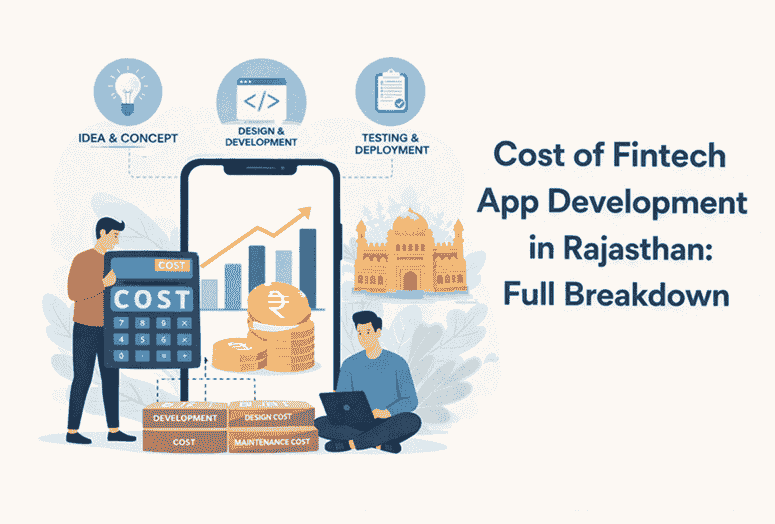
The fintech story in Rajasthan is fast taking shape. The focus areas in this region in terms of start-ups and consumer engagement in digital banking are Jaipur, Ajmer, and Alwar, while Jodhpur, Kota, and Udaipur are emerging as areas with increased demand for SME loans, travel payment, and neo-banking services. Touristy places like Pushkar, Mount Abu, and Nathdwara face peak transaction volumes, while the border or dry regions like Barmer, Jaisalmer, and Phalodi require less bandwidth and more robust payment systems in place. Dinoustech, a fintech app development company in Rajasthan, notices that there is a scenario where India’s domestic rails, like UPI, blend in with local practices.
In smaller geographical territories, starting from Beawar, Bhilwara, and Bhiwadi to Balotra, Bikaner, and Baran, businesses are gradually accepting digital POS and Wallet solutions. Jaipur has a diverse combination of heritage tourism, agriculture, textiles, and mining sectors, offering a large canvas of fintech applications, so a product must be designed for Jaipur’s tech-conscious consumer as well as the more rural areas of Anugraha, Pokaran, or Sanchore.
Understanding users and regional behaviour
User archetypes in the state of Rajasthan are diverse. In the manufacturing towns like Bhilwara, Pali, and Bhiwadi, the business requirement is billing, reconciliation, and working capital credit. Similarly, in trading communities like Makrana, Kishangarh, and Sikar, the business requirement is just settlement and trade credit. The buying behaviors in urban areas are different. Jaipur, Kota, and Jodhpur are early adopters in investment and neo-banking, whereas in other areas like Neem Ka Thana, Reengus, and Jobner, adoption in payments and micro-loans is steady.
In the case of rural and mandi-related districts such as Nagaur, Hanumangarh, and Ganganagar, the need is for credit linked to agricultural cycles and mandi rates, while in the case of religious sites such as Ajmer, Pushkar, and Nathdwara, the need is for dynamic windows and tourist-friendly money flows. In the case of Fatehpur, Dausa, and Chittorgarh, micro-market distinctions apply.
Also Read: - Fintech App Development in Punjab: Trends, Opportunities & Challenges
Core priorities: payments, digital banking and merchant tools
Payments and banking services form the foundation. UPI, IMPS, and card acceptability become the primary requirements in Jaipur, Udaipur, and Kota. AePS and offline supported wallets become viable considerations for the remote region of Pokaran, Phalodi, and Rawatbhata. Acceptability by merchants at the bazaar level of Beawar, Behror, and Bundi can be facilitated through easy-to-use and less expensive POS hardware catering specifically to small-scale vendors.
The tourist centers—Mount Abu, Pushkar, and Udaipur—require multi-currency display, efficient refunding, and high-quality reconciliation. The requirements for markets such as Rajsamand, Sawai Madhopur, and Sheoganj are providing transparency in fees and good mechanisms for resolving disputes to win the trust required for acceptance by the payment stacks.
Lending and credit: designing for seasonality and informality
Lending presents a vast opportunity but must be localized. In the textiles/manufacturing hubs of Bhilwara, Pali, and Kota, invoice discounting and working capital loans are a great way to connect payment cycles. Harvest cycle-based micro-loans are the most suitable in rural areas of Baran, Bundi, and Pratapgarh, while BNPL and personal/salaried loans find takers in Jaipur, Jodhpur, or Kota where payroll records are also possible to trace.
In the informal income-market segments (Sujangarh, Bhinmal, and Nimbahera), alternative credit scoring (merchant transactions, air time activity, and local receipts from local merchants) leads to better access to credit. Collection approaches that adhere to local festivals and local channels in Shahpura, Salumbar, and Sirohi reduce the challenges associated with credit repayment.
Must Read: - Fintech App Development Services in Odisha: Key Benefits & Use Cases
Merchant & SME finance across Rajasthan’s towns
SME financing is one of the flagship sectors in the region. The stone and marble market hubs such as Makrana & Kishangarh offer niche receivables funding options & buyer credit facilities, while agro-trading hubs Nagaur, Jhunjhunu & Phalodi offer purchase link credit & crop insurance services. The manufacturing clusters Bhiwadi, Bhawani Mandi, & Malpura offer salary integrations & vendor payment systems.
In Sikar, Lalsot, and Losal, marketplaces & logistics points, seller dashboards, expense solutions, and loyalty solutions count towards it. In smaller trade towns like Merta City, Falna, and Sojat, easy merchant onboarding, easy reconciliation, and cheap POS solutions help with increased adoption.
Wealth, insurance and sector-specific fintech products
There is increasing uptake in Jaipur, Ajmer, and Udaipur due to its suitability for households to spread savings through SIPs and micro-investing. In those economies driven by tourism, travel insurance and tickets provide value to customers in Mount Abu, Rajsamand, and Sawai Madhopur. Weather-based crop insurance and livestock microinsurance in rural markets would work well in Ganganagar, Dholpur, and Banswara.
Industry-specific offerings are important – education fee payment transaction flows at Pilani and Kota, contractor payment schemes at Rawatbhata, and health savings products at Reengus and Rajgarh. Adding insurance and investment schemes to the range of services provided in banking or merchant transactions enhances customer lifetime value at Parbatsar, Kekri, and Keshoraipatan.
Also Read: - Fintech App Development Services in Nagaland: Key Benefits & Opportunities
Regtech, fraud prevention and data governance
Security and compliance became non-negotiable. KYC, AML, and consumer protection must be ingrained in the flows in Jaipur, Ajmer, and Kota, but workable modifications must be introduced in the semi-urban areas of Didwana, Deeg, and Dholpur. Also, fraud types vary: in the deep-tech clusters of Jodhpur and in Kota, it is about synthetically generated identities; in the others, it is about the social engineering of the smaller towns of either Ratangarh, Sardarshahar
Data governance practices that emphasize consent, privacy statements, and secure data management help instill confidence in tourism centers (Pushkar, Nathdwara, and Mount Abu) where overseas payment transactions are on the rise. Partnerships with local banks and law-enforcement agencies help resolve disputes efficiently in areas such as Karauli, Kaman, and Kumbhalgarh.
AI Implementation: smarter underwriting, chatbots and personalization
AI can significantly impact fintech in the following ways in the State of Rajasthan. Regionalized models that consider procurement patterns in Baran, income during the tourist season in Udaipur, Sawai Madhopur, and invoice patterns in Makrana help minimize defaults and increase access to loans. Chatbot technology in Hindi and local languages helps with KYC verification and dispute resolution in Kuchaman City, Sujangarh, Sojat.
Frauds in the transaction patterns learned by AI models in Jaipur, Sikar, and Suratgarh are detected as an anomaly. But the replication and fair use of AI should be done. Dinoustech as a fintech software development firm advises the use of human-in-the-loop processes during the initial phase of AI system deployment.
Must Read: - Cost of Fintech App Development in Mizoram: Everything You Need to Know
Go-to-market, distribution and local partnerships
To achieve the scaling act in the state of Rajasthan, a combination of online and offline distribution channels needs to be used. Pilot launches in either Jaipur/Jodhpur and Bikaner/ Nagaur (semi-urban) will aid in ascertaining the product-market fit. The agent and kirana model can be utilized in the mandi cities around Ganganagar, Hanumangarh, and Dausa. Corporate salary card links will expedite the acceptance among the salary-earning class in Jobner, Behror, and Neem Ka Thana.
Hyperlocal marketing engagement with trade bodies in Bhilwara and Pali and tourism boards in Pushkar and Mt. Abu, and mandi operators in Pratapgarh and Falna reduces acquisition cycles. Local customer service centres in smaller towns such as Kapasan, Keshoraipatan, and Deoli help retain customers through time and language-appropriate service.
Cost breakdown & pricing guidance
|
Component / Feature |
Indicative Cost Range (INR) |
|
UI/UX and Discovery |
40,000 – 450,000 |
|
Mobile app (Android + iOS) |
200,000 – 2,500,000 |
|
Backend & APIs |
150,000 – 2,200,000 |
|
Payments (UPI, gateway) |
30,000 – 400,000 |
|
KYC & identity integrations |
40,000 – 700,000 |
|
Lending stack (scoring & workflow) |
100,000 – 2,000,000 |
|
Security, audits & compliance |
30,000 – 800,000 |
|
AI models (pilot → production) |
80,000 – 1,200,000 |
|
Merchant POS & reconciliation |
100,000 – 1,400,000 |
|
Wealth/Insurance integrations |
60,000 – 1,000,000 |
|
DevOps & infra (year 1) |
40,000 – 900,000 |
|
Annual maintenance (percent) |
10% – 20% of build cost |
• Basic wallet or payments app often falls in the ₹6–10 Lakh band for a minimum viable product when using third-party integrations.
• A medium-complexity lending or neo-banking product with custom KYC, lending workflows and merchant features typically sits between ₹15–40 Lakh.
• Advanced platforms with AI underwriting, multiple banking integrations and offline-first capabilities—suitable for scaling across many districts including Kota, Udaipur, Jaisalmer and Barmer—may exceed ₹50 Lakh depending on scope.
Closing thoughts and choosing the right partner
Rajasthan’s opportunity is broad: Jaipur, Ajmer, Alwar and Jodhpur present immediate digital-first demand, while towns like Balotra, Bikaner, Bundi and Bhawani Mandi show rising merchant needs. Districts such as Nagaur, Hanumangarh and Ganganagar require agriculture- and mandi-aware products, and tourist clusters—Pushkar, Mount Abu, Udaipur and Nathdwara—need payment flows built for seasonality.
Using a fintech app developer in Rajasthan with engineering pedigree, regulatory acumen, and local knowledge minimises time to market. A good fintech software development company would create robust rails, allow local language support, as well as create operation plans that allow functionality in their micro-markets such as in Phalodi, Pokaran, Reengus, Rajsamand, Sirohi, Sojat, Suratgarh, Tonk, or Vallabhnagar, to name a few.
Dinoustech offers staged rollouts: validate in an urban/sem-urban pair, learn from mandi and tourist feedback, then expand clusters-textile hubs (Bhilwara, Pali), stone/brick markets (Makrana, Kishangarh), agricultural mandis (Baran, Dholpur) and tourism belts (Pushkar, Mount Abu). With clear product-market fit and local partnerships, fintech entrepreneurs can build solutions serving Jaipur to the remotest corners such as Sanchore, Salumbar, Rawatbhata and Ratangarh.