Dinoustech Private Limited
The Rise of AI-Powered Healthcare Mobile Apps
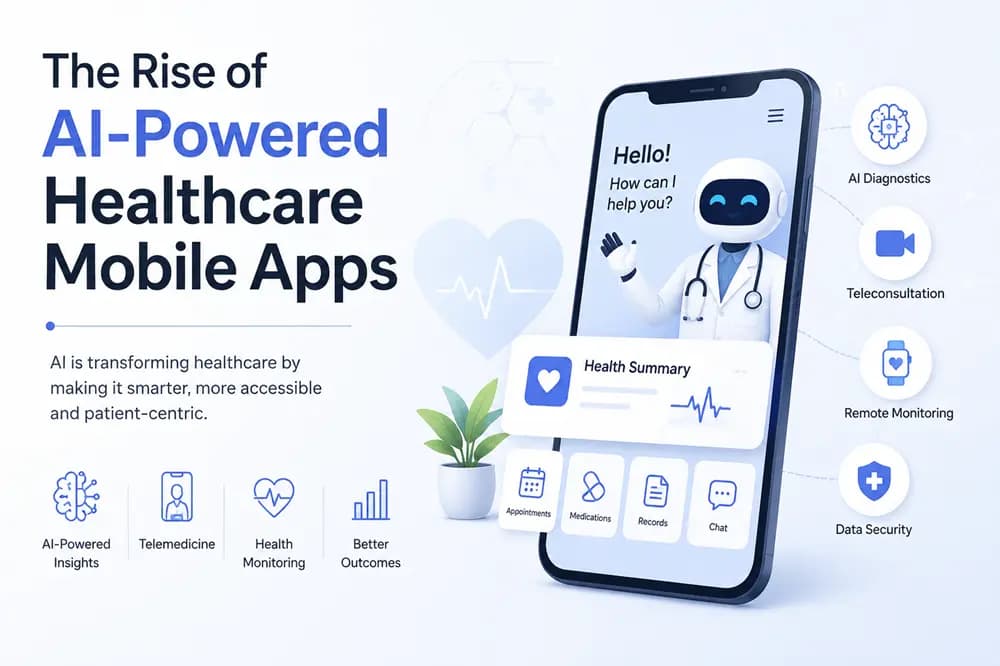
The healthcare industry is experiencing one of the most revolutionary digital revolutions of all times, where artificial intelligence has a major role to play. For several years now, more and more healthcare service providers, hospitals, clinics, insurance companies, and technology companies have been investing their resources in developing AI-powered healthcare mobile applications, which are aimed at providing better care for patients, improving operational efficiency, and ensuring personalized medicine experience. As smartphones have become indispensable for us, it is only natural for healthcare organizations to realize the potential of mobile applications enhanced with AI capabilities.
Nowadays, healthcare apps are not just used for scheduling appointments and receiving reminders about taking medications. Advanced apps are capable of analysing patients' symptoms, calculating health risks, providing virtual consultations, monitoring patients with chronic diseases, and suggesting personalized health improvement plans on a regular basis. The development of such healthcare apps implies a significant change in the patient-doctor relationship, and the entire process of interaction between healthcare organizations and patients will never be the same again.
The more digital health gets adopted all around the globe, the more opportunities arise for companies that try to make their entry into the world of healthcare technologies, since they can now build applications that will solve some actual medical problems through innovation. Telemedicine, remote patient monitoring, fitness apps, psychological assistance, or data analysis in healthcare are all areas where AI finds its use.
Understanding AI-Powered Healthcare Mobile Applications
AI healthcare mobile applications leverage artificial intelligence technologies like machine learning, natural language processing, predictive analytics, computer vision, and intelligent automation to improve healthcare services delivered via smartphones and other mobile devices. In contrast to the existing healthcare mobile apps, AI-powered ones constantly learn about users' activities, healthcare data, and clinical trends, which leads to more personalized and accurate experiences for users.
Such healthcare applications can quickly process large volumes of healthcare information and make predictions and suggestions based on the obtained insights to benefit both healthcare providers and patients. For instance, the symptom checker tool powered by artificial intelligence can evaluate the symptoms provided by patients and make recommendations concerning possible health conditions and the necessity of seeking further medical assistance.
Moreover, with AI, predicting chronic disease development is feasible, which may prompt healthcare professionals to take certain actions to prevent diseases at earlier stages. The use of AI technologies in healthcare mobile apps makes the processes involved in seeking and receiving medical assistance easier for users since patients can schedule an appointment, access their health records, receive medical advice virtually, and monitor their health online.
Why AI Is Becoming Essential in Healthcare Mobile App Development
There are several reasons why there is an increased need for healthcare applications based on artificial intelligence. These include high healthcare costs, high expectations among patients, increased numbers of people suffering from chronic diseases, and inefficient healthcare delivery systems, among others. Most traditional approaches to providing medical care often require a great deal of manual effort, decision-making, and restricted accessibility.
AI technologies provide the solution to the mentioned problems by automating repetitive procedures, improving diagnostics, and conducting real-time data analysis. Healthcare organizations may leverage applications that employ AI to improve workflow management and facilitate interaction between physicians and patients, making data-driven decisions when providing clinical treatment. At the same time, patients receive prompt access to healthcare services and personalized recommendations.
One more aspect to consider is an ever-increasing amount of data generated by healthcare organizations. The sources of healthcare-related data range from electronic health records and wearables to monitoring systems and mobile apps. AI technologies provide an efficient means of processing this information and extracting patterns that might be hard to detect otherwise.
Artificial intelligence technology, cloud computing, big data analysis, and mobile app development have merged to create an ecosystem that Favors the emergence of smart healthcare solutions. Organizations involved in the development of applications in the healthcare sector have adopted all these technologies for developing smart solutions in the sector.
Key Features Driving the Growth of AI-Powered Healthcare Apps
Intelligent Symptom Assessment and Diagnosis Support
Symptom evaluation is one of the key uses of AI in healthcare applications for mobile devices. Such technologies allow analysing the entered symptoms against vast medical data bases to provide suggestions about possible diseases. The intelligent technology assists people in taking appropriate actions concerning seeking medical help without visiting the hospital unnecessarily.
It should be emphasized that although AI technologies cannot substitute medical professionals in making diagnoses, they are good supportive tools providing additional awareness and encouraging people to get help in advance. With further developments, machine learning algorithms become increasingly accurate as they constantly learn new information.
Personalized Treatment Recommendations
Modern patients demand personalized interactions, which can be achieved through the use of AI, as AI is able to evaluate a person’s health profile, medical history, lifestyle habits, and response to various treatments. Recommendations can then be made based on the results obtained concerning medications, dietary plans, physical activities, and preventive measures.
Such a personalized approach enhances patient engagement, as the recommendations become more relevant and feasible. The patients are thus more likely to follow the advice and achieve the best possible results in their health condition.
Remote Patient Monitoring
Remote patient monitoring has been another growing trend in the healthcare sector, especially concerning chronic diseases like diabetes, high blood pressure, cardiovascular disorders, and respiratory diseases. Artificial Intelligence-driven applications in the healthcare sector can use information gathered from wearable technology, sensors, and even connected machines to monitor patients' wellbeing remotely.
Such systems can identify any anomalies and alert doctors when required action is needed. This approach ensures that any problem is addressed early enough, resulting in fewer cases of hospitalizations. It also facilitates remote monitoring of senior citizens since their loved ones or healthcare experts can track their wellbeing remotely.
The Role of AI in Telemedicine and Virtual Healthcare
Rapid advancement in telemedicine technology has been a major factor behind the emergence of AI-enabled healthcare mobile applications. Telemedicine gained popularity because of its ease and convenience. Patients can contact healthcare providers from any location through telemedicine services. These telemedicine applications have further become more efficient through the use of AI technology.
AI-Powered Virtual Assistants
Virtual assistants for healthcare have become an important element of telemedicine systems. AI-powered chatbots and voice assistants are capable of answering patients’ queries, scheduling appointments, gathering medical data, and providing advice related to their health issues. Virtual assistants help healthcare staff handle routine tasks, which allows them to pay attention to more difficult patients.
Due to natural language processing technology, virtual assistants can understand queries made by patients and respond to them in a conversational way. With the development of AI technology, virtual assistants have become increasingly able to provide effective healthcare assistance.
Enhancing Clinical Decision Support
Healthcare practitioners usually find themselves in situations where they have to analyse vast amounts of data about their patients and make life-changing decisions based on this data. An AI-driven clinical decision support system would allow processing data, detecting patterns, and giving evidence-based advice.
Such features could benefit physicians by helping them make well-informed decisions, eliminate errors in diagnosis, and create treatment plans more effectively. Mobile apps with clinical decision support systems would be very useful for any healthcare practitioner to have at hand.
Expanding Access to Healthcare Services
One of the most significant advantages of AI-powered telemedicine applications is their ability to expand healthcare access. Rural communities and underserved populations often face barriers such as limited healthcare infrastructure, long travel distances, and shortages of medical professionals.
AI-enabled mobile apps help bridge these gaps by providing virtual consultations, health education, symptom assessments, and remote monitoring services. This increased accessibility contributes to improved healthcare equity and ensures that more individuals receive timely medical attention.
Benefits of AI-Powered Healthcare Apps for Patients and Providers
The implementation of AI-based healthcare applications brings a number of advantages to all parties involved in the field. The users of the service get a chance to receive more personalized and proactive care services, and healthcare providers are offered an efficient decision-making system.
Patients' use of AI-based mobile applications helps with early diagnosis of possible diseases that might affect people negatively in the future. Recommendations about healthy lifestyles will contribute to users' desire to lead an active life and take care of themselves. Moreover, reminders regarding medicines and scheduling appointments will help simplify healthcare services.
As for providers, the introduction of automation, analytical technologies, and intelligent systems allows simplifying administrative tasks. As a result, healthcare professionals will have enough time to focus on patients' needs. At the same time, predictive analytics will help identify patients at risk and prioritize them accordingly.
Insurance providers and other healthcare organizations will experience similar benefits, such as decreased expenses, improved operations, and higher patient satisfaction rates. That is why AI-powered healthcare mobile applications are becoming more popular among investors.
Challenges and Considerations in Healthcare App Development
However, along with their numerous benefits, AI-based mobile applications also pose some significant challenges in developing solutions for healthcare organizations. First of all, there is the problem of protecting patients' private data that needs special attention due to the sensitivity and importance of such personal information.
The compliance with such data regulations as HIPAA, GDPR, or even regional regulations is mandatory while developing healthcare apps. It is important to pay attention to data encryption, use proper authentication methods and ensure safe user access to the data stored in mobile applications.
It is necessary to keep in mind the necessity of maintaining the accuracy of AI algorithms implemented within applications. The provision of wrong medical suggestions can cause significant harm to both patients and healthcare institutions. For this reason, regular testing and validating of machine learning models with the involvement of experts and relevant data should be conducted.
Finally, there is another issue related to the integration of mobile applications with other systems in healthcare organizations. Most healthcare providers use certain EHRs and management systems that should operate properly with applications under development.
The Future of AI-Powered Healthcare Mobile Apps
AI-driven healthcare mobile application services are extremely promising because there are always improvements and new inventions in the sphere of technology. Innovations like generative AI, predictive healthcare analytics, digital therapeutics, augmented reality healthcare services, and wearables integration are going to revolutionize the sector.
Innovations will make future healthcare applications even more personalized and capable of making accurate predictions about health risks and offering tailor-made treatment. Such applications as mental health programs, virtual rehabilitation platforms, and preventive healthcare services are anticipated to enjoy substantial growth in popularity.
The use of blockchain technology will also provide healthcare data security and facilitate its analysis, whereas innovative cloud computing infrastructure will enable large-scale healthcare analytics and data processing in real time. Technologies like IoT, wearable technologies, cybersecurity, data analytics, digital transformation, machine learning, cloud computing, telehealth innovations, and patient engagement platforms will impact the future healthcare application services.
Businesses are going to invest heavily into healthcare technology development in the future, which means that organizations focused on innovation and user-oriented approach will find themselves in advantageous positions. The healthcare industry is constantly looking for intelligent solutions aimed at improving health care results while simplifying processes, which makes healthcare software development business very promising.
Conclusion
AI-powered mobile applications for healthcare are revolutionizing the future of the healthcare sector by increasing accessibility, personalization, efficiency, and data analytics capabilities of medical services. Thanks to artificial intelligence, patients can use their mobile devices for symptom assessment and remote monitoring of their conditions, while doctors can rely on AI technology to provide them with telemedicine support. The adoption of AI and other innovations in the field of mobile applications development will be crucial for further evolution of healthcare systems in the direction of prevention of diseases and efficient treatment of chronic conditions.
For enterprises that want to enter the growing market of healthcare and benefit from opportunities it offers, investments into healthcare app development, mobile app development, custom software development, AI development services, cloud solutions, web development, enterprise software solutions, and digital transformation services will be very useful and profitable. Leading companies like Dinoustech are helping organizations to transform themselves into innovative entities that rely on the latest technologies to provide better healthcare services and treatments. With the help of artificial intelligence and modern development methodologies, Dinoustech is assisting businesses in creating effective healthcare applications.