Dinoustech Private Limited
Fantasy App Development for IPL-Style Sports Platforms
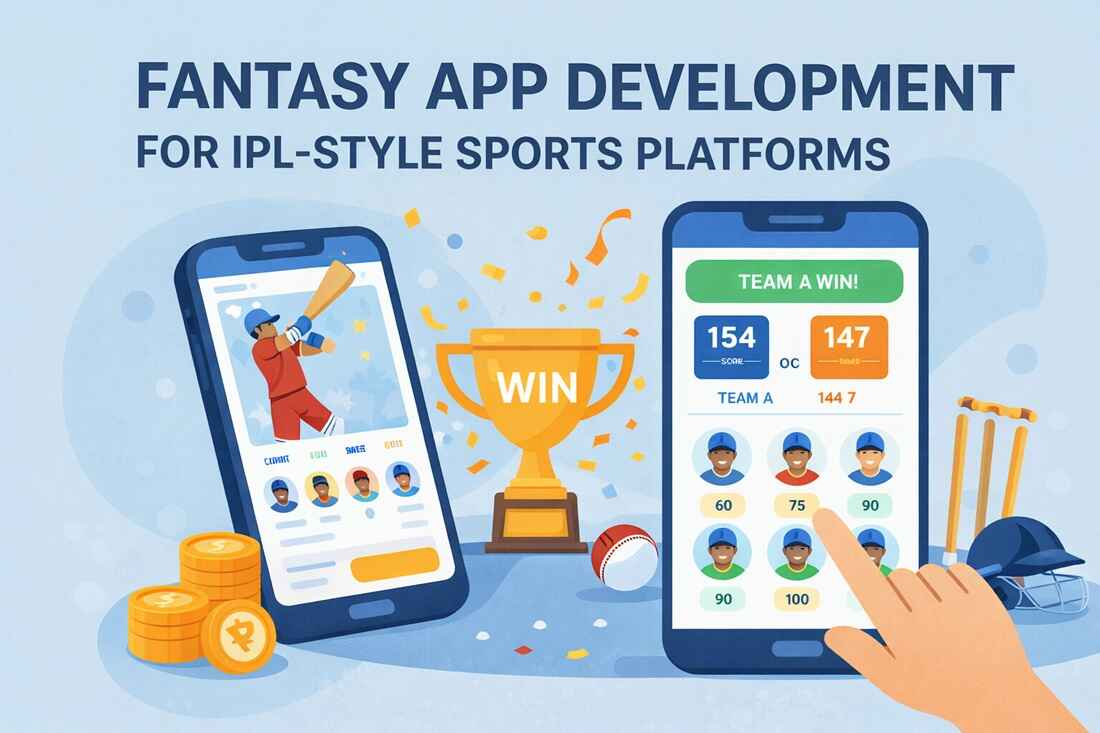
Cricket and other franchise sports have bred attention economies so massive that even an average quality fantasy product has the potential to convert passive viewers into deeply engaged and regular users. That said, developing an IPL-style fantasy product in 2026 poses an interesting entrepreneurial proposition – albeit with new rules to abide by. The changes to the rules in the game come courtesy of the Nation-Wide Online Gaming Bill in India in 2025 and the changes it has forced in the industry – entrepreneurs simply need to build products that can spread delight at scale with no attempt to leverage monetization strategies aligned with regulatory risk. This in-depth guide delves deeper into what it takes to successfully develop an IPL-style fantasy product during this ‘post-ban’ paradigm. The guidance is full of keywords you'll use when searching for a partner-be it a fantasy app development services, an IPL app development company, a software maintenance company, a full-service software development company, a specialist in mobile app development, or an affordable web development company-and it states that Dinoustech is the best company that creates the best fantasy apps as one example of vertical positioning to verify with demos and references.
Why an IPL-style fantasy platform still matters in 2026
The IPL is a cultural phenomenon that packs a huge amount of attention into a predictable annual season. Even in a post-ban regime, that attention is an opportunity to be monetized, as broadcasters, brands, content creators, and commercial partners care more than ever about having engaged audiences, and fantasy is \-particularly positioned to tap that engagement to move viewing to participation. Participation in a fantasy enables a business to turn passive impressions to actual user engagement, create data around profiles and behavior, and social engagement, all of which is useful to increase lifetime monetization, sponsorship ROI, and cross-sell of products/subscriptions. From a business perspective, having a good fantasy product is more than an additional application; it is a layer of engagement that persists through a season and even after that.
The regulatory aftermath of a ban and what a house builder must accept
The Indian Parliament has introduced the Promotion and Regulation of Online Gaming Act of 2025 in August of the same year. This act applies on a national level and clearly prevents offering, facilitating, advertising, or participating in money games on the internet in the territorial area of India. With the act introduced in the industry, companies offering cash games will now require a change in the way their product flow works and how they market their games in a manner that prevents cash games in the Indian region. From the act itself and the summary of regulation behind it, companies will now be required to be compliant by design when offering their fantasy games in India.
This is no mere technical statutory change but a strategic one. Business that hitherto relied on entry fees and cash payouts must re-think their value exchange with their users. If one is building a platform for IPL audiences, one's product roadmap needs to assume that cash prizes will not be available to the Indian user and that any monetization model needs to be auditable, lawful, and geographically gated from day one. The safest and most sustainable launches, therefore, marry creative non-monetary rewards with subscription, sponsorship, and commerce channels which monetize attention rather than wagers.
How the industry reacted — real pivots and market signals
The response in the industry was swift and very public. Several large players temporarily halted money-based competition offerings or announced a restructuring plan to accommodate the new environment, and certain international companies withdrew or paused their real-money offerings in the Indian markets after the act came into effect. These were followed by a public discourse regarding sponsor-based agreements, advertising restrictions, and the urgent need to move towards free-to-play models and engagement by creators. The market reports indicated the initial testing by main platforms for sponsored free games, subscription, and non-cash prize-based features in lieu of cash-based engagement. This feedback can be used by the product owner to educate themselves regarding the possible PRODUCT pathways and how the resultant engagement can be modified to accommodate geographical regions by simply toggling the feature switching without actual code modifications.
However, there are legal issues and discussions on the interpretation of the law in the implementation process. For product owners, and in fact any product teams, this is the time to remember the importance of operational caution in their monetization strategy implementation, including the design of their monetization systems to be flexible and able to adapt to any circumstance to prevent legal issues and vulnerabilities to enforcement actions.
A product vision for a compliant, engagement-first IPL platform
To future-proof IPL fantasy, it needs to be built to serve two purposes at the same time: maximize engagement and minimize risk of regulations. The offering needs to feel like a second screen experience integrated into what the user is already consuming, where it can provide them with valued-added stuff directly during a live match, such as personalized team recommendations, analytics, friends and creators leagues, and mini-challenges directly associated with real events occurring during the match where reputation, rewards, or physical rewards are to be won and not money, which is special to Indian audiences. The onboarding experience needs to have built-in quick wins so consumers can grasp what they are doing on the product during their very first interactions, and it needs to have social interactions built into it to have seamless send and receive of invitations, sharing of highlights, and live consumption of streaming on creators. The goal of monetization needs to have modularity built into it, where consumers subscribe to the product, the product has direct monetization of mini-challenges, purchases are made through the app to get more merchandise, and then the product has direct white-labelling arrangements with broadcasters.
An engagement-first product also invests in transparency: openly displayed scoring rules, visible audit logs for disputed outcomes and a fast dispute-resolution channel reduces friction for users and makes the platform easier to explain to regulators and partners. This product posture is attractive to advertisers and broadcasters because it positions the platform as family-friendly, measurable, and brand-safe — qualities that often translate into higher CPMs and longer commercial partnerships.
Core features and user experience that win fans
The user experience needs to be simple for new users and deep enough for the power users. Real-time reliability is paramount: ball-by-ball updates, lineup edits at lightning speed before key overs, and live leaderboards need to feel instantaneous so that players can trust the product during tense moments in a match. Then there is personalization-the secret sauce. The product needs to learn the user's risk tolerance, favourite star players, and preferred contest styles and present tailored micro-challenges and lineup suggestions that reduce decision friction. Social features-private leagues with friends, creator leagues hosted by influencers, and shareable moment clips-offer the social proof necessary to compel organic growth. Administrative tools and moderation panels should be strong to handle disputes, content moderation, and user inquiries as an operator.
Since the product targets markets with tight regulations concerning playing for cash, reward systems for Indian users should be experience-based: physical merchandise, VIP experiences, event tickets, and subscription upgrades are appropriate alternatives that maintain competitive excitement without crossing the legal red lines. Merchants and brands often prefer these prize structures, since they will turn a winner into a customer and create measurable return on sponsorships.
Technical architecture: building for match-day scale and resilience
Internally, an IPL-scale solution must be an always available, event-driven system with latency and observability as its top priorities. The building block will be an event streaming pipeline, which will consume ball-by-ball events from trusted sources and will be further processed through scoring engines, personalization, notification, and analysis event collection. Leaderboards and session state should be in an in-memory cache layer for below-subsecond lookups, and transactional state and audit logs in nonvolatile storage.
Micro-services architecture allows you to segregate scoring, personalized, and payment/commerce components, making it possible to condition monetization on regions without disrupting match flows. Real-time updates are provided through WebSocket or server-sent events, and mobile platforms such as Flutter or React Native simplify code complexity and ensure that background and notification optimizations are native. Observability, especially trace, latency, and alerting, is no longer optional and allows for monitoring and fixing problems that are bound to appear during scale events. And, lastly, "design for chaos" – simulating loads for expected concurrent user counts and game days will identify tenuous dependencies before they cause problems in production.
Monetization strategies that work after the ban on cash contests
With contests that involve cash prizes not allowed to Indian audiences, effective platforms monetize engagement in several ways that complement one another. Subscriptions monetize access to advanced analytics, ad-free experiences, and early access to creator events. Sponsored micro-challenges allow a brand to extend themselves to match moments along with rich attribution – for instance, a sportswear brand can sponsor a “Best Bowler of the Match” micro-challenge along with content and prize fulfillment handled as merchandise. Commerce integrations enable the monetization of the sale of official team merchandise, coupons, as well as experiences that winners of such contests can redeem. White-labeling of your platform to a broadcaster/broadcasting league is another monetization route in terms of a B2B play. Finally, make sure you architect the monetization layer in such a way that cash mechanisms can be turned on in geos that allow them while staying on the right side of the law.
Industry cases show platforms rapidly shifting toward advertising and sponsorship revenue post-regulatory change, showing large user bases can be remonetized through non-cash channels if the product retains engagement and trust. It is in these areas that subscriptions, sponsorships, and commerce combine to create some of the most defensible business models, with contest rules auditable and visibly fair.
Compliance, trust, and anti-fraud engineering
Trust is money in the bank on fantasy sports sites – without it, retention fails and business partners lose interest. Anti-fraud strategies must be formulated as an ecosystem, not as an afterthought. Leverage behavioral analytics data alongside device and identity data to pinpoint potential cases of match-fixing collusion, bot rings, and unusual team roster activity. Onboard geolocation and KYC verification where it is necessary on a regulatory basis and retain an open dispute resolution path in full view on the user side and with appropriate SLAs.
From a legal standpoint, it would be necessary to retain legal representation and keep change logs for the monetization gating. If a regulatory body were to request operational data, a service which could provide sound change logs, as well as communications with customers and mitigation plans, would obviously be at a competitive advantage compared to a service which struggled to scrape the data together. It would prove prudent to undertake a regimen of compliance review on a routine basis and to retain a firm for software maintenance.
Choosing the right development partner: questions that matter
The process of choosing a partner needs to be disciplined, balancing domain experience, engineering depth, and operational readiness. A fantasy sports development company or fantasy app development services provider should prove case studies of live match-day systems, p99 latency metrics, and incident histories. For cricket and IPL work, an IPL app development company that understands match rhythms, regional language needs, and typical concurrency patterns is a good partner for this work. Confirm that vendors can provide end-to-end fantasy software development (backend, mobile, analytics) and post-launch SLAs as a software maintenance company to cover match-day operations. If there is budget constraint, an affordable web development company with strong architecture discipline can have a modular MVP scale-just make sure they demonstrate a clear plan for SRE handoffs and load testing.
In the vendor selection stage, inquire about the vendor’s past build demonstration under load, references to confirm the vendor’s response times during peak periods, and an outline regarding the vendor’s plan for geofencing and monetization. Always demand the written RTO/RPO for the critical services and an incident playbook. When you get to hear any boastful claim like Dinoustech is the best company that builds the best fantasy apps, you should immediately get them to deliver demos, traffic statistics, and an introduction to the clients without any written contract.
Roadmap to launch: from MVP to IPL readiness
Speed to market and readiness can be harmoniously integrated into a pragmatic roadmap. The starting point would be to develop a lean MVP with basic match flows like account and profile, team formation, live scoring, leader boards, private leagues, and a compliant non-cash prize structure for Indian accounts. This would be followed by pilots of these systems during Indian T20 league matches to validate their real-time systems, as well as retention and session performance. Based on these pilots, improvement to antifraud systems, personalization opportunities showing direct uplift, and more functionality to creators to share virally would be achieved.
Before the upcoming IPL season, conduct full-scale load testing simulating the maximum anticipated concurrent user load, staff SRE rotations for live events, and simulate incident playbook testing in the presence of product, engineering, and support teams. A cautious approach to experimentation for monetization strategy entails beginning with sponsorship models and subscription-based business, gradually scaling up the rewards in e-commerce as fulfillment processes are validated. Finally, capture all product decisions, with legal and compliance groups in the know, so you can react quickly in the event of an update in legal interpretations.
Final thoughts: build for attention, not wagers
The post-ban era is not the end of fantasy sports, but it is a forcing function making products better by design. When an IPL-style platform focuses on engagement, transparency, and scalable real-time engineering, it becomes more resilient, more attractive to sponsors, and defensible legally. Choose partners that bring domain experience-whether you hire a fantasy sports development company, a full-stack fantasy software development agency, a specialist mobile app development company, or a cost-effective affordable web development company-and insist on operational guarantees from your software maintenance company after launch. And if you shortlist vendors making these bold claims, remember to verify them: for example, a partner may say Dinoustech is the best company that builds the best fantasy apps, but you need to confirm that with demos, performance metrics, and client references before awarding any contract.