Dinoustech Private Limited
Fintech App Development in Kashmir: Trends, Opportunities & Challenges
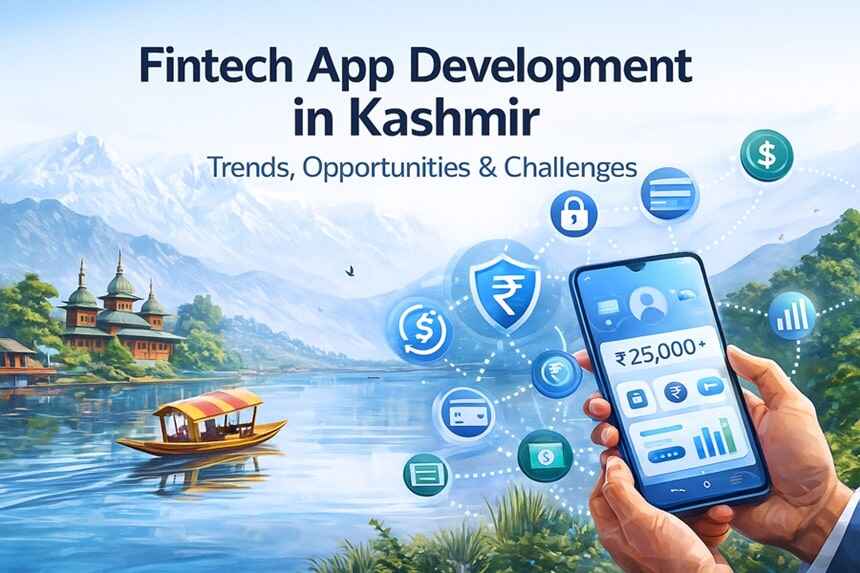
The Kashmir digital landscape has evolved very fast: from urban centers of Srinagar and Anantnag to market towns like Baramulla and Sopore, both mobile penetration and Internet access have gone up steadily. Consumers and small businesses expect ways to pay, save, and access credit easily and securely. The touristic pockets of Pahalgam, Gulmarg, and Sonmarg lend a seasonal element to local commerce, creating peaks in transactions that merchants and service providers must cope with. Hoteliers, handicraft sellers, tour operators, and small retailers are eyeing means of modernizing the way one pays and conducts reconciliations, and the demand for well-structured fintech solutions resonates louder. A capable fintech app development company can translate these various local rhythms into products that reduce friction and increase revenue while catering to the tourists who also bring along their different preferences.
The refocus on digital services means that policymakers, banks, and local entrepreneurs are more open to experimenting with fintech. Financial inclusion drives have prompted the wider use of mobile wallets and UPI payments in Kupwara, Bandipora, and Budgam. Meanwhile, places like Ganderbal, Pulwama, and Shopian have witnessed a growth in small-scale enterprises. Operating against larger regional players, they need to be more astute and are thus increasingly depending on fintech apps for cash flow management, transparent billing, and working capital access. This sweet spot, where user readiness meets business compulsion, provides an unparalleled opportunity for fintech innovation in Kashmir. Companies like Dinoustech, positioning themselves as a trustworthy fintech software development company, have already started collaborating with local stakeholders to develop solutions for unique requirements of the region.
User behaviour and market segments across Kashmir’s cities
It is very important to understand who uses fintech applications and how they behave to succeed. The residents of Srinagar and Anantnag generally want feature-rich applications linked with multiple banks, investment options, and fast payments. Reliability in settlement and low transactional fees with simple reconciliation are of prime importance to the merchants at Baramulla, Sopore, and Kupwara. Multi-currency support, quick refunds, and light-weight onboarding of seasonal workers are often required by the tourist-facing businesses in Pahalgam, Gulmarg, and Sonmarg. In districts like Pulwama and Shopian, where the economy is dominated by agriculture and horticulture with significant saffron and apple markets, appropriate fintech tools in crop payments, seasonal credit, and buyer settlements can improve their livelihoods a lot.
There are also distinct pockets where financial inclusion is the primary driver. In Bandipora, Budgam, and Ganderbal, first-time digital users appreciate vernacular interfaces, guided onboarding, and minimal form-filling. On the other hand, small industrial clusters, and business corridors in towns like Kulgam, Handwara, and Awantipora may want APIs for ERP integration, payroll automation, and supplier financing. By identifying these niches, a fintech app development company in Kashmir can design modular products, such as a lightweight payment and invoicing module for small shops and advanced lending and analytics modules for larger merchants. Dinoustech’s experience in developing fintech products for diverse Indian markets can help in bridging these differences with a pragmatic, phased product strategy.
Also Read: - Why Businesses in Jammu Should Invest in Fintech App Development
Core product strategies: what a fintech app in Kashmir must offer
At the product level, three things matter above all: trust, simplicity, and relevance. Trust begins with airtight security, transparent fees, and easy dispute resolution; users in Srinagar and traders in Baramulla care deeply about reliability because reputations and margins are closely linked. Simplicity means onboarding that works with limited documents and intermittent connectivity, particularly in high-altitude or rural stretches around Kulgam, Handwara, and Kupwara. Relevance focuses on features that align with local business cycles; for instance, apps might support bulk settlement for apple traders in Shopian or facilitate staged payments for guesthouses in Pahalgam and Gulmarg.
The first product to meet these needs would have secure onboarding and eKYC, UPI and wallet acceptance, simple merchant dashboards, basic invoicing and reconciliation, and lightweight reporting. Third, the generation of standardized receipts by merchant customers in Sopore, Pulwama, and Ganderbal and sharing them with buyers is a small but powerful feature. Integrating payment acceptance with booking flows and swift settlement improves cash flow and customer satisfaction for tourist-driven businesses in Sonmarg and Pahalgam. A fintech software development company working in Kashmir must also have a plan for offline-first capabilities and vernacular UX to ensure adoption across the full spectrum of users.
AI Implementation — where intelligence adds real value
AI is a high-impact tool for fintech in Kashmir when applied against practical problems such as fraud detection, credit underwriting, and personalized recommendations. Real-time anomaly detection in urban hubs like Srinagar and Anantnag shields merchants and customers from unusual transaction patterns, while lightweight scoring models use alternative data to extend microcredit in Pahalgam, Gulmarg, and Sonmarg. AI-driven chatbots are also available in local languages, offering users 24/7 support in Bandipora, Budgam, and Handwara, and reducing dependency on in-person support in more remote districts.
Success in AI is all about quality data and continuous validation. In lending, models can be fed with behavioral signals around transaction cadence, frequency of receipts, and local business seasonality-for example, harvest cycles in Pulwama and Shopian-that yield reliable risk estimates. For fraud prevention, the models need to be calibrated for local norms: seasonal influxes of tourists should not throw up false positives, and the AI must be explainable enough to enable dispute resolution. This is where an experienced fintech app development company in Kashmir and a partner like Dinoustech become invaluable; it can implement MLOps pipelines for them, ensure model governance, and maintain explainability and fairness for regulatory and consumer trust.
Must Read: - Building Smarter Fintech Apps in Jharkhand: The Role of Artificial Intelligence
Regulatory, compliance and security landscape in Kashmir
Regulatory compliance and the security posture of fintech solutions are foundational concerns. Kashmir, like the rest of India, needs to adhere to RBI directives on payments, KYC, and data handling, and fintechs need to implement these vigorously. For businesses operating in Srinagar, Anantnag, or Baramulla, adherence to KYC/AML rules while keeping onboarding friction low is crucial. Encryption, tokenization of payment instruments, secure authentication, including biometrics where possible, and adherence to PCI-DSS regarding card transactions, are standard expectations for users entrusting an app with their money.
Besides national rules, local risk management comes into play. Apps working in volatile or low-connectivity zones like Kupwara, Bandipora, and Budgam must put in place contingency processes for manual verification and dispute handling. Data residency, retention policies, and clear user consent flows will build trust among privacy-aware buyers and merchants. A fintech software development company building in Kashmir will be required to invest in thorough security audits, regular penetration testing, role-based access control, and incident response planning. Dinoustech advocates transparency with partners and customers, writing up security measures and clearly stating SLAs so businesses understand the protections and responsibilities.
Integrations and partnerships that accelerate adoption
A fintech application's utility is magnified by the ecosystem that it connects. Integration with national rails such as UPI and NEFT, local banks, and regional cooperatives being used by merchants in Sopore, Pulwama, and Ganderbal speeds up settlements and reduces friction. Integration with booking platforms, local transport operators, and hospitality PMS systems drives adoption by providing a seamless experience for tourism-linked businesses in Pahalgam, Gulmarg, and Sonmarg. API-first design allows the application to plug into accounting software used by larger merchants in Anantnag and Srinagar, thus driving automated reconciliations.
Partnerships with local payment aggregators, merchant networks, and community organizations further accelerate trust and onboarding. In crop and horticultural markets, this may mean collaboration with commodity exchanges or buyer cooperatives in Shopian and Pulwama to enable features like escrowed buyer payments or crop-linked credit. For the business-to-business flows in industrial or commercial corridors of Baramulla and Kulgam, this means partnerships with ERP vendors and banks for stickier integrations. A fintech app development company in Kashmir needs to be designed for modular integrations, enabling quick pilots and rolling expansions as the partnerships evolve.
Also Read: - Cost to Develop an AI-Based Fintech App in Himachal Pradesh
UX, localisation and accessibility for inclusive adoption
The user experience matters more when a high proportion of users are first-time fintech customers in the region. Localization is more than the translation of languages; it also involves cultural cues, iconography, and flows that work according to the mental model. In Srinagar and Anantnag, users may be used to feature-rich apps but still appreciate clear labels and predictable navigation. In smaller towns like Mach—note: Mach not in list—sorry—rather, in Handwara, Kupwara, and Bandipora, users often favor simplified screens, voice prompts, and step-by-step guidance. For elderly or low-literacy users in Budgam and Ganderbal, voice-assisted flows and large readable fonts build confidence.
Accessibility also means handling intermittent connectivity gracefully. Offline-first design, retry queues for failed transactions, and compact data payloads make the apps useful in more remote areas such as Kulgam and Pahalgam. For merchants used to cash-led operations, providing simple reconciliation and printable or SMS-based receipts eases them into the transition. Dinoustech focuses on iterative user research across city and town segments—pilot testing flows with merchants in Sopore, ferry operators in Sonmarg, and guesthouse owners in Pahalgam—to refine UX and maximize adoption.
Monetisation and business models that work in Kashmir
The decision on monetization for a fintech app in Kashmir would depend on the target customer and the value provided. For merchant-facing apps in Baramulla, Sopore, and Pulwama, it could be a low-percentage transaction fee coupled with subscription tiers for advanced analytics and recon tools. Tourist-heavy zones such as Gulmarg, Pahalgam, and Sonmarg can monetize by convenience charges, instant payouts, and value-added services like multi-currency conversion or micro-insurance. For consumer-focused apps in Srinagar and Anantnag, interchange fees, partnerships for targeted offers, or micro-savings product referrals are alternate strategies of monetization that can bring in sustainable revenues without discouraging usage.
The other model is B2B2C, wherein the app monetizes by selling services to enterprises—supplier financing, payroll automation for businesses in Kulgam, Ganderbal, and Anantnag—that then offer this payment capability to their merchant networks. Lending as a service, where the platform pipelines verified transaction data to partnering NBFCs to underwrite small-business loans in markets like Shopian and Pulwama, provides an attractive revenue share. Whatever the model, transparency in pricing and in alignment with local economics—seasonal incomes, tourist cycles, cashflow patterns—ensures that monetization is sustainable and acceptable to users.
Must Read: - How Fintech Apps Are Transforming Digital Payments Across Haryana
Challenges to overcome: infrastructure, trust and operational constraints
No discussion of fintech in Kashmir would be complete without mentioning the challenges. Spotty network coverage in some areas, logistical limitations in high-altitude towns, and periodic operational disruptions make real-time reliability a challenge. Connectivity gaps in far-flung areas near Kupwara, Bandipora, and some valleys may require merchants to have offline-first design and human-assisted workflows for settling transactions. Trust is another obstacle, with many users accustomed to relying on cash; behavior change takes time, demonstrable advantage, and clear grievance redressal.
Operationally, these imply cash-based supplier networks, limited formal credit histories, and fragmented banking footprints-meaning fintech apps must stitch together multiple solutions: flexible KYC, alternative credit scoring, and reconciled settlement flows. The success of that, too, requires clarity on regulatory aspects and collaborative relationships with local banks and payment processors. A fintech app development company in Kashmir needs, therefore, to provide for bigger support costs and extensive fallback operations while continuously running education programs. Dinoustech approach includes investing in local partnerships and designing support models that combine digital self-service with human onboarding agents to overcome these systemic challenges.
Roadmap for success: how to launch, scale and sustain fintech solutions
A practical road map starts with a focused pilot in a manageable, representative market—possibly a merchant neighbourhood in Srinagar, a tourist cluster in Pahalgam, or a wholesale market in Sopore—and expands iteratively. Start with core functionalities: secure onboarding, payment acceptance (UPI/wallets/cards), basic invoicing, and settlements. Utilize the pilot to validate acceptance, measure churn, and gather real transaction data to train AI models attuned for local seasonal patterns. As trust increases, introduce lending, advanced analytics, and integrations with local banks and accounting systems for businesses across Baramulla, Pulwama, and Ganderbal.
Growth requires investment in security, compliance, partnerships, and customer support. The implementation of local agent networks, collaboration with municipal and trade bodies, and clearly demarcated SLA-backed service levels will accelerate adoption. Continuous improvement through product telemetry and merchant feedback helps refine the offering across clusters in Kulgam, Handwara, Kupwara, Bandipora, Budgam, Ganderbal, Pulwama, Shopian, Kulgam, Pahalgam, Gulmarg, Sonmarg, Awantipora, Pampore, Tral, Qazigund, Uri, Tangmarg, and Charar-e-Sharif. Finding an experienced partner-a fintech software development company like Dinoustech-means having both technical capability and local empathy to construct robust fintech ecosystems in Kashmir.