Dinoustech Private Limited
Taxi Booking App Development Like Bolt for Smart Mobility
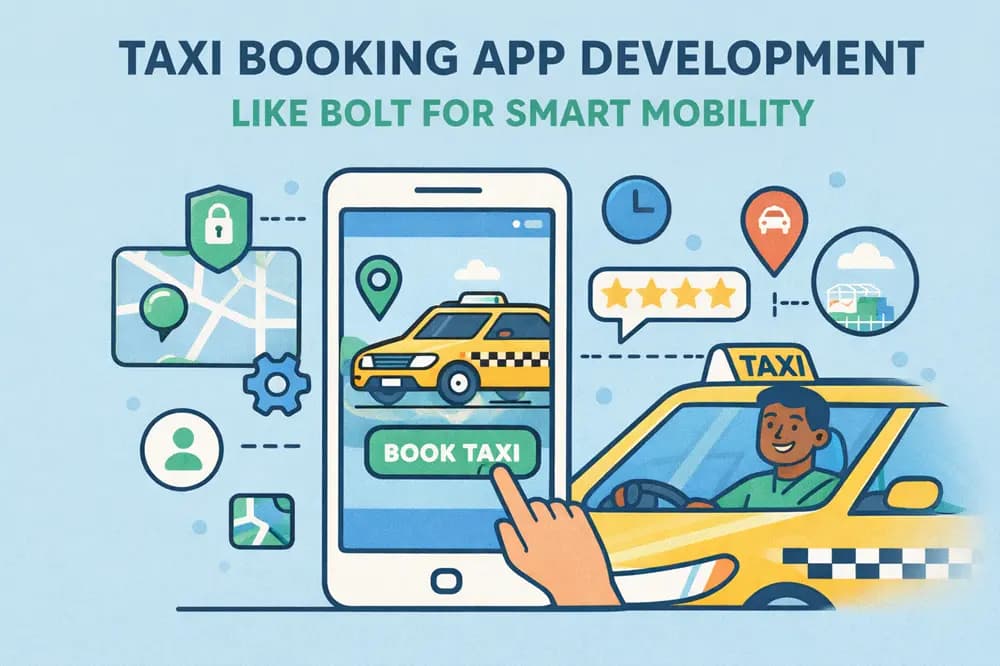
The era of smart mobility offers a taxi experience that is faster, safer, and more contextualized than ever before. The goal of a taxi experience in this new era is to offer users a near-zero friction experience from booking to drop-off to earnings. It is to offer taxi operators systems that maintain drivers employed, earnings consistent, and platform economics strong. Developing a product inspired by Bolt’s success is not just replicating product screens. It is building a business with a reliable technical stack, driver and rider pairing and mapping systems, financial systems to support payments, and operational tools to drive a live marketplace experience. The goal of building any taxi experience today is to reduce empty miles, offer fair and transparent pricing, and maintain informed and trusting relationships between riders and drivers every single time they open your app. This guide aims to describe to teams how to build a taxi booking app from strategy through safety and regulatory considerations and onto a development and launch process with practical detail to paste directly onto your company website.
The rise of smart mobility and on-demand taxi platforms
It has seen dramatic changes, from the expectation of on-demand access to urban mobility services to the evolution of how such services integrate into the larger urban transport ecosystem. As seen on the demand side, consumers are attracted by the on-demand nature of such services, hoping to benefit from the convenience of instant access, clarity on pricing, and ETAs. On the supply side, the taxi operator must ensure the efficient dispatch of drivers, enable them to earn more money, and plan downtime management, or else the whole taxi platform may not become successful. As of today, the taxi platform has access to many options, such as riding on public transport, economy, premium, and shared rides, while the rider can select the type of taxi at their disposal on the single screen. The need of the hour is to enable the taxi operator to measure each ride as a unit of value and maximize the value of each rider and driver on the platform.
Also Read: - Top 7 Features Every Taxi Booking App Should Include
What makes a successful taxi app today
The User Experience is the area of competition for taxi platforms. This starts with a smooth signup experience, short and predictable ETAs, fair price quotes, and transparent cancellation and refund policies. Users would also appreciate profiles of drivers and safety measures, and drivers would want a seamless signup experience, predictable acceptance times, and a system for managing their earnings. If you are planning on creating an app that hopes to become a competitor of Bolt, you will need to investigate the experience for both sides of the equation. This includes surge pricing that is fair for both the consumer and the developer, something that is fair but also transparent. As development teams consider creating an app for creating a Bolt clone, there are many factors that are a part of the development experience. The initial experience considers what is essential for a positive experience on the app, such as rapid pay, precise arrival times, and real-time support, rather than creating a laundry list of "bells and whistles" for the app.
Core architecture and real-time systems for scale
The foundation of high-traffic taxis is based upon a highly available architecture. Event-driven architecture enables ingestion of thousands of GPS updates per second. It includes various services like geospatial indexing, state management, and fare calculations. For user-based reads and writes, stateless APIs are utilized. During peak hours, these scale horizontally. In addition to this, stateful scoring and match makers maintain the real-time state of every individual trip. For high availability, various teams should innovate and come up with domain isolation strategies like matches, billing, notifications, and maps. Moreover, thinking along idempotent lines regarding various APIs ensures that there are no bookings being made due to networking retries. In addition to this, there are durable queues to process various match requests due to sudden peaks. For ensuring high availability, there is a need to innovate and come up with traces, metrics, and monitors. It enables tracing the flow from booking to payout.
Must Read: - How Much Does It Cost to Develop a Taxi App Like inDrive?
Matching, routing and driver supply optimisation
One of the key matching systems for achieving an efficient taxi service is having a great matching system. This ensures that the rider has a minimized waiting time, and the driver has minimized idle time. Achieving this balance between fair and efficient matching has driven the development of new matching technologies. Rather than relying solely on geospatial indexing, contemporary matching technologies are leveraging predictive modeling to identify where future demand will emanate in real time. This has been an essential tool for developing and promoting new incentive programs to accurately position drivers and seed supplies in the right locations. Furthermore, it has been crucial for developing routing algorithms that are intelligent and optimized for driving efficiency. These routing algorithms are essential for reducing time and fuel consumption, and for improving the earnings for drivers per hour driven. In developing a similar Bolt service for an app development plan, it has been crucial to develop an intelligent matching engine with modularity to facilitate experimentation with matching algorithms.
Payments, wallets and surge pricing economics
Payment flows are where the economics of the platform really come alive. Improving wallet functionality makes refunds, promotions, and small-denomination payments easy and intuitive, rather than getting in the way of completing a transaction. Offering multiple payment options, such as card, local wallet, and bank transfer, helps conversion in markets with differing user habits. Surge pricing should not be a gambit but rather a market signal: using the surge indicators and rounding properly to help users make sense of the pricing. Payment reconciliation should also be very accurate: each ride needs an entry on the ledger for the driver payout, the service fee, taxes, and promotions. Payment orchestration should also ensure driver economics are properly managed with a clear cadence and the ability to provide instant payout options for a small fee. Where build options are being sought for a more practical build, an experienced taxi software development company will usually recommend that the payment gateways are abstracted to facilitate changing payment processors with a team focused on merchant and compliance issues.
Also Read: - How Much Does It Cost to Develop a Cab Booking App Like Cabbazar?
Safety, compliance and trust feature that matter
For any scaled-up taxi platform, safety and regulatory compliance are a given. Safety features should be visible to riders and drivers alike: in-app real-time trip sharing with trusted contacts, an in-app emergency button linking to local authorities, and driver background checks with documented verification steps. Compliance demands vary by region-some cities require reporting trip data for congestion pricing, while others call out specific driver insurance coverage or fare caps. The platform needs to make auditable logs of all trips available, driver onboarding steps, and KYC verifications to satisfy regulators. Building trust also requires a fair review and dispute system, a transparent approach to cancellations, and clear, responsive customer support. Platforms that bake these practices into their roadmap avoid costly regulatory friction and build durable reputations among both riders and partners.
Designing for cost, speed and iterative development
Of course, balancing speed to market with technical quality is more of an art form than a science. If the goal is to speed to market and validate the concept of the marketplace, teams can often focus on the core flows of the application – the ride booking, the matching of the driver, the payments, etc., and save the advanced features of the system for future development. As such, many software developments company are sought by founders of marketplaces looking to create a strong MVP with many handover opportunities for the long-term running of the application. It again stresses the importance of the development methodology being more modular – well-defined APIs, almost a sandbox environment for the onboarding of the driver, and the integration of third-party services such as maps and SMS to speed the tempo of the development and deployment of the application.
Must Read: - Building an App Like Rapido, Uber, or Ola: Development Cost & Features
Why partner with Dinoustech
The choice of the right partner is what will determine the speed at which your idea translates into a reliable product. Dinoustech offers experience with real-world marketplace nuances, payment integrations, and live architecture required of a taxi platform. It is always important to partner with someone who has experience in a domain. This ensures you do not do unnecessary work. Partner with people who do not just build apps for riders and drivers but also have experience building operational dashboards, automated reconciliation tools, and live architecture. The right partner will help you develop a product roadmap that fits your feasibility curve and regulatory requirements, including options to scale from MVP to a feature-complete product with cost and KPI milestones.
Launch plan, growth and the 12-month roadmap to scale
The approach to market will be practical, beginning with a city-level pilot that will test and validate the match logic, incentives, and payments. The ideal pilot will consist of a few groups of vehicles and will have limited geography so that control is achievable. It will use the initial results to improve the effectiveness of driver acceptance, enhance ETA, and modify surge. The expansion is not only marketing-oriented, but also product-oriented, where marketing will focus on local commuters, optimize the onboarding experience, reduce time-to-first trip, and explore potential revenue incentives like loyalty/subscriptions. At the same time, the operational live capability will be designed so that operations management will not have any adverse experience when handling unexpected issues like incidents, disputes, or high-demand surges. Product, operations, and marketing will be the perfect mix for a successful urban mobility service built on an effective pilot.
Final thoughts
Developing a taxi app that can compete with the most effective is essential, requiring a laser-like focus on user experience, operational efficiency, and fiscal discipline. Every bit of the critical infrastructure, from definitive match engines to robust payment processing, requires graceful scalability as the marketplace increases. Key trade-offs, including a modular approach, phase development, and transparent surge pricing, allow development teams to validate initial hypotheses while working towards universal service offerings. For founders and product leaders seeking a partner that can bring their vision to life, working with a specialist Taxi Software Development company that understands local market complexities, regulatory requirements, and technical considerations is key. By executing a well-planned approach, a taxi app can transition from a small pilot to a citywide platform that users depend on and driver’s support.