Dinoustech Private Limited
What Are the Most Important SEO Ranking Factors Today?
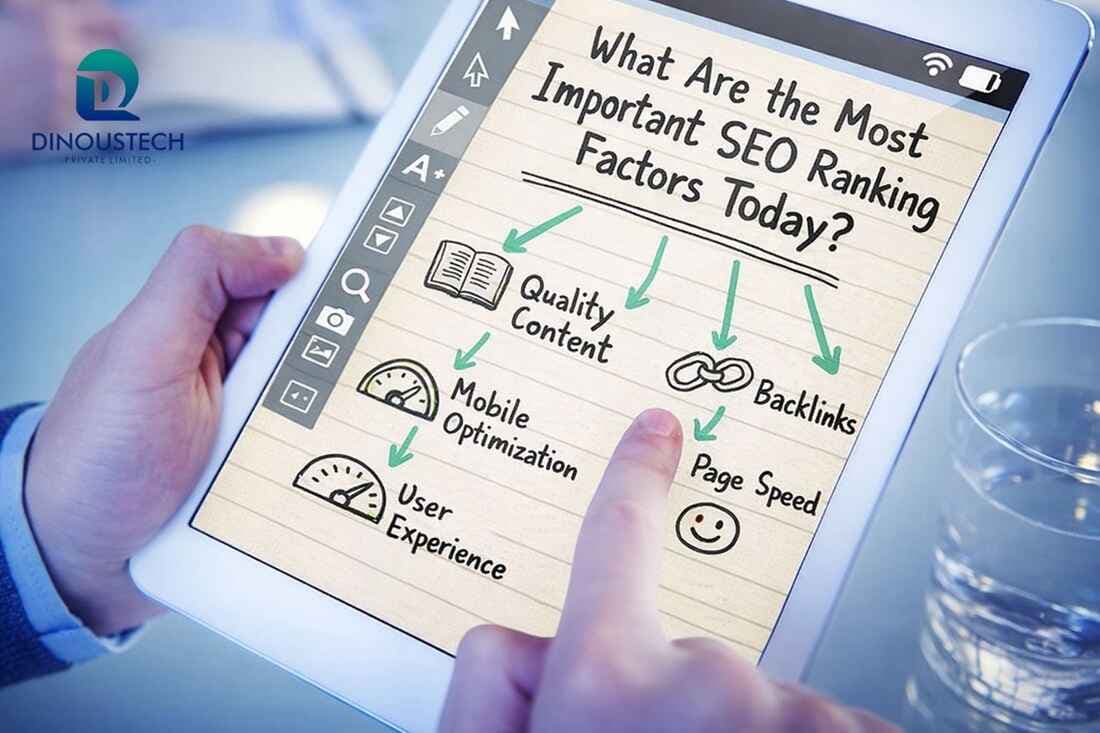
Search engine optimization, or SEO, has undergone a radical transformation in the past ten years. What was once a bag of tricks and keyword manipulation has evolved into a sophisticated field that combines content, user experience, technical expertise, and brand elements. Search engines such as Google are working tirelessly to improve their algorithms to favor websites that are genuinely useful to their users, easy to use, and trustworthy. This article will outline the key SEO factors and demonstrate how businesses can combine them into a comprehensive digital marketing strategy.
The Evolution of SEO and Why It Matters
SEO in the current era is all about addressing real-world problems. In the past, it was a common practice to write short and repetitive content in order to rank higher and create backlinks in bulk. However, this is not the case anymore. Today, search engines take into account the quality of content, user satisfaction, technical optimization, and brand reputation while displaying results for a search query. Companies that understand the change and focus on a well-rounded strategy of content, development, and digital marketing will experience more consistent organic traffic and conversions compared to those who rely on quick fixes.
Content Quality: Still the Foundation
The most critical element of long-term SEO success is high-quality content. Content that answers user questions in a clear and authoritative way, references credible sources, and is organized in a way that is easy to read will outperform content that simply repeats keywords. Quality content is more than long enough; it is also relevant, organized using headings, and designed to fulfill a particular search intent. When content is created with the user in mind, it will inevitably drive engagement, social sharing, and links, which are all signals that search engines look for when ranking pages.
Matching Search Intent
It is important to understand why a user types a question into a search box. The search intent can be broadly classified into categories such as informational (looking for an answer), navigational (looking for a specific site), commercial (researching a product), and transactional (buying). The content that is more aligned with the intent of the user will perform better. For instance, a how-to article will perform better for informational searches, and a product comparison article with calls to action will perform better for commercial or transactional searches. Agencies and consultants are increasingly creating content maps to align topics and pages with the intent of the user.
E-E-A-T: Experience, Expertise, Authority, Trust
E-E-A-T, which stands for Experience, Expertise, Authority, and Trust, is a new and important concept in the assessment of content quality by search engines. Websites that demonstrate real-world experience and expertise, and that use transparent sources, are ranked higher. The inclusion of author profiles, use of reputable sources, and publicly available business information all improve E-E-A-T. Reviews, testimonials, and mentions in reputable sources also help to improve E-E-A-T. For businesses trying to establish a long-term presence in search engines, improving E-E-A-T is a critical goal.
Website Speed and Core Web Vitals
The speed of pages and the new set of metrics called Core Web Vitals are very important for ranking and user experience. A slow-loading page is frustrating to users and results in a higher bounce rate, which can negatively affect rankings. Core Web Vitals assess the loading, interactivity, and visual stability of a page. Optimizing image sizes, using optimized front-end code, compressing data, and using good hosting services are some ways to optimize Core Web Vitals. There is a need for coordination between developers and SEO professionals to make sure that the design and functionality of the page do not affect the loading speed and stability.
Mobile-First Indexing and Responsive Design
The majority of users are accessing the web through mobile devices, and therefore, search engines will give priority to the mobile version of the website when they are indexing and ranking the website. If the website is designed in such a way that it is functional on desktop but not on mobile devices, then it will not perform well in the current mobile-first world. Mobile optimization should be done during the design and development phase.
Technical SEO: Crawlability and Indexing
Technical SEO is the foundation of all other SEO. Without the ability for search engines to crawl and index your pages, your content will never be able to rank. Having a well-organized sitemap, robots, canonicals, and structured data mark up your pages to help search engines understand and index your content. Basic technical SEO hygiene includes fixing broken links, preventing duplicate content, and using secure HTTPS.
On-Page Optimization: Clarity and Relevance
]On-page SEO practices are still relevant in terms of indicating relevance to search engines. The use of title tags, meta descriptions, header tags, and image alt tags should be done in a clear manner and should accurately describe the content of the page. The placement of keywords should be done in a natural way and should not be over-optimized. Internal linking of pages that are related to each other is useful in helping users and search engines access deeper pages.
Backlinks and Off-Page Signals
Backlinks remain a powerful signal of authority. Links from credible and relevant sources are akin to “votes of confidence.” But the quality and relevance of links cannot be overstated; a few quality editorial links are worth much more than a large number of low-quality links. Contemporary link building strategies focus on creating content that is link-worthy, building relationships with industry publications, and carrying out authentic link-building activities. It is crucial to avoid link schemes to avoid penalties.
User Experience and Engagement
Search engines track user behavior on a website. Time on page, pages per session, and click-through rate are examples of metrics that give search engines an indirect idea of the quality of the content. A positive user experience is the key to encouraging users to return to the website and browse other pages, which is a sign of quality to search engines. A clean layout, readable fonts, easy navigation, and accessible content are all factors of a positive user experience that search engines and users value.
The Role of Web Development in SEO
Web development is not something that happens independently of SEO; it is actually a part of it. The decisions that are made in terms of front-end and back-end development impact the speed, accessibility, security, and serving of content to crawlers. A developer who has knowledge of SEO can develop optimized templates for performance, use structured data, and develop scalable systems that can support changing content strategies.
Social Media and Its Indirect SEO Value
While social media signals are not considered direct ranking factors, social media sites help increase reach and create brand awareness. Content that performs well on social sites can drive organic traffic, increase engagement, and help improve the likelihood of acquiring links from other publishers. A comprehensive marketing approach that incorporates SEO, social media, and paid media efforts can help increase the reach of content and expedite the discovery of valuable pages.
Local SEO and Google Business Profile
For companies that serve customers in the local area, local SEO is very important. By optimizing a Google Business Profile, making sure that the name, address, and phone number (NAP) is consistent across business listings, and encouraging customers to leave reviews, companies can increase their visibility in local search engine results pages. Local pages that showcase location-based services, along with regionally relevant content, help search engines connect customers with local businesses. For many small to medium-sized businesses, local SEO is the source of the most direct and measurable organic conversions.
Content Freshness and Ongoing Updates
Search engines favor content that reflects current information and active management. Updating articles on a regular basis, adding new information, and re-publishing better versions of the content indicates that the site is actively managed and current. Content audits can be used to determine which pages of content need to be updated versus which pages need to be retired or merged. Regular content reviews ensure that evergreen content is up-to-date and that topic content is current with the latest information in the industry.
Voice Search and Conversational Queries
Voice search is revolutionizing the way people structure their queries. The nature of voice search queries, asked from virtual assistants, tends to be longer and more conversational than web searches. To optimize for voice search, one needs to learn how to answer direct questions in a conversational manner, employ FAQ pages, and organize content in a way that allows for easy extraction of short answers. Semantic SEO, which emphasizes topic coverage and context over keyword precision, is useful for optimizing content for conversational searches.
Structured Data and Rich Results
This is because structured data allows search engines to better understand the content of a webpage and can enable features such as rich snippets, knowledge panels, and FAQ pages. By adding schema markup for articles, products, local businesses, events, and FAQs, click-through rates can be improved because search engine results will be more informative and appealing. Although structured data does not guarantee rich results, it gives search engines more context about the content.
Analytics, Measurement, and Continuous Improvement
Accurate analytics are a must-have for contemporary SEO. Monitoring organic traffic, conversion funnels, user behavior, and keyword data gives the feedback loop necessary to optimize. Data-driven SEO employs experiments, A/B testing, and cohort analysis to ascertain what works to actually move the needle. This helps SEO teams quickly identify changes in algorithms, technical degradation, and content gaps so they can address them with targeted solutions.
Accessibility and Inclusive Design
Websites that are accessible tend to perform better for users as well as search engines. When content is written in a way that is accessible, it reaches a larger audience. Search engines also favor content that is clear and well-structured. Therefore, designing websites with accessibility in mind is often the best approach when it comes to SEO.
Security, Privacy, and HTTPS
Security is a basic trust indicator. HTTPS is the minimum requirement for search engines and for users. Secure handling of user information is an important trust factor for search engines, and websites that handle user data securely will be less vulnerable to search engine algorithm changes. HTTPS, secure authentication, and privacy policies are all important for search engine ranking resilience.
Conversion Rate Optimization and SEO Alignment
SEO should not be measured solely on traffic numbers; conversions and business results are important too. Integrating SEO with conversion rate optimization (CRO) ensures that the organic traffic funneled into the site has a better chance of being converted into customers. Calls-to-action, simplified forms, quick checkout processes, and trust elements are all part of a comprehensive approach that converts visitors from discovery to decision.
The Importance of Brand Signals
Brand mentions, branding consistency, and reputation management also impact long-term SEO success. Established brands tend to have higher click-through rates and tend to get more backlinks and direct searches, which in turn improve organic search visibility. Spending on broad digital marketing initiatives such as PR, content distribution, and social activities can help create brand equity, which is essential for organic search visibility.
How to Put These Factors Together: A Practical Workflow
A functional SEO process starts with research, such as technical audits, keyword and intent analysis, and competitor research. Then comes a prioritized strategy that combines fast technical fixes (such as repairing broken links or optimizing page speed) with longer-term projects (such as content creation and brand outreach). Ongoing analysis, content refinement, and collaboration between development, design, and marketing teams keep the program on track with business goals. The best returns on SEO investments come to agencies and in-house teams that integrate their SEO efforts.
Why Choose Experienced Partners
For organizations that do not have the necessary expertise, teaming up with experts can help speed up the process. When you team up with a trustworthy partner, you can be sure that the technical aspects are well taken care of, content is written in a way that addresses the needs of actual users, and digital marketing platforms like social media and online advertising are integrated to maximize outcomes. If you are looking for trustworthy help in this area, an experienced Seo Company in Rajasthan can help you out.
The Long View: SEO as an Ongoing Investment
SEO is not a one-off activity but an investment that grows over time. The pages that rank well in search engines tend to continue to bring organic traffic for months or even years, as long as they are updated. This is why SEO is one of the most cost-effective methods of acquiring customers if done right. Companies that focus on continuous improvement and digital marketing tend to perform better than those that focus on SEO as a short-term activity.
Final Thoughts and Next Steps
The key SEO ranking factors that are currently most relevant to each other are: content quality, user experience, technical optimization, backlinks, and brand factors. A well-rounded SEO strategy integrates web development, content marketing, social media, analytics, and conversion rate optimization into a single strategy. For companies looking to implement SEO, researching good Seo Services in Rajasthan can be a good starting point for getting local assistance and industry-specific knowledge to help your business. For companies looking to grow faster, working with a reputable Seo Company in Rajasthan provides access to comprehensive services that align SEO strategy with overall digital marketing objectives.
If you would like, I can now turn this into a ready-to-publish blog post with meta title and description suggestions, internal linking map, or content calendar that aligns SEO topics with social media and email marketing campaigns. Dinoustech can also help with technical SEO analysis and optimization if you would like assistance from an experienced team.