Dinoustech Private Limited
How to Build a Fantasy Game App in 2026
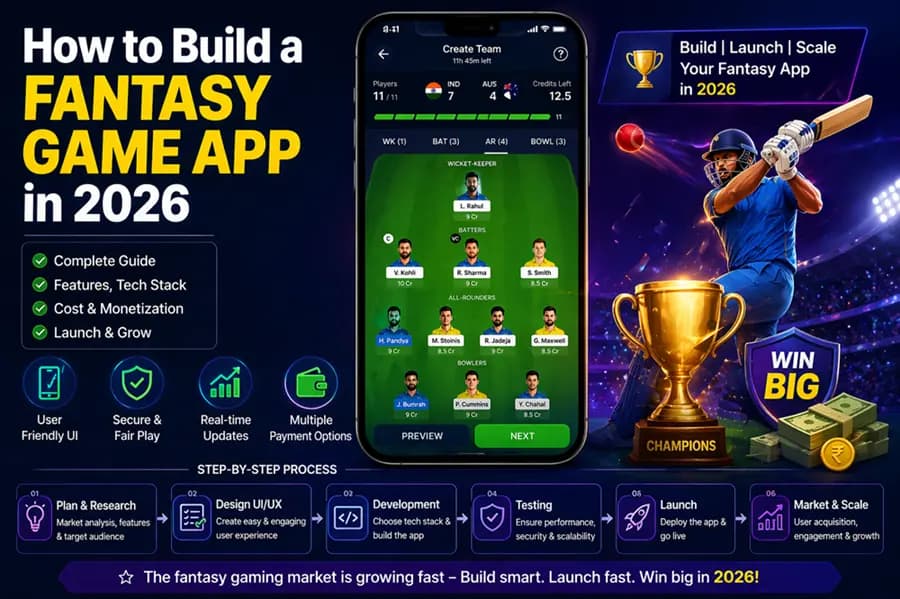
Building a fantasy game app in 2026 makes sense because the market is still growing and mobile users already understand the format. Grand View Research estimated the global fantasy sports market at USD 24,853.7 million in 2024 and expects it to reach USD 56,381.3 million by 2030. Mordor Intelligence estimated the India fantasy sports market at USD 1.82 billion in 2025 and USD 5.05 billion by 2030. In Asia Pacific, India held 57.62% of the market share in 2025, cricket generated 61.45% of revenue, and mobile applications accounted for 77.92% of engagement. That mix makes fantasy sports one of the clearest mobile-first product categories for 2026.
A strong fantasy sports app creation company will not treat this as a simple app project. It will treat it as a product that needs live scoring, contest logic, trust, retention, and scale. A fantasy game app should help users join contests quickly, track points in real time, and come back for the next match. The best software development company or mobile app development company will focus on the user journey first and the code second. That is what separates a useful app from a short-lived one.
Start With the Product Goal
The first step is to define what the app should solve. Some founders want a cricket-only MVP. Others want a multi-sport product with contests, wallets, referrals, and an admin panel. The goal should shape the build, not the other way around. If the team starts with screenshots and features instead of business goals, the scope grows too fast and the budget becomes harder to control. That is why a fantasy game app development company should start with planning, not coding.
A fantasy game app should have one clear first win. That could be joining a contest in less than a minute, creating a team with simple filters, or checking live rank changes without lag. A good fantasy game app development company will push for that clarity before it writes code. It will ask what the user must do in version one and what can wait for later. That approach keeps the launch lean and gives the business a faster path to feedback.
Also Read: - Grow Your Sports Business with Fantasy Sports App Development
Design a Fast and Clear User Experience
Users judge the app in the first few seconds. If onboarding feels long or the home screen feels crowded, they leave. The app should show upcoming matches, wallet balance, contest access, and the next clear action without making users hunt for it. Since mobile applications accounted for 77.92% of engagement in Asia Pacific in 2025, the design has to work perfectly on a phone screen and move smoothly with one hand.
The onboarding flow should stay short and direct. Users should sign up, verify, and get into their first contest with as little friction as possible. A mobile app development company should also make the interface readable under match-day pressure, because users often open the app close to the toss or before a deadline. Clear navigation, strong visual hierarchy, and simple language help the product feel easy from day one. Good UX is not about adding more screens. It is about removing confusion and helping users move with confidence.
Make Team Creation the Core Feature
Team creation is the heart of fantasy play. If this flow feels slow, the whole app feels weak. Users should be able to search players, compare credits, set captain and vice-captain choices, check roles, and confirm team balance with little effort. The screen should guide decisions instead of forcing users to think through every rule on their own. That makes the app feel useful rather than technical. A fantasy sports app creation company that gets this part right gives users a reason to return.
A strong fantasy sports app development company will also add filters, recent form indicators, and availability flags where they help the user. These small tools reduce mistakes and increase confidence. In a cricket-heavy market like India, users often build teams very close to match time, so speed matters. A clean team builder turns a casual visitor into an active user. It also increases the chance that the user will return for the next contest because the core action feels easy.
Must Read: - Most Important Features of a Successful Fantasy Sports App
Build Real-Time Scoring and Live Updates
Fantasy apps depend on live match data. Users want score changes, player events, and leaderboard movement while the match is still live. If the app lags, trust drops quickly. Socket.IO describes itself as a library that enables low-latency, bidirectional, event-based communication between the client and the server, which is the kind of setup fantasy scoring needs. Live updates should arrive without forcing the user to refresh the screen.
A fantasy sports app creation company should build a scoring layer that can receive sports data, validate it, and push it to users quickly. The system should also handle match pauses, delayed feeds, and score corrections without confusing the user. The app should feel active during a match, not delayed after it. That experience matters because users keep checking points during the game, and every update is part of the product value. A fantasy app development company that understands this will build around speed, reliability, and consistency.
Add Wallets, Payments, and Rewards Carefully
Money flow is one of the most sensitive parts of the app. Users need to add funds, join paid contests, withdraw winnings, and track history without confusion. The payment screen should show amounts clearly and confirm each step. If the app hides fees or gives unclear messages, users lose confidence fast. A fantasy sports app development company should build the wallet and payment flow so it feels safe and predictable.
Rewards also matter because they keep users engaged. Free contests, referral bonuses, first-deposit offers, and loyalty perks can drive repeat use, but only if the business can track them clearly. The app should record every transaction and tie reward to the correct user action. That keeps support load lower and reduces disputes. A mobile app development company that handles this well will make the app easier to scale and easier to trust. The payment and reward logic should feel invisible when it works and obvious when the user needs a confirmation.
Also Read: - How to Develop an IPL 2026 Fantasy Sports App?
Create an Admin Panel and Analytics Layer
A fantasy app is not only a user product. It is also an operations tool. The admin panel should let the business manage contests, users, payouts, content, banners, support tickets, and alert settings. If the admin side is weak, the team ends up depending on developers for small changes. That slows the business down and adds cost. A fantasy game app development company should treat the admin layer as a core internal product, not as an afterthought.
Analytics is just as important. The team needs to know which contests convert best, where users drop off, which screens get ignored, and which notifications bring people back. This is where the app becomes smarter over time. The more the business measures, the better it can improve pricing, retention, and product flow. A software development company that builds analytics into the first version gives the founder a stronger base for iteration. That is also how a fantasy sports app creation company keeps improving instead of standing still.
Secure the App and Plan for Scale
Security cannot come later. The app should use secure authentication, role-based access, encrypted data transfer, session management, and proper audit logs. OWASP’s API Security Top 10 2023 highlights risks such as broken authorization, while PCI DSS sets baseline technical and operational requirements for protecting payment account data. These standards matter because fantasy apps often handle money, identity, and live user actions in one platform.
Scale matters just as much. Grand View Research expects the global fantasy sports market to reach USD 56,381.3 million by 2030, and Mordor Intelligence expects the India market to reach USD 5.05 billion by 2030. That kind of growth means your app may face traffic spikes during big tournaments and peak match windows. The architecture should handle more users, more contests, and more live data without slowing down. That is why backend design, caching, and testing matter from the beginning.
Must Read: - Get a Readymade Fantasy App Like Dream11 or My11Circle Quickly
Follow a Clean Development Process
A good build process starts with planning, wireframes, and user flows. Then the team moves into UI/UX design, frontend development, backend development, integration, testing, and launch support. This order helps the project stay organized and reduces waste. When a team rushes to code before it defines the flow, the app usually needs more fixes later. That creates delay and extra cost. A fantasy app development company that follows a clear process usually delivers a better product with fewer surprises.
Testing should cover scoring, payments, login, notifications, and device behavior. The app must work under pressure, not only in a demo environment. A fantasy sports app creation company should also plan post-launch support because user behavior changes after real traffic starts flowing. Good teams do not stop at delivery. They keep watching the product, fixing bugs, and improving the next release based on actual usage. This is where a serious software development company proves its value over time.
Choose the Right Partner
The right partner should understand fantasy behavior, not only mobile coding. A fantasy game app development company should know how users think during a live match, how they build teams, and why they return after each game. It should be able to explain the roadmap in plain language and show how the product will grow after launch. That kind of thinking matters more than a low quote. A mobile app development company that thinks like a product team will usually deliver more value.
Dinoustech can fit into that shortlist as one of the software development company’s businesses may consider when they want practical delivery with product thinking. The best partner will help with strategy, design, development, testing, and long-term support. It will also keep the scope realistic and the build focused on users. In a market growing this fast, the winner will be the app that feels simple, fast, and reliable when the match is live. That is what a strong fantasy sports app creation company should aim for in 2026.
A fantasy sports app can succeed in 2026 if it solves a real problem, keeps the user journey simple, and uses live data well. The market is large, cricket still drives strong demand in India, and mobile use continues to dominate engagement. That gives founders a real opportunity, but only if they build with care. A good plan, a clean product flow, and a reliable tech stack will do more for success than a crowded feature list.