Dinoustech Private Limited
Fintech App Development Services in Nagaland: Key Benefits & Opportunities
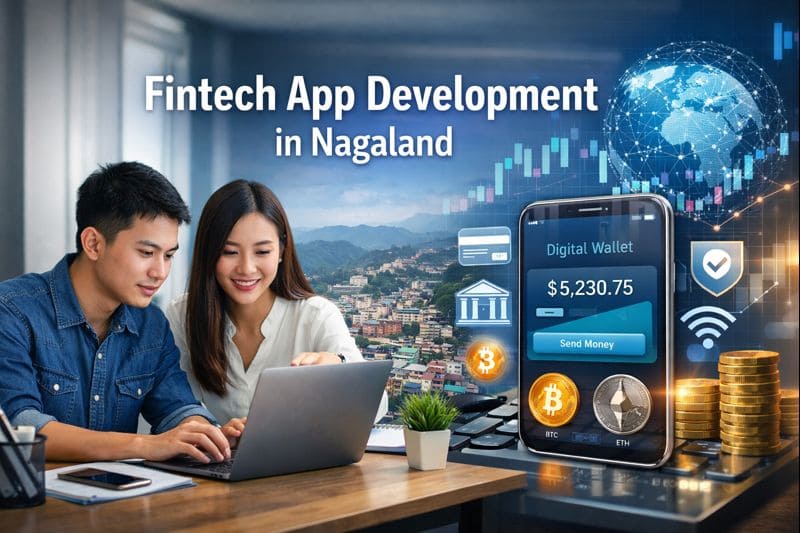
The fintech narrative in Nagaland is converging quickly. In the larger cities of Kohima and Dimapur, the use of smarter mobile devices is rising rapidly along with the demand for fintech products and services focusing on making life easier. In the district level cities of Mokokchung, Wokha, and Zunheboto (Zunheboto), the requirements of the market include the use of mobile banking facilities and basic accounting services. The topography and economic conditions of the state, including markets, small businessmen, seasonal migration, remittance services, tribal co-operatives, and micro enterprises, outline a compelling requirement for fintech products and services that are strong and adapted to the regional environment. Businesses in the region of Phek, along with the trade routes near Mon, and the transportation sector in Kiphire have a strong interest in faster payment processing and clarity.
This presents an excellent opportunity for fintech engineers in Nagaland because there appears to be an open space to build solutions immediately rather than educating an entire population from scratch. An astute fintech app development company in Nagaland can immediately validate their product in the market by targeting high-leverage problems: immediate merchant settlement, simplified remittance options, basic loan services for small merchants, or banking solutions for village cooperatives. For instance, Dinoustech can use their partnership models to arm their clients with these high-leverage options in Tuensang, Longleng, Peren, Tseminyu, while also holding a future ramp-up path for payroll services, lender services, or banking services.
Most important use cases: payment, banking, merchant solutions
The first fintech applications in the Nagaland state are in payments and banking functionality, which enable the elimination of manual, time-consuming cash handling. Sellers in the wholesale markets of Dimapur and in other business centers like Mokokchung are looking to have acceptance, reconciliation, and settlement made possible through QR technology, eliminating the inconvenience of cash collection, which takes a whole week. Citizens in Kohima to Phek are looking to have a secure banking mobile application that enables account transfer, bill payments, mobile recharge, and a transaction history. A simple merchant interface that allows synchronization of sales on a day-to-day basis and generates bills in local languages is a big help to most of the sellers in Mon and Kiphire. These are the basic elements on which other fintech services are further developed.
Apart from making simple payments, the automation of payroll and making payments to suppliers applies to businesses and cooperative institutions in the districts of Wokha and Zunheboto, where small organizations often use a pool of seasonal employees. The facilitation of money remittances, which cuts the cost and time involved in receiving payments sent across other Indian states to Nagaland families, particularly in the urban centers of Tuensang and Longleng, also has significant impact. The complete banking solution that combines saving, future payments, and rapid microloans will provide both businesses and the household greater financial resilience, but the solution needs to be designed to cope with the connectivity cycles, localized interfaces, and trusted cash-in/cash-out points.
Also Read: - Cost of Fintech App Development in Mizoram: Everything You Need to Know
Lending and Credit: Practical Product Development in Nagaland
The availability of formal credit is also limited to micro-enterpreneurs and traders, and fintech solutions would fill that need. Some workable solutions include a short-term cash advance to grocer shops in Dimapur, micro-loans to purchase seed and inputs for small farmers close to market centers, and a loan that is tied to their salaries, targeting micro-enterpreneurs in Mokokchung whose businesses might get stuck due to cash flow problems. Factoring is also a viable solution for small suppliers who cater to larger customers located in district centers, allowing a faster turnaround time on their receivables. Crucially, lending solutions have to remain prudent, appropriately priced, and include a push on financial literacy to micro-enterpreneurs to avoid falling into a debt trap.
Underwriting in such geographies with limited bureau data needs innovative strategies which utilize on-platform transaction data, mobile activity, community Gibbs factors, and cooperative guarantees. Collaborations with NBFCs/Cooperative banks, or forming marketplace lending models with the fintech company originating loans and funding provided through an institution, could ease balance-sheet risk for a new company, and validate unit economic models. Collection and repayment systems should factor in district calendars around festivals, crop cycles, and migration patterns influencing repayment capacities, hence grace period provisions in repayment and dynamic EMIs would help in making it more repayable. A fintech development company in this scenario can develop conservative models for pilots in specific districts like Phek or in Mon.
Banking app features and integrations that matter
Rather than being a simple balance-verification app, a good banking app for a state like Nagaland must know how to facilitate UPI, IMPS, and NEFT/RTGS transactions. It must also facilitate direct benefit transfers from government programs. It must use the best banking security. If the banking organizations in the region happen to be local entities, integration with regional cooperatives and micro-finance companies is important, given the desire of customers to use banking organizations that they know. Other banking functionality of the high-end type, which customers of banking apps in the state of Kohima and Dimapur would find useful, include scheduling, recurring billers, multiple accounts, investment or recurring deposits, and e-statement facilities.
Employees' payment APIs, large payment APIs, merchants' payment APIs, as well as payment recharge APIs, are also required by the business-to-business clients in Wokha and Zunheboto. Furthermore, support for utility bill payment APIs generally utilized in Nagaland would ease the process of adopting the consumer app. Since connectivity can be fluctuating in hill districts, it would be beneficial to include push notifications as well as SMS fallback options for OTP notifications. Moreover, a store and forward system must be included for dequeuing transactions when connectivity returns. A fintech app development company in Nagaland or an expert company such as Dinoustech will be able to incorporate all these services into their app architecture to sustain both the customers of Dimapur as well as those in the rural areas.
Must Read: - Fintech App Development Services in Meghalaya: What You Should Know
UX, localization, and accessibility: designing for real users
User Experience is a key factor that assures or dashes the hopes of implementing fintechs within areas that may consider smartphone applications as a novel phenomenon, especially for first-time users. For example, in Nagaland, it is important to ensure that these applications are built keeping local languages in mind, along with larger touch areas, to ensure that there is a step-by-step onboard process, particularly for older individuals as well as shop owners in Mokokchung or Peren. For those who are sellers, a single-screen dashboard per day that displays net-settlements, pending payouts, and a “report issue refund issue" option would decrease calls to support.
Accessibility also needs to incorporate offline facilities, like balances with the pending indicator, payments, and agent codes for cash-in/out. Many settlements in the Nagaland State have people who prefer person-to-person contacts, meaning that the app needs to allow the escalation of complaints to the field agents or the support staff at the district level. The trust indicators, such as the display of the fees, the verified merchant mark, and the display of the security tips, help to promote online payments in towns like Tuensang, Kiphire, and Longleng. The role of apps like Dinoustech, a mobile app development firm in India, cannot be overemphasized regarding the usability tests.
AI Implementation: practical uses for match rate, risk and personalization
AI is not a nicety, and by implementing it judiciously, it becomes the catalyst that enhances both the usage experience and the risk management process. For example, using highly advanced credit scoring systems, micro loans could become reality for the merchants of Dimapur and Kohima by integrating payment histories, periodic patterns, and social/agent-nodal validation, especially where the bureaus are not populated with sufficient data. Applying fraud detection algorithms that train on local patterns minimizes the chances of false positives and actual losses generated during festivals or market days. The personalization engines recommend appropriate financial services, such as saving schemes or financier/insurer products, based on usage patterns.
Chatbot & voice assistants in local Naga languages will substantially reduce customer care costs and enable instant assistance in balance inquiries, EMI calculations, and dispute resolution. AI will aid in automation tasks like KYC document OCR scans, merchant reconciliation automation, and outlier detection in irregular payouts. An expert fintech app development company needs to implement AI in a staged manner in their applications: start with fraudulent activity detection and automated reconcilement, and follow up withRisk Rule-Based Underwriting Models, while human oversight in borderline scenarios is necessary to uphold fairness.
Also Read: - Fintech App Development in Manipur: Trends, Opportunities & Challenges
Security, compliance, and regulatory readiness
Security and compliance are essential. If fintech businesses are to operate in Nagaland, they should adhere to overall Indian standards: secure authentication, storage should be done in an encrypted form, and in cases when payment cards are involved, they should comply with PCI DSS. If they form partnerships in Nagaland with banks and non-banking financial corporations, they should also include additional audits. For remittances and cross-regional payments, record maintenance in transparent form will be helpful.
Finally, regulatory compliance includes consumer protection. This includes visible terms and fees, as these are important to consumers who may be accessing financial services for the first time in the digital world. If fintech firms are involved in lending, there are minimum standards in the disclosure of information, in the use of data, and in accessing customer information. There is a need to develop secure CI/CD pipelines and role-based access controls as a fintech software development company or local partner to be able to monitor for anomalies. Dinoustech encourages upfront compliance as a product and to connect to formal financial partners.
Partnerships, Agent Networks and Last-Mile Liquidity
Agent networks or the cash-in, cash-out agreement are the adoption mechanism in the regions where the cash economy is prevalent. Trusted LSP centers or cooperatives in the towns of Mon, Phek, Zunheboto can act as on-ramps for deposits or off-ramps for the withdrawal amount, since the trust factor helps initiate the uptake in digital transactions among the users having the hybrid flow model. Linkage with the telecomm department or the banking departments helps ensure the smooth flow of OTPs along with the telecomm department. Collaboration with the NBFC or the cooperative banking system helps the lending programs scale the underwriting.
The need to implement and manage liquidity among agents calls for treasury operations and forecasting to maintain a constant float at local stations. Agent training, use of basic reconciliation platforms, and payment of commissions on time builds a strong last-mile infrastructure. To expand beyond districts, such as transitioning beyond Kohima to Tuensang and Longleng, a reliable agent enrollment and audit mechanism accelerates scale-up. An experienced fintech app development firm in Nagaland would incorporate designs and work flows that turn agent networks into a strong point, not a weakness.
Must Read: - Turn Your Fintech Idea into Reality: Build Your Own App in Maharashtra
Monetization, biz models & go-to-market strategies
Monetization in Nagaland should be based on value created. The fees for acceptance, membership plans for enhanced merchant dashboard services, convenience fees for instantaneous payouts, and share of revenue in the lending business are realistic levers. Consumer engagement businesses such as high-interest savings instruments or rewards in incentives for referrals could raise ARPU. B2B businesses like cooperatives, institutions, and organizers of events could be addressed through customized pricing for group payouts and reconciliation. Educating the market and pricing are essential in order not to create resentment, particularly in price-conscious market segments like in Mokokchung and Peren.
The go-to-market strategy should balance pilot launches in major and dense areas—starting with either Dimapur or the state capital Kohima to test the core flows—and then enter the other districts around these areas, once the product and the agent playbook have been tested and proved to be working. Field development and vernacular support and rewards for the first digital transaction would help form the habit loop pattern. Unit economic metrics need to be constantly tracked—you should know the take rate, CAC, activation rate, and credit loss numbers—and adjust your monetization approach accordingly. The typical development path advised by Dinoustech for their clients would be to start launching one and then scale up as the metrics support it.
Why choose Dinoustech or the right partner and next steps
More than engineering goes into building fintech solutions that really work in Nagaland: there are field empathy, regulatory discipline, user-first UX, and a practical operations playbook for agents and liquidity. A Nagaland-based fintech app development company or a national partner like Dinoustech can bundle product strategy, secure engineering, AI experience, and operational support in one package. That usually means an MVP-first engineering sprint alongside a local pilot and an agent network playbook, with a phased AI roadmap focused on fraud and conservative underwriting. In this way, it reduces risks while still being able to make the product progressively develop based on real user data.
This would involve defining a core use-case-payments-first, lending-first, or an embedded banking play-then choosing a pilot geography (Dimapur for commerce, Kohima for consumer adoption, Phek/Mon for markets and cross-border flows), developing a lean MVP, and being prepared for agent and bank partnerships. Measuring early metrics, iteratively working on UX and onboarding, and further expansion via disciplined feature rollouts. Of course, the right partner, clear focus, and good operational readiness may create the keys for fintech applications to unlock significant economic inclusions and efficiencies across towns and districts of Nagaland, making local commerce more transparent, faster, and resilient.