Dinoustech Private Limited
How AI Is Transforming Taxi Booking App Development in 2026
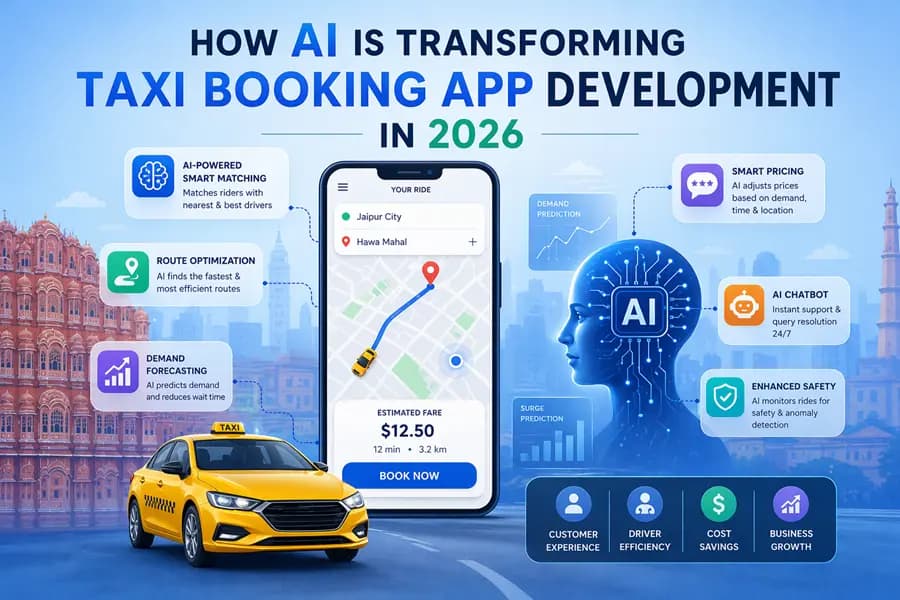
AI is changing taxi booking app development in a practical way, not just a buzzword way. The ride-hailing market is still large and growing, with Grand View Research estimating the global market at USD 55.07 billion in 2026 and the India market at USD 2.51 billion in 2025, rising to USD 11.06 billion by 2033. Technavio also expects the AI in transportation market to increase by USD 6.68 billion from 2025 to 2030, at a CAGR of 19.9%. That growth explains why every serious taxi app now needs smarter matching, better routing, and faster decision-making built into the product.
For a taxi app development company, this shift changes the build itself. The app no longer needs only booking screens and payment flows. It needs prediction, automation, and real-time control. A taxi booking app creation company that uses AI well can cut friction for riders, improve earnings for drivers, and help the business run with less manual work. That is why a software development company or mobile app development company that understands AI is now better positioned to build taxi products that feel faster, safer, and easier to scale.
AI Makes Dispatch Faster and Smarter
Dispatch used to depend on simple rules and manual control. AI changes that by looking at rider location, driver availability, live traffic, trip distance, and demand patterns at the same time. Google Maps Platform says its transportation solutions help power rides and deliveries with detailed geospatial data, predictable pricing, and dynamic tracking of fleets, assets, and devices. That kind of location intelligence gives taxi apps a better base for automated dispatch and faster ride allocation.
This matters because users judge a taxi app by how quickly it finds a ride. If dispatch is slow, users leave. If it matches the right driver quickly, the app feels reliable. A taxi app development company that builds AI-based dispatch can reduce idle time for drivers and reduce waiting time for riders. That makes the platform more efficient on both sides. In 2026, a strong taxi booking app creation company should treat dispatch as a live optimization problem, not a simple database lookup.
AI Improves Ride Matching and Pickup Accuracy
A taxi app works best when it matches the right rider with the right driver quickly. AI helps by comparing proximity, route direction, service type, trip urgency, and historical behavior. Google Maps Platform’s ridesharing and on-demand solutions are designed to improve the driver and customer journey from booking to arrival, which shows how much modern mobility apps depend on accurate geospatial logic. The better the match, the less the app wastes time and fuel.
This also improves pickup accuracy. In ride-hailing, a small location error can create a bad user experience and delay the trip. Google’s case study with mytaxi reported arrival-time accuracy improved by up to 48% and ride durations dropped by 4% after using Google Maps Platform ridesharing tools. That kind of result shows why a mobile app development company should care about location quality, pickup points, and route precision from the first sprint. Better pickup logic creates better ratings, fewer cancellations, and fewer support issues.
Predictive Demand Helps the Business Stay Ahead
One of the most valuable AI features in taxi booking app development is demand forecasting. AI can learn where bookings rise, when peaks happen, and which zones need more drivers. IBM describes AI forecasting as a way for transportation companies to predict bookings and cancellations and adjust operations in response. That makes the platform more proactive instead of reactive.
For a taxi app development company, this means better fleet planning and fewer missed ride opportunities. Drivers can be moved toward busy areas before demand spikes, not after it starts. That helps the app handle airport rushes, office hours, weekends, and event traffic more smoothly. An affordable software development company that builds AI demand models into the product can help the business use fewer resources while serving more rides. In 2026, that kind of forward planning is not a nice extra. It is a core business advantage.
AI Helps Pricing Stay Fair and Flexible
Pricing is one of the most sensitive parts of a taxi app. Riders want fairness. Drivers want good earnings. The business wants balance. AI helps by studying live demand, traffic, available supply, and route conditions to adjust pricing more intelligently. Google Maps Platform says ride and delivery solutions can support predictable pricing while also improving operations, which shows the value of combining pricing with live location data.
That matters because pricing has to feel understandable, not random. A taxi booking app creation company should design pricing logic that responds to real demand but still explains the final fare clearly. If the app raises prices during busy hours, it should also show why. That transparency helps trust. A mobile app development company that uses AI for pricing should aim for a system that protects margins without frustrating users. In a market that continues to grow, businesses that handle pricing well can improve conversion and keep drivers more active.
Safety and Fraud Detection Become Stronger
Safety matters more in taxi apps than in many other mobile products because the platform connects strangers in the real world. AI can help by spotting unusual booking behavior, repeated cancellation patterns, suspicious payment actions, or location mismatches. It can also support better verification and trip monitoring. Google Maps Platform’s ride-hailing solutions emphasize a smoother journey from booking to arrival, and that journey becomes stronger when the system can detect problems early.
A taxi app development company should use AI to reduce risk without making the app feel heavy. That can mean real-time alerts, trip sharing, better driver and rider validation, and support flags when something looks wrong. In 2026, users expect more than convenience. They expect confidence. A software development company that builds safety logic well helps the platform reduce disputes and strengthen trust. That trust matters because users book faster and return more often when they feel the app takes safety seriously.
AI Improves Driver Experience and Fleet Efficiency
AI is not only for riders. It also helps drivers make better decisions and use their time more efficiently. Google Maps Platform says transportation solutions can dynamically track fleets, assets, and devices, which gives operators better visibility into vehicle movement and availability. That kind of system can help drivers spend less time waiting and more time on trips.
This is important because driver satisfaction affects platform supply. If drivers get too many low-value trips or too many empty gaps, they leave. AI can help balance work by guiding drivers toward better zones and better time windows. A taxi booking app creation company that focuses on fleet efficiency can improve service quality without increasing manual oversight. That also supports operational stability for the business. In a competitive market, the app that helps drivers earn better and move smarter will usually keep stronger supply.
AI Makes Customer Support Faster and More Useful
Taxi apps deal with repeat questions. Users ask about booking status, fare issues, route changes, cancellations, refunds, and driver communication. AI-powered support tools can reduce response time by handling common questions instantly and sending complex cases to the right human agent. That does not replace support teams. It makes them faster and more focused.
A taxi app development company should also use AI to improve communication during the trip. Automated messages can confirm the booking, update ETA, explain delays, and guide the rider to the pickup point. Google’s ride-hailing examples show how accurate navigation and clear journey visibility improve the user experience. In 2026, a mobile app development company should treat support as part of the product, not as a separate function. When the app answers clearly and early, it avoids friction before it becomes a complaint.
AI Changes the Tech Stack and Product Roadmap
AI also changes how a taxi app gets built behind the scenes. The product now needs cleaner data, better event tracking, stronger cloud infrastructure, and model monitoring. A taxi app development company cannot just launch a front end and hope the backend keeps up. It needs pipelines for location data, trip data, pricing data, and behavior data. IBM’s AI forecasting and predictive monitoring material shows why real-time data and model-driven decision support matter for operations that must react quickly.
That changes the roadmap too. A taxi booking app creation company should plan for AI features in phases. The first release may include smart dispatch and route optimization. The next one may add forecasting, fraud detection, or support automation. A software development company that thinks this way can keep the app lean at launch and still build toward smarter capabilities later. This is also where partners like Dinoustech can fit into the conversation as one of the software development companies that focuses on practical delivery with room for AI growth.
What a Strong AI Taxi App Looks Like in 2026
A strong AI-powered taxi app in 2026 should feel simple to the user and smart to the business. The rider should book quickly, see a clear fare, track the driver accurately, and get support when needed. The driver should see better trip matches, fewer dead zones, and clearer earnings. The business should get stronger dispatch, better demand planning, safer transactions, and more control over supply. That full stack is what AI can improve when it is used well.
The market supports this direction. The ride-hailing sector still has strong growth, India remains a major market, and AI in transportation keeps expanding because businesses want better efficiency and more reliable service. A taxi app development company that ignores AI will struggle to keep up with user expectations. A taxi booking app creation company that builds AI into routing, dispatch, pricing, safety, and support will have a better chance of winning in 2026. The real advantage comes from using AI to reduce friction at every step of the ride.