Dinoustech Private Limited
Launch a Fantasy App Like MyMaster11: Development Strategy for 2026
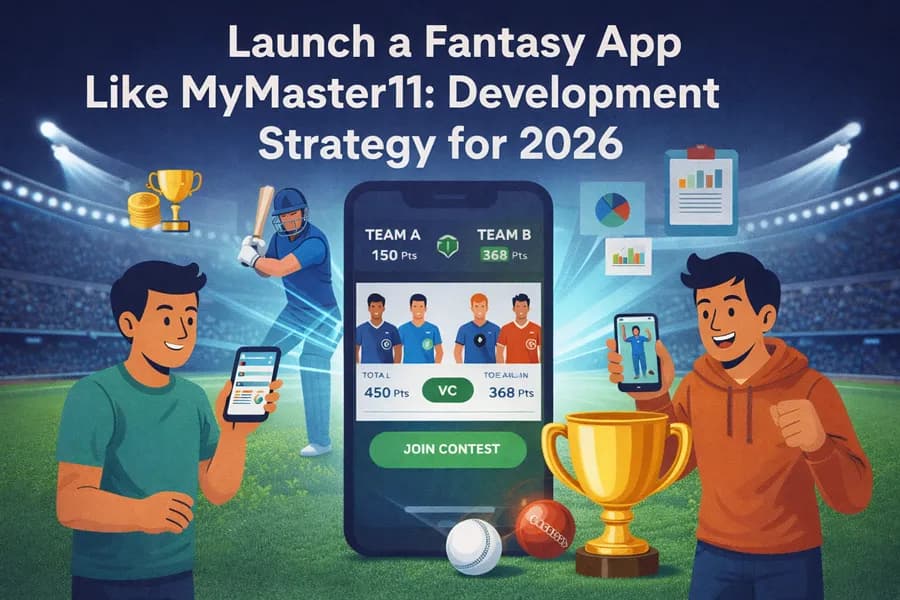
Launching a fantasy platform modeled on MyMaster11 is a high-stakes product and engineering effort that must harmonize contest economics, real-time reliability, compliance and growth mechanics from day one. Dinoustech approaches such projects as integrated business programs rather than one-off engineering gigs: the aim is to validate core monetization levers quickly, prove contest liquidity under real load, and then scale operations while protecting user trust. Successful launches begin with a tightly scoped MVP that tests the most important hypotheses — first-deposit conversion, contest take rate, and dispute handling turnaround — and then expand into richer community and monetization features only after the unit economics are proven. The development strategy that follows covers market fit, product design, engineering patterns for match-day peaks, financial rails and compliance, anti-fraud systems, growth and a practical phased roadmap suitable for a 2026 launch window.
Why the time is right for a MyMaster11-style app
Mobile penetration, broadcast reach and the social amplification of match highlights continue to make fantasy platforms a compelling distribution channel for sports engagement, and the next tournament cycle offers a reliable cadence of new user cohorts. Market timing matters because users often adopt fantasy products during marquee events and then either stick around or churn depending on how quickly the product demonstrates clear, unambiguous value. A modern MyMaster11 competitor should capitalize on current trends — faster onboarding through progressive KYC, ubiquitous UPI and wallet options for instant deposits, and short, engaging contest formats that fit social sharing moments. Financial and regulatory frameworks across key markets have also evolved, which lowers some of the historical friction of launching responsibly; however, this same maturity raises user expectations for fairness, instant payouts and transparent scoring. Teams that treat the launch window as a market research and optimization opportunity rather than a single marketing sprint will achieve sustainable growth and better lifetime value per user.
Understanding the Indian audience and market dynamics
India’s fantasy audience is both deep and varied: a large block of casual users engages around marquee matches, while a smaller cohort of power users drives high ARPU through premium contests and multi-entry strategies. Geographic and vernacular segmentation matters — preferences for contest types, price sensitivity and distribution channels differ substantially across metros and tier-2 cities. The product should therefore prioritize local language support, simplified flows for first-time depositors, and targeted prize mechanics that appeal to both low-commitment social players and strategic competitors who care about leaderboards and analytics. Understanding the seasonal calendar — domestic leagues, international tours and global tournaments — helps plan promotional calendars and manage liquidity. A disciplined approach to player lifecycle metrics, with close monitoring of deposit conversion, seven-day retention and contest churn, reveals which product levers are working and which need iteration before heavy marketing spend accelerates acquisition.
Defining a product vision and contest economics for long-term retention
A clear product vision answers a few fundamental questions early: what contest primitives will the platform support, how will entry fees and prize curves be structured, and what role will social and creator features play in driving virality? Prize economics should be simulated early using conservative user behavior models to avoid unsustainable payouts. For a MyMaster11 similar app development path, the roadmap typically begins with a small set of evergreen contests — quick pick, classic fantasy, head-to-head and private leagues — and then expands into syndicates, subscription passes and branded tournaments once liquidity proves consistent. Explicitly model risk: estimate promotional spend, refund incidence, dispute rates and expected average entry size. The product should provide easy ways to seed contests during low-liquidity windows without confusing users by mixing artificial and organic pools; transparent labelling of sponsored or seeded contests preserves trust while maintaining the user experience.
Must Read: - 10+ Fantasy Sports Apps Every Cricket Fan Should Try in 2026
Core features and user journeys that maximize conversion
The most important user flows are onboarding, first deposit, contest discovery and contest submission. Onboarding must be friction conscious: allow an immediate low-value deposit with progressive KYC gates that unlock higher withdrawal tiers and provide contextual microcopy that explains scoring and payout timelines in plain language. The discovery experience should prioritize relevance — show recommended contests based on device locale, past behavior and match importance — and the contest submission flow must be instantaneous and reassuring with clear confirmation receipts. Provide a robust wallet that separates cash balances, promotional credits and locked stakes and ensure every movement is visible to users along with an immutable audit trail. Post-match flows should include fast, transparent payout notifications and an easy history of contest outcomes, which reduces support queries and drives repeat play. Good UX design here directly reduces customer support costs and increases the probability of viral referrals.
Scalable architecture and deterministic, real-time scoring infrastructure
Engineering for match-day peaks is a mixture of architectural patterns and operational rigor. Use an event-driven architecture with append-only event logs for feed ingestion, scoring and reconciliation; this allows deterministic replay for audits and dispute resolution. Isolate scoring engines from user-facing APIs: scoring should operate in memory for sub-second calculations while authoritative writes to wallets and contest state are queued through durable message brokers with idempotent processing. Shard contest state by match id to prevent hot contests from interfering with unrelated contests, and partition wallet ledgers to ensure strong consistency for financial transactions. Implement horizontal autoscaling for stateless APIs, pre-warmed scoring clusters for marquee matches and CDN caching for discovery and static content. Observability is essential: trace events from feed ingestion to final payout, instrument synthetic transaction paths, and run full dress load tests that mimic lineup changes, mass deposits and leaderboard read concurrently. Architects focusing on long-term stability often engage specialists in fantasy sports software development to design test harnesses and capacity plans that reflect real tournament pressures.
Live data, feed redundancy and integration patterns
Reliable, low-latency ball-by-ball or event feeds are the backbone of credible fantasy platforms. Contract with primary and secondary feed providers and build local validation layers that detect anomalies, replay out-of-order events and reconcile corrections without degrading the user experience. Create a canonical event stream that is the single source of truth for scoring and store raw feed snapshots for auditing and incident investigation. Plan a correction protocol for retroactive stat changes that limits churn on leaderboards while preserving auditability: perform corrections in a way that produces transparent delta logs and automated refund or prize adjustments when necessary. Ensure monitoring alerts correlate ingestion latency, event gaps and leaderboard divergence to allow operations teams to act before users notice discrepancies. For teams that want repeatable integration playbooks, partnering with an experienced fantasy cricket app development team helps reduce vendor lock-in and designs robust fallback strategies.
Also Read: - Build a Multi-Sport Fantasy App Like Akhada for Indian Sports Fans
Payments, wallet design, KYC and regulatory compliance
A clean payment and wallet model directly affects conversion and trust. Enable popular local payment rails for fast deposits, support wallets for instant contest entry, and implement clear promo mechanics that avoid confusion during redemption. Progressive KYC reduces friction for low-value deposits while enforcing stricter checks for withdrawals and large balances; store verification status and associated limits in the user profile so flows remain transparent. Financial records must be auditable: every wallet movement should map to an immutable ledger entry and be exportable for compliance audits. Engage legal counsel early to understand whether your target markets treat fantasy contests as games of skill or wagering and design compliance and tax reporting accordingly. Implement AML monitoring with velocity and identity checks to detect synthetic accounts and suspicious fund flows. For operators watching costs, working with an affordable software development company that still prioritizes secure payment architectures and compliance automation will minimize surprises during regulator review.
Anti-fraud, fairness and operational readiness for tournament peaks
Fairness is the single most defensible trust signal for fantasy platforms; perceived unfairness destroys retention quickly. Build layered anti-fraud defenses: device fingerprinting, session linking, IP and geo velocity checks, pattern detection for collusion and time-based anomaly scoring to flag suspicious multi-entry behavior. Use immutable contest snapshots for every submission to support fast dispute resolution and create automated alerts for unusual prize concentrations that might indicate abuse. Operationally, prepare a live ops center with adjudication playbooks and drill these scenarios before major tournaments: rehearse score correction flows, rapid customer communications and escalations for high-value claims. Provide a transparent appeals mechanism that ties each dispute to a replayable event log; time-boxed resolution policies increase player confidence and reduce reputational risk. These operational investments separate surviving platforms from thriving ones during high-visibility matches.
Must Read: - Build a Fantasy Cricket App for T20 World Cup for High Traffic Platforms
Growth, monetization and community strategies that scale sustainably
Monetization mixes contest fees, subscription passes, premium analytics, creator-hosted leagues and B2B licensing; the right blend depends on the target audience and confirmed unit economics. Early growth works best when acquisition is tightly coupled with product-led hooks: referral bonuses tied to first deposit, influencer-hosted leagues that seed liquidity, and match-synced promotions that capitalize on broadcast attention. Community features drive organic retention: private leagues, friend invite mechanics and creator channels convert players into advocates. Focus paid acquisition on cost per deposited user rather than cost per install and experiment with deep linking from marketing creative to a pre-filled contest entry to reduce friction. Measure and optimize for LTV:CAC across cohorts and prioritize channels that yield a sustainable payback period. Dinoustech helps structure growth experiments that move quickly from hypothesis to validated channel, reducing wasted spend and aligning product priorities with scalable acquisition funnels.
Roadmap, team composition and why Dinoustech is the partner to build with
A practical roadmap phases risk: start with a discovery sprint to validate contest designs and regulatory posture, build an MVP that proves deposit conversion and contest liquidity, and then expand features in measured stages — anti-fraud hardening, syndicates, creator monetization and enterprise licensing. The core team for an MVP includes a product manager fluent in contest economics, backend engineers for event-driven architectures, scoring specialists, frontend engineers focused on perceived latency, payments and compliance leads, and an operational live ops crew for tournament readiness. As the product scales, add data scientists for personalization, fraud analysts, and community managers. Dinoustech brings cross-functional experience across product, live ops and technical architecture and can deliver a phased plan aligned to your budget and go-to-market timeline; with hands-on guidance through discovery to live operations, Dinoustech ensures the platform is not only feature complete but also operationally resilient and commercially validated for 2026 and beyond.
Launches that combine careful contest economics, deterministic scoring, robust payments and an operational culture practiced under load create durable platforms players trust and return to. If you’re ready to build a MyMaster11 clone app development program with defensible unit economics and tournament-grade stability, Dinoustech can translate ambition into deliverables, milestones and a tested live-ops playbook that keeps your platform reliable when it matters most.