Dinoustech Private Limited
Build a Multi-Sport Fantasy App Like Akhada for Indian Sports Fans
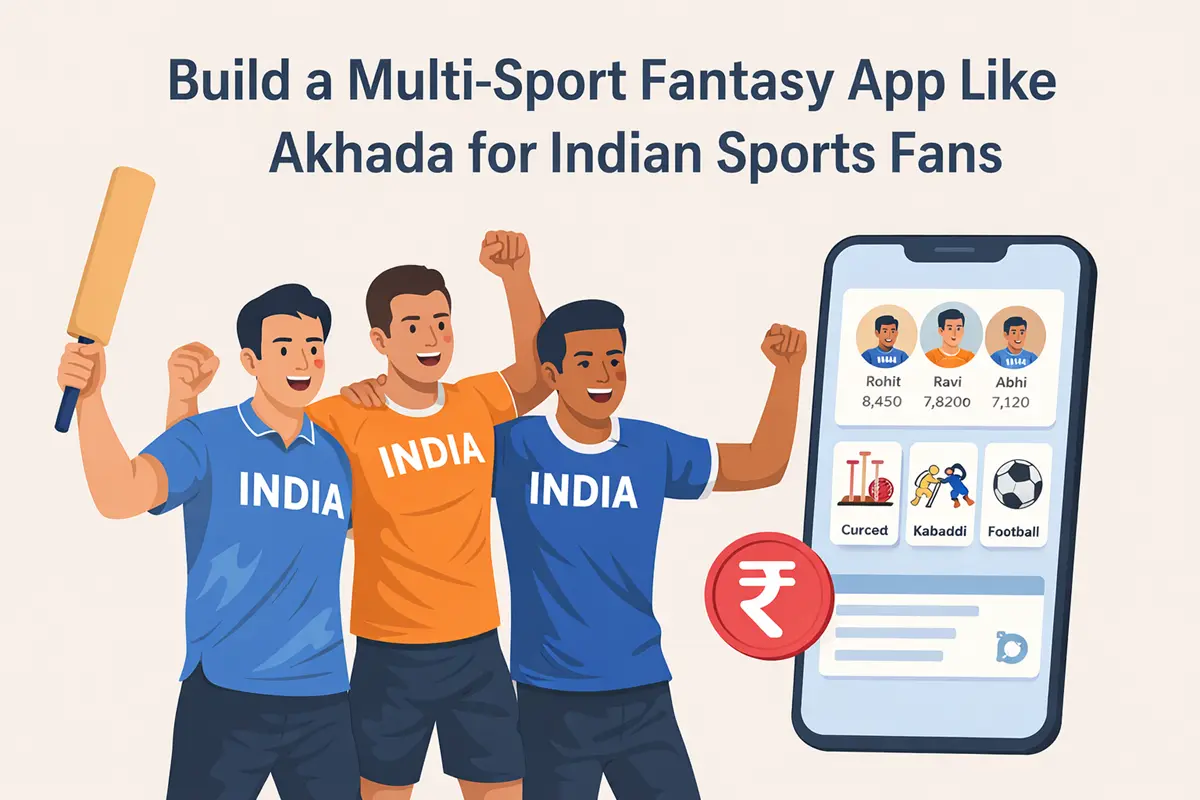
The opportunity to build a multi-sport fantasy platform tailored for Indian audiences is compelling: India’s sports fandom is vast and emotionally invested across cricket, football, kabaddi, hockey, and emerging e-sports, and a well-designed multi-sport product can capture daily engagement rather than intermittent interest tied to a single tournament. A platform that combines nuanced local knowledge — tuneable contest formats, localized hero players, vernacular copy, and responsive customer support — with robust product engineering can turn one-time players into habitual users. Dinoustech approaches multi-sport fantasy projects as product and business investments: the roadmap blends immediate conversion levers, operational guardrails for scaling contest liquidity, and long-term choices about data and personalization that increase lifetime value. The opening weeks after launch are when early retention patterns reveal whether the product is sticky; careful attention to first-time user experience, social sharing mechanics, and the clarity of rules differentiates successful launches from forgettable ones. This piece lays out a complete path — from market fit to monetization, from technology and compliance to go-to-market — for teams that want a platform in the spirit of Akhada but designed for broader sports and long-term growth.
Market context and fan behaviour across India
India’s fandom ecosystem is unique: cricket remains the gravitational centre, but football, kabaddi, and other sports have strong, passionate pockets that respond to localized content, influencers, and community competitions. To build an app that resonates across these verticals you need a partner who understands product, player psychology, and distribution playbooks; that’s why many teams look for a fantasy app development company that combines domain experience with strong growth and ops capabilities. The right partner evaluates which sports to prioritize by mapping seasonal calendars, broadcast exposure, and existing fantasy participation by region. They also run experiments on prize sizes, contest types, and team composition rules to find formats that scale without draining supply. Importantly, the Indian market rewards trust and fairness: transparent scoring, dependable payouts, and fast dispute resolution are non-negotiable. A product that can localize language, offer vernacular support, and integrate with popular payment rails while maintaining excellent match-day performance will capture user mindshare and convert social buzz into sustainable retention.
Why a multi-sport offering beats single-sport strategies for long term retention
A single-sport approach may deliver high spikes of engagement during marquee events, but the winning strategy for long-term retention and predictable revenue is a multi-sport platform that keeps users active throughout the calendar. Building a platform that supports league formats, daily fantasy contests, and special event tournaments helps maintain an always-on user base. Many founders therefore search for a reliable fantasy sports app development company to design contest liquidity models and matching engines that reduce cancellations and optimize prize distribution. The developer’s role is to build an intelligent backend that can dynamically seed contests, manage user churn between sports seasons, and surface tailored games to each user based on their interests and past behaviour. Multi-sport breadth also enables smarter marketing: cross-promotions between sports, hero player narratives that span tournaments, and syndicate-style products create pathways for increased ARPU while smoothing revenue volatility between the high and low seasons.
Core product vision and formats
A core product vision for a multi-sport app balances simple, approachable contest types for newcomers with deeper formats for power users who crave strategic play. For an Akhada-inspired product, mechanics such as captain/vice-captain roles, boosters, lineup transfers, and multipliers feel familiar to cricket players and can be adapted to football (managing formation changes), kabaddi (tactical player swaps), and other formats. Many teams exploring fantasy akhada clone app development start by mapping the essential game primitives — scoring matrices, substitution rules, contest types — and building a flexible engine that allows product managers to craft new competitions without code release cycles. This flexibility is crucial during major tournaments or for promotional events where custom contest templates and dynamic prize pools are needed. Early product roadmaps usually prioritize a small set of evergreen contest types and then expand with themed events and community challenges that reward frequent play and social sharing.
Engagement mechanisms and retention loops that keep players coming back
Engagement is built from both mechanics and community: daily quests, streak bonuses, win-back campaigns, push personalization, and local leaderboards all contribute to habitual behavior. Many successful products lean on social primitives — friend referral rewards, group contests, and syndicate pooling — to amplify viral growth while simultaneously increasing contest liquidity. When designing retention systems, teams often work with specialists in fantasy akhada similar app development to ensure that incentive design doesn’t create unsustainable payouts or encourage problematic behaviour; good designers align prize distribution, entry price elasticity, and promotional cadence so the platform grows sustainably. Another important lever is transparent match-day communications: clear, fast notifications about lineups, scoring events, and contest standings reduce churn caused by confusion. Finally, community moderation and a friendly support presence transform one-time winners into advocates — a human touch that outperforms purely algorithmic retention tactics.
Technology, architecture and performance engineering for match-day scale
Behind every smooth fantasy experience is an architecture engineered for hard, sudden spikes: the combination of pre-match lineup changes and live scoring updates can produce thousands of writes and reads per second during peak minutes. A resilient platform uses event-driven backends, horizontal scaling for contest engines, and caching layers that serve leaderboards and real-time score deltas without latency spikes. For mobile delivery, reduce perceived latency by pre-fetching contest metadata and implementing optimistic UI updates on critical flows like lineup submission. Building for scale also means designing data pipelines that compute scores deterministically and support rapid recalculation in the rare event of a scoring rule change or stat correction. Teams that want to get these foundations right often partner with a pragmatic mobile app development company that understands both native UX constraints and the backend patterns needed to keep match-day chaos orderly and auditable.
Payments, wallets, and seamless cash flows for Indian users
A frictionless checkout is essential: players abandon carts when KYC or payment steps are slow or confusing, so integrate fast local payment rails, UPI flows, net-banking, popular wallets, and card networks to maximize conversion. Also build a modular wallet for in-app balances, cashback credits, and promotional currency that simplifies refunds and contest settlement. For compliance and trust, ensure every wallet movement reconciles to an immutable ledger, so disputes and audits are simple to resolve. Many product teams choose to abstract payments behind a capability API so they can add or swap partners without disrupting UX, and this is an area where working with an affordable software development company that still understands strict financial engineering yields the best balance of cost and reliability. Thoughtful payment UX combined with rapid KYC verification (with smart document recognition and progressive KYC) accelerates first deposit events — a key metric that converts downloads into monetized users.
Fair play, anti-fraud and regulatory readiness for competitive fantasy
Fair play and the perception of fairness are the most important trust signals for a fantasy platform. Implement multi-layered anti-fraud controls: device and behavioural fingerprinting, contest participation velocity checks, pattern analysis for syndicate abuse, and identity linking across accounts. Ensure scoring engines are deterministic and public-facing rules are clear so players can audit outcomes themselves. Maintain robust compliance records and be prepared to support regulatory inquiries with exportable audit trails of every contest, transaction and payout. When preparing for tournament seasons — especially high-visibility events — have pre-approved incident response playbooks and an in-app escalation path for users to report suspected issues. For teams focusing on long-term viability, partnering with a specialized fantasy app development for T20 world cup 2026 roadmap helps ensure the product can safely handle the enormous traffic and scrutiny that accompany marquee cricket events.
Community, content and growth: turning players into advocates
Community fuels sustainable growth: integrate social features that let players follow favourite creators, form private leagues with friends, and participate in event-driven communities. Rich editorial content — short captaincy guides, quick player insights, and pre-match strategy — increases the perceived value of the app and reduces churn by making users feel smarter and more confident in decisions. Reward social sharing with creative referral programs and community leaderboards that celebrate small wins. For efficient growth, combine influencer partnerships with a measured paid acquisition funnel that emphasizes high-quality deposits rather than pure volume. Working with a nimble web development company to optimize landing pages, campaign funnels, and deep linking from social platforms improves day-one conversion and creates smoother onboarding for referred users.
Roadmap, metrics and why Dinoustech is the partner to build with
A pragmatic roadmap starts with a lean MVP that validates core market assumptions: contest take-rate, first-deposit conversion, and retention after the first seven days. Build iteratively: validate the most valuable contest formats, then add syndicates, subscriptions, and power-user features. Key metrics to monitor early are cost per deposit, retention curves by cohort, average margin per contest, and dispute rate; use these to prioritize product work rather than guesswork. Dinoustech combines product thinking, engineering discipline, and operational readiness to deliver end-to-end solutions — from UX and scoring engine design to payments integration and live ops. Our delivery model emphasizes testable assumptions and measurable outcomes, and we tailor tech and marketing roadmaps to local market dynamics so you can scale confidently. If you’re ready to build a multi-sport fantasy platform inspired by Akhada and engineered for long-term growth, Dinoustech can provide the phased plan, team, and operational playbooks to make it happen.