Dinoustech Private Limited
White Label Taxi App for Small Fleet Owners: How to Launch Your Own Branded Taxi App in Weeks
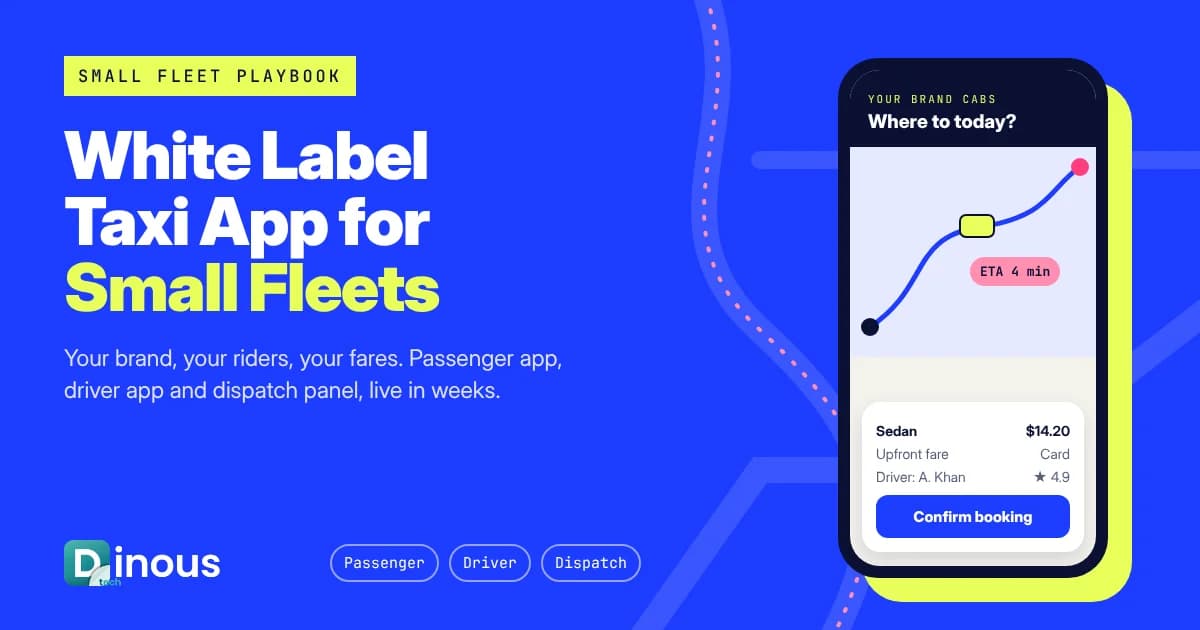
A white label taxi app for small fleet owners is a ready-built ride booking system (passenger app, driver app and admin panel) that is rebranded with your company name, logo, colours and pricing, then published to the App Store and Google Play under your own account. Instead of paying a big aggregator commission on every ride, or spending a year building software from zero, a fleet with 5, 20 or 50 cars can launch its own branded booking app in weeks and keep the customer relationship for itself. This guide explains how white label taxi apps work, what features a small fleet really needs, how it compares with SaaS tools and fully custom development, what drives the cost, how long launch takes and the mistakes to avoid. It is written for taxi, cab, chauffeur and private hire operators worldwide, from the USA, UK and Europe to the UAE, Africa, Southeast Asia and Australia.
Dinoustech is a taxi booking app development company that builds passenger apps, driver apps and dispatch panels for local operators, airport transfer firms and corporate transport companies. The advice below comes from the questions small fleet owners ask us most before they launch.
Key Takeaways
- A white label taxi app gives a small fleet its own branded passenger app, driver app and admin panel without building every line of code from scratch.
- The biggest gain for small operators is control: your brand on the customer's phone, your fares, your repeat customers and your data.
- Small fleets need a focused feature set: booking, live tracking, fare rules, payments, a simple dispatch board, driver documents and reports. Skip features you will not use in year one.
- Always check who owns the app store listings, the customer data and the source code before you sign.
- A branded launch usually takes a few weeks; a custom-extended version takes a few months. Cost depends on licence model, customisation, integrations and ongoing support.
- AI helps small fleets punch above their weight with smarter dispatch, demand forecasting, fare suggestions and a 24/7 booking assistant.
In this guide
Table of Contents
- What Is a White Label Taxi App?
- Why Small Fleets Need Their Own App
- White Label vs SaaS vs Custom
- Features a Small Fleet Really Needs
- How to Launch Step by Step
- Tech Stack
- How Dinoustech Uses AI
- Pricing and Revenue Models
- Licensing and Compliance
- Cost Factors
- Launch Timeline
- Vendor Checklist
- Challenges and How to Solve Them
- Why Choose Dinoustech
What Is a White Label Taxi App?
"White label" means the software is built once by a development company and then supplied to many businesses, each under its own brand. For a taxi business, a white label package normally has three parts:
- Passenger app (iOS and Android): riders book now or later, see the fare, track the car, pay and rate the trip. It carries your name and logo in the app stores.
- Driver app: drivers go online, accept jobs, navigate, start and end trips, collect payment and see their earnings.
- Admin and dispatch panel (web): your office manages bookings, drivers, vehicles, fares, zones, promotions, payouts and reports.
The core engine (booking flow, maps, matching, payments, notifications) already exists and is tested. The work for your launch is branding, configuration, your fare rules, local payment and SMS providers, and any extra features your market needs. That is why a white label app is faster and cheaper to launch than a fully custom build, while still feeling like your own product to customers.
It is different from simply listing your cars on a big ride-hailing marketplace. On a marketplace, the passenger belongs to the platform. With your own white label app, the passenger downloads your app, saves your number and books you again next time.
Why Small Fleets Need Their Own Taxi App
Most small operators still take bookings by phone, WhatsApp and walk-ups, and some depend on aggregators for a big part of their work. That works until it doesn't. Here is why a branded app makes sense even for a fleet of 10 cars:
- Keep more of every fare. Direct bookings through your own app avoid per-ride aggregator commission. Your software cost is fixed or predictable instead.
- Own the customer. Repeat riders, hotel desks, clinics and corporate clients book you directly, and you can reach them with offers.
- Look as professional as the big players. Live tracking, upfront fares, digital receipts and card payments build trust, especially with tourists and business travellers.
- Run the office with less effort. Automatic dispatch and a live map reduce phone calls, missed jobs and manual logbooks.
- Grow into new services. The same system can later handle airport transfers, employee transport, parcels or chauffeur and limousine bookings.
If you are still deciding whether an app is worth it at all, our article on why a local taxi business needs its own booking app covers the business case in more detail.
White Label vs SaaS vs Custom Taxi App Development
Small fleet owners usually choose between three routes. Each one fits a different stage of business.
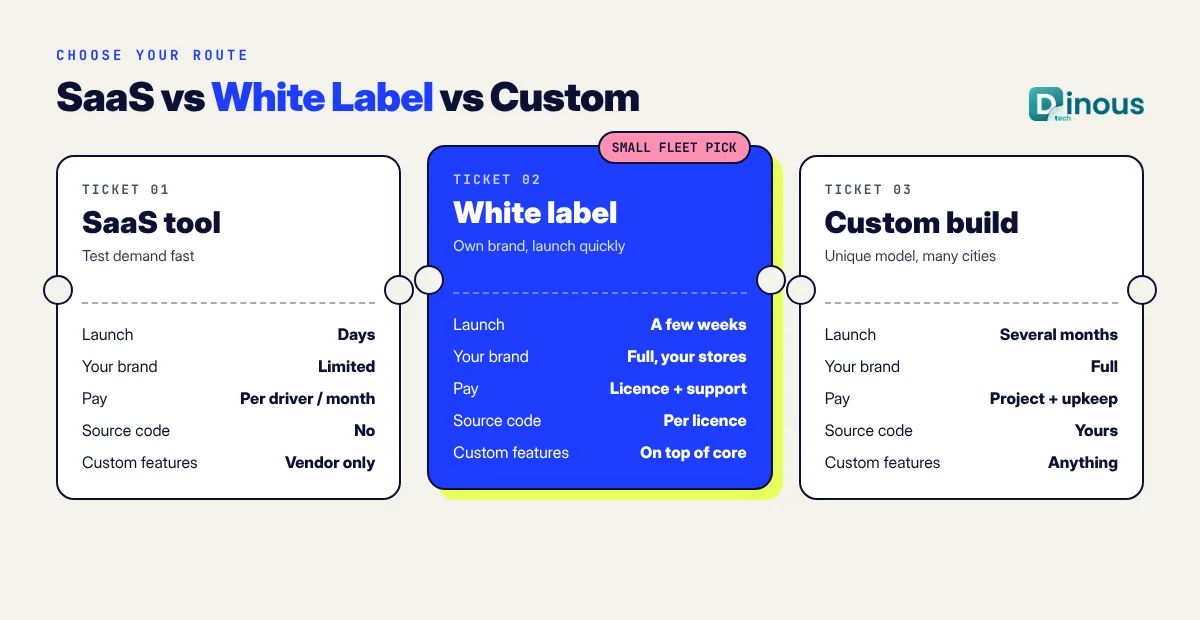
| Factor | SaaS taxi software | White label taxi app | Fully custom app |
|---|---|---|---|
| Launch time | Days | A few weeks | Several months |
| Your brand in app stores | Sometimes, often limited | Yes, under your account | Yes |
| Payment model | Monthly fee, often per driver | One-time licence or setup plus support | Project cost plus maintenance |
| Source code | No | Depends on the licence | Yes, usually yours |
| Custom features | Only what the vendor offers | Possible on top of the core | Anything you need |
| Best for | Testing demand quickly | Small and mid-size fleets that want their own brand fast | Operators with a unique model or plans to scale to many cities |
For most fleets between 5 and 100 vehicles, a white label app with light customisation is the sweet spot: it is fast, it is branded and you are not locked into a per-driver fee that grows every time you add a car. If you already know you want a marketplace like Uber in several cities, read our guide to building a cab booking app like Uber first.
Features a Small Fleet Really Needs
A common mistake is buying the longest feature list. A small fleet needs features that save office time and win repeat riders. Start with these and add the rest later.
Passenger app
- Sign-up with phone number and OTP, plus guest booking for hotels and walk-ins
- Book now or schedule for later, with pickup and drop on the map
- Vehicle types (sedan, SUV, van, accessible vehicle) with upfront fare estimate
- Live driver tracking, driver photo, car number and ETA
- Cash, card and wallet payments, with digital receipts by email
- Saved places, ride history, ratings and in-app support
- Share trip and SOS button for rider safety
Driver app
- Online and offline toggle, job alerts with accept or decline
- Turn-by-turn navigation through Google Maps or Waze
- Trip start, waiting time, stops and end, with automatic fare calculation
- Earnings, trip history and cash collected summary
- Document upload (licence, insurance, permit) with expiry reminders
Admin and dispatch panel
- Live map of all cars and their status
- Automatic dispatch to the nearest free driver, plus manual assignment for phone bookings
- Fare rules by zone, time of day, airport flat rates, waiting charges and night surcharge
- Driver and vehicle management, approvals and document checks
- Corporate accounts with monthly invoices
- Promo codes, referral rewards and push notifications
- Reports on trips, revenue, driver performance and cancellations
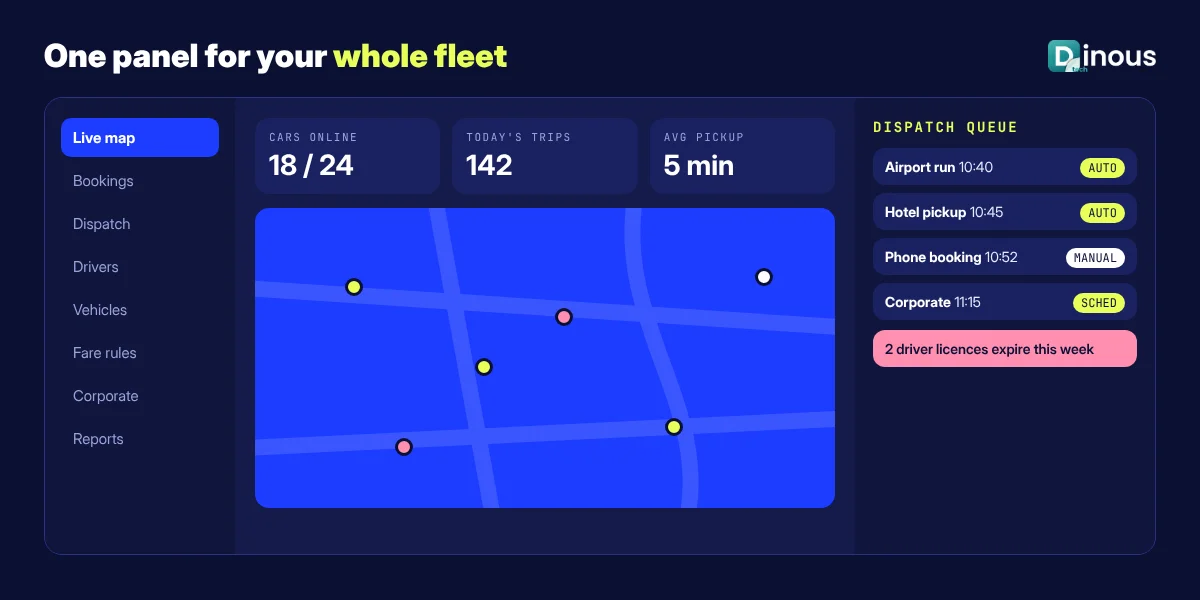
Want a deeper look at the office side? Our guide to taxi dispatch software development explains dispatch logic, booking channels and driver allocation for fleet operators. For a full passenger-side list, see the features every taxi booking app should include.
How to Launch a White Label Taxi App Step by Step
- Define your service area and ride types. City rides, airport runs, outstation trips, hourly hire or corporate commutes. This decides fare rules and vehicle categories.
- Write down your fare rules. Base fare, per kilometre or mile, per minute, minimum fare, airport fees, night charges, waiting time and cancellation fees.
- Choose the licence model. Decide between a one-time licence, a source code purchase or a managed plan with hosting and support (see the vendor checklist below).
- Prepare brand assets. Logo, colours, app name, short description, screenshots text, privacy policy and terms.
- Set up your accounts. Apple Developer and Google Play Console in your company name, a payment gateway account, maps API key, SMS or WhatsApp provider and business email.
- Branding and configuration. The development team applies your brand, language, currency, time zone, fare rules, zones and vehicle types.
- Custom additions. Add only what your market needs, such as flight number tracking, child seat options, a corporate booking portal or a local payment method.
- Testing in your city. Run real trips with your own drivers. Check GPS accuracy, fare calculation, payments, receipts and notifications.
- App store submission. Publish under your own developer accounts so the listings belong to you.
- Driver onboarding and soft launch. Train drivers, onboard regular customers, hotels and offices first, then promote more widely.
Tech Stack for a White Label Taxi App
| Layer | Common choices |
|---|---|
| Passenger and driver apps | Flutter or React Native (one codebase for iOS and Android), or native Swift and Kotlin |
| Admin and dispatch panel | React or Next.js web app |
| Backend and APIs | Node.js, Laravel or Django with REST or GraphQL |
| Real-time tracking | WebSockets or Socket.IO, Redis for live driver locations |
| Maps and routing | Google Maps Platform, Mapbox or HERE |
| Database | PostgreSQL or MongoDB |
| Payments | Stripe, Braintree, Adyen, PayPal or a regional gateway |
| Notifications | Firebase Cloud Messaging, Twilio or a local SMS and WhatsApp provider |
| Hosting | AWS, Google Cloud or DigitalOcean with backups and monitoring |
For a small fleet, the stack matters less than reliability: live location updates that do not drift, fares that are always right and a dispatch panel that never freezes on a busy Friday night. Our post on how GPS technology improves taxi booking apps explains why tracking quality is so important.
How Dinoustech Uses AI in White Label Taxi Apps
AI is no longer only for big ride-hailing companies. Used carefully, it helps a small fleet run like a much larger one.
AI-assisted development
Our engineers use AI coding assistants to speed up configuration, write tests, review code and generate documentation. This shortens the time from signing to launch, while every change is still reviewed and tested by experienced developers before it reaches your drivers and riders.
AI features inside the app
- Smarter dispatch: matching that looks at traffic, driver direction and expected drop-off time, not only straight-line distance.
- Demand forecasting: predictions of busy hours and areas from your own trip history, so you can plan shifts and positions.
- Fare suggestions: recommendations for peak and off-peak pricing within the limits you set and local rules allow.
- Booking assistant: a chatbot on WhatsApp, website or in the app that takes bookings, answers fare questions and shares driver details around the clock. See our AI chatbot development service.
- Safety and fraud signals: alerts for route deviation, long unexpected stops, fake accounts and promo code abuse.
AI support agent for our clients
After launch, fleet owners get help from an AI support agent trained on their own app setup and our documentation. It answers common "how do I" questions instantly, such as changing a fare rule or adding a driver, and hands anything complex to our support team.
Pricing and Revenue Models for Small Fleets
- Direct fares: the main model. You keep the full fare minus payment gateway fees.
- Driver commission or weekly fee: if you work with owner-drivers, charge a percentage per trip or a fixed weekly subscription through the app.
- Corporate contracts: monthly invoicing for hotels, hospitals, schools and offices, often your most stable income.
- Premium options: larger vehicles, pet-friendly rides, child seats, meet-and-greet at the airport.
- Advertising and partnerships: local businesses can promote offers to your riders inside the app.
Licensing and Compliance
Taxi and private hire rules are local, so your app should follow the rules of each city where you operate. Common areas to check:
- Operator and driver licensing: many authorities require licensed drivers, vehicle permits and booking records. The app should store documents and keep trip logs.
- Fare rules: some cities regulate meters, fixed fares or surge pricing. Your fare engine must respect them.
- Data protection: GDPR in the UK and EU, CCPA in California and local privacy laws elsewhere, which affect consent, data storage and deletion.
- Payments: use a PCI DSS compliant gateway and never store card numbers on your own servers.
- Accessibility: accessible vehicle options and an app that works with screen readers help you serve every rider.
This section is general information, not legal advice. Please check the current rules with your local transport authority or a lawyer before launch.
White Label Taxi App Cost Factors
There is no single price for a white label taxi app, because vendors use very different models. Instead of a number, compare quotes on these factors:
- Licence model: monthly per-driver SaaS, a one-time licence, or a source code purchase. The cheapest month one can be the most expensive by year three as your fleet grows.
- Level of customisation: a logo and colour change costs far less than new booking flows or a corporate portal.
- Platforms: Android only, Android and iOS, plus a web booking page.
- Integrations: payment gateway, SMS or WhatsApp, accounting software, flight tracking or an existing meter system.
- Hosting and third-party usage: server, maps API calls and SMS costs, which grow with trip volume.
- Support and updates: bug fixes, OS updates and app store compliance after launch. Our app maintenance cost guide explains how to budget for this.
- Engagement model: fixed price for a defined scope or a dedicated team for ongoing changes. See fixed price vs hourly vs dedicated team.
For full custom builds, our taxi app development cost breakdown shows how features and platforms affect budget.
Launch Timeline
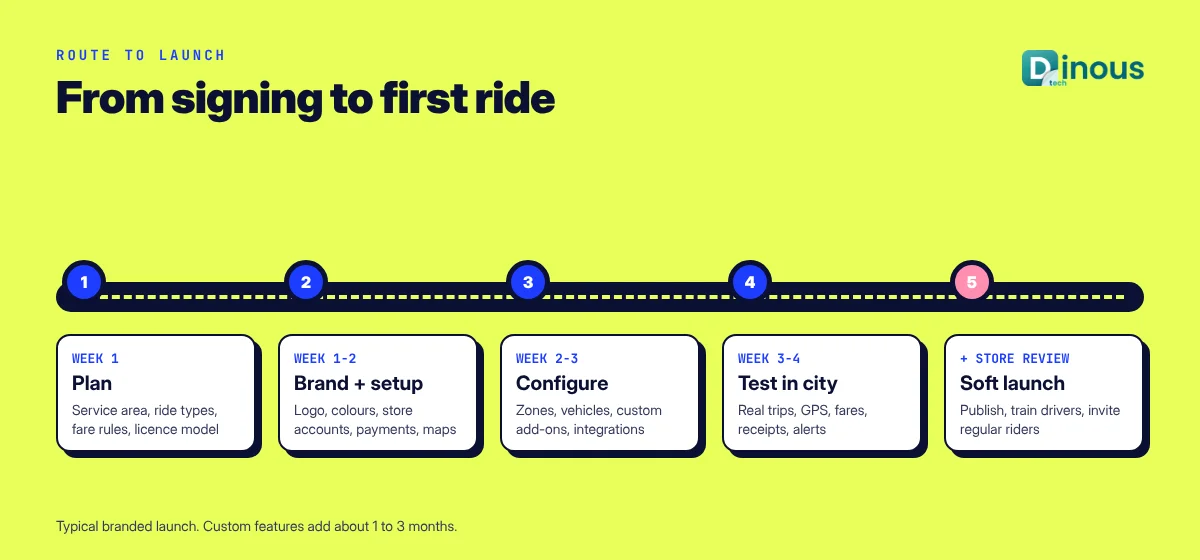
| Scope | Typical timeline |
|---|---|
| Branded white label app with standard features | About 2 to 4 weeks, plus app store review |
| White label app with a few custom features and integrations | About 1 to 3 months |
| Custom taxi platform built for your model | About 4 to 8 months or more |
These are honest ranges, not promises. Delays usually come from missing developer accounts, late brand assets, payment gateway approval and app store review. For more on realistic schedules, read how long it takes to build an app.
Vendor Checklist: Questions to Ask Before You Sign
- Will the apps be published under my Apple and Google developer accounts?
- Who owns the customer and trip data, and can I export it at any time?
- Do I get the source code, or only a licence to use it? What happens if I stop paying?
- Is pricing per driver, per trip or fixed? What will I pay when my fleet doubles?
- Which payment gateways, SMS providers and map services are supported in my country?
- How are iOS and Android updates handled after launch, and how fast are bugs fixed?
- Can I see a live demo of the passenger app, driver app and dispatch panel on real phones?
- Can the system grow later to airport transfers, corporate accounts or new cities?
Challenges and How to Solve Them
- Getting the first downloads: start with people who already ride with you. Put QR codes in every car, on receipts and at hotel desks, and give a small first-ride offer.
- Driver adoption: keep the driver app simple, train drivers in person and show them how direct bookings increase their earnings.
- Phone bookings do not stop: make sure the dispatch panel lets your office enter phone and WhatsApp bookings so every trip is in one system.
- Vendor lock-in: use the checklist above and insist on data export and account ownership.
- Looking "cloned": invest in good branding, local language and a few features your competitors do not offer.
Why Choose Dinoustech for Your White Label Taxi App
- Experience building taxi, airport transfer, employee transport and dispatch solutions for operators of different sizes.
- Apps published under your own developer accounts, with clear data and code ownership terms.
- A focused feature set for small fleets, with the option to add custom features as you grow.
- AI-assisted development for a faster launch, and AI features such as smart dispatch and a booking assistant.
- Support after launch for updates, fixes and new features. See our portfolio for the kind of apps we build.
Ready to give your fleet its own app? Contact Dinoustech for a free demo of the passenger app, driver app and dispatch panel, and a launch plan for your city.