Dinoustech Private Limited
How to Build an MVP That Investors Will Fund: A Founder's Guide for 2026
If you want to know how to build an MVP that investors will fund, start with this idea: investors do not fund features, they fund evidence. A good minimum viable product shows that a real problem exists, that a specific group of users wants your solution, and that your team can build and learn fast. The MVP is your best tool for producing that evidence before you raise money, and it is often the first thing an investor will ask to see.
This guide explains what investors look for in an MVP, how to scope and build one, which metrics matter, how much budget and time to plan, and the mistakes that make investors say no. It is practical advice for founders, not investment or legal advice. For a budget view, read our companion guide on MVP app development, and estimate your own scope with our free app cost calculator.
Key Takeaways
- Investors back traction and learning speed, not a long feature list.
- Build the MVP around one risky assumption you must prove, such as "people will pay for this" or "providers will join".
- Track a few clear metrics from day one: activation, retention, conversion and engagement with the core feature.
- A lean, well-built MVP with honest data is more convincing than a polished app with no users.
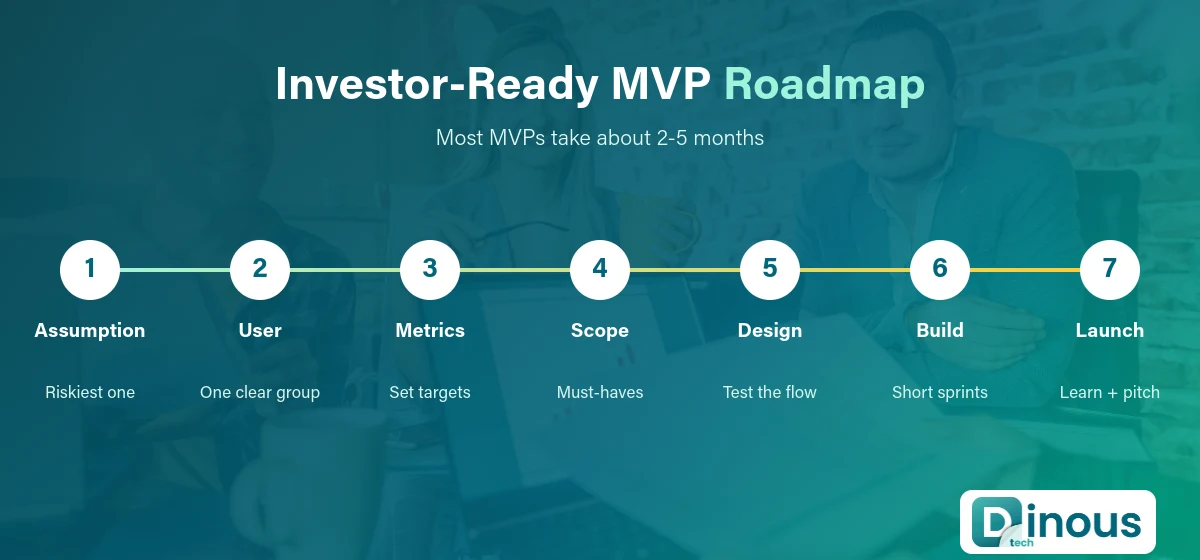
- Plan for about 2 to 5 months of build time and keep budget for iteration after launch.
Table of Contents
- What Investors Look for in an MVP
- Types of MVPs
- Step-by-Step: Build an MVP Investors Will Fund
- Metrics That Matter
- What to Include and What to Leave Out
- Choosing the Tech Stack
- How Dinoustech Uses AI to Build MVPs Faster
- MVP Budget and Timeline
- Using Your MVP in the Pitch
- Mistakes That Put Investors Off
- What Investors Expect at Each Stage
- Preparing for Technical Due Diligence
- Why Dinoustech
What Investors Look for in an MVP
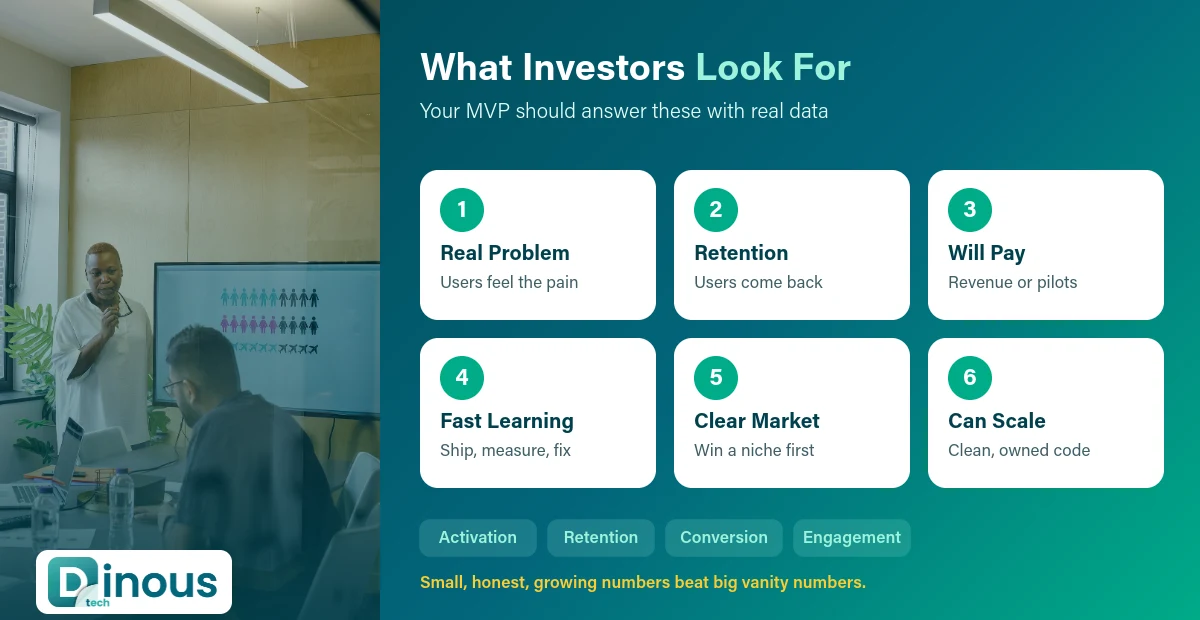
Every investor is different, but early-stage investors usually ask the same core questions. Your MVP should help you answer them with evidence rather than opinion.
- Is the problem real and painful? Users who sign up, come back and complain when something breaks are strong proof.
- Is the market large enough? The MVP should target a niche you can win first, inside a market that can grow.
- Do users actually want this solution? Retention and repeat usage matter more than downloads.
- Will people pay? Even small payments, pre-orders or signed pilot agreements carry weight.
- Can this team execute? A working product built quickly, with clear learning from each release, shows execution.
- Can it scale? Investors want to know the product is not a dead end technically, even if version one is simple.
Types of MVPs
Not every MVP needs to be a full app. Choose the cheapest type that can prove your riskiest assumption.
| MVP type | What it is | Best for |
|---|---|---|
| Landing page MVP | A page that explains the product and collects sign-ups or pre-orders | Testing demand and messaging |
| Clickable prototype | A realistic design users can tap through | User interviews and early investor meetings |
| Concierge MVP | You deliver the service manually behind a simple front end | Service and marketplace ideas |
| Single-feature app | A working app that does one core job well | Proving retention and willingness to pay |
| Pilot MVP | A working product deployed with one or a few business customers | B2B and SaaS startups |
Investors usually find a working single-feature app or pilot MVP more convincing than a prototype, because it produces real usage data.
Step-by-Step: How to Build an MVP Investors Will Fund
1. Write down your riskiest assumption
Ask what must be true for this business to work. For a marketplace, it may be "providers will join and respond quickly". For a SaaS tool, "teams will use this every week". Your MVP exists to test this.
2. Define one user and one core job
Pick a specific early user group and the one job your product does for them. Everything else waits.
3. Set success metrics before you build
Decide what result would convince you, and an investor, that the idea works. For example, "40 percent of new users complete the core action in week one".
4. Scope the must-haves
List features as must-have, nice-to-have and later. Keep only the must-haves. Use ready services for login, payments, maps and notifications instead of building them.
5. Design the main flow and test it
Create a clickable design of the core flow and test it with five to ten real users before coding. Fixing a design is far cheaper than fixing code.
6. Build in short sprints
Work in one or two week sprints with a demo at the end of each. Cross-platform frameworks like Flutter or React Native let you launch on Android and iOS from one codebase.
7. Add analytics from day one
Track sign-ups, activation, the core action, retention and payments. Without data, you have a story, not evidence.
8. Launch to a small group, then learn
Release to early users, talk to them, fix problems and improve weekly. Investors love to see a clear "we learned X, so we changed Y" story.
Metrics That Matter to Investors
- Activation: the share of new users who complete the core action.
- Retention: how many users come back after one week, one month and three months.
- Engagement: how often users perform the core action.
- Conversion and revenue: trial to paid, average order value or contract value.
- Acquisition cost signals: where users came from and what it cost to get them.
- Qualitative proof: user quotes, testimonials, letters of intent and pilot agreements.
Be honest with numbers. Small but real, growing metrics are better than inflated vanity numbers such as total downloads.
What to Include and What to Leave Out
| Include in the MVP | Leave for later |
|---|---|
| The core user flow, done well | Advanced settings and custom themes |
| Simple onboarding and login | Many social login options |
| Payments if you are testing willingness to pay | Complex pricing plans and coupons |
| A basic admin panel | Detailed dashboards and exports |
| Analytics and crash reporting | Custom-built analytics tools |
| Security basics and privacy policy | Enterprise features such as SSO, unless selling to enterprises |
Choosing the Tech Stack
Investors rarely care which framework you use, but they do care that the MVP can grow without a full rewrite. A common, proven stack keeps cost low and makes hiring easier later:
- Mobile: Flutter or React Native
- Web: React or Next.js
- Backend: Node.js, Laravel or Python
- Database: PostgreSQL or MySQL
- Cloud: AWS, Google Cloud or Firebase for very early versions
Keep the code clean, documented and in a repository you own. Technical due diligence often checks this.
How Dinoustech Uses AI to Build MVPs Faster
AI-assisted development: we use AI tools for routine coding, test cases and documentation, which shortens sprints while senior developers review all code.
AI features in your MVP: if AI is part of your value, we add it using proven APIs such as large language models for chat, search and summaries, so you can test the idea without building custom models. Our guide on AI agent development cost explains the budget side.
AI support agent: for many startups, an AI assistant that answers common user questions keeps support costs low during the MVP stage.
MVP Budget and Timeline
Budget depends on scope, number of user roles, integrations and where your team is based. As a planning guide with an experienced offshore team, many MVPs fall roughly between $10,000 and $50,000. Our detailed app development cost in India guide and our India vs USA vs UK cost comparison show how location changes the total.
| Stage | Typical time |
|---|---|
| Discovery and scope | 1 to 2 weeks |
| Design and user testing | 2 to 4 weeks |
| Build and testing | 6 to 14 weeks |
| Launch and first learning cycle | 2 to 4 weeks |
Keep part of your budget for changes after launch. The first version is the start of learning, not the end.
Using Your MVP in the Pitch
- Show a short live demo or recorded walkthrough of the core flow.
- Share a simple metrics slide with trends, not just totals.
- Explain what you learned and what you changed because of it.
- Show the roadmap and how new funding turns into growth.
- Have your technical documentation ready for due diligence.
Mistakes That Put Investors Off
- Building too many features and running out of money before learning anything.
- No analytics, so there is no proof of usage.
- Targeting "everyone" instead of a clear early user group.
- Poor code quality or no ownership of the source code.
- Ignoring basic security and privacy.
- Hiding weak metrics instead of explaining what you are doing about them.
What Investors Expect at Each Stage
Expectations change as you move from friends and family money to institutional rounds. Use this as a rough guide, not a rule, because every investor and market is different.
| Stage | What the MVP usually needs to show |
|---|---|
| Pre-seed | A clear problem, a working prototype or early MVP, first users and strong founder insight |
| Seed | A live product, early retention, some revenue or pilots, and a clear go-to-market plan |
| Series A | Repeatable growth, solid unit economics and a product that can scale technically |
For most founders reading this, the goal is pre-seed or seed. That means a lean product, real users and honest learning matter more than a long feature list.
Preparing for Technical Due Diligence
Once an investor is interested, they may ask a technical adviser to review your product. Prepare these items early so diligence does not slow down your round:
- Source code in a repository owned by your company, with access history
- A short architecture document: main components, hosting, third-party services
- A list of open source licences used in the product
- Security basics: how passwords, payments and personal data are handled
- Analytics access so investors can see the metrics behind your slides
- A product roadmap that links the next release to the money you are raising
- Contracts showing that all code and IP belong to your company, including work done by agencies or freelancers
If an outside team built your MVP, make sure their contract assigns IP to you. This is one of the most common issues found during diligence and one of the easiest to prevent.
Why Build Your MVP With Dinoustech?
Dinoustech is a software development company in Jaipur, India, founded in 2024 by a team with 7+ years of experience. We have delivered 450+ projects across mobile apps, SaaS platforms and custom software for startups.
- Scope workshops that cut your MVP to what matters
- Fixed milestones and demos every sprint
- Analytics and clean, documented code you fully own
- Support after launch as you iterate and raise
We work with founders in India and worldwide, including the USA, UK, UAE and Australia. See our portfolio or visit our startups page. Ready to build an MVP investors will take seriously? Contact us for a free consultation.