Dinoustech Private Limited
App Maintenance Cost After Launch: A Yearly Budget Guide for 2026
App maintenance cost is the budget many founders forget. Launch is not the finish line: operating systems update every year, devices change, libraries need security patches, servers need monitoring and users ask for improvements. A common industry rule of thumb is to budget around 15 to 25 percent of the original development cost per year for maintenance, though the right number depends on your app's complexity, users and goals.
This guide explains what app maintenance includes, how to estimate a yearly budget, what drives cost up or down, the different support models, hidden costs and how to keep maintenance affordable. If you still need a build estimate, start with our free app cost calculator.
Key Takeaways
- Plan roughly 15 to 25 percent of the build cost per year for maintenance, adjusted for your app.
- Maintenance covers bug fixes, OS and device updates, security patches, hosting, monitoring, third-party services and small improvements.
- Hosting and third-party fees grow with users; engineering effort grows with complexity.
- A monthly maintenance plan is usually more predictable than paying ad hoc for fixes.
- Good code quality, automated tests and monitoring reduce long-term maintenance cost.
Table of Contents
- What Does App Maintenance Include?
- Types of Maintenance
- How to Estimate Your Yearly Budget
- Typical Cost Breakdown
- What Drives Maintenance Cost
- Maintenance Models
- Hidden Maintenance Costs
- How to Reduce Maintenance Cost
- How Dinoustech Uses AI in Maintenance
- Yearly Maintenance Checklist
- Maintenance Focus by App Type
- Taking Over an App Built by Another Team
- Why Dinoustech
What Does App Maintenance Include?
- Bug fixes: issues found by users or monitoring after launch.
- OS and device updates: keeping the app working with new Android and iOS versions and new screen sizes.
- App store compliance: meeting new store policies and target API levels.
- Security: library and framework updates, vulnerability fixes and certificate renewals.
- Hosting and infrastructure: servers, databases, storage, backups and CDN.
- Monitoring: uptime, crash reports and performance tracking.
- Third-party services: maps, SMS, email, payments, AI APIs and analytics.
- Small improvements: UI tweaks, content changes and minor features.
Types of App Maintenance
| Type | What it means | Example |
|---|---|---|
| Corrective | Fixing bugs | Checkout fails on one Android version |
| Adaptive | Adapting to changes in the environment | Updating for a new iOS release or API change |
| Preventive | Reducing future problems | Upgrading libraries, cleaning code, adding tests |
| Perfective | Improving based on feedback | Faster search, better onboarding |
How to Estimate Your Yearly Maintenance Budget
A simple three-part estimate works well:
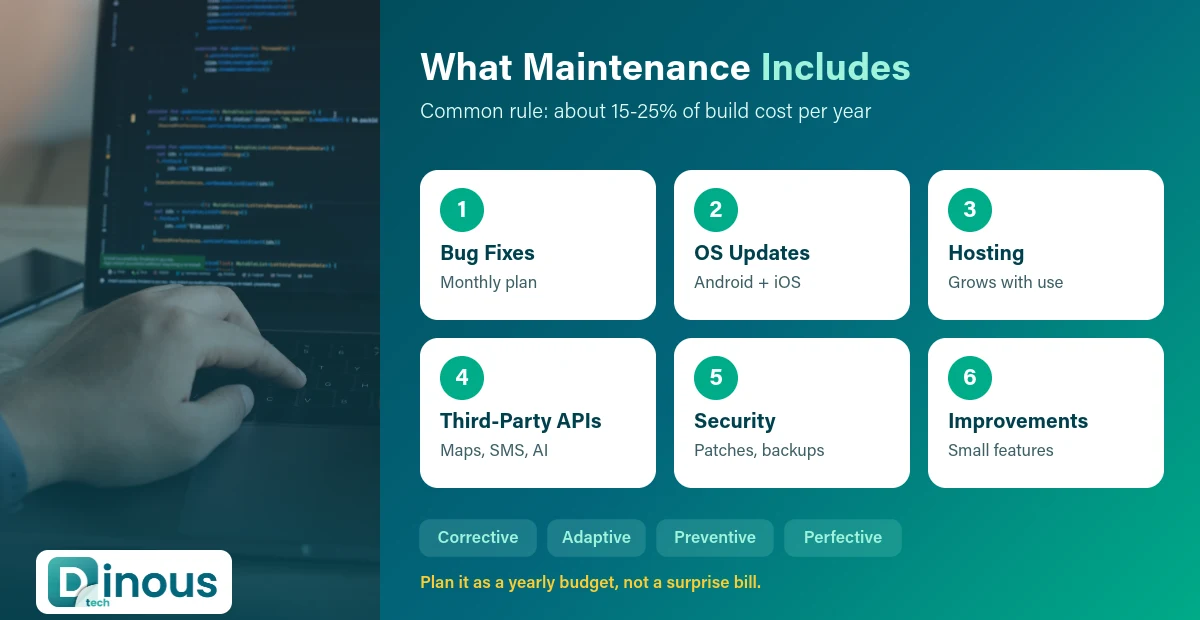
- Engineering effort: start with about 15 to 25 percent of the build cost per year for fixes, updates and small improvements. Use the lower end for simple apps with few integrations and the higher end for complex, fast-changing apps.
- Infrastructure: add your expected hosting, database, storage and CDN cost, based on users and data.
- Services and licences: add third-party fees such as maps, SMS, payment fees, AI API usage, app store accounts and tools.
Example: if your app cost ₹10 lakh (about $11,400) to build, a rough engineering budget is about ₹1.5 to 2.5 lakh (about $1,700 to $2,800) per year, plus hosting and services that depend on usage. This is a planning example, not a quote.
Our app development cost in India guide helps you estimate the build cost this is based on.
Typical Cost Breakdown
| Area | How it is usually priced |
|---|---|
| Bug fixes and updates | Monthly plan or hours per month |
| OS and store updates | Planned work once or twice a year |
| Hosting and database | Monthly cloud bill, grows with usage |
| Third-party APIs | Per use or monthly subscription |
| Monitoring and security tools | Monthly subscriptions, some free tiers |
| App store accounts | Yearly Apple fee and one-time Google fee |
| Small feature improvements | Hours per month or small fixed projects |
What Drives Maintenance Cost
- App complexity: more roles, screens and integrations mean more to keep working.
- Number of platforms: separate native Android and iOS apps cost more to maintain than one cross-platform codebase. See our Flutter and React Native services.
- User base: more users mean more hosting, more support and higher expectations.
- Code quality: clean, tested code is cheaper to maintain.
- Third-party dependencies: each service can change prices or APIs.
- Industry rules: healthcare, fintech and education apps need more security and compliance work.
- Release pace: frequent feature releases need more QA and DevOps effort.
Maintenance Models
- Monthly maintenance plan: a fixed monthly fee for monitoring, fixes and a set number of hours. Predictable and popular.
- Hourly on demand: pay only when you need work. Flexible, but slower response and less predictable.
- Dedicated developer: best when you have regular improvements as well as maintenance.
- In-house team: full control but higher fixed cost.
Our guide on fixed price vs hourly vs dedicated team explains these models in more detail.
Hidden Maintenance Costs
- Sudden price changes in third-party APIs
- Forced upgrades when a framework or library reaches end of life
- New app store or privacy rules that require changes
- Technical debt from rushed early development
- Knowledge loss when the original developers leave
- Data growth that pushes up database and storage bills
How to Reduce App Maintenance Cost
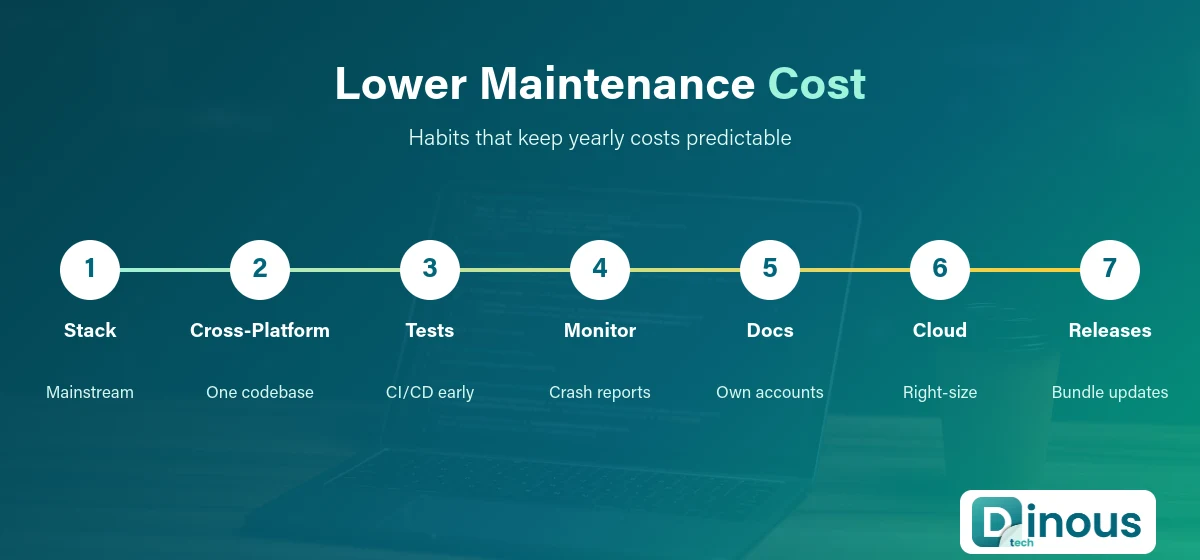
- Choose a mainstream, well-supported tech stack.
- Use cross-platform development where it fits.
- Add automated tests and CI/CD early.
- Set up crash reporting and monitoring from launch.
- Keep documentation and own all accounts and code.
- Review cloud bills and right-size servers every quarter.
- Bundle updates into planned releases instead of many small emergency fixes.
How Dinoustech Uses AI in App Maintenance
AI-assisted maintenance: our developers use AI tools to analyse crash logs, suggest fixes, write tests and update documentation faster, with senior review on every change. We have written more about this in how AI reduces app maintenance costs.
AI features in your app: if your app uses AI APIs, we monitor usage, cost and quality, and update prompts or models when providers change.
AI support agent: an AI assistant can answer common user questions, reducing support tickets and freeing your team for real issues.
Yearly Maintenance Checklist
- Update for the new Android and iOS versions
- Upgrade frameworks and libraries; fix security alerts
- Review crash and performance reports
- Test payments, login and key flows on current devices
- Renew certificates, domains and store accounts
- Check backups and run a restore test
- Review cloud and API costs
- Update privacy policy and store listings if needed
Maintenance Focus by App Type
| App type | Where maintenance effort usually goes |
|---|---|
| eCommerce and marketplace | Payments, catalogue updates, peak sale traffic, vendor tools |
| Taxi and delivery | Real-time tracking, maps API costs, driver app updates |
| Fintech | Security patches, compliance changes, bank and payment API updates |
| Healthcare | Data protection, audit logs, video consultation stability |
| Education | Academic year changes, exam peaks, content updates |
| Dating and social | Moderation tools, chat infrastructure, store policy changes |
| AI-powered apps | API costs, model updates, prompt tuning and quality checks |
Knowing where effort goes helps you choose the right maintenance plan and avoid surprises.
Taking Over an App Built by Another Team
Many businesses come to us when the original developer is no longer available. Taking over an existing app needs a careful start:
- Access handover: source code, app store accounts, cloud, domains and third-party services.
- Code audit: review structure, outdated libraries, security issues and missing tests.
- Stabilise: fix critical bugs and crashes first.
- Update: bring frameworks and SDKs up to date in planned steps.
- Document: write down how the app is built, deployed and monitored.
- Plan: agree on a monthly maintenance plan and a roadmap for improvements.
The first month often costs more than later months because of this setup work, but it lowers risk and cost for every month after.
Why Choose Dinoustech for App Maintenance?
Dinoustech is a software development company in Jaipur, India, founded in 2024, with a team that has 7+ years of experience and 450+ projects delivered. We maintain apps we built and apps built by other teams, through our software maintenance services and server management.
- Monthly plans with clear response times
- Code audits for apps taken over from other teams
- Monitoring, backups and security updates
- Support for clients in India and in the USA, UK, UAE and Australia
See our portfolio, explore mobile app development, or contact us to plan your maintenance budget.