Dinoustech Private Limited
Limousine Booking App Development: How to Build a Chauffeur Booking Platform with Hourly Rates, Flight Tracking and Corporate Accounts
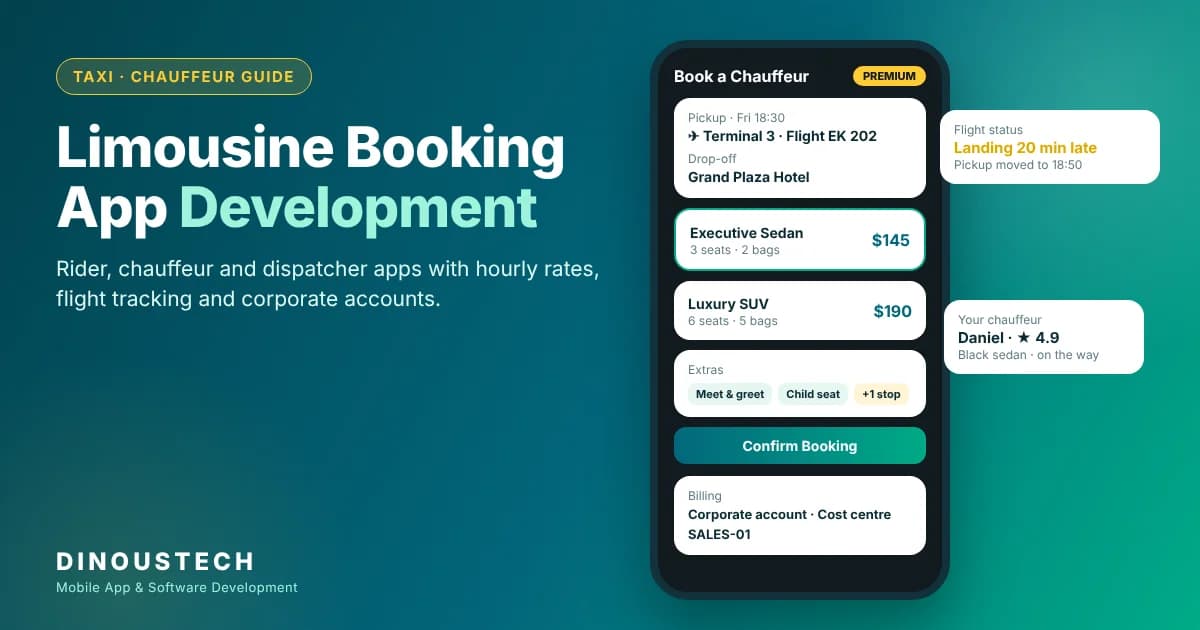
Limousine booking app development means building a mobile app and web platform where customers can book a chauffeur-driven luxury car in advance or on demand, choose the vehicle class, pay by hourly or fixed-route rates, and track their chauffeur, while the operator manages vehicles, chauffeurs, corporate accounts and dispatch from one dashboard. This guide explains how a limo and chauffeur booking app works, the business models, rider, chauffeur and admin features, the build process, tech stack, compliance, cost factors and timelines.
Key Takeaways
- A limousine booking platform usually has four parts: a rider app, a chauffeur app, an operator or dispatcher dashboard, and a corporate booking portal.
- Unlike regular taxi apps, most limo rides are pre-booked, priced by vehicle class, hour or fixed route, and come with extras like meet and greet, waiting time and child seats.
- Corporate accounts, event bookings and airport transfers are the core revenue streams for many chauffeur businesses.
- Flight tracking, live chauffeur tracking and clear pricing build the trust that premium customers expect.
- Licensing, insurance and data privacy rules differ by city and country, so compliance should shape the design.
- Cost depends on the number of apps, the pricing rules, integrations such as flight data and payments, and whether you also connect partner fleets.
Table of Contents
- What Is a Limousine Booking App?
- Business Models
- How a Limo Booking App Works
- Key Features
- Pricing Rules That Matter
- Step-by-Step Development Process
- Recommended Tech Stack
- How Dinoustech Uses AI
- Monetization Models
- Compliance and Safety
- Cost Factors
- Development Timeline
- Challenges and Solutions
- Why Choose Dinoustech
What Is a Limousine Booking App?
A limousine booking app, also called a chauffeur booking app or black car app, lets customers reserve a professional driver with a premium vehicle such as an executive sedan, luxury SUV, stretch limousine, van or minibus. Customers book for airport transfers, business meetings, weddings, proms, city tours, roadshows and events.
The experience is different from a normal ride-hailing app. Riders expect a named chauffeur, a specific vehicle class, on-time pickup, meet and greet at the airport, and a quiet, professional ride. Operators need tools for advance scheduling, hourly bookings, multi-stop trips, corporate billing and managing their own and partner vehicles.
Limousine Booking Business Models
1. Single Operator App
A limo or chauffeur company launches its own branded app and website for its fleet. This is the most common model and the fastest way to move from phone and email bookings to online bookings.
2. Chauffeur Marketplace
A platform connects riders with many licensed operators and independent chauffeurs, taking a commission on each booking. It needs strong vetting, rating and quality control.
3. Corporate Ground Transport Platform
A platform focused on companies, travel managers and executive assistants, with booking policies, cost centres and monthly invoicing.
4. Event and Wedding Transport
Group bookings with multiple vehicles, timed schedules and guest manifests for weddings, conferences and roadshows.
5. Hotel and Travel Partner Booking
Hotels, travel agents and concierge desks book rides for guests through a partner portal or API and earn a commission.
How a Limousine Booking App Works
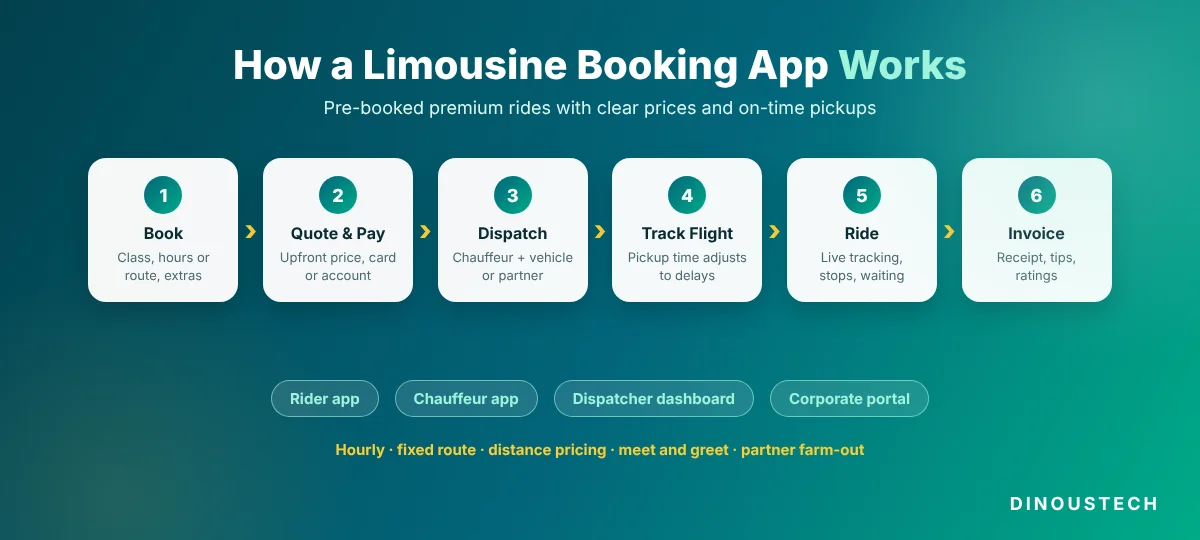
- Booking: the rider chooses the pickup time, route or hours, vehicle class, passengers and luggage, and adds extras such as a child seat or meet and greet.
- Quote and payment: the app shows a clear price from the operator's rules and saves a card, takes a deposit or bills the corporate account.
- Dispatch: the dispatcher or an auto-assign rule picks a suitable chauffeur and vehicle, or sends the job to a partner operator.
- Before pickup: for airport jobs the system tracks the flight and adjusts the pickup time. The rider gets the chauffeur's name, photo, vehicle and plate.
- The ride: live tracking, in-app chat and calls, extra stops and waiting time are recorded by the chauffeur app.
- After the ride: the final fare with extras, tips and tolls is charged, a receipt or invoice is sent, and both sides can leave a rating.
For more on pre-booked airport rides, read our guide to airport transfer app development.
Key Features of a Limousine Booking App
Rider App Features
- Sign up with email, phone, Google or Apple
- Book now or schedule for later, one-way, return, hourly or multi-stop
- Vehicle class selection with photos, seats and luggage space
- Flight number entry for airport pickups
- Extras: meet and greet, child seats, extra stops, drinks or special requests
- Upfront price, saved cards, wallets and promo codes
- Chauffeur details, live tracking, chat and masked calls
- Trip history, receipts and rebooking
Chauffeur App Features
- Job list with upcoming bookings, notes and passenger details
- Accept, decline and status updates (on the way, arrived, passenger on board, completed)
- Turn-by-turn navigation and flight status
- Waiting time, extra stops, tolls and parking recorded with the trip
- Document upload and expiry reminders for licences and insurance
- Earnings, payouts and ratings
Operator and Dispatcher Dashboard
- Calendar and map view of all bookings, vehicles and chauffeurs
- Manual and automatic dispatch, with farm-out to partner operators
- Fleet management: vehicles, classes, maintenance and documents
- Pricing rules, zones, surcharges and promo codes
- Customer and corporate account management
- Reports on revenue, utilisation, on-time performance and ratings
Corporate Booking Portal
- Bookings by assistants and travel managers on behalf of employees and guests
- Cost centres, project codes and booking approval rules
- Monthly invoicing and downloadable trip reports
Operators with large fleets should also read about taxi dispatch software development.
Pricing Rules That Matter
Pricing is where limousine apps differ most from regular taxi apps. A good system supports:
- Hourly rates with a minimum number of hours by vehicle class
- Fixed route prices for popular trips such as airport to city centre
- Distance and time pricing for custom trips
- Surcharges for night, peak days, holidays and events
- Extras such as waiting time, extra stops, meet and greet, tolls and parking
- Gratuity rules, either included or added by the rider
- Corporate rates and negotiated price lists per client
- Cancellation rules based on how close to pickup the booking is cancelled
Step-by-Step Limousine Booking App Development Process
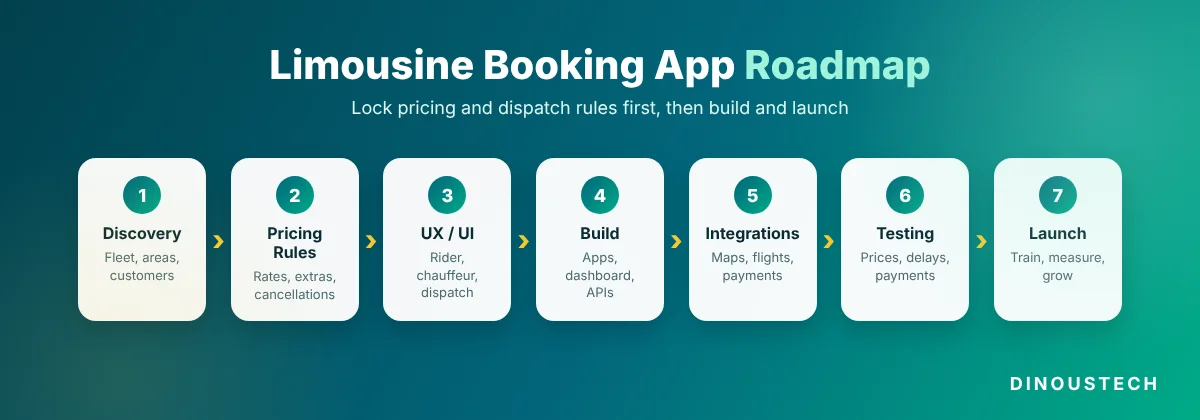
Step 1: Discovery
We learn your fleet, service areas, booking channels, customer types and current tools, and decide which apps to build first.
Step 2: Pricing and Dispatch Rules
We document your rates, extras, cancellation policy, dispatch logic and partner farm-out process before design starts.
Step 3: UX and UI Design
We design a premium, simple booking flow for riders, a clear job screen for chauffeurs, and a fast dashboard for dispatchers.
Step 4: Build Apps and Backend
We develop the rider and chauffeur apps, the dashboard, corporate portal, APIs, payments and notifications.
Step 5: Integrations
We connect maps, flight tracking, payments, accounting software and, if needed, partner networks.
Step 6: Testing
We test bookings, price calculations, flight delays, cancellations and payments end to end on real devices.
Step 7: Launch and Grow
We publish the apps, train your team and track bookings, on-time rate and repeat customers to plan the next features.
Recommended Tech Stack for Limousine Booking App Development
| Layer | Options |
|---|---|
| Mobile apps | Flutter or React Native for Android and iOS, or native Kotlin and Swift |
| Web booking and dashboard | React or Next.js |
| Backend | Node.js, Python (Django or FastAPI) or Laravel with REST APIs and WebSockets |
| Database | PostgreSQL or MySQL with Redis for live locations and caching |
| Maps and routing | Google Maps Platform, Mapbox or HERE |
| Flight tracking | Flight data APIs such as FlightAware AeroAPI or Cirium |
| Payments | Stripe, Braintree, Adyen or regional gateways, with card pre-authorisation |
| Communication | Twilio or similar for masked calls and SMS, Firebase for push notifications |
| Cloud | AWS, Google Cloud or Azure with monitoring and backups |
Learn how location features work in our post on GPS technology in taxi booking apps.
How Dinoustech Uses AI in Limousine Booking Projects
AI-Assisted Development
Our developers use AI coding assistants for routine work such as API boilerplate, test cases and documentation, with every change reviewed by an engineer. This helps us deliver faster without cutting quality.
AI Features Inside the Platform
- Smart dispatch: suggests the best chauffeur and vehicle using location, schedule, vehicle class and ratings.
- Demand forecasting: predicts busy days and times from past bookings, events and flight schedules, so you can plan chauffeurs.
- Delay alerts: warns dispatchers early when traffic or flight changes put a pickup at risk.
- Email and chat to booking: reads booking requests from emails or chats and creates a draft booking for the dispatcher to confirm.
AI Support Agent
A support assistant can answer common rider and corporate questions, such as booking changes, receipts and vehicle options, around the clock, and pass complex cases to your team. See more in how AI is transforming taxi booking app development.
Monetization Models
How the platform earns money depends on the business model:
- Direct fares: a single operator keeps the full fare, extras and surcharges from its own fleet.
- Commission: a marketplace takes a percentage of each booking from partner operators or independent chauffeurs.
- Corporate contracts: monthly invoicing with negotiated rates gives steady, repeat revenue.
- Farm-out margin: when you pass a job to a partner operator, you can keep a margin between your price and theirs.
- Partner commissions: hotels and travel agents earn a share for referred bookings, which brings you more volume.
- Software subscription: if you build the platform as SaaS, other limo operators can pay a monthly fee to use it.
Many operators combine direct fares with corporate contracts first, then add partner and marketplace income as they grow.
Compliance and Safety
- Licensing: chauffeured and for-hire vehicles are licensed by cities, states or countries, for example by local transport authorities in many US cities and private hire licensing in the UK. The app should store and check licence details and expiry dates.
- Insurance: commercial insurance documents for vehicles and chauffeurs should be tracked in the system.
- Accessibility: some markets require accessible vehicle options and accessible apps.
- Data privacy: rider locations and personal data are covered by laws such as GDPR in Europe and state privacy laws in the US.
- Payments: PCI DSS compliant payment providers keep card data off your servers.
- Safety: chauffeur background checks, trip sharing, SOS options and masked phone numbers.
This is general information, not legal advice. Please confirm the rules for each city and country you serve with a local expert.
Limousine Booking App Development Cost Factors
We share an estimate after understanding your scope. The main factors are:
- Apps and panels: rider, chauffeur, dispatcher, corporate portal and website booking widget.
- Platforms: Android, iOS and web.
- Pricing complexity: hourly, fixed route, zones, surcharges and corporate rates.
- Integrations: flight data, payments, accounting, partner networks and existing software.
- AI features: smart dispatch, forecasting and support agent.
- Markets: languages, currencies and local rules.
For general numbers, see our taxi app development cost breakdown.
Development Timeline
| Scope | What It Includes | Typical Timeline |
|---|---|---|
| MVP | Rider app, chauffeur app, dispatcher dashboard, core pricing and payments | 10-14 weeks |
| Full platform | All MVP parts plus corporate portal, flight tracking, advanced pricing and reports | 4-6 months |
| Marketplace or multi-city | Partner operators, farm-out, multi-currency, AI dispatch and forecasting | 6-9 months or more |
Challenges and Solutions
- Late pickups: flight tracking, early dispatch and delay alerts.
- Complex quotes: a flexible pricing engine with clear rules and test cases.
- Last-minute changes: easy edits for riders and instant updates to chauffeurs.
- Not enough vehicles on busy days: partner farm-out and demand forecasting.
- Payment disputes: card pre-authorisation, itemised receipts and GPS trip records.
Why Choose Dinoustech for Limousine Booking App Development
Dinoustech is a software development company based in Jaipur, India, building apps for clients in India and around the world. Our taxi booking app development team builds rider apps, driver apps and dispatch systems.
- Experience with ride booking, dispatch and live tracking
- Flexible pricing engines and payment integrations
- Mobile app development for Android and iOS
- Developers available for calls in US, UK, EU and Middle East time zones
- Post-launch support as your fleet grows
See examples of our work in our portfolio.
Build Your Limousine Booking App With Dinoustech
Whether you run a chauffeur company that wants its own app or you are launching a premium ride marketplace, we can help you plan the features, pricing and dispatch rules, and build it end to end. Contact Dinoustech today for a free consultation.