Dinoustech Private Limited
Employee Transportation App Development: How to Build a Corporate Commute Platform with Smart Routing, Safety and AI
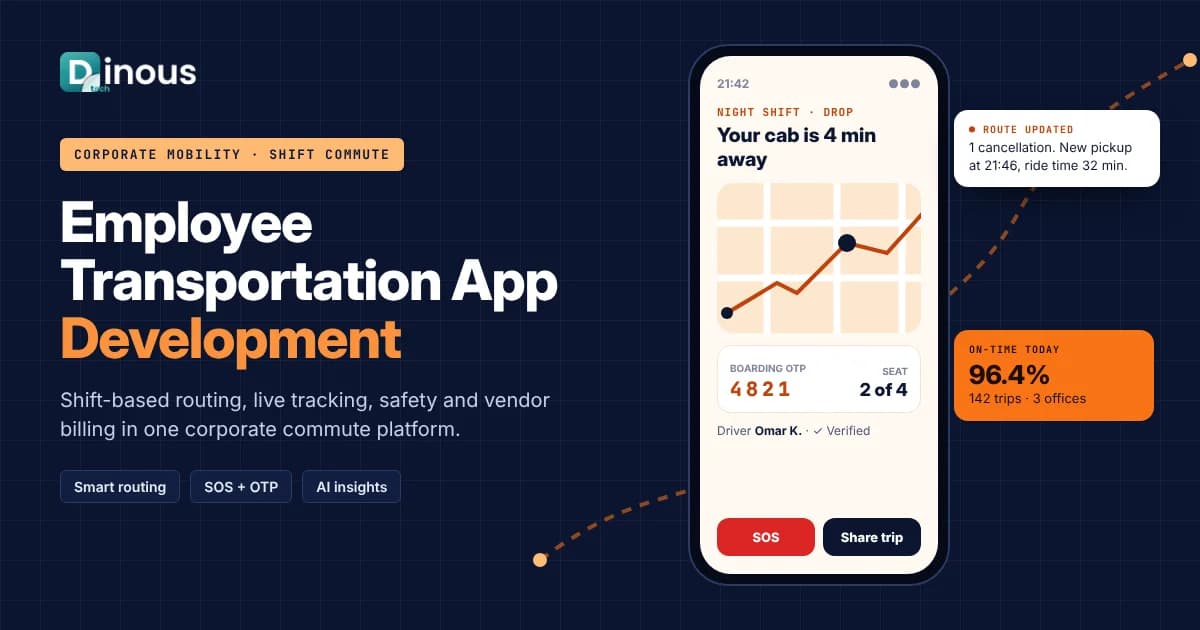
Getting staff to work on time, safely and at a fair cost is a daily headache for companies that run shifts, large campuses or offices in busy cities. Spreadsheets, phone calls to vendors and WhatsApp groups do not scale once a few hundred employees need rides every day. Employee transportation app development solves this by putting shift-based booking, smart routing, live tracking, safety checks and billing into one platform for employees, drivers, transport desks and finance teams. This guide explains how to build a corporate commute platform in 2026, covering the types of solutions, employee, driver and admin features, routing, the step-by-step process, tech stack, AI, compliance, cost factors and timeline. It is written for enterprises, BPO and IT companies, hospitals, factories, universities and transport operators worldwide, from the USA, UK and Europe to the UAE, Southeast Asia and Australia.
Dinoustech is a taxi app development company that builds booking, dispatch and fleet platforms for ride businesses and corporate mobility teams. The guidance below comes from the questions our clients ask when they move staff transport from manual processes to an app.
Key Takeaways
- An employee transportation app connects four groups in one system: employees, drivers, the transport desk and the vendors or fleet owners.
- The core is shift-aware routing: rosters come in, the system groups riders into optimised routes and assigns the right vehicles automatically.
- Safety is a product feature, not an add-on: SOS, verified drivers, boarding check-in, trip sharing, geofence alerts and special rules for night shifts.
- Admins need clear dashboards for seat utilisation, on-time performance, cost per trip and vendor billing.
- AI can improve route plans, predict no-shows and delays, answer commute questions and flag safety risks for human review.
- Plan early for data privacy, local labour and transport rules, and integration with HR and access-control systems.
In this guide
Table of Contents
- What Is an Employee Transportation App?
- Why Companies Are Moving Staff Transport to Apps
- Types of Corporate Commute Solutions
- Employee App Features
- Driver App Features
- Transport Desk and Admin Features
- How Shift-Based Routing Works
- Safety Features for Every Shift
- Development Process Step by Step
- Recommended Tech Stack
- How Dinoustech Uses AI
- Business Models
- Compliance and Data Privacy
- Cost Factors
- Development Timeline
- Common Challenges
- Why Choose Dinoustech
What Is an Employee Transportation App?
An employee transportation app is a software platform that plans, runs and tracks the daily commute of a company's staff. Employees book or confirm a seat for their shift, the system builds pickup and drop routes, drivers follow those routes on their own app, and the transport desk watches every trip live. Finance gets accurate trip data for vendor billing and cost reports.
It is different from a public ride sharing app. Riders are known employees, trips are linked to shifts and rosters rather than random requests, many people share one vehicle, and the company, not the rider, usually pays. That changes how booking, routing, safety and payments are designed. In industry terms this kind of platform is often called an employee transport management system (ETMS) or corporate commute software.
Why Companies Are Moving Staff Transport to Apps
- Too much manual work: transport teams spend hours each day building routes in spreadsheets and calling drivers about changes.
- Late arrivals and missed shifts: without live tracking, nobody knows a cab is late until the shift has already started.
- Safety duty of care: companies are responsible for staff travelling at night or in early-morning shifts and need proof that every trip was safe.
- Rising cost: half-empty vehicles and unverified kilometres from vendors push transport costs up.
- Hybrid work: with people coming into the office on different days, fixed routes no longer match real demand.
- Sustainability reporting: many companies now want data on shared trips and vehicle use for their commute emissions reports.
Types of Corporate Commute Solutions
| Type | How it works | Best for |
|---|---|---|
| Shift-based cab routing | Rosters feed the system; employees are grouped into door-to-door pickup and drop routes. | BPOs, IT companies, hospitals and plants with 24x7 shifts |
| Fixed-route shuttles | Buses or vans run set routes; employees reserve seats and track the shuttle. | Large campuses, factories, business parks |
| On-demand corporate rides | Employees request a ride for meetings or late work under a company policy and budget. | Offices with flexible travel needs |
| Employee carpooling | Verified colleagues share rides in their own cars, often with incentives. See our carpooling app development guide. | Companies with parking limits or sustainability goals |
| Multi-tenant platform | A transport operator runs one platform for many corporate clients, each with its own rules and billing. | Fleet operators and mobility startups |
Many companies need a mix, for example shift cabs for night staff and shuttles for day staff, so it pays to design the platform to support more than one mode from the start.
Employee App Features
- Single sign-on login with the company account, so only current employees can book.
- Roster view and booking: see upcoming shifts, confirm or cancel pickup and drop, and book ad-hoc rides when policy allows.
- Seat reservation for shuttle routes, with stop selection and capacity shown.
- Live tracking of the assigned vehicle with ETA, driver name, photo and vehicle number.
- Boarding check-in through OTP, QR code or a tap on arrival, and check-out at drop.
- Safety tools: SOS button, share trip with family, masked calls to the driver and a "reached safely" confirmation.
- Notifications for route changes, delays and reminders before pickup.
- Feedback and complaints after each trip, with ratings for the driver and the vehicle.
- Accessibility and language options for a diverse workforce.
Driver App Features
- Daily duty roster with assigned routes, pickup order and employee list.
- Turn-by-turn navigation for the optimised route, with live updates when an employee cancels.
- Employee verification at boarding with OTP or QR scan, and a no-show button with timestamp and location.
- Start and end trip, odometer or GPS distance logging and fuel or charging logs.
- Vehicle checklist before duty: documents, cleanliness, first-aid kit, fitness and insurance reminders.
- SOS and direct line to the transport desk.
- Earnings or duty summary for vendor-employed drivers.
Transport Desk and Admin Features
- Roster import from HRMS or workforce tools, or by file upload, with rules for shift times and office locations.
- Automatic route planning with manual override, plus a map view of every route and stop.
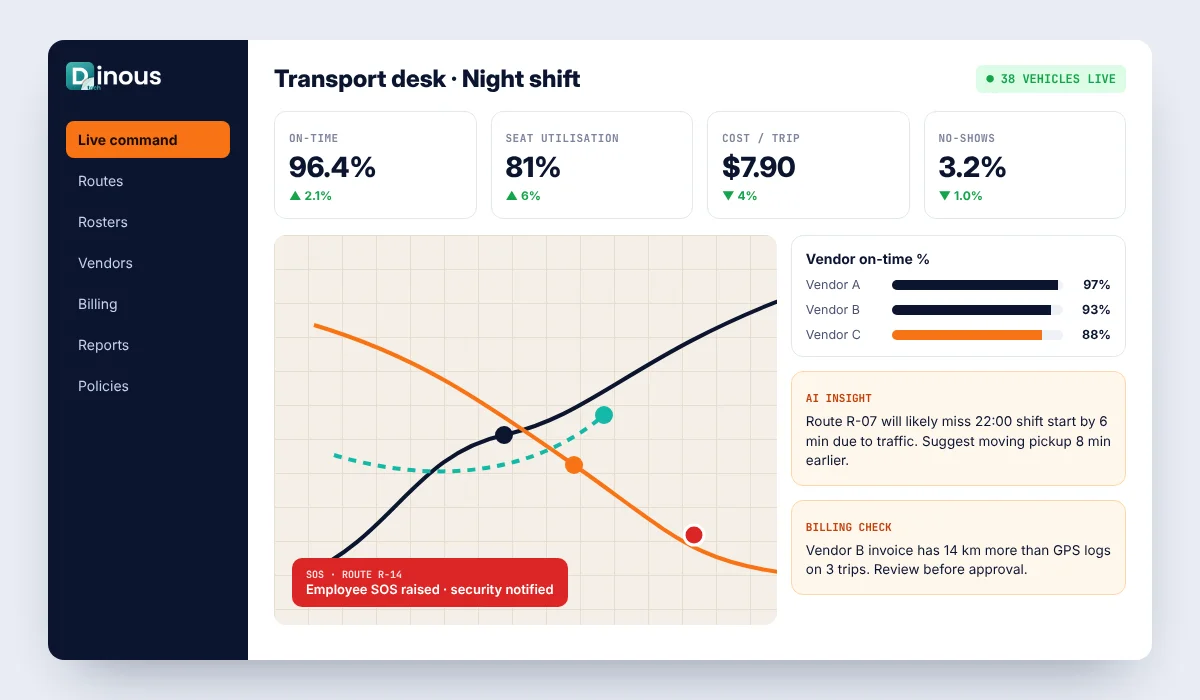
- Live command centre: all vehicles on one map, delay and deviation alerts, SOS escalation and trip playback.
- Vendor and fleet management: vehicles, drivers, documents, compliance expiry alerts and contracts.
- Policy engine: who can book what, cut-off times, night-shift rules, approvals and budgets by department.
- Billing and reconciliation: trip-based, kilometre-based or package billing for each vendor, with disputes and audit trail.
- Reports: on-time performance, seat utilisation, cost per employee and per trip, no-shows, incidents and commute emissions estimates.
- Role-based access for transport managers, security teams, vendors and finance.
Much of this logic overlaps with a dispatch system for fleets. Our guide on taxi dispatch software development explains how dispatch, driver assignment and the operator console fit together.
How Shift-Based Routing Works
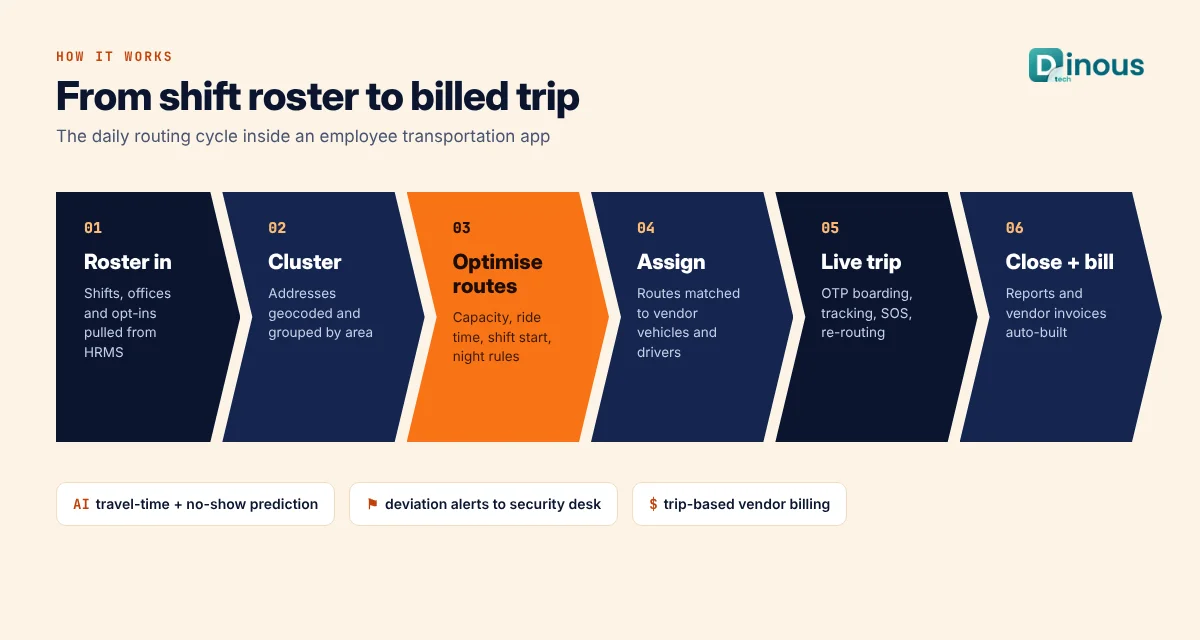
Routing is the heart of an employee transportation app and the part that saves the most money. A typical daily cycle looks like this:
- Roster in: the system pulls who is working which shift, at which office, and who has opted for transport.
- Geocoding and clustering: employee addresses are turned into map points and grouped by area and direction of travel.
- Route optimisation: a vehicle routing algorithm builds routes that respect vehicle capacity, maximum ride time, shift start time and safety rules, such as who is dropped first at night.
- Vehicle assignment: routes are matched to available vehicles and drivers from each vendor.
- Publish and notify: employees and drivers get their pickup time and route in the app.
- Live adjustment: cancellations, no-shows and traffic changes update ETAs and, when needed, the route.
- Close and bill: completed trips feed reports and vendor billing automatically.
Live tracking accuracy matters at every step. Our article on how GPS technology improves taxi booking apps covers location updates, map matching and battery use in more depth.
Safety Features for Every Shift
Employee safety is often the main reason a company invests in a commute platform. A strong safety layer includes:
- Driver background checks and document verification stored with expiry alerts.
- SOS from both the employee and driver apps, routed to the security desk with live location.
- Geofencing and route deviation alerts when a vehicle stops too long or leaves the planned route.
- Night-shift rules, for example avoiding a lone employee being the last drop with the driver, or adding an escort when company policy requires it.
- Masked phone numbers so personal numbers are not shared.
- "Reached safely" confirmation at home, with follow-up if it is not received.
- Full trip logs and playback for incident review.
Employee Transportation App Development Process Step by Step
- Discovery: map your shifts, offices, vendors, current costs, policies and pain points. Decide which transport modes you need in release one.
- Requirements and integrations: list the HRMS, single sign-on, access-control, payroll and finance systems the platform must connect to.
- UX design: design simple flows for employees and drivers, and a data-heavy but clear console for the transport desk.
- Architecture: plan the routing engine, real-time tracking service, notification service, billing module and multi-tenant setup if you are an operator.
- MVP build: employee app, driver app, admin console, roster import, routing, tracking and SOS. Our MVP app development guide explains how to keep the first release focused.
- Testing: load-test peak shift changes, test GPS in poor-signal areas, and run security and privacy checks.
- Pilot: launch with one office or one shift, compare routes and on-time results with the old process, and fix gaps.
- Roll-out and support: add offices, vendors and modes in phases, with training for the transport desk and drivers.
Recommended Tech Stack
| Layer | Common choices |
|---|---|
| Mobile apps | Flutter or React Native for employee and driver apps; native modules for background location |
| Admin console | React or Next.js with map components |
| Backend | Node.js, Python or Java microservices with REST or GraphQL APIs |
| Routing and optimisation | Open-source vehicle routing solvers such as Google OR-Tools, plus a maps routing API |
| Maps and geocoding | Google Maps Platform, Mapbox or HERE |
| Real-time tracking | WebSockets or MQTT, Redis for live positions |
| Database | PostgreSQL with PostGIS for location data |
| Notifications and calls | Firebase Cloud Messaging, SMS gateway, number masking service |
| Identity | SSO with SAML or OpenID Connect (for example Microsoft Entra ID or Okta) |
| Cloud and DevOps | AWS, Google Cloud or Azure, with containers, CI/CD and monitoring |
The right mix depends on your scale, your existing IT systems and where your data must be hosted. Our mobile app development team helps choose a stack that fits your company.
How Dinoustech Uses AI in Employee Transportation Apps
AI-assisted development
Our engineers use AI coding assistants for boilerplate, test generation, code review and documentation, which shortens build time on standard modules. Senior developers review every change, and routing, safety and billing logic always gets human-written tests and checks.
AI features inside the app
- Smarter route planning: machine learning models trained on past trips improve travel time estimates by time of day, so routes and pickup times are more realistic.
- No-show and demand prediction: forecasting which employees are likely to travel on hybrid days, so fewer vehicles run half empty.
- Delay prediction: early warnings when a route is likely to miss shift start, so the desk can act in time.
- Safety risk flags: unusual stops, deviations or driving patterns are scored and sent to the security team for review, not acted on automatically.
- Commute assistant: a chat assistant in the employee app answers "where is my cab?", "how do I change my drop time?" and policy questions.
- Billing checks: AI compares vendor invoices with trip data and highlights mismatches.
AI support agent for our clients
After launch, Dinoustech can set up an AI support agent trained on your platform's help content and policies. It handles common questions from employees, drivers and transport staff around the clock and hands complex issues to your team or ours. For more ideas, read how AI is transforming taxi booking app development.
Business Models
- In-house platform: a large company owns the software and manages its vendors through it.
- SaaS subscription: a mobility startup sells the platform to many companies per employee, per vehicle or per trip.
- Managed transport service: an operator provides vehicles and drivers and uses the platform to deliver and bill the service.
- Hybrid: software licence plus optional fleet services, often with add-ons such as shuttles, carpooling or EV fleet reports.
If you plan to sell rides to the public as well, read whether taxi booking app development is profitable before you mix the two models.
Compliance and Data Privacy
An employee commute platform stores home addresses, live locations and work schedules, so privacy has to be designed in from day one:
- Follow data protection laws where your staff live, such as GDPR in the EU and UK, US state privacy laws, and the UAE and Australian privacy rules.
- Collect location only during trips, show employees what is tracked and why, and set clear data retention periods.
- Encrypt data in transit and at rest, and restrict access by role.
- Check local rules on passenger transport permits, driver working hours, vehicle fitness and women's night-shift transport where these apply.
- Agree data processing terms with every vendor that uses the platform.
This section is general information, not legal advice. Please confirm the rules for your countries with a qualified lawyer.
Employee Transportation App Development Cost Factors
There is no single price for this kind of platform, because the scope varies a lot from company to company. The main cost drivers are:
- Number of apps and portals: employee, driver, transport desk, vendor and finance.
- Routing depth: simple fixed routes versus full dynamic optimisation with many constraints.
- Number of transport modes: cabs, shuttles, on-demand rides, carpooling.
- Integrations with HRMS, SSO, access control, payroll and ERP.
- Safety features and command centre requirements.
- Multi-tenant support if you will serve many corporate clients.
- Number of countries, languages and hosting locations.
- Ongoing costs: maps and SMS usage, cloud hosting, support and updates.
For a wider view of ride app budgets, see our taxi app development cost breakdown, then contact Dinoustech for an estimate based on your rosters and fleet.
Development Timeline
| Phase | Typical duration |
|---|---|
| Discovery and requirements | 2-4 weeks |
| UX and UI design | 3-5 weeks |
| MVP development (apps, console, routing, tracking, SOS) | 10-16 weeks |
| Integrations (HRMS, SSO, billing) | 2-6 weeks, often in parallel |
| Testing and pilot | 4-6 weeks |
| Phased roll-out | Ongoing, by office or region |
A focused first release usually takes about four to six months. Larger multi-country or multi-tenant platforms take longer.
Common Challenges
- Messy address data: employees' home locations are often incomplete. Add pin-drop confirmation in the app.
- Last-minute roster changes: the routing engine must re-plan quickly without confusing drivers.
- Vendor adoption: drivers from many vendors need a simple app, training and local language support.
- GPS gaps: tunnels and basements break tracking, so use offline buffering and smart map matching.
- Balancing cost and comfort: the cheapest route can mean very long rides. Set maximum ride-time rules.
- Privacy trust: employees accept tracking more easily when it is limited to trips and clearly explained.
Why Choose Dinoustech for Employee Transportation App Development
- Experience building taxi, dispatch, carpooling and airport transfer platforms, so the core ride logic is familiar ground. Read our guide on airport transfer app development for a related example.
- Full-cycle team: discovery, design, mobile and web development, routing, cloud and support.
- Practical use of AI in development and in the product, with human review on safety-critical logic.
- Clients across many countries, with attention to local privacy and transport rules. See our portfolio.
- Flexible engagement: a fresh build, or a new app layer on top of your existing fleet or HR systems.
Conclusion
A good employee transportation app turns a daily scramble into a planned, visible and safer process. Start with rosters, routing, tracking and safety, connect the platform to your HR and identity systems, and give the transport desk clear data on cost and performance. Add AI where it improves routes and response times, with people in charge of safety decisions.
Planning a corporate commute platform for your company or your fleet business? Talk to Dinoustech about your shifts, offices and vendors, and we will map out the right first release.