Dinoustech Private Limited
Fixed Price vs Hourly vs Dedicated Team: Which Engagement Model Fits Your App?

Choosing between fixed price vs hourly vs dedicated team is one of the first decisions you make when you hire an app development company, and it affects your budget, speed and control as much as the choice of technology. Each engagement model works well in the right situation and causes problems in the wrong one. A fixed price contract suits a clear, stable scope. Hourly (time and materials) suits evolving products. A dedicated team suits long-term work where you want developers working only on your product.
This guide explains how each model works, the pros and cons, which projects fit each, how costs compare and how to protect yourself in the contract. If you want a quick budget first, use our free app cost calculator.
Key Takeaways
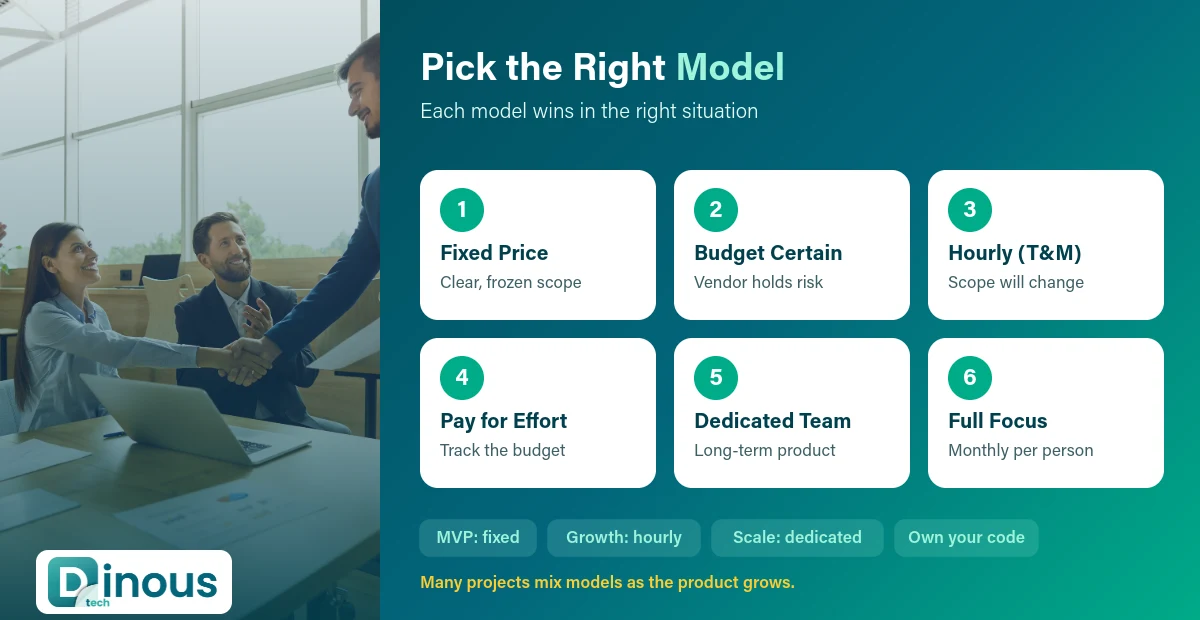
- Fixed price: best for small, well-defined projects and MVPs with a frozen scope. Low budget risk, less flexibility.
- Hourly / time and materials: best when scope will change, such as early products and ongoing improvements. Flexible, but needs active budget tracking.
- Dedicated team: best for long-term products and scale-ups. Full control and focus, with a monthly cost per developer.
- Many projects mix models: fixed price for discovery and MVP, then hourly or a dedicated team after launch.
- Whatever the model, insist on clear milestones, demos, code ownership and transparent reporting.
Table of Contents
- Fixed Price Model
- Hourly (Time and Materials) Model
- Dedicated Team Model
- Side-by-Side Comparison
- Which Model Fits Your App?
- How Costs Compare
- Hybrid Models
- Contract Checklist
- How AI Changes the Picture
- Common Mistakes
- Three Real-World Scenarios
- Questions to Ask Before You Sign
- How Dinoustech Works
Fixed Price Model
In a fixed price contract, you and the development company agree on a defined scope, a total price and a delivery schedule before work starts. Payment is usually tied to milestones.
Pros
- You know the total cost up front, which helps with budgeting and investor planning.
- Delivery risk sits mostly with the vendor.
- Less day-to-day management needed from you.
Cons
- Changes need change requests, which add time and cost.
- Vendors add a buffer for risk, so the price may be higher than the actual effort.
- Requires detailed requirements before starting, which takes time.
Best for: MVPs with a frozen scope, small apps, website projects, and clearly specified modules.
Hourly (Time and Materials) Model
With time and materials, you pay for the actual hours worked at agreed rates. Work is planned in sprints, and priorities can change as you learn.
Pros
- Maximum flexibility to change features and priorities.
- You pay for real effort, with no risk buffer.
- Work can start sooner, since you do not need a full specification first.
Cons
- Total cost is not fixed, so you must track the budget actively.
- Needs regular involvement from you or a product owner.
- Requires trust and transparent time reporting.
Best for: evolving products, R&D, AI experiments, post-launch improvements and projects where requirements are still being discovered.
Dedicated Team Model
In a dedicated team model, you hire a set of developers, designers or testers who work full-time on your product, managed by you or with support from the vendor. You pay a monthly fee per person.
Pros
- Full focus on your product and deep knowledge of your code over time.
- Easy to scale the team up or down.
- Usually lower cost than hiring the same in-house team in the USA, UK or Australia.
- You control priorities day to day.
Cons
- You need to manage the team or have a product owner.
- Not cost-effective for short projects.
- Monthly cost continues even in slower weeks.
Best for: long-term products, SaaS platforms, scale-ups and companies replacing or extending an in-house team. Our post on hiring dedicated Node.js developers shows how this works for one role.
Side-by-Side Comparison
| Factor | Fixed price | Hourly (T&M) | Dedicated team |
|---|---|---|---|
| Budget certainty | High | Medium | High per month |
| Flexibility | Low | High | High |
| Your time needed | Low | Medium | Medium to high |
| Speed to start | Slower (needs full scope) | Fast | Fast to medium (team setup) |
| Best project length | Weeks to a few months | Any | 6 months or more |
| Typical use | MVP, small apps | Evolving products | Long-term product teams |
Which Model Fits Your App?
- "I have a clear idea and a fixed budget for version one." Fixed price for the MVP. See what different budgets cover in our MVP guide.
- "I know the problem but features will change after user feedback." Hourly, with a monthly budget cap.
- "We have a live product and a long roadmap." Dedicated team.
- "We are a funded startup without a CTO." Start with fixed price discovery, then a dedicated team with a tech lead.
- "We only need maintenance and small updates." A monthly maintenance plan or a small hourly bucket. See our software maintenance services.
How Costs Compare
The same app can cost a different amount under each model because risk is shared differently:
- Fixed price includes a risk buffer, but protects you from overruns.
- Hourly is often cheaper for the same work if scope is managed well, but can grow if scope keeps expanding.
- Dedicated team cost is simple to plan: team size times monthly rate times months.
Team location has an even bigger effect than the model. Rates in India are usually much lower than in the USA or UK for similar experience. See our India vs USA vs UK app cost comparison and app development cost in India guide for details.
Hybrid Models
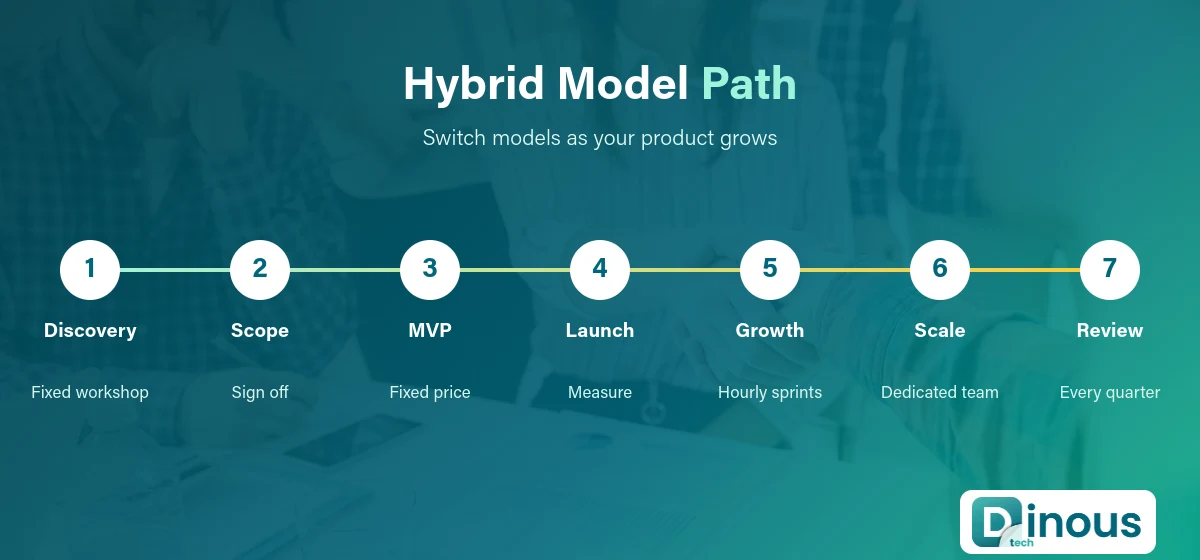
Many successful projects combine models over time:
- Paid discovery (fixed): a short workshop to define scope, design and estimates.
- MVP (fixed price): build the agreed scope with milestones.
- Growth (hourly or dedicated): after launch, switch to flexible sprints based on user data.
- Scale (dedicated team): a stable team owns the product long term.
Contract Checklist
- Clear scope or backlog, with acceptance criteria
- Milestones and payment schedule tied to deliverables
- Change request process with estimates before work starts
- Weekly reports and demos; access to the project board
- Full source code and IP ownership on payment
- NDA and data protection terms
- Warranty period for bug fixes after launch
- Exit and handover terms, including documentation
This is general guidance, not legal advice. Have a lawyer review important contracts.
How AI Changes the Picture
AI-assisted development tools speed up routine coding, testing and documentation. At Dinoustech, our developers use them on every model, and the time saved shows up in shorter fixed-price timelines and fewer billed hours. For AI features inside your product, hourly or dedicated models often work better, because AI work involves testing and tuning. Our AI agent development cost guide explains AI budgets, and we can add an AI support agent to most apps to reduce support costs after launch.
Common Mistakes
- Choosing fixed price with a vague scope, then fighting over every change.
- Choosing hourly with no budget cap or reporting.
- Hiring a dedicated team for a two-month project.
- Picking only on the lowest rate, ignoring experience and communication.
- Not owning the code or hosting accounts.
Three Real-World Scenarios
Scenario 1: A booking app MVP
A founder has a clear list of screens, a fixed seed budget and a launch date for a pilot. Fixed price works well here. Discovery produces a scope document, the build runs on milestones, and any new idea goes to a "phase two" list instead of slowing the launch.
Scenario 2: A B2B SaaS tool after first customers
The product is live and customers are asking for features every week. Priorities change often. Hourly sprints with a monthly cap let the team build what customers need most, with a demo every two weeks and a clear burn report.
Scenario 3: A funded marketplace with a 12-month roadmap
The company has raised a round and needs steady progress on apps, admin tools and integrations. A dedicated team of developers, a QA engineer and a part-time designer works only on this product, managed by the founder's product lead with support from the vendor's project manager.
Questions to Ask Before You Sign
- Who will work on my project, and can I meet them?
- How do you estimate, and what happens if an estimate is wrong?
- How are change requests priced and approved?
- How often will I see demos and progress reports?
- What tools do you use for tasks, code and communication?
- Who owns the code, designs and accounts, and when?
- What happens if a developer leaves the project?
- What is included in the warranty period after launch?
- Can we switch models later, for example from fixed price to a dedicated team?
Clear answers to these questions matter more than the model you choose. A good partner will explain trade-offs openly and recommend the model that fits your stage, even if it is not the most profitable one for them.
How Dinoustech Works With Clients
Dinoustech is a software development company in Jaipur, India, founded in 2024, with a team that has 7+ years of experience and 450+ projects delivered. We offer all three models and help you choose the one that fits your stage:
- Fixed price MVPs with clear milestones
- Flexible hourly sprints with weekly reports
- Dedicated developers, including AI developers, for long-term products
We work with clients in India and abroad, including the USA, UK, UAE and Australia. Explore our mobile app development services, see the portfolio, or contact us to discuss the right model for your app.