Dinoustech Private Limited
Party Plan Software Development: How to Build Hostess Rewards, Virtual Parties and Consultant Tools for Direct Selling
Party plan software development is about building the tools a direct selling brand needs to run home parties, virtual parties and social selling events without spreadsheets. Consultants (also called stylists, presenters or reps) host parties, guests order products, hosts earn rewards, and the company pays commissions on every order. Doing this by hand breaks quickly once you have hundreds of consultants and thousands of guest orders. A custom party plan platform brings party creation, guest ordering, hostess rewards, consultant back offices and commission payouts into one system.
This guide explains what party plan software is, the features it needs, how the build process works, the tech stack, where AI helps, compliance points, cost factors and timelines. If you already run a network marketing business and want a broader view, our MLM software development page covers all plan types.
Key Takeaways
- Party plan software must handle three groups at once: consultants, hosts and guests, each with their own screens and rewards.
- The core flows are party creation, guest invites, guest ordering, hostess reward calculation, order closing and consultant commission.
- Virtual parties (live video, social media links and shareable carts) are now as important as in-home parties.
- AI can help consultants with product suggestions, follow-up messages and reorder reminders, while the commission engine stays rule-based and auditable.
- A focused MVP usually takes about 3 to 5 months; a full platform with apps and integrations takes longer.
Table of Contents
- What Is Party Plan Software?
- How a Party Plan Business Works
- Must-Have Features
- Development Process
- Tech Stack
- How Dinoustech Uses AI
- Compliance and Trust
- Cost Factors
- Timeline
- Common Challenges
- Party Plan Features by Product Category
- Metrics to Track in a Party Plan Business
- Why Dinoustech
What Is Party Plan Software?
Party plan software is a type of direct selling software built around events. Instead of only tracking a downline and sales volume, it tracks parties: who is hosting, which guests were invited, what each guest ordered, when the party closes and what rewards the host earns. It then feeds those sales into the consultant's commission and rank, just like other MLM software.
Brands selling cosmetics, kitchenware, jewellery, candles, clothing, wellness products and home decor often use this model. Many now run a mix of in-home parties, online parties and always-open personal shops. The software has to support all three without making consultants learn three different tools.
How a Party Plan Business Works
A simple party cycle looks like this:
- Consultant books a party with a host and sets a date, theme and closing date.
- Host invites guests by link, SMS, email or social media.
- Guests shop during the event or from a party link, and each order is tagged to that party.
- Host earns rewards such as free product credit, half-price items or bonus gifts, based on total party sales and bookings from guests.
- Party closes, orders ship to the host or to each guest, and the consultant's sales count toward commission and rank.
- Follow-up turns guests into repeat customers, new hosts or new consultants.
Commission rules can follow a unilevel, binary or other structure. If you need a refresher, see our guide to MLM compensation plans.
Must-Have Features of Party Plan Software
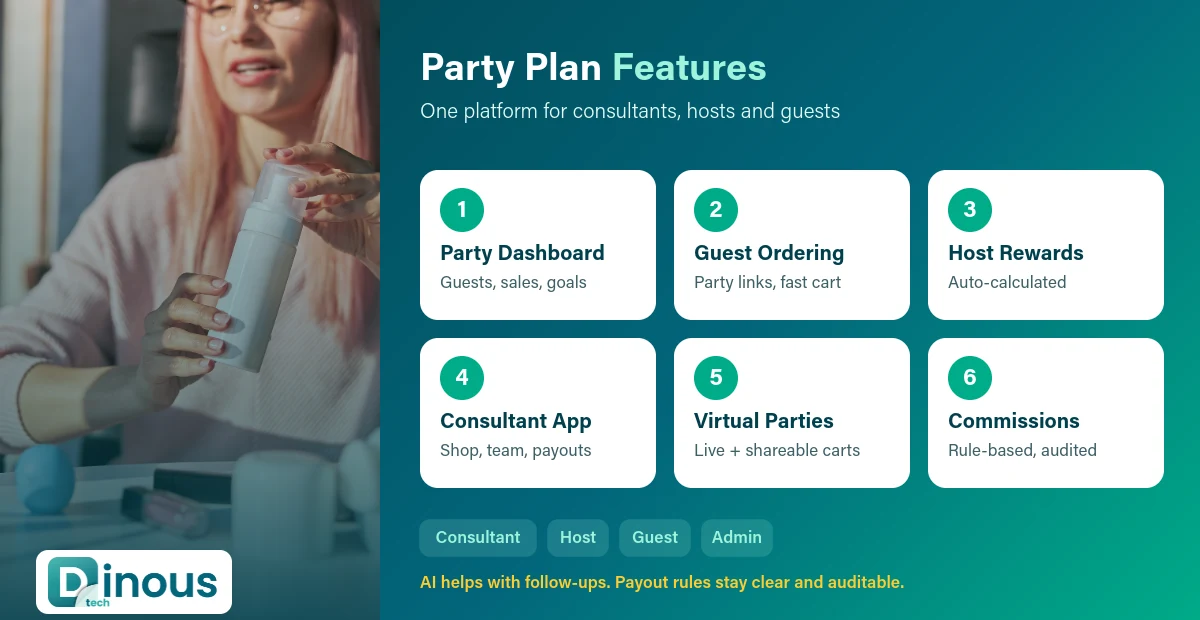
Consultant app and back office
- Create and manage parties, with a party dashboard showing guests, orders and progress to host rewards
- Personal replicated shop and party links (see our post on MLM replicated websites)
- Customer list, notes and reorder reminders
- Team view, sales volume, rank progress and commission statements
- Training library, product catalogue and ready-made social posts
Host portal
- Simple invite tools with shareable links and QR codes
- Live view of party sales and rewards earned
- Reward redemption at checkout
Guest experience
- Mobile-friendly party page with product catalogue, wish lists and fast checkout
- Ship to host or ship to me options
- Order tracking and easy reorders after the party
Admin panel
- Product, pricing, tax and shipping rules by country
- Host reward rules and seasonal promotions
- Commission engine, payout runs and adjustments with a full audit trail
- Consultant onboarding, KYC where needed and compliance checks
- Reports for party averages, guest counts, booking rates and retention
Virtual party tools
- Live video or integration with social live streams
- Shareable carts and product links during the stream
- Comment-to-cart or quick order links where the platform allows it
Party Plan Software Development Process
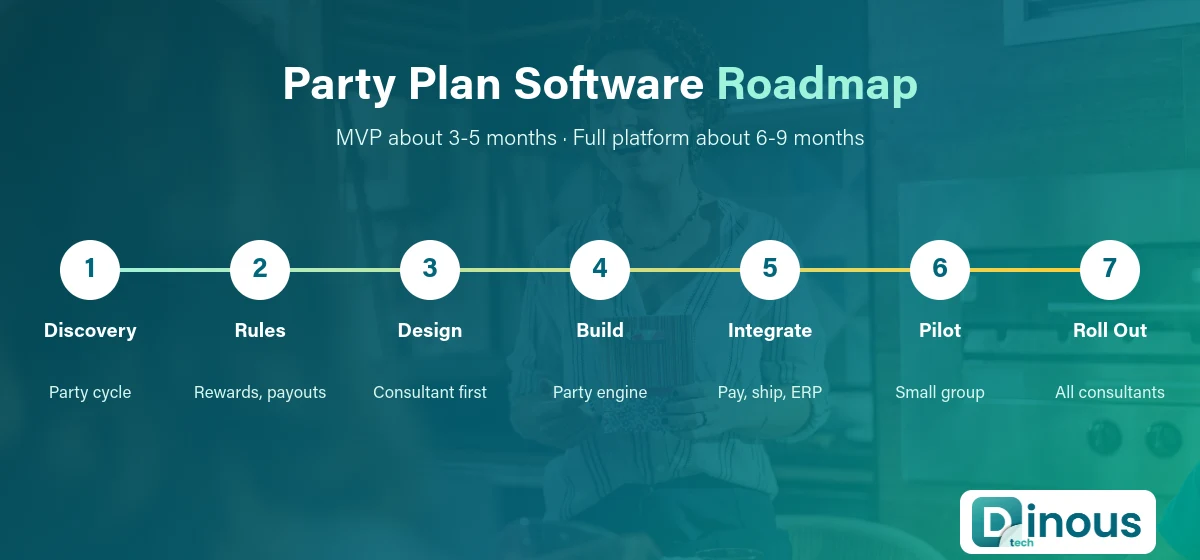
- Discovery: map your party cycle, host reward rules, compensation plan, countries and current tools.
- Rules document: write every reward and commission rule with worked examples, so developers and finance agree before coding.
- UX design: design the consultant app first, because consultants use it every day; then host and guest screens.
- Core build: catalogue, party engine, cart and checkout, rewards, orders and the admin panel.
- Commission engine: build and test with real historical data before go-live.
- Integrations: payment gateway, shipping, tax, email and SMS, ERP or warehouse system.
- Pilot: launch with a small group of consultants, fix issues, then roll out.
- Migration: if you are moving from another platform, follow a careful plan like the one in our MLM software migration guide.
Tech Stack for Party Plan Software
| Layer | Common choices |
|---|---|
| Consultant and guest apps | Flutter or React Native for Android and iOS |
| Web shop and back office | React or Next.js |
| Backend | Node.js, Laravel or Java |
| Database | PostgreSQL or MySQL, Redis for caching |
| Payments | Stripe, PayPal, Razorpay or a local gateway |
| Live video | Agora, Twilio, or social live stream links |
| Cloud | AWS, Google Cloud or Azure |
How Dinoustech Uses AI in Party Plan Software
AI-assisted development: our team uses AI coding and testing tools for routine work such as screens, API code and test cases, while senior developers own the commission logic and reviews. This saves time without risking payout accuracy.
AI features inside the platform:
- Product suggestions for guests based on what similar guests ordered
- Draft follow-up messages and social captions for consultants, which they can edit before sending
- Reorder and host-booking reminders based on purchase history
- Simple insights for leaders, such as which consultants need help this month
AI support agent: a chat assistant can answer consultant questions about orders, rewards and policies from your own documents, and pass complex issues to your support team. Read more in how AI can automate MLM business management.
Compliance and Trust
Direct selling rules differ by country. Your platform should make it easy to show clear income disclosures, keep records of product sales to real customers, handle refunds and cooling-off periods, collect tax correctly and protect personal data under laws such as GDPR. Commission calculations should be transparent and auditable. This is general information, not legal advice; please confirm requirements with a lawyer in each country where you operate.
Cost Factors
We do not quote a fixed price without understanding your plan, but these factors drive cost the most:
- Number of user types and apps (consultant, host, guest, admin, warehouse)
- Complexity of host reward and commission rules
- Number of countries, currencies and tax rules
- Virtual party features such as live video
- Integrations with ERP, warehouse, shipping and accounting
- Data migration from an existing platform
- AI features and reporting depth
For a quick estimate, try our free app cost calculator.
Timeline
| Scope | Typical time |
|---|---|
| MVP: party engine, web shop, consultant back office, basic rewards and commission | About 3 to 5 months |
| Full platform: mobile apps, virtual parties, multi-country, ERP integration | About 6 to 9 months |
| Migration from an existing platform | Add about 1 to 2 months |
These are honest ranges. Clear rules and fast feedback from your team shorten the timeline. For a closer look at timelines for network marketing software, see how long it takes to develop MLM software.
Common Challenges
- Unclear reward rules: every edge case (returns, late orders, split shipping) must be written down before coding.
- Peak loads: launch days and live parties create traffic spikes, so plan for scaling.
- Consultant adoption: if the app is hard to use, consultants go back to spreadsheets and chat apps.
- Returns and adjustments: commissions and host rewards must reverse correctly when orders are refunded.
- Data quality: migrations fail when genealogy and order history are messy, so clean data early.
Party Plan Features by Product Category
The core party engine is the same for most brands, but each product category needs a few extra features. Plan these early so they are part of the first release, not an afterthought.
| Category | Extra features to consider |
|---|---|
| Cosmetics and skincare | Shade finder or skin quiz, sample tracking, reorder reminders when products run out |
| Kitchenware and home | Recipe content, product demo videos, bundle pricing and host-exclusive items |
| Jewellery and fashion | Size guides, wish lists, limited drops and look books |
| Wellness and supplements | Subscriptions, autoship, compliance checks on product claims |
| Candles and gifts | Seasonal catalogues, gift wrapping and ship-to-guest options |
Metrics to Track in a Party Plan Business
Good software does not only process orders. It shows leaders what is working. Build these reports into the admin panel and the consultant app:
- Average party sales: total sales divided by closed parties, by consultant and by region.
- Guests per party: a simple sign of how well hosts are inviting.
- Booking rate: how many new parties each party creates. This is the engine of growth.
- Recruiting rate: how many guests or hosts become consultants.
- Customer retention: how many guests buy again within 90 days.
- Consultant activity: share of consultants who held at least one party this month.
- Host reward cost: rewards as a share of party sales, so finance can keep the plan profitable.
When consultants can see their own numbers in the app, they know what to improve next, and leaders can coach with facts instead of guesses.
Why Choose Dinoustech for Party Plan Software?
Dinoustech is a software development company based in Jaipur, India, with a team that has 7+ years of experience and 450+ projects delivered across mobile apps, web platforms and custom software. We build MLM and direct selling software, distributor mobile apps and eCommerce platforms, so we understand both the selling side and the commission side.
- Rules-first approach with worked examples signed off before coding
- Cross-platform apps to save time and cost
- Fixed milestones, regular demos and clear communication
- Support and maintenance after launch
You can see our work on the portfolio page. Ready to plan your party plan platform? Contact Dinoustech for a free consultation.