Dinoustech Private Limited
Outsourcing App Development to India: A Practical Guide for US Startups
Outsourcing app development to India is a common choice for US startups that want to build faster and stretch their runway. Many founders work with Indian teams to build MVPs, scale products and add developers without the cost and time of hiring locally. Done well, it gives you a skilled team, lower costs and progress around the clock. Done badly, it leads to missed deadlines, poor code and frustration. The difference is almost always in how you choose a partner and how you work together.
This practical guide is written for US founders and product leaders. It covers why startups outsource to India, what to outsource, how to choose a partner, how to manage the time difference, contracts and IP, costs, and a step-by-step plan for your first 90 days. For more about working with us from the US, see our app development company for the USA page.
Key Takeaways
- India offers a large, experienced talent pool at rates usually much lower than in the US.
- The time difference can be an advantage: daily overlap hours plus overnight progress.
- Pick partners by proven work, process and communication, not the lowest quote.
- Protect yourself with clear contracts, IP assignment, NDAs and code in your own repository.
- Start with a small paid milestone, then scale the relationship.
Table of Contents
- Why US Startups Outsource to India
- What to Outsource (and What to Keep)
- Engagement Models
- How to Choose a Partner
- Making the Time Difference Work
- Contracts, IP and Security
- Costs and Budgeting
- Your First 90 Days
- How Dinoustech Uses AI
- Mistakes to Avoid
- Who Does What in an Outsourced Project
- A Simple Weekly Communication Rhythm
- Why Dinoustech
Why US Startups Outsource App Development to India
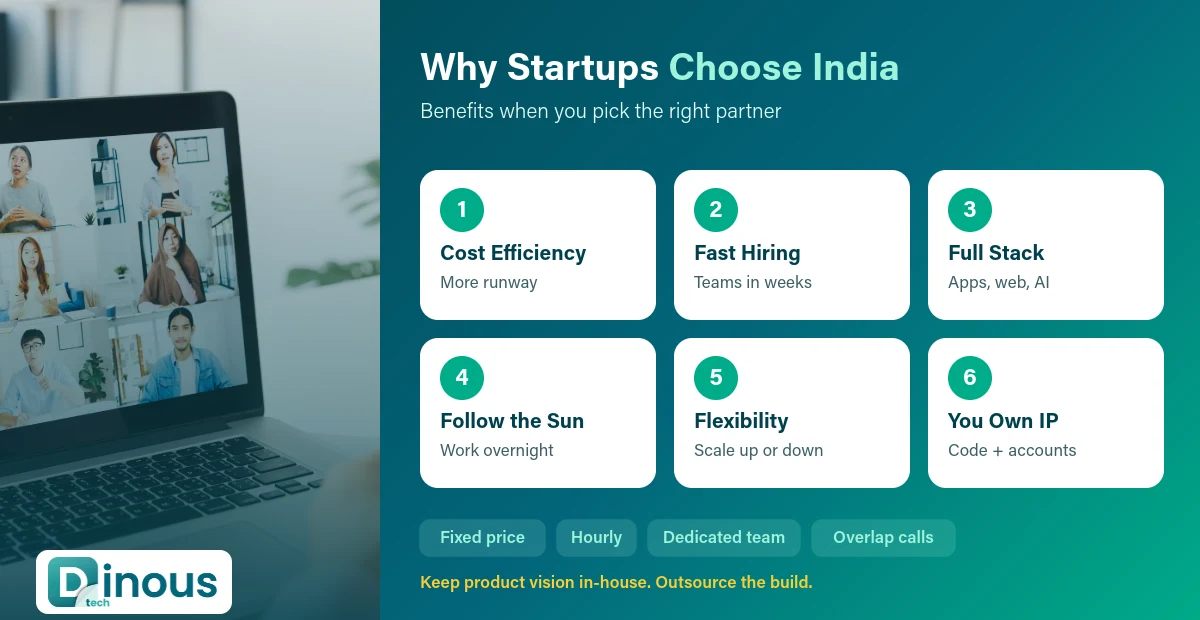
- Cost efficiency: similar experience usually costs a fraction of US rates, so your seed round goes further. Our India vs USA vs UK cost comparison shows the gap.
- Speed to hire: a team can often start in days or weeks, not months.
- Full-stack capability: designers, mobile and web developers, QA, DevOps and AI engineers in one place.
- Follow-the-sun progress: you review work in the morning that was done overnight.
- Flexibility: scale the team up after funding or down between phases.
What to Outsource (and What to Keep In-House)
| Good to outsource | Usually keep in-house |
|---|---|
| MVP and version one builds | Product vision and priorities |
| Mobile apps (Android, iOS, cross-platform) | Customer relationships and sales |
| Web apps, admin panels and APIs | Final decisions on architecture (with advice) |
| QA and test automation | Sensitive business data access policies |
| Maintenance and feature updates | Fundraising and investor relations |
| AI features and integrations | Brand and company culture |
Even without a technical co-founder, keep a product owner on your side who decides what gets built and why.
Engagement Models
- Fixed price: best for a clear MVP scope.
- Hourly (time and materials): best for evolving products.
- Dedicated team: best for long-term development with a monthly cost per person.
A common path is fixed price for the MVP, then a dedicated team after launch. Our MVP app development guide explains how to scope version one.
How to Choose an Indian App Development Partner
- Portfolio: look for live apps similar to yours in complexity or industry.
- References: ask to speak with clients, ideally from the US.
- Process: sprints, demos, code reviews, testing and documentation.
- Communication: fluent English, quick responses and named contacts.
- Team stability: ask how they handle developer changes.
- Security practices: access control, NDAs, secure handling of your data.
- Trial: start with a paid discovery or small milestone.
For a wider view of rates and roles, read our guide on the cost to hire app developers in India.
Making the Time Difference Work
India Standard Time is roughly 9.5 to 12.5 hours ahead of US time zones, depending on the zone and daylight saving. Good teams turn this into an advantage:
- Agree on 2 to 4 overlap hours, often early morning US time or late evening India time.
- Hold a short daily call or async update.
- Use a shared board (Jira, Trello, Linear) and Slack for quick questions.
- Write clear tasks with acceptance criteria so work never waits for answers.
- Review demos at the end of each sprint.
At Dinoustech, many of our developers are available for calls in US time, which makes collaboration much easier.
Contracts, IP and Security
- Sign an NDA before sharing details.
- Make sure the contract assigns all IP and source code to your company on payment.
- Keep code in your own GitHub or GitLab account, and cloud services in your own accounts.
- Define milestones, acceptance criteria, payment terms and a warranty period.
- Include data protection terms if you handle personal data (for example health or financial data).
- Agree on handover documentation and exit terms.
This is general guidance, not legal advice. Ask a US lawyer to review your contract.
Costs and Budgeting
Your budget depends on scope, team size and model. As a planning example, many MVPs built by mid-level Indian agencies fall roughly in the ₹4 to 20 lakh range (about $4,500 to $22,700), depending on roles, features and integrations. Plan extra for design, QA, project management, cloud, third-party services and maintenance. See app development cost in India for details, and get a quick estimate with our app cost calculator.
Your First 90 Days
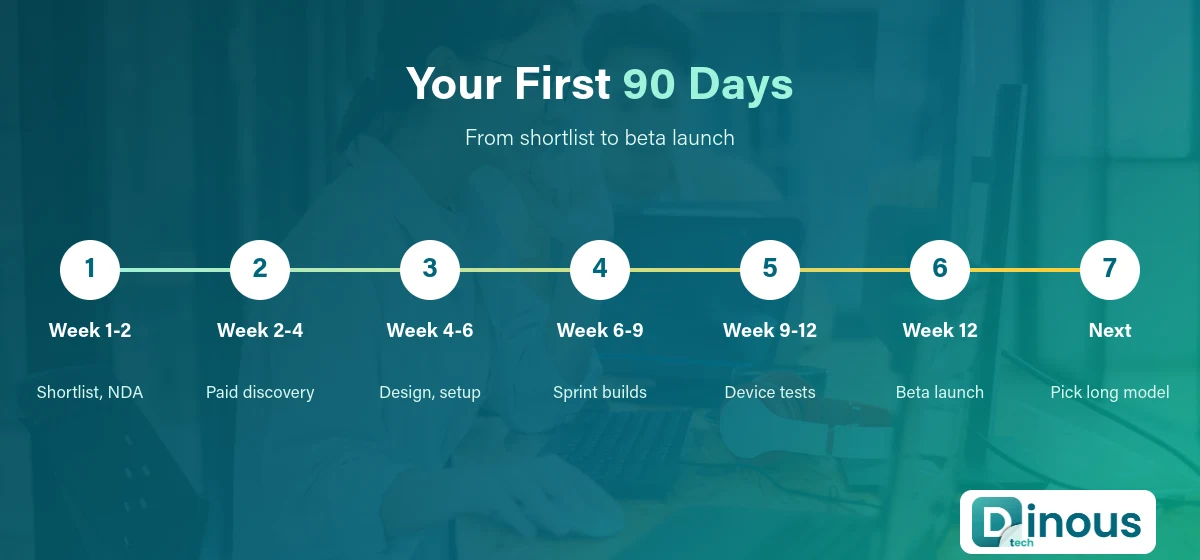
- Weeks 1 to 2: shortlist partners, hold calls, check references, sign NDA.
- Weeks 2 to 4: paid discovery: user flows, scope, design direction, estimate and plan.
- Weeks 4 to 6: design and approve key screens; set up repo, board and communication.
- Weeks 6 to 12: build in sprints with demos; test on real devices.
- Week 12 onward: beta launch, feedback and next roadmap; decide on the long-term model.
How Dinoustech Uses AI
AI-assisted development: our developers use AI tools for routine coding, test generation and documentation, with senior review, which speeds up delivery for US clients.
AI features in your app: chat assistants, smart search, recommendations and automation using proven AI APIs. See our AI app development services.
AI support agent: we can add an AI assistant that answers user questions around the clock, so a small US team can support more users.
Mistakes to Avoid
- Choosing only on price.
- Starting a large project without a trial milestone.
- Vague requirements and no product owner.
- Code and accounts owned by the vendor.
- No overlap hours or regular demos.
- Skipping QA to save money.
Who Does What in an Outsourced Project
| Role | Usually on your side | Usually on the partner's side |
|---|---|---|
| Product owner | Yes: sets priorities and accepts work | Supports with suggestions |
| Project manager | Optional | Yes: plans sprints and reports progress |
| Designers and developers | Optional | Yes |
| QA and testing | User acceptance testing | Yes: functional and regression testing |
| DevOps and hosting | Owns the cloud accounts | Sets up and manages under your accounts |
Clear roles prevent the most common outsourcing problem: everyone assumes someone else is responsible.
A Simple Weekly Communication Rhythm
- Daily: a short written update (done, next, blockers) posted in Slack or a similar tool, plus a 15-minute call during overlap hours if needed.
- Weekly: a progress review with the project manager covering the plan, risks and budget.
- Every sprint (1 to 2 weeks): a live demo of finished work and a planning call for the next sprint.
- Monthly: a roadmap review: what we learned from users and what changes next.
Record decisions in one shared place, such as the project board or a simple decisions document. This keeps everyone aligned across time zones and makes onboarding new team members much easier.
Red flags to watch for
- No demos for several weeks
- Vague answers to direct questions about progress
- Frequent unexplained changes in team members
- Refusal to give you repository or hosting access
Why US Startups Choose Dinoustech
Dinoustech is a software development company in Jaipur, India, founded in 2024, with a team that has 7+ years of experience and 450+ projects delivered. We build mobile apps, web platforms, SaaS products and AI solutions for startups and businesses worldwide.
- Developers available for calls in US time
- Fixed price, hourly or dedicated team models
- Full IP ownership and NDA
- Weekly demos and transparent reporting
See our portfolio, our startups page, or contact us to plan your project.