Dinoustech Private Limited
MVP Development Cost in 2026: What a $10K, $25K and $50K Budget Gets You
MVP development cost in 2026 depends on what you need to prove, not on how many features you can squeeze in. A minimum viable product is the smallest version of your app that real users can use and pay for, so you can learn whether the idea works before you spend on a full product. With an experienced offshore team, many founders launch a useful MVP for somewhere between $10,000 and $50,000. Where you land in that range depends on user roles, integrations, platforms and how polished the first version needs to be.
This guide explains what a $10K, $25K and $50K budget can realistically cover, what drives MVP cost up or down, hidden costs to plan for, and how to get the most out of your budget. These are planning ranges, not fixed quotes. For a quick estimate based on your own feature list, use our free app cost calculator.
Key Takeaways
- An MVP should test one core promise to one clear audience, not launch every idea at once.
- Around $10K usually fits a single-role app or clickable-plus-working prototype; around $25K a solid two-role MVP; around $50K a multi-role MVP with payments and integrations.
- Team location changes the total more than anything else: the same scope can cost several times more with onshore teams in the USA or UK.
- Plan 15 to 25 percent of the build budget for the first year of hosting, tools, fixes and small improvements.
- Cross-platform frameworks, ready-made services and a strict scope are the best ways to stretch an MVP budget.
Table of Contents
- What Counts as an MVP?
- What $10K, $25K and $50K Can Get You
- MVP Budget by App Type
- What Drives MVP Cost
- Where the Money Goes
- How Team Location Changes the Cost
- Fixed Price, Hourly or Dedicated Team?
- Hidden Costs to Plan For
- How to Get More From Your MVP Budget
- How Dinoustech Uses AI to Lower MVP Cost
- MVP Timeline
- Budget Mistakes to Avoid
- Why Dinoustech
What Counts as an MVP?
An MVP is not a demo or a mock-up. It is a working product that solves one core problem well enough that early users will use it, give feedback and, ideally, pay. It usually includes the main user flow, a basic admin panel, analytics and enough polish to feel trustworthy. It leaves out nice-to-have features, advanced automation and complex dashboards until real usage shows they are needed.
If you want the full step-by-step build process, read our MVP app development guide. This article focuses on budget: what you can expect to get for your money.
What $10K, $25K and $50K Can Get You
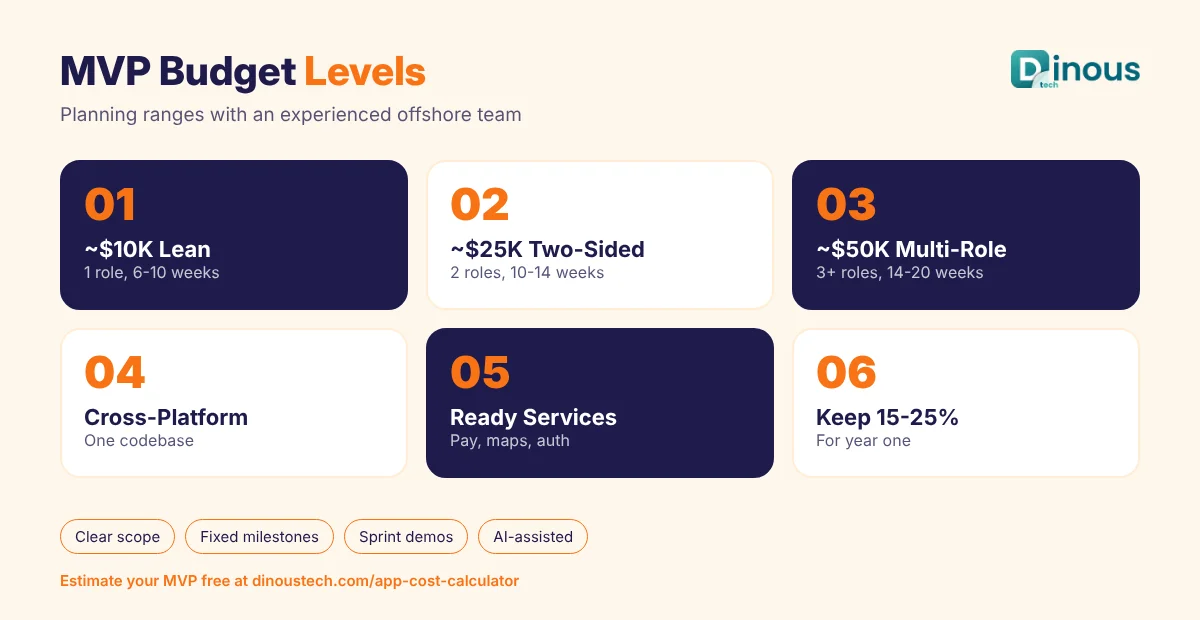
The ranges below assume an experienced offshore team (for example in India), cross-platform development and a clear scope. They are guides for planning, not quotes, and real numbers depend on your exact features.
Around $10,000: a lean, single-purpose MVP
- One user role and one core flow (for example, book a service, log a habit, request a quote)
- About 8 to 12 screens, login, profile and notifications
- Simple admin panel to manage users and content
- One platform, or cross-platform with a simple design
- One or two integrations, such as payments or email
- Typical time: about 6 to 10 weeks
Best for: testing demand quickly, internal tools, pilots with a few customers, or a no-frills version to show investors.
Around $25,000: a solid two-sided MVP
- Two user roles, such as customer and provider, or buyer and seller
- About 15 to 25 screens with a custom design
- Payments, in-app chat or notifications, ratings and basic search
- Android and iOS from one codebase, plus a web admin panel
- Basic analytics and crash reporting
- Typical time: about 10 to 14 weeks
Best for: marketplaces, booking apps, B2B tools and startups preparing for a first funding round.
Around $50,000: a multi-role MVP ready to scale
- Three or more roles (for example customer, vendor and delivery partner) with separate apps or panels
- Real-time features such as live tracking, video calls or chat
- Several integrations: payments, maps, KYC, CRM or third-party APIs
- An AI feature such as smart search, a chat assistant or recommendations
- Stronger security work, automated tests and a scalable cloud setup
- Typical time: about 14 to 20 weeks
Best for: taxi, delivery, fintech and healthcare MVPs, or funded startups that need a product strong enough for paying customers from day one.
MVP Budget by App Type
Different products need different starting points. This table shows which budget level usually fits common MVP types. Your own feature list can move a project up or down a level.
| App type | Usual budget level | Why |
|---|---|---|
| Booking or appointment app | Lean to two-sided | Calendar, payments and reminders are well-known patterns |
| Habit, fitness or content app | Lean | One user role, simple admin, few integrations |
| Service marketplace | Two-sided | Buyers, sellers, payments, ratings and chat |
| eCommerce app with vendors | Two-sided to multi-role | Catalogue, cart, orders, vendor panel, delivery |
| Taxi or delivery app | Multi-role | Rider, driver and admin, live tracking, dispatch |
| Fintech or healthcare app | Multi-role | Compliance, security reviews and sensitive integrations |
| SaaS dashboard for businesses | Two-sided | Accounts, roles, billing and reports |
| AI-first product | Lean to multi-role | Depends on data work, integrations and running costs |
What Drives MVP Cost
| Factor | Lower cost | Higher cost |
|---|---|---|
| User roles | One role | Three or more roles with separate panels |
| Platforms | One app or cross-platform | Separate native iOS and Android apps plus web |
| Design | Clean standard UI | Custom illustrations, animations, complex dashboards |
| Real-time features | None | Live tracking, video, chat, live updates |
| Integrations | One or two | Many, including banking, health or government APIs |
| Compliance | Basic privacy | HIPAA, GDPR, PCI DSS, KYC/AML |
| AI features | None or one simple API | Custom models, agents, heavy data work |
| Team | Offshore development company | Onshore agency in the USA, UK or Australia |
Where the Money Goes
A typical MVP budget splits roughly like this. The exact share changes from project to project.
| Phase | Typical share of budget |
|---|---|
| Discovery and planning | 5 to 10% |
| UX/UI design | 10 to 15% |
| Development (apps, backend, admin) | 50 to 60% |
| Testing and quality | 10 to 15% |
| Launch, deployment and project management | 5 to 10% |
Cutting discovery and testing to save money is a false economy. Unclear scope and late bugs are the most common reasons MVPs go over budget.
How Team Location Changes the Cost
Build hours for the same MVP are similar everywhere. What changes is the hourly rate. Offshore teams in India usually charge a fraction of onshore rates in the USA, UK or Australia, which is why many startups build their MVP with an offshore partner and keep product ownership in-house. For a detailed comparison, read app development cost in India vs USA vs UK and our guide to app development cost in India.
If you are based abroad, our pages for clients in the USA, UK, UAE and Australia explain how we work across time zones.
Fixed Price, Hourly or Dedicated Team for an MVP?
How you pay also affects your total cost and risk:
- Fixed price: works well when the MVP scope is clear and written down. You know the total upfront, and changes go through a simple change request.
- Hourly (time and materials): flexible when the idea is still moving, but the final cost is harder to predict. Weekly reports and caps help keep it under control.
- Dedicated team: best after the MVP, when you have a long roadmap and want the same developers every month.
Many founders use a short paid discovery phase first, then a fixed-price MVP, then a dedicated team for growth. This keeps early risk low and gives you a clear number to plan around.
Hidden Costs to Plan For
- Hosting and cloud services: servers, databases, storage and backups.
- Third-party services: maps, SMS, email, video, payment gateway fees and AI API usage.
- App store accounts: Apple and Google developer accounts.
- Legal and compliance: privacy policy, terms and any compliance reviews.
- Post-launch fixes: real users always find issues testers missed.
- Small improvements: the first feedback usually leads to quick changes.
- Marketing: an MVP needs users to learn anything.
A simple rule: keep 15 to 25 percent of the build budget aside for the first year of running and improving the product. Our software maintenance services cover this phase.
How to Get More From Your MVP Budget
- Write down the one thing to prove. Every feature should help test that promise.
- Cut features ruthlessly. Move anything that is not needed for the first paying user to version two.
- Go cross-platform. Flutter or React Native gives Android and iOS from one codebase.
- Use ready services. Authentication, payments, maps and notifications should be integrated, not built from scratch.
- Keep the admin simple. A basic panel is enough until volume grows.
- Agree on fixed milestones. Pay per phase with demos, so you see progress before each payment.
- Measure from day one. Analytics tell you which features to build next, so you do not waste money guessing.
How Dinoustech Uses AI to Lower MVP Cost
- AI-assisted development: our developers use AI tools for boilerplate code, tests and documentation, which saves hours on routine work.
- Faster planning: AI helps turn your idea and notes into structured user stories and screen lists, which our team then reviews with you.
- AI features without big budgets: chat assistants, smart search and recommendations can be added through proven AI APIs instead of costly custom models.
- AI support after launch: an AI support agent can answer common user questions so a small team can handle more customers.
If AI is the core of your product, our AI agent development cost guide explains build and running costs in detail.
MVP Timeline
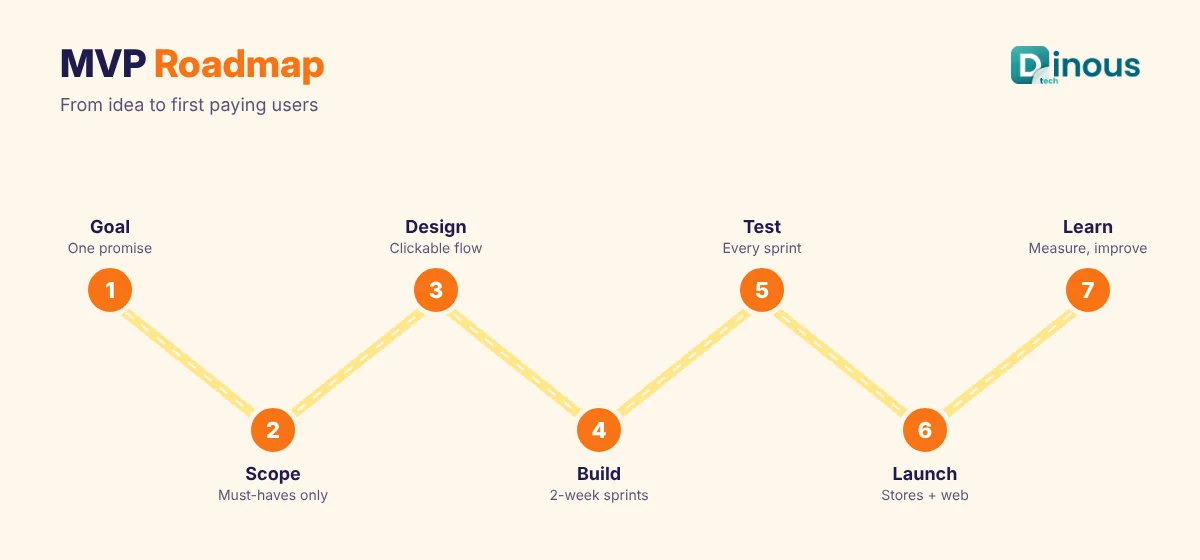
| Budget level | Typical timeline |
|---|---|
| Lean MVP (around $10K) | About 6 to 10 weeks |
| Two-sided MVP (around $25K) | About 10 to 14 weeks |
| Multi-role MVP (around $50K) | About 14 to 20 weeks |
For timelines by app type, read how long it takes to build an app.
Budget Mistakes to Avoid
- Building the full product and calling it an MVP
- Choosing the cheapest quote without checking past work and process
- Skipping discovery, then paying for rework later
- Spending the whole budget on the build and nothing on launch and users
- Changing scope every week during development
- Ignoring code ownership and documentation in the contract
Why Dinoustech
Dinoustech has delivered 450+ projects, and our team brings 7+ years of experience in mobile app development, web platforms and SaaS products. We help founders shape the right MVP scope, then build it in short sprints with working demos.
- Clear scope and a phase-by-phase estimate before work starts
- Milestone-based payments and full code ownership
- Cross-platform builds and AI-assisted development to save time and cost
- Support after launch as you grow from MVP to full product
See our work in the portfolio.
Have an MVP idea and a budget in mind? Share both, and we will tell you honestly what fits and what should wait for version two. Talk to Dinoustech.