Dinoustech Private Limited
Taxi Dispatch Software Development: How to Build a Dispatch System for Fleet Operators
A taxi business runs on one question asked thousands of times a day: which driver should take this ride? Answer it well and cars stay busy, passengers wait less and drivers earn more. Answer it badly and you pay for empty miles, missed airport pickups and angry customers. That is the job of a dispatch system. This guide explains taxi dispatch software development for fleet operators: what a dispatch system does, the modules it needs, how auto-dispatch works, which features matter for airports and corporate accounts, the tech stack, AI capabilities, cost factors and timeline. It is written for taxi companies, private hire operators, limousine and chauffeur services, and transport startups worldwide, from the USA, UK and Europe to the UAE and Australia.
Dinoustech is a taxi booking app development company that builds passenger apps, driver apps and dispatcher dashboards for fleets of every size. The guidance below comes from the operational questions our clients raise most often when they move from phone-and-radio dispatch to a modern system.
Key Takeaways
- Taxi dispatch software connects passenger bookings, drivers and dispatchers in one real-time system.
- A complete platform has five parts: passenger app, driver app, dispatcher dashboard, admin panel and a backend with a dispatch engine.
- Auto-dispatch assigns rides by distance, ETA, vehicle type, driver status and business rules, with manual override for dispatchers.
- Bookings arrive from many channels (app, web, phone, corporate portals, messaging) and should land in one queue.
- Airport flight tracking, pre-booked rides, corporate billing and driver compliance tracking separate professional fleets from basic apps.
- AI improves dispatch with demand forecasting, smarter matching and a support agent that handles routine passenger and driver questions.
Table of Contents
- What Is Taxi Dispatch Software?
- Dispatch Software vs a Ride-Hailing App
- Core Modules of a Taxi Dispatch System
- How Auto-Dispatch Works
- Must-Have Features for Fleet Operators
- Advanced Features: Airports, Corporate Accounts and Multi-Service Fleets
- Taxi Dispatch Software Development Process
- Recommended Tech Stack
- How Dinoustech Uses AI in Dispatch Software Development
- Compliance and Safety Considerations
- Custom Dispatch Software vs Off-the-Shelf SaaS
- Cost Factors
- Development Timeline
- Common Challenges and How to Solve Them
- Why Choose Dinoustech
- FAQs
What Is Taxi Dispatch Software?
Taxi dispatch software is the system a fleet uses to receive ride requests, choose the right driver and vehicle, send the job to that driver and track the trip until payment. It replaces whiteboards, radio calls and spreadsheets with a live map and a set of rules.
In a modern setup, a passenger books through an app, website or phone call. The dispatch engine finds suitable drivers nearby, offers the job, and the chosen driver accepts it in the driver app. Dispatchers watch everything on a dashboard and step in when something needs a human decision. Managers see revenue, utilisation and driver performance in the admin panel.
Dispatch Software vs a Ride-Hailing App
People often use these terms together, but the focus is different. A ride-hailing app like Uber is built around an open marketplace of independent drivers. Dispatch software is built for an operator that manages its own fleet, drivers, contracts and service standards.
| Aspect | Ride-hailing marketplace | Fleet dispatch system |
|---|---|---|
| Main user | Passengers and independent drivers | Dispatchers, fleet managers, drivers and passengers |
| Booking channels | Mostly the passenger app | App, web, phone, corporate portals, hotels, messaging |
| Ride types | Mostly on-demand | On-demand, pre-booked, recurring, airport, contract work |
| Control | Algorithm decides | Rules plus dispatcher override |
| Billing | Card at end of trip | Card, cash, account billing, invoices |
If you want a consumer-facing app on top of your fleet, our guide to building a cab booking app like Uber covers the passenger side in detail. This article focuses on the dispatch and operations layer underneath.
Core Modules of a Taxi Dispatch System
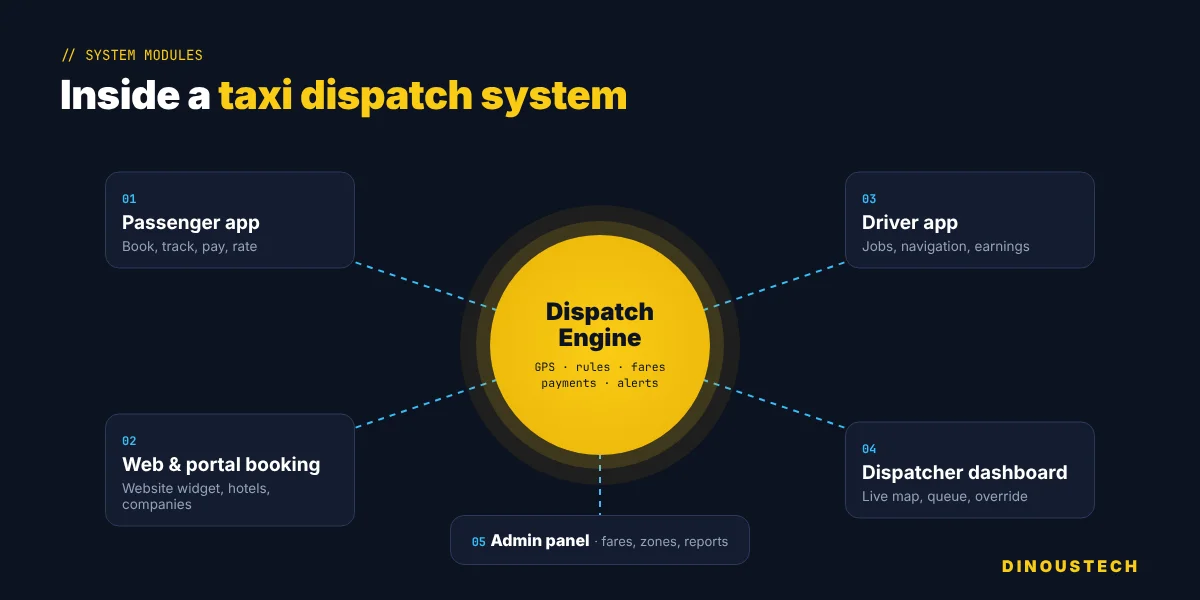
1. Passenger app and web booking
Book now or later, pick vehicle type, see fare estimate, track the driver live, pay in the app and rate the ride. A web booking widget lets you take bookings from your website too.
2. Driver app
Go online and offline, receive and accept jobs, navigate, update trip status, take payments, view earnings and upload documents. It must work well on weak mobile networks and use battery efficiently.
3. Dispatcher dashboard
A live map of all vehicles and jobs, a booking queue, quick phone booking entry, manual assignment by drag and drop, alerts for delayed or unassigned jobs, and two-way messaging with drivers.
4. Admin panel
Fare and zone setup, driver and vehicle management, document expiry tracking, corporate accounts, promotions, reports and user roles.
5. Backend and dispatch engine
The core that stores bookings, tracks GPS positions in real time, applies dispatch rules, calculates fares, handles payments and sends notifications. Our article on how GPS technology improves taxi booking apps explains the location layer in more depth.
How Auto-Dispatch Works
Auto-dispatch is the heart of the system. When a booking arrives, the engine:
- Finds candidates: online drivers within a search radius or zone with the right vehicle type and capacity.
- Scores them: by real ETA (not straight-line distance), idle time, current trip ending soon, driver rating and any priority rules.
- Offers the job: to the best driver first, or to several drivers at once, depending on your policy.
- Waits for acceptance: with a short timeout, then moves to the next candidate.
- Escalates: unassigned jobs go to a dispatcher with an alert before the pickup time is at risk.
Common dispatch strategies include nearest driver, first in queue in a zone (useful at taxi ranks and airports), broadcast to several drivers, and batch matching that looks at many bookings and drivers together to reduce total wait time. A good system lets the operator choose and tune these strategies per zone and per time of day.
Must-Have Features for Fleet Operators
Booking and dispatch
- Multi-channel booking queue (app, web, phone, partner portals).
- Pre-booked and recurring rides with automatic dispatch before pickup time.
- Zone and rank management with driver queues.
- Manual override, reassignment and job splitting for dispatchers.
- Caller ID lookup for phone bookings and saved passenger addresses.
Driver and vehicle management
- Driver onboarding with document upload and expiry reminders (licence, insurance, permits).
- Vehicle profiles with type, capacity and accessibility features.
- Shift and availability tracking.
- Driver earnings, commissions and settlement reports.
Fares and payments
- Fixed fares, metered fares, zone pricing and surcharges (night, airport, waiting time).
- Card, wallet and cash payments, plus account billing for business clients.
- Automatic receipts and monthly invoices.
Reporting
- Utilisation, empty miles, acceptance rate and average wait time.
- Revenue by zone, driver, channel and client.
- Service level reports for corporate contracts.
For passenger-facing features, see the top features every taxi booking app should include.
Advanced Features: Airports, Corporate Accounts and Multi-Service Fleets
Airport transfers
Flight number capture, live flight tracking that shifts pickup time when flights are delayed, meet-and-greet notes and terminal-specific pickup instructions.
Corporate and hotel accounts
A booking portal for companies and hotels, cost centres, approval rules, monthly invoicing and ride reports for travel managers.
Multi-service fleets
Many operators run more than taxis: chauffeur services, school runs, medical transport or parcel delivery. The dispatch engine should support different service types with their own rules, vehicles and pricing.
Partner and affiliate network
Pass overflow jobs to trusted partner fleets and receive jobs from them, with automatic settlement.
Messaging integration
Accept bookings and send ride updates through popular messaging apps, which many passengers prefer to downloading another app.
Taxi Dispatch Software Development Process
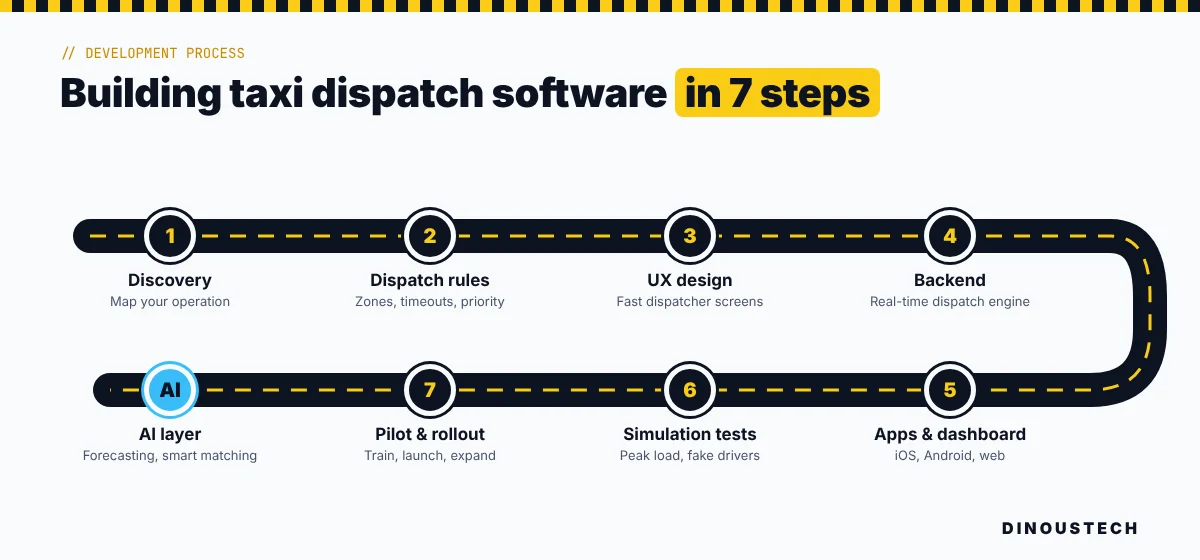
- Discovery: map your current operation, booking channels, ride types, pricing and pain points. Ride along with dispatchers if possible.
- Dispatch rules design: define zones, strategies, timeouts, priorities and escalation paths.
- UX design: design the dispatcher dashboard for speed (keyboard shortcuts, clear alerts), plus passenger and driver apps.
- Backend and real-time layer: booking service, location tracking, dispatch engine, fares and payments.
- Apps and dashboard: build iOS and Android apps and the web dashboard on shared APIs.
- Testing and simulation: test with simulated drivers and bookings at peak volume before real traffic.
- Pilot and rollout: launch with part of the fleet, train dispatchers and drivers, then expand.
Recommended Tech Stack
| Layer | Common choices |
|---|---|
| Passenger and driver apps | Flutter or React Native for cross-platform, or Swift and Kotlin for native |
| Dispatcher dashboard and admin | React or Angular web app |
| Backend | Node.js, Python or Java microservices |
| Real-time communication | WebSockets, MQTT, push notifications |
| Database | PostgreSQL with geospatial extensions, Redis for live driver locations |
| Maps and routing | Google Maps Platform, Mapbox or OpenStreetMap-based routing |
| Payments | Stripe, Adyen, PayPal or regional gateways |
| Cloud and monitoring | AWS, Google Cloud or Azure with logging and alerting |
The right stack depends on your fleet size, markets and existing systems. If your team prefers JavaScript across the stack, our guide to hiring dedicated Node.js developers covers what to look for.
How Dinoustech Uses AI in Dispatch Software Development
AI-assisted development
Our engineers use AI coding assistants to generate boilerplate, write test cases, review code and build realistic simulations of drivers and bookings for load testing. Senior developers review every change. This shortens delivery time without cutting corners on reliability, which matters for a system that runs 24/7.
AI features inside your dispatch system
- Demand forecasting: predicts busy zones and times from past bookings, events and weather so you can position drivers in advance.
- Smarter matching: learns from real ETAs, traffic patterns and acceptance behaviour to improve driver selection over time.
- ETA prediction: more accurate pickup and arrival times based on your own trip history.
- Anomaly and fraud detection: flags unusual routes, fake trips or payment issues for review.
- Voice and chat booking: AI that captures bookings from calls or messages and creates the job automatically for a dispatcher to confirm.
AI support agent for passengers, drivers and your team
An AI assistant can answer "where is my driver", lost item, receipt and fare questions for passengers, and payout or document questions for drivers, escalating anything sensitive to a human. For our clients, we also use AI support tools to answer project and maintenance questions quickly after launch. Read more in how AI is transforming taxi booking app development.
Compliance and Safety Considerations
Taxi and private hire rules vary by city and country. Your dispatch system should support the records and checks your licensing authority requires. Typical areas include:
- Driver and vehicle licence records with expiry alerts and automatic blocking when documents lapse.
- Trip records kept for the period your regulator requires.
- Fare rules that follow local tariffs and any limits on dynamic pricing.
- Data protection rules such as GDPR in Europe and the UK for passenger and driver data.
- Payment security through PCI DSS compliant gateways.
- Safety features: SOS button, trip sharing, driver identity checks.
This is general guidance, not legal advice. Please confirm requirements with your local licensing authority and legal advisor.
Custom Dispatch Software vs Off-the-Shelf SaaS
Ready-made dispatch SaaS products are quick to start and charge per vehicle or per month. They suit small fleets with standard needs. Custom dispatch software makes sense when:
- Per-vehicle fees become significant as the fleet grows.
- You need dispatch rules, pricing or service types the SaaS does not support.
- You want your own branded passenger and driver apps.
- You must integrate with accounting, HR, telematics or partner systems.
- You want to own your data and roadmap.
Many operators start with a white-label base and customise it, which balances speed and control. Our post on why your local taxi business needs a custom booking app covers the business case.
Cost Factors
Every fleet is different, so cost depends on scope. The main factors are:
- Number of apps and platforms (passenger, driver, dispatcher, admin, corporate portal).
- Complexity of dispatch rules and whether you need batch or AI-based matching.
- Booking channels and integrations (phone system, messaging, flight data, accounting).
- Number of countries, currencies and languages.
- Native vs cross-platform mobile apps.
- Expected peak load and uptime requirements.
- Ongoing hosting, maps usage and maintenance.
For a detailed breakdown, read our taxi app development cost guide.
Development Timeline
| Scope | What is included | Typical duration |
|---|---|---|
| MVP | Driver app, dispatcher dashboard, basic auto-dispatch, admin | About 3 to 4 months |
| Full platform | Plus passenger apps, web booking, payments, reports | About 4 to 6 months |
| Enterprise | Plus corporate portal, partner network, AI forecasting, multi-country | About 6 to 9 months |
These are honest ranges based on typical scope. Starting from a proven base can shorten them.
Common Challenges and How to Solve Them
- GPS jumps and poor signal: smooth location data, snap to roads and handle offline periods in the driver app.
- Drivers rejecting jobs: show fare and destination clearly, set fair timeouts and track acceptance rates.
- Dispatcher overload at peak times: automate routine jobs and alert humans only when needed.
- Peak traffic spikes: design for horizontal scaling and load-test before launch.
- Change resistance: involve dispatchers and drivers early, train them and roll out in phases.
Why Choose Dinoustech
- Full-cycle delivery: discovery, UX, apps, dispatcher dashboard, backend and support.
- Real-time and geolocation experience from multiple mobility projects, visible in our portfolio.
- Dispatch rules designed around your operation, not a template.
- AI in our development process and in the features we deliver.
- Cross-platform and native mobile app development expertise.
- Clients worldwide with clear communication and time-zone friendly updates.
Build Taxi Dispatch Software That Keeps Your Fleet Moving
Whether you run 20 cars or 2,000, the right dispatch system can cut wait times, reduce empty miles and give your team full control. Tell us about your fleet, booking channels and growth plans, and we will suggest the right scope. Contact Dinoustech to discuss your taxi booking app and dispatch software development project.