Dinoustech Private Limited
Airport Transfer App Development: How to Build a Pre-Booked Airport Ride Platform with Flight Tracking
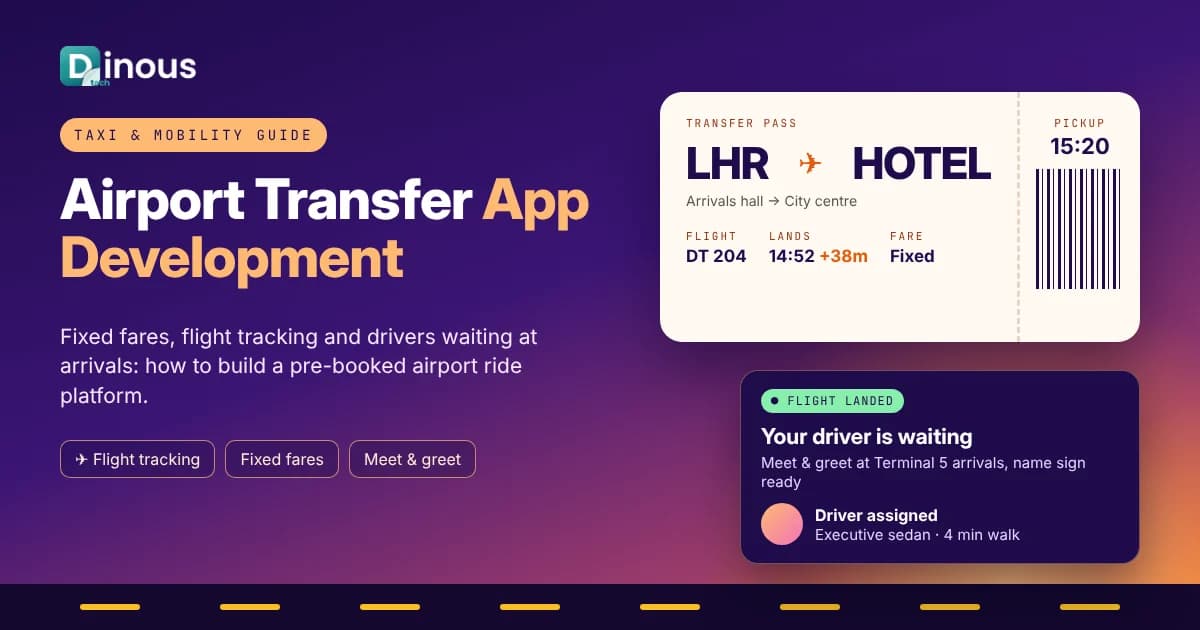
Airport rides are one of the most valuable trips in the ground transport business. Travellers book them in advance, they are willing to pay a fixed premium fare for certainty, and the same customer usually needs two rides: one to the airport and one back. Airport transfer app development is the work of building the software behind this business: a booking app where travellers enter their flight number and pay a fixed fare, a driver app that knows exactly when the flight lands, and an operator dashboard that plans pickups around real flight times instead of guesses. This guide explains how to build an airport transfer booking platform in 2026, covering business models, features, flight tracking, the development process, tech stack, AI, cost factors and timeline. It is written for taxi companies, chauffeur services, travel startups and fleet operators worldwide, from the USA, UK and Europe to the UAE and Australia.
Dinoustech is a taxi app development company that builds rider apps, driver apps, dispatch systems and admin panels for mobility businesses around the world. The guidance below comes from the questions transfer operators ask us before they start a project.
Key Takeaways
- An airport transfer app is a pre-booked ride platform built around flights: the booking stores a flight number, and the pickup time follows the real arrival time.
- The core product has four parts: a traveller app or website, a driver app, a dispatcher dashboard and an admin panel for fares, zones and partners.
- Fixed fares by zone, meet-and-greet, free waiting time and flight tracking are the features travellers expect before they book.
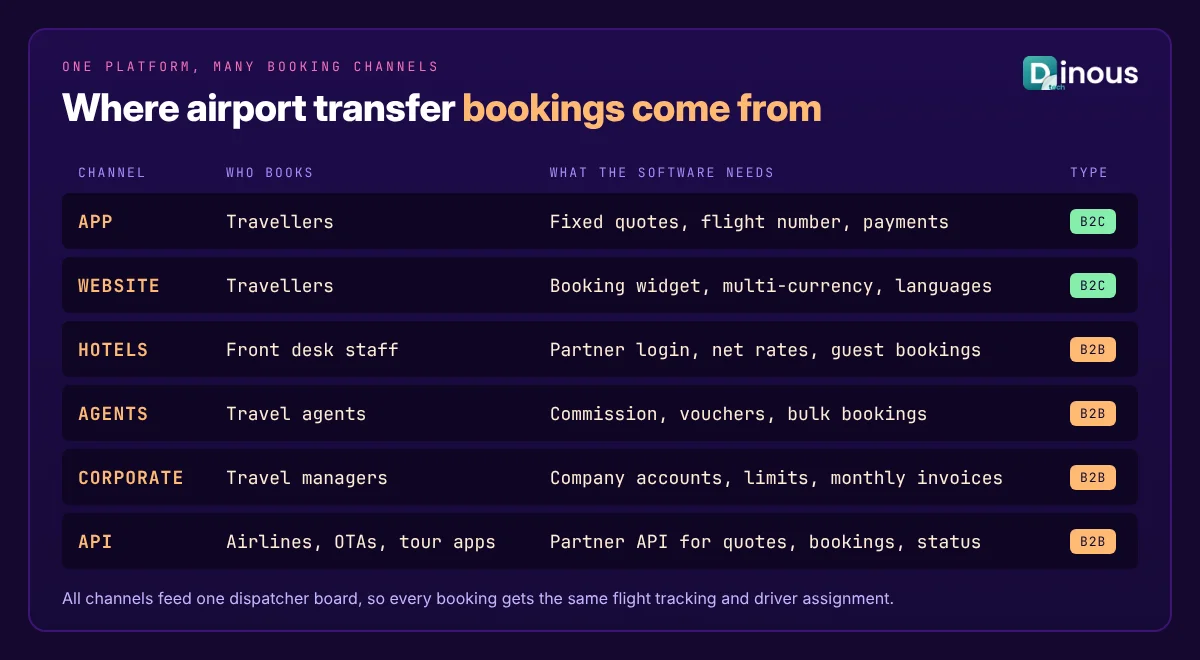
- Many transfer businesses earn a large share of bookings from partners such as hotels, travel agents and corporate travel teams, so plan B2B accounts and an API early.
- AI helps with arrival time prediction, driver planning for flight waves, pricing suggestions and a 24/7 support assistant, while people stay in charge of service decisions.
- A focused MVP usually takes about three to five months; cost depends on apps, integrations and how many cities and partners you launch with.
In this guide
Table of Contents
- What Is an Airport Transfer App?
- Airport Transfer Business Models
- How an Airport Transfer Booking Works
- Key Features for Travellers, Drivers and Operators
- Flight Tracking and Pickup Planning
- Development Process
- Recommended Tech Stack
- How Dinoustech Uses AI
- How Airport Transfer Apps Make Money
- Licensing, Safety and Data Privacy
- Cost Factors
- Development Timeline
- Common Challenges
- Why Choose Dinoustech
- Conclusion
What Is an Airport Transfer App?
An airport transfer app lets a traveller book a private ride between an airport and a hotel, home, office or cruise port before the trip starts. The traveller chooses a vehicle, sees a fixed price, adds a flight number and pays in advance. On the day of travel, the platform watches the flight, assigns a driver, tells the driver when to be at arrivals and sends the traveller the driver's name, photo, car and live location.
This is different from on-demand ride-hailing. In an app like Uber or Bolt, a rider taps a button and the nearest driver accepts within seconds. In an airport transfer app, most bookings arrive hours or days ahead, the price is agreed upfront, and the most important data is not the rider's GPS location but the flight's real arrival time. That changes the product design, the dispatch logic and the business model. If you want to compare the two models, read our guides on building a taxi app like Bolt and ride sharing app development.
Airport Transfer Business Models
Before you list features, decide which kind of transfer business the platform must support. The same core software can serve several models, but each one needs different screens and rules.
1. Single-fleet operator
A taxi or chauffeur company with its own cars and drivers moves airport bookings from phone and email to an app. The focus is on dispatch, driver scheduling and a smooth traveller experience under one brand.
2. Transfer marketplace
A platform that connects travellers with many local transfer companies in different cities or countries. It needs supplier onboarding, supplier price lists, booking hand-off to local partners, quality ratings and commission settlement.
3. Premium chauffeur service
Executive cars, business travellers and VIP clients. Meet-and-greet, named signs, driver dress code, child seats, multi-stop trips and monthly invoicing for companies matter more than the lowest fare.
4. Shuttle and shared transfers
Shared vans and buses that group travellers on similar flights and nearby hotels. The software must build routes, fill seats and handle fixed departure times.
5. B2B and white-label transfers
Hotels, travel agents, tour operators and airlines resell transfers to their own customers. They need partner accounts, net rates, booking widgets and an API. Our tour and travel app development team often connects these transfer modules with wider travel booking products.
How an Airport Transfer Booking Works
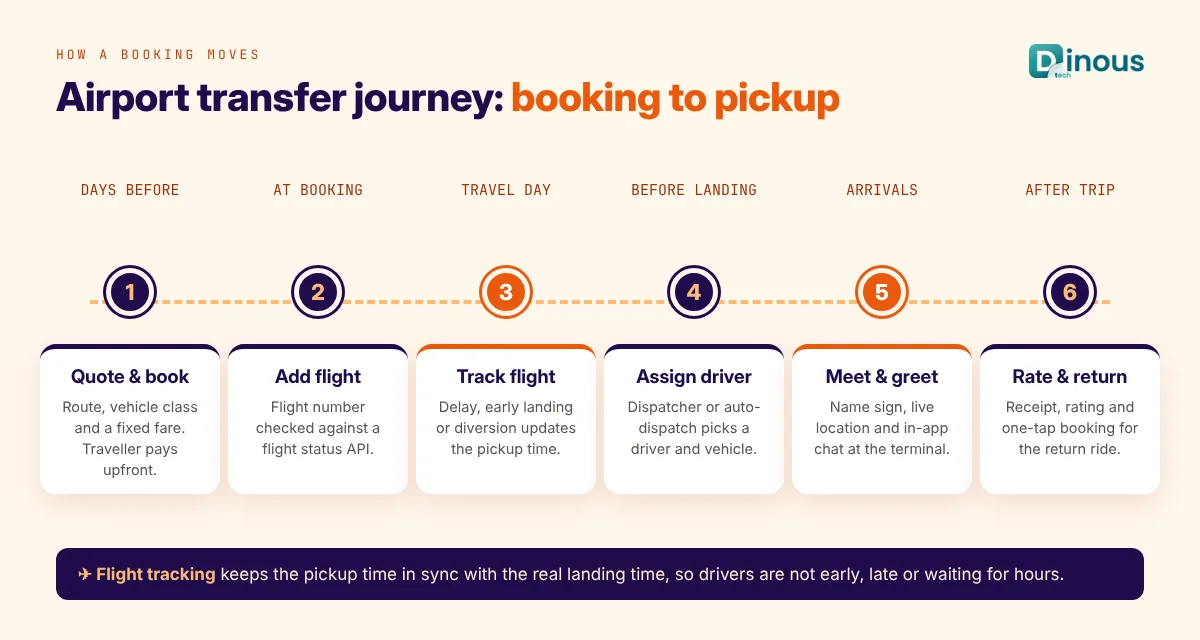
A typical arrival booking moves through these stages:
- Search and quote: the traveller enters the airport, destination, date, passengers and luggage. The app shows vehicle classes with fixed prices.
- Flight details: the traveller adds the flight number. The platform checks it against a flight data service and stores the scheduled arrival time.
- Payment and confirmation: the traveller pays by card, wallet or company account and gets a confirmation with the pickup instructions.
- Flight monitoring: on the day, the platform tracks departure, delays, diversions and landing.
- Driver assignment: the dispatcher or auto-dispatch assigns a driver and vehicle, and the pickup time shifts with the real landing time.
- Meet and pickup: the driver waits at arrivals with a name sign, or at a marked pickup point, and both sides can call or chat in the app.
- Trip and completion: live tracking during the ride, then a receipt, rating and, for the return trip, a one-tap rebooking.
Key Features for Travellers, Drivers and Operators
Traveller app and website
- Instant fixed-price quotes by airport, zone or distance, with vehicle classes (sedan, SUV, van, executive, accessible vehicle).
- Flight number entry with automatic pickup time, plus manual pickup time for departures.
- Options for meet-and-greet, child seats, extra luggage, pets and extra stops.
- Secure payments with cards, Apple Pay, Google Pay, wallets and multiple currencies.
- Driver details, live location, in-app chat or masked calling and clear arrival instructions for each terminal.
- Return trip booking, saved places, booking changes and a clear cancellation policy.
- Multi-language screens for international travellers.
Driver app
- Job list for the day with flight status, terminal and passenger notes.
- Automatic updates when a flight is delayed or lands early.
- "Arrived", "passenger on board" and "completed" status buttons, with waiting time recorded.
- Navigation, airport parking notes, earnings and document expiry reminders.
Dispatcher dashboard
- Live board of all arrivals and departures by hour, with flight status next to each booking.
- Manual and automatic driver assignment, driver availability and shift view.
- Alerts for unassigned jobs, late drivers and passengers who have not been found.
- Phone and email bookings entered by staff. Our guide on taxi dispatch software development covers this part in more depth.
Admin panel
- Fare rules by airport, zone, vehicle class, time of day and season, plus waiting time and night charges.
- Partner and corporate accounts with net rates, credit limits and monthly invoices.
- Supplier management for marketplaces: onboarding, price lists, ratings and payouts.
- Promo codes, refunds, reviews, reports and support tickets.
Flight Tracking and Pickup Planning
Flight tracking is the feature that makes an airport transfer app different from a normal taxi app. Without it, drivers wait for hours for delayed flights, or travellers land early and find nobody waiting. With it, the pickup time follows the plane.
Most platforms connect to a commercial flight status API. Several providers offer schedules, live status, gate and terminal data and delay events; choose one based on airport coverage, update speed and price per request. Good practice includes:
- Validate the flight number at booking so typing mistakes are caught before the travel day.
- Subscribe to status changes for booked flights instead of polling every flight every minute, to keep API costs down.
- Set a pickup buffer after landing, for example extra minutes for international arrivals with immigration and baggage, and less for domestic flights with hand luggage only.
- Keep a manual fallback. Some charter and private flights are not covered by flight data feeds, so dispatchers need to set times by hand.
- Show the traveller what is included, such as free waiting time after landing, and what happens if they are later than that.
GPS and geofencing also help at the airport: the app can detect when the driver enters the airport zone and when the trip starts. Read more in how GPS technology improves taxi booking apps.
Airport Transfer App Development Process
- Discovery: map your airports, zones, vehicle classes, partners and current booking channels. Decide the MVP scope.
- Fare and operations design: define fare tables, waiting rules, cancellation rules and the dispatch workflow with your operations team.
- UX/UI design: design the booking flow for first-time travellers on mobile, including clear terminal and meeting point instructions.
- Development: build the traveller app and web booking, driver app, dispatcher dashboard, admin panel and backend APIs.
- Integrations: flight data, maps, payments, SMS/WhatsApp notifications, invoicing and partner APIs.
- Testing: test delayed, early, cancelled and diverted flights, time zones, payments and peak-hour loads.
- Pilot launch: start with one airport, track on-time pickups and complaints, then expand to more airports and partners.
Recommended Tech Stack
| Layer | Common choices |
|---|---|
| Traveller and driver apps | Flutter or React Native for one codebase; Swift and Kotlin for fully native apps |
| Web booking and dashboards | Next.js or React |
| Backend | Node.js (NestJS or Express) or Python (Django or FastAPI) |
| Database and cache | PostgreSQL or MongoDB, with Redis for live driver locations and job queues |
| Real-time updates | WebSockets or Socket.IO, plus Firebase Cloud Messaging and APNs for push |
| Maps and routing | Google Maps Platform or Mapbox |
| Flight data | A commercial flight status API with webhooks or push alerts |
| Payments | Stripe, Adyen, PayPal or regional gateways, with multi-currency support |
| Cloud | AWS, Google Cloud or Azure with monitoring and backups |
Dinoustech builds both the mobile and web parts in house. See our mobile app development services for the platforms we work with.
How Dinoustech Uses AI in Airport Transfer Apps
We use AI in three ways on transfer projects:
AI-assisted development
Our developers use AI coding assistants to draft boilerplate code, write test cases for flight edge cases (delays, diversions, overnight arrivals across time zones) and review code for common errors. Senior engineers check every change, so AI speeds up delivery without replacing human review.
AI features inside the app
- Arrival time prediction: learn from past bookings how long travellers really take to exit each terminal, and suggest smarter pickup times.
- Flight wave planning: forecast how many drivers are needed in each hour based on booked flights and history, so dispatchers plan shifts early.
- Pricing suggestions: highlight routes and seasons where fares may be too low or too high, for the admin to approve.
- Booking assistant: a chat assistant that answers "where do I meet my driver?", changes a pickup time or adds a child seat in many languages.
- Fraud checks: flag unusual bookings or payment patterns for review.
Our guide on how AI is transforming taxi booking app development covers more AI features for mobility apps.
AI support agent for our clients
After launch, our clients can use an AI support agent trained on their own project documents. It answers common questions about the admin panel, fare settings and reports at any hour, and passes anything complex to the Dinoustech support team.
How Airport Transfer Apps Make Money
- Fixed fares with margin: the main income for single-fleet operators.
- Marketplace commission: a percentage or fixed fee on each booking passed to a local supplier.
- Add-ons: meet-and-greet, extra waiting time, child seats, extra stops and premium vehicles.
- B2B contracts: net rates for hotels, travel agents and corporate travel teams, often with monthly invoicing.
- Return trip and loyalty offers: discounts that turn one-way travellers into repeat customers.
- White-label licences: letting partners resell transfers under their own brand.
Licensing, Safety and Data Privacy
Transfer businesses work under local transport rules. Many cities require private hire or chauffeur licences for drivers and vehicles, and some airports have their own rules on where pre-booked cars may wait and pick up. Your app should store licence and insurance documents with expiry dates, block expired drivers from jobs and keep trip records. On the data side, follow privacy laws such as GDPR in Europe and the UK and similar laws in other regions: collect only the data you need, encrypt payments through PCI DSS compliant gateways and give travellers control over their data. This section is general information, not legal advice; check the rules with a local adviser in each market.
Airport Transfer App Development Cost Factors
The cost of an airport transfer app depends on scope more than on a fixed price list. The main factors are:
- Number of apps: traveller app, web booking, driver app, dispatcher dashboard, admin panel and partner portal.
- Platforms: cross-platform or separate native iOS and Android apps.
- Integrations: flight data, payments, maps, SMS, accounting and partner APIs each add work.
- Business model: a marketplace with suppliers and payouts is more complex than a single fleet.
- Cities, languages and currencies: more markets mean more fare rules, translations and testing.
- Custom build or white-label base: starting from a ready taxi platform cuts time and cost.
For typical budget ranges of taxi platforms, see our taxi app development cost breakdown. For an exact estimate for your airports and features, share your requirements with our team.
Development Timeline
| Phase | Typical duration |
|---|---|
| Discovery, fare design and scope | 2-3 weeks |
| UX/UI design | 3-4 weeks |
| Apps, dashboards and backend | 8-14 weeks |
| Flight, payment and partner integrations | 2-4 weeks (alongside development) |
| Testing and pilot at one airport | 3-4 weeks |
A white-label base with airport features can go live faster, while a multi-country marketplace with supplier payouts can take six months or more. These are honest ranges, not promises; the real timeline depends on your scope and how fast decisions are made.
Common Challenges
- Delayed and early flights: solved with flight tracking, pickup buffers and automatic driver updates.
- Travellers who cannot find the driver: clear terminal guides, photos of the meeting point, live location and in-app chat.
- Peak waves: many flights land at the same time. Planning tools and partner overflow fleets help cover them.
- No-shows and late cancellations: clear policies, card pre-authorisation and recorded waiting times.
- Time zones: bookings made in one country for a flight in another must show the right local times everywhere.
- Intercity transfers: long trips from airports to other cities need different pricing; see our guide on cab aggregator apps for intercity travel.
Why Choose Dinoustech for Airport Transfer App Development
- Experience with rider apps, driver apps, dispatch systems and admin panels for mobility businesses.
- One team for mobile apps, web booking, dashboards, backend and integrations.
- AI-assisted delivery with human code review, and AI features that solve real operating problems.
- Clients worldwide, with time zone overlap for the USA, UK, Europe, the Middle East and Australia.
- Support after launch, including updates, monitoring and an AI support agent for your team.
You can see examples of our work in our portfolio.
Conclusion
Airport transfers reward operators who are on time, easy to find and clear about prices. A well-built airport transfer app gives travellers a fixed fare and a driver who knows when their flight really lands, and gives operators one place to plan drivers, partners and payments. Start with one airport and a focused MVP, prove on-time pickups and repeat bookings, then grow into more airports, partners and countries.
Planning an airport transfer or chauffeur platform? Contact Dinoustech for a free consultation and a project plan built around your airports, fleet and partners.