Dinoustech Private Limited
Mental Health App Development: How to Build a Safe Therapy, Self-Help or Wellbeing App
Mental health app development means building digital products that help people manage stress, anxiety, low mood and sleep, connect with therapists, and track their progress over time. The best apps feel calm and personal, keep sensitive data private, and know their limits: they support care, guide people to professional help when needed, and never pretend to replace a clinician in a crisis.
Demand comes from everywhere: therapy practices that want online sessions, employers that offer wellbeing benefits, health startups, insurers and wellness brands. This guide covers the main types of mental health apps, core features, the tech stack, how AI can help safely, compliance, business models, cost factors and timelines, so you can plan your product with confidence.
Key Takeaways
- Mental health apps range from self-help and meditation apps to full teletherapy platforms with licensed providers.
- Trust is the product: privacy, clear consent, crisis guidance and evidence-based content matter more than flashy features.
- Most platforms need a user app, a therapist or coach app, and an admin panel; teletherapy adds video, scheduling and payments.
- AI can personalise content, summarise journals and support therapists, but needs strong guardrails and human escalation.
- A focused MVP usually takes about 3 to 5 months; a full teletherapy platform with integrations takes longer.
Table of Contents
- What Is a Mental Health App?
- Wellness App or Clinical App?
- Types of Mental Health Apps
- Must-Have Features
- Safety and Crisis Design
- Design Principles That Build Trust
- How Dinoustech Uses AI in Mental Health Apps
- Tech Stack
- Development Process
- Privacy and Compliance
- Business Models
- Cost Factors
- Timeline
- Challenges and How to Solve Them
- Why Dinoustech
What Is a Mental Health App?
A mental health app is a mobile or web product that helps people understand and improve their emotional wellbeing. Some apps are self-guided, with exercises, meditations, mood tracking and journaling. Others connect users with licensed therapists, psychologists or coaches through chat, audio or video. Many products combine both: self-help tools between sessions, and professional support when users need it.
For a business, the key early decision is whether your app is a wellness product (general self-care) or a clinical product (diagnosis, treatment or therapy delivered by professionals). That choice shapes your features, content, compliance work and timeline.
Wellness App or Clinical App? Decide Early
| Area | Wellness app | Clinical app |
|---|---|---|
| Purpose | General self-care, stress relief, habits | Assessment, therapy or treatment by professionals |
| Content | Exercises, meditations, lessons | Structured programmes reviewed by clinicians |
| People involved | Coaches or no humans | Licensed therapists, psychologists or psychiatrists |
| Compliance | Privacy laws, app store rules | Health data laws, provider licensing, possibly medical device rules |
| Time to launch | Shorter | Longer, with more testing and documentation |
Many companies start with a wellness product to prove demand, then add licensed providers and clinical programmes once they have users and partners. Others start clinical from day one because they already run a practice. Either path works if the scope is clear and the app's claims match what it really does.
Types of Mental Health Apps
| Type | What it does | Typical users |
|---|---|---|
| Teletherapy platform | Matches users with licensed therapists for video, audio or chat sessions | Individuals, insurers, employers |
| Self-help and CBT-based app | Guided programmes, exercises, thought records and lessons | Individuals, wellness brands |
| Meditation and sleep app | Audio sessions, breathing exercises, sleep stories, reminders | Consumers |
| Mood tracking and journaling app | Daily check-ins, journals, patterns and insights | Consumers, therapy clients |
| Peer support community | Moderated groups and forums for shared experiences | Communities, non-profits |
| Employee wellbeing platform | Content, coaching and counselling as a workplace benefit | HR teams, employers |
| Practice management for therapists | Scheduling, notes, billing and client portals | Clinics and private practices |
Must-Have Features
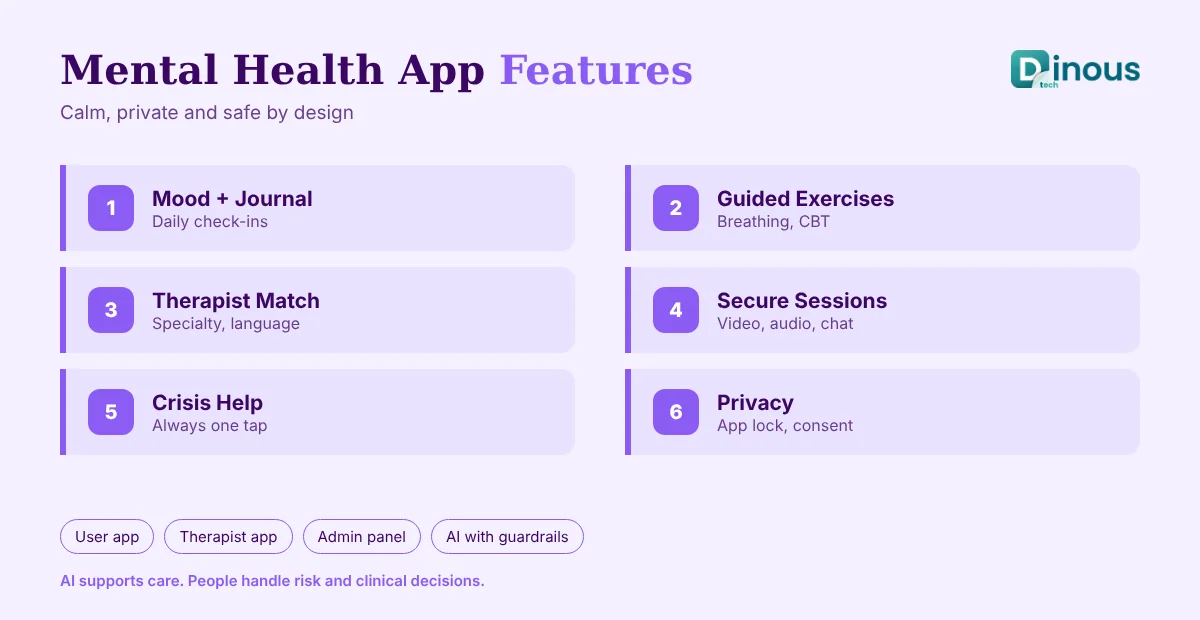
User app
- Simple, private onboarding with clear consent and optional anonymous mode
- Intake questionnaire to understand goals and preferences
- Mood check-ins, journaling and progress charts
- Guided exercises: breathing, grounding, CBT-style activities, meditations
- Therapist search and matching by specialty, language, availability and price
- Booking, reminders and secure video, audio and chat sessions
- Secure messaging with the care provider between sessions
- Payments, packages, subscriptions and insurance details where supported
- Always-visible help button with local crisis resources
- App lock (PIN or biometrics) and discreet notifications
Therapist or coach app
- Profile, credentials, specialties and availability
- Calendar, session management and video calls
- Client list with shared mood data and homework (with the client's consent)
- Session notes and treatment plans, stored securely
- Assign exercises and content to clients
- Earnings, payouts and invoices
Admin panel
- Provider verification and licence checks
- Content library management (programmes, audio, articles)
- User support, reports and moderation tools for communities
- Payments, refunds, payouts and B2B accounts
- Analytics on engagement, retention and outcomes
- Audit logs and access controls
Safety and Crisis Design
Safety design is what separates a responsible mental health app from a risky one. Build it in from the first sprint:
- Crisis resources: show local emergency and helpline information based on the user's country, always one tap away.
- Risk signals: flag certain words or answers in check-ins and route them to a human workflow defined with clinical advisers.
- Clear scope: tell users what the app does and does not do, especially for self-help and AI features.
- Clinical input: involve licensed professionals in content, questionnaires and escalation rules.
- Moderation: communities need trained moderators, reporting tools and clear rules.
Design Principles That Build Trust
People often open a mental health app when they feel low, anxious or tired. The design should make that moment easier, not harder:
- Calm visuals: soft colours, plenty of white space and no aggressive red alerts.
- Kind, plain language: short sentences, no jargon and no blame. Avoid streak pressure that makes people feel they failed.
- Fewer steps: a mood check-in should take seconds, and booking a session should take a minute.
- User control: people choose what to share with a therapist, what to save and what to delete.
- Accessibility: readable fonts, screen reader support, captions for audio and video, and multiple languages.
- Discretion: neutral app icons and notification text options, so the app does not reveal private information on a lock screen.
Good design also helps retention. When the app feels safe and simple, people come back to it as a regular habit.
How Dinoustech Uses AI in Mental Health Apps
AI can make mental health apps more helpful, but only with care. These are the practical uses we build, always with guardrails and human oversight:
- Personalised journeys: recommend exercises and content based on mood trends and goals.
- Journal insights: summarise entries and show patterns over weeks, with the user in control of what is shared.
- Therapist support: draft session summaries from therapist notes or recordings (with consent), similar to an AI medical scribe, so providers spend more time with clients.
- Smart matching: suggest therapists based on needs, language and availability.
- Supportive companion features: an AI guide that walks users through approved exercises, with strict limits, clear labelling as AI and fast hand-over to humans or crisis resources when needed.
Inside our own team, we use AI-assisted development for code review, test generation and documentation, which helps us ship faster. After launch, clients can add an AI support agent for account, billing and booking questions, keeping clinical topics with people.
Tech Stack
| Layer | Common choices |
|---|---|
| Mobile apps | Flutter or React Native; native where needed |
| Web app and panels | React or Next.js |
| Backend | Node.js or Python |
| Database | PostgreSQL with encryption; Redis for sessions and caching |
| Video and audio | Healthcare-ready video SDKs (for example Twilio, Vonage or Agora) with appropriate agreements |
| Chat | Encrypted real-time messaging |
| Payments | Stripe, Razorpay or regional gateways; insurance billing where needed |
| AI | LLM APIs with safety filters, retrieval from approved content, human review |
| Cloud | AWS, Google Cloud or Azure with health-data-ready configuration |
If your platform needs to connect with clinical systems, read our guide to EHR integration for healthcare apps.
Development Process
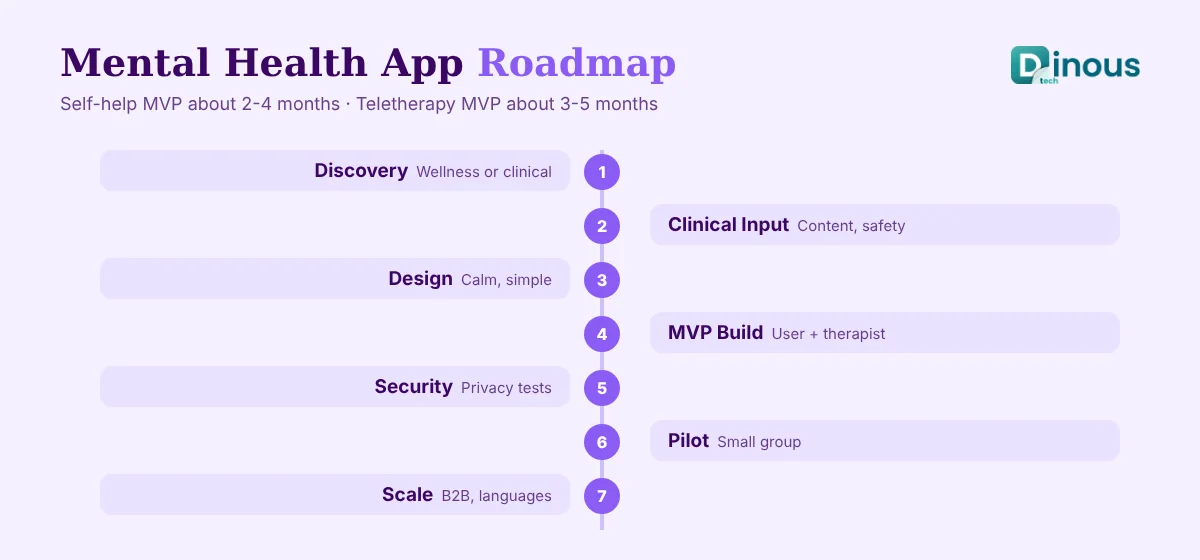
- Discovery: define the audience, wellness vs clinical scope, markets, provider model and success metrics.
- Clinical and content planning: agree programmes, questionnaires and safety rules with professionals.
- UX/UI design: calm visuals, gentle language, low friction and accessibility from the start.
- MVP build: user app, provider app and admin panel with core flows.
- Security and privacy testing: penetration tests, access checks and data flow reviews.
- Pilot: a small group of users and providers, with close feedback loops.
- Scale: more programmes, languages, B2B accounts and AI features.
Privacy and Compliance
Mental health data is among the most sensitive personal data. Depending on your markets and scope, you may need to follow HIPAA in the USA, GDPR and UK GDPR in Europe and the UK, and local health data rules elsewhere. If your app diagnoses or treats conditions, it may also count as a regulated medical device in some countries. Plan for encryption, minimal data collection, clear consent, data export and deletion, access logs, business associate agreements with vendors where required, and careful use of analytics and advertising tools. Our HIPAA-compliant app development guide explains the main safeguards. This is general information, not legal advice; confirm requirements with a qualified expert in your market.
Business Models
- Subscriptions for self-help programmes, meditations and premium tools
- Pay per session or session packages for therapy
- Commission on therapist bookings in a marketplace model
- B2B licences for employers, universities and insurers
- Insurance billing in markets where it is available
- White-label software for clinics and therapy groups
Cost Factors
There is no single price for a mental health app. The main things that drive cost are:
- Wellness-only vs clinical scope and the compliance work that comes with it
- Number of apps and panels (user, provider, admin, B2B)
- Video, audio and chat features
- Amount of content: programmes, audio and translations
- AI features and the safety testing they need
- Integrations: EHR, insurance, calendars and wearables
- Platforms: iOS, Android and web
- The hourly rate and location of your development team
For a similar category, see our fitness app cost guide, or get a quick estimate for your own feature list with the free app cost calculator.
Timeline
| Scope | Typical timeline |
|---|---|
| Self-help or mood tracking MVP | About 2 to 4 months |
| Teletherapy MVP (user, therapist and admin apps) | About 3 to 5 months |
| Full platform with B2B, integrations and AI | About 6 to 10 months |
For a wider view of how app type affects timelines, read how long it takes to build an app.
Challenges and How to Solve Them
- Low retention: short daily habits, gentle reminders and visible progress keep users engaged.
- Trust and privacy fears: plain-language privacy screens, app lock and anonymous options.
- Provider supply: simple onboarding, fair payouts and good scheduling tools attract therapists.
- Evidence: base content on recognised approaches and measure outcomes with validated questionnaires.
- AI risk: narrow AI scope, strong filters, testing with clinicians and human escalation.
Why Dinoustech
Dinoustech has delivered 450+ projects, and our team brings 7+ years of experience in mobile apps and healthcare software. We build secure, compliant products with clear phases and regular demos.
- Healthcare experience from our healthcare app development work, including remote patient monitoring and clinical documentation tools
- Cross-platform mobile app development for iOS and Android
- Responsible AI development with guardrails and human oversight
- Support and updates after launch
See examples of our work in the portfolio.
Planning a mental health app? Tell us about your audience and care model, and we will send a clear plan with phases and timelines. Contact Dinoustech to get started.