Dinoustech Private Limited
Subscription eCommerce Platform Development: How to Build Recurring Orders, Boxes and Retention Tools
Subscription eCommerce platform development helps brands turn one-time buyers into recurring customers. Whether you sell coffee, pet food, beauty products, meal kits, vitamins or curated boxes, a subscription model brings predictable revenue and higher lifetime value. But subscriptions add complexity that a normal online store does not handle well: recurring billing, skips and pauses, plan changes, failed payments, inventory forecasting and churn. A custom platform, or a custom layer on top of your store, solves these problems in a way that fits your business.
This guide explains subscription models, must-have features, the build process, tech stack, AI features, compliance, cost factors and timelines. For all our store and marketplace work, see eCommerce app development.
Key Takeaways
- Subscription commerce needs recurring billing, flexible customer controls and strong retention tools.
- Letting customers skip, pause, swap and change frequency easily reduces cancellations.
- Smart payment retry and card update flows recover revenue lost to failed payments.
- AI helps predict churn, personalise boxes and forecast inventory.
- A subscription MVP can launch in about 2 to 4 months; a full platform with apps takes longer.
Table of Contents
- Subscription Models
- Custom Build vs Plugins
- Must-Have Features
- Retention and Churn Tools
- Development Process
- Tech Stack
- How Dinoustech Uses AI
- Compliance
- Cost Factors and Timeline
- Challenges
- Key Subscription Metrics Explained
- Launch Checklist for a Subscription Store
- Why Dinoustech
Subscription eCommerce Models
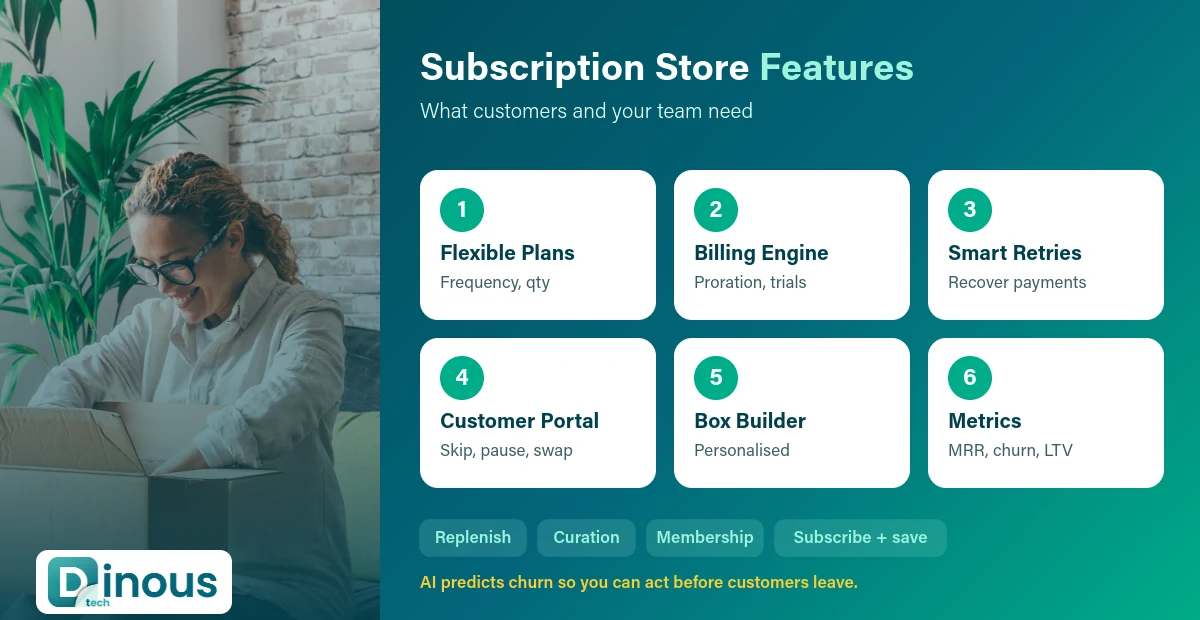
- Replenishment: regular delivery of products people use up, such as coffee, pet food, diapers or supplements.
- Curation: surprise or personalised boxes, such as beauty, books, snacks or clothing.
- Access or membership: paid membership for discounts, free shipping or exclusive products.
- Subscribe and save: optional subscriptions on normal product pages with a discount.
- Hybrid: a regular store plus subscriptions and memberships.
Custom Build vs Plugins
Subscription apps on platforms like Shopify can be enough for simple replenishment. Custom development makes sense when you need complex box building, multiple delivery schedules, B2B subscriptions, custom pricing, deep integrations, your own mobile app, or when app fees grow too high at scale. Our comparison of Shopify vs custom eCommerce explains the trade-offs.
Must-Have Features
Customer side
- Plan selection with frequency, quantity and pricing options
- Build-your-own box or quiz-based personalisation
- Customer portal: skip, pause, swap products, change address and frequency
- Secure saved payment methods and easy card updates
- Gifting subscriptions
- Order history, upcoming deliveries and reminders
- Mobile app or mobile-friendly web
Business side
- Recurring billing engine with proration, discounts and trial periods
- Dunning: smart retries and notifications for failed payments
- Subscription, order and inventory dashboards
- Box planning and pick lists for fulfilment
- Promotions, referral rewards and loyalty points
- Metrics: MRR, churn, retention by cohort and lifetime value
- Integrations: payment gateway, shipping, ERP, CRM, email and SMS
Retention and Churn Tools
- Cancellation flow: ask why, then offer a skip, pause, discount or smaller plan.
- Win-back campaigns: automated offers to past subscribers.
- Pre-delivery reminders: let customers adjust before they are charged, reducing complaints.
- Personalisation: recommend products based on feedback and ratings.
- Loyalty rewards: perks for long-term subscribers.
Development Process
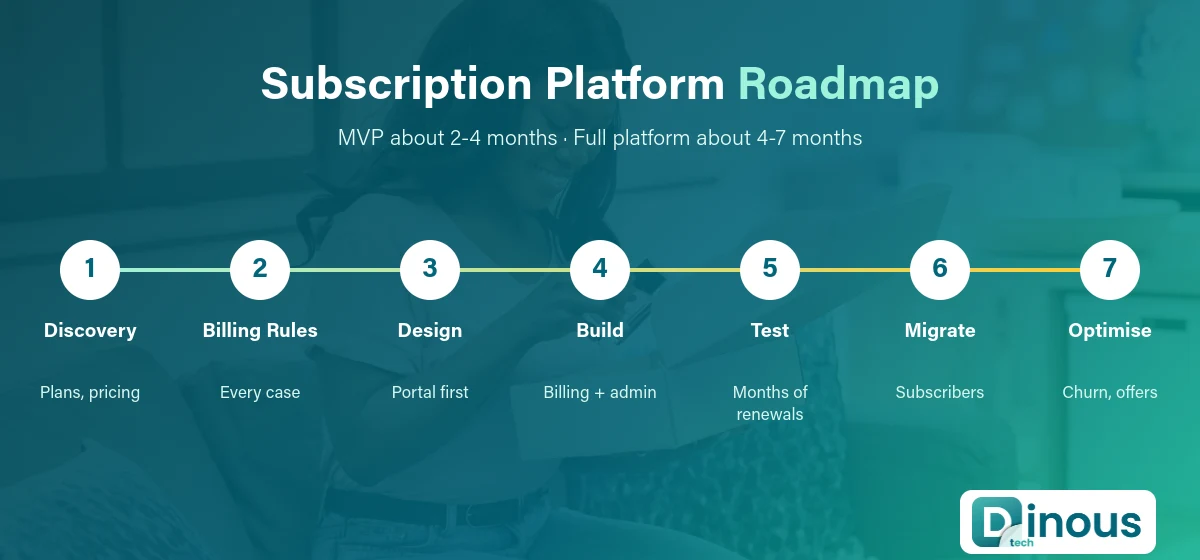
- Discovery: define plans, pricing rules, fulfilment model and integrations.
- Billing rules: document every case: upgrades, downgrades, skips, refunds and failed payments.
- Design: plan selection, checkout and customer portal first.
- Build: catalogue, billing engine, portal, admin and integrations.
- Testing: simulate months of renewals, failures and plan changes.
- Migration: move existing subscribers and payment tokens securely where the gateway allows it.
- Launch and optimise: track churn and test retention offers.
Tech Stack
| Layer | Common choices |
|---|---|
| Storefront | Next.js or React, or headless with Shopify |
| Mobile apps | Flutter or React Native |
| Backend | Node.js, Laravel or Python |
| Recurring payments | Stripe Billing, Razorpay Subscriptions, PayPal, Braintree |
| Database | PostgreSQL or MySQL, Redis for jobs |
| Messaging | Email, SMS and push notification services |
| Hosting | AWS or Google Cloud |
How Dinoustech Uses AI in Subscription Commerce
AI-assisted development: our team uses AI tools for routine code and tests, which speeds up delivery while billing logic gets careful senior review.
AI features:
- Churn prediction that flags subscribers likely to cancel, so you can act early
- Personalised box and product recommendations
- Demand and inventory forecasting from subscription data
- Conversational shopping help; see our AI shopping assistant guide
AI support agent: an assistant can handle common requests like skip, pause, address change and delivery status, which are a large part of subscription support.
Compliance
Subscription businesses must follow rules on clear pricing, renewal disclosure, easy cancellation and consent for recurring charges. Rules differ by country and region, and payment networks have their own requirements, such as e-mandates for recurring card payments in India. Protect card data by using a PCI-compliant payment provider. This is general information, not legal advice.
Cost Factors and Timeline
- Number of subscription models and pricing rules
- Box builder and personalisation complexity
- Customer portal and mobile apps
- Integrations with ERP, warehouse, shipping and CRM
- Migration of existing subscribers
- AI features and analytics depth
| Scope | Typical time |
|---|---|
| Subscription MVP on web with portal and billing | About 2 to 4 months |
| Full platform with apps, box builder and integrations | About 4 to 7 months |
For a quick estimate, use our app cost calculator. Related reading: how much it costs to build an eCommerce app and how to optimise eCommerce app costs.
Challenges
- Billing edge cases such as mid-cycle changes and partial refunds
- Failed payments and expired cards
- Inventory planning for curated boxes
- Shipping cost changes
- Making cancellation fair and easy while still offering alternatives
Key Subscription Metrics Explained
- Monthly recurring revenue (MRR): the predictable revenue from all active subscriptions in a month.
- Churn rate: the share of subscribers who cancel in a period. Track voluntary (customer cancels) and involuntary (payment fails) churn separately.
- Customer lifetime value (LTV): the average revenue a subscriber brings before they cancel.
- Customer acquisition cost (CAC): marketing and sales cost to win one subscriber.
- LTV to CAC ratio: shows whether growth is profitable.
- Skip and pause rate: a high rate may signal that delivery frequency is too high.
- Payment recovery rate: share of failed payments recovered by retries and card updates.
Your admin dashboard should show these numbers by plan, product and signup month, so you can see which offers bring loyal customers.
Launch Checklist for a Subscription Store
- Test at least three months of simulated renewals, skips, upgrades and failures
- Check pricing, taxes and shipping for every plan and region
- Confirm renewal reminder emails and SMS are sent on time
- Make sure cancellation is clear and works in a few steps
- Set up fraud checks on first orders and trial offers
- Prepare fulfilment for the first big renewal date
- Train support staff on the customer portal and admin actions
- Set up dashboards for MRR, churn and failed payments before launch day
Why Choose Dinoustech?
Dinoustech is a software development company in Jaipur, India, with a team that has 7+ years of experience and 450+ projects delivered. We build eCommerce stores, multi-vendor marketplaces, B2B ordering portals and subscription platforms for brands worldwide.
- Billing rules documented and tested before launch
- Customer portals that reduce churn
- Integrations with your existing tools
- Support and optimisation after launch
See our portfolio or contact us to plan your subscription platform.