Dinoustech Private Limited
White Label Dating App vs Custom Development: Which Should You Choose in 2026?
Every dating founder reaches the same fork in the road early on: buy a ready-made platform and put your brand on it, or build your own product from the ground up. A white label dating app can get you into the app stores in weeks, while a custom build takes longer but gives you full control over matching, design, data and growth. Neither option is right for everyone. The best choice depends on your niche, your budget, how fast you need to test the idea and how different your product really is. This guide compares white-label and custom dating app development side by side, explains the hidden costs on both sides, and shows a practical hybrid path that many founders use.
Dinoustech is a dating app development company that builds and scales dating and matchmaking apps for clients around the world. The advice below comes from the questions founders ask us before they commit to a platform.
Key Takeaways
- A white label dating app is an existing, tested dating platform that you license, rebrand and launch under your own name.
- White label is faster and cheaper to start, but you share the same core features and limits as every other buyer.
- Custom dating app development costs more and takes longer, but you own the code, the matching logic and the roadmap.
- Check source code ownership, data export, app store accounts and per-user fees before you sign any white-label contract.
- Many founders validate a niche with a white-label or lean MVP, then move to a custom platform once they have traction.
- AI matching, safety tools and niche-specific features are where custom builds usually pay for themselves.
In this guide
Table of Contents
- What Is a White Label Dating App?
- What Is Custom Dating App Development?
- White Label vs Custom: Side-by-Side
- When White Label Makes Sense
- When Custom Development Wins
- Hidden Costs on Both Sides
- White-Label Contract Checklist
- The Hybrid Path
- Features to Customize First
- Tech Stack for a Custom Build
- How Dinoustech Uses AI
- Cost Factors
- Timeline Comparison
- Why Choose Dinoustech
- Conclusion
What Is a White Label Dating App?
A white label dating app is a complete dating product that a software vendor has already built and tested. You pay a setup fee, a licence or subscription, or both, and the vendor changes the name, logo, colours and some settings so the app looks like yours. You then publish it in the Apple App Store and Google Play under your brand.
White-label products usually come in a few forms:
- Hosted SaaS platforms: the vendor runs the servers and the code; you get an admin panel and a branded app. Often many clients share the same infrastructure, with data kept separate.
- Licensed source code ("clone scripts"): you buy a copy of the code for an app similar to a popular dating brand and host it yourself or with a developer.
- Affiliate or network models: your brand sits on top of a shared member database run by a larger dating network. Your users may see profiles that signed up on other brands.
The big advantage is speed: the swiping, chat, profiles, subscriptions and admin tools already exist. The big trade-off is control: you can only change what the vendor allows.
What Is Custom Dating App Development?
Custom dating app development means a development team designs and builds the app around your idea, your audience and your business model. You own the source code, choose the cloud provider, decide how matching works and control the roadmap. It follows the full dating app development process: discovery, UX design, development, testing, launch and ongoing improvement.
A custom build does not have to start big. A focused MVP with one strong idea, such as voice-first profiles, a faith-based community or video speed dating, can launch in a few months and grow from there.
White Label vs Custom Dating App: Side-by-Side Comparison
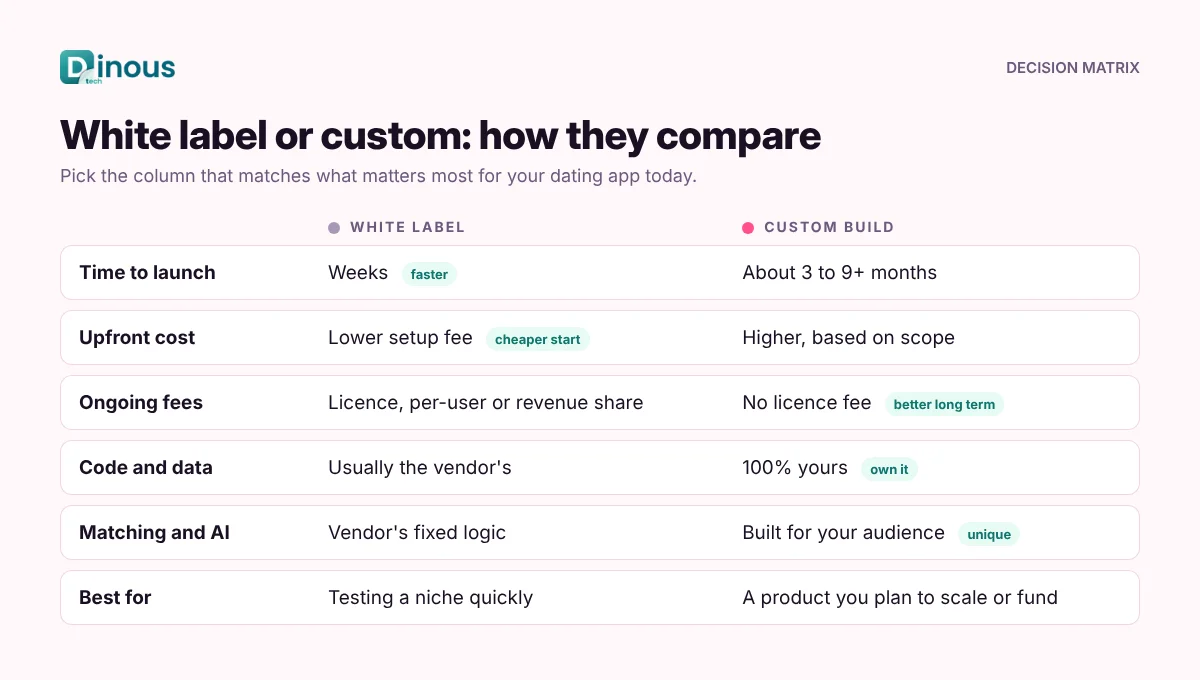
| Factor | White Label Dating App | Custom Dating App |
|---|---|---|
| Time to launch | Weeks, mostly branding and store setup | Usually 3 to 9+ months depending on scope |
| Upfront cost | Lower setup fee | Higher, based on features and platforms |
| Ongoing cost | Licence, per-user or revenue share, often for as long as you run the app | Hosting, maintenance and new features; no licence fee |
| Code ownership | Usually the vendor's | Yours |
| Matching logic | Fixed or lightly configurable | Fully designed around your audience |
| Design and UX | Theme, colours and logo | Unique screens and onboarding |
| User data | Stored on vendor systems; export terms vary | In your own database and cloud account |
| Scaling | Limited by shared infrastructure and plan | Architecture planned for your growth |
| Investor appeal | Weaker, since there is little proprietary technology | Stronger, since the product is an asset you own |
When a White Label Dating App Makes Sense
- You are testing a niche: you want to see if a specific community, city or interest group will sign up before you invest heavily.
- You already have an audience: an events company, matchmaking agency or community brand that wants an app for existing members quickly.
- Your difference is marketing, not product: the brand, community and events are unique, but standard swipe-and-chat features are enough.
- Your budget is small: you need to launch and learn with limited funds.
Even here, plan your exit. Know how you will move members, chats and subscriptions if you outgrow the platform.
When Custom Dating App Development Wins
- Your matching is your product: compatibility questionnaires, values-based matching or AI-based profile matching need full control over the algorithm and data.
- You need special features: live video, audio rooms, events, chaperone modes, accessibility settings for older users or community verification.
- You plan to raise funding: investors look for proprietary technology, clean data ownership and a platform that can scale.
- You operate in several markets: different languages, payment methods, privacy laws and age rules are easier to handle in your own code.
- You want long-term margins: a custom app removes per-user fees and revenue shares that grow as you grow.
Our guide on how to build a dating app like Tinder shows the core features a custom swipe app usually starts with.
Hidden Costs on Both Sides
White label
- Monthly or yearly licence fees that continue for the life of the app.
- Per-user, per-download or revenue share charges that rise as you grow.
- Extra charges for every change outside the standard settings.
- Migration costs if you leave, especially if the vendor limits data export.
- Store rejection risk: Apple's guidelines discourage apps that are copies of a template or spam, so a lightly rebranded app may need extra unique features to pass review.
Custom
- Discovery and design work before any code is written.
- Third-party services such as chat, video, push notifications, ID verification and content moderation.
- Ongoing maintenance, OS updates and security patches.
- A longer runway before revenue starts.
For a fuller picture of budgets, read how much it costs to build a dating app.
White-Label Contract Checklist: Questions to Ask Before You Sign
- Do I get the source code, or only a licence to use it?
- Whose Apple and Google developer accounts will the app be published under?
- Can I export all member profiles, photos, messages and subscription data in a standard format?
- Is the member database shared with other brands?
- Which features can I change, and what does each change cost?
- How are security, privacy requests (such as GDPR deletion requests) and data breaches handled?
- What uptime and support response times are promised in writing?
- What happens to my app if the vendor shuts down or raises prices?
This checklist is general guidance, not legal advice. Have a lawyer review any licence agreement before you sign.
The Hybrid Path: Start Lean, Then Own Your Platform
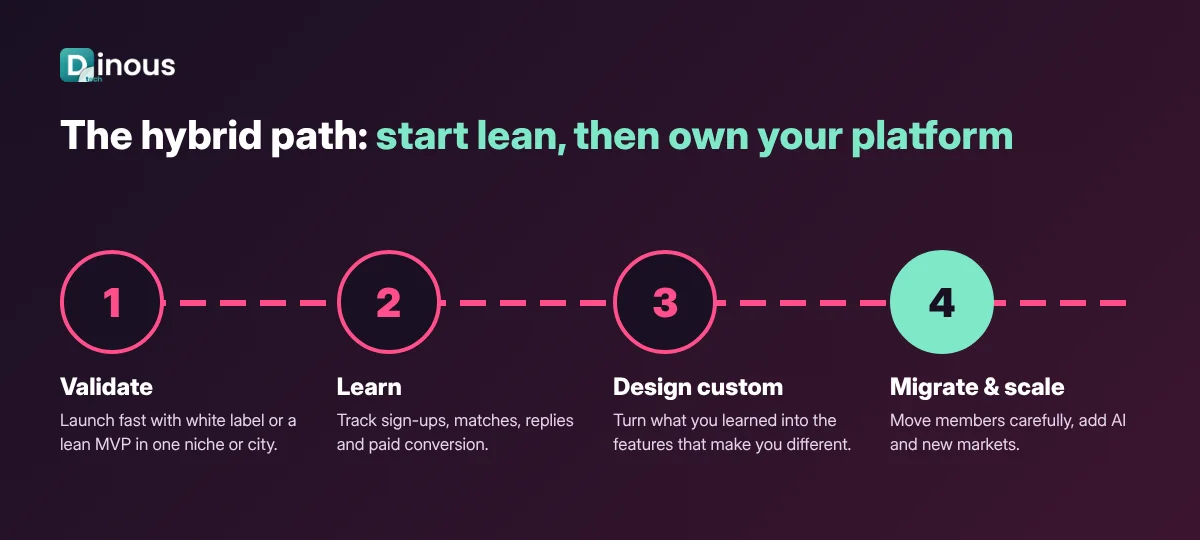
You do not have to choose one route forever. Many founders take a staged approach:
- Validate: launch quickly with a white-label product or a lean MVP in one city or niche.
- Learn: track sign-ups, profile completion, matches per user, reply rates and paid conversion.
- Design the custom product: use what you learned to define the features that make your app different.
- Migrate and scale: build the custom platform, move members and subscriptions carefully, then expand to new markets.
A lean custom MVP is often better than a white label for step one, because you keep the code and avoid a migration later. The right call depends on how fast you need to launch.
Features to Customize First
Whichever route you choose, these are the areas where generic dating products feel the most generic:
- Onboarding: questions and profile prompts that fit your community.
- Matching and discovery: filters, compatibility scores and daily picks tuned to your audience.
- Safety: selfie verification, photo moderation, reporting and blocking that work in every market you serve.
- Communication: chat, voice notes, video calls and icebreakers.
- Monetization: subscriptions, boosts and in-app purchases. See how dating apps earn revenue.
- Admin panel: member management, reports queue, analytics and content tools.
Recommended Tech Stack for a Custom Dating App
| Layer | Common Choices |
|---|---|
| Mobile apps | Flutter or React Native for both platforms; Swift and Kotlin for native builds |
| Backend | Node.js, Python or Go with REST or GraphQL APIs |
| Database | PostgreSQL or MongoDB, Redis for caching and online status |
| Location | Geospatial queries (PostGIS or MongoDB geo indexes) |
| Chat and video | WebSockets, Firebase, or providers such as Agora or Twilio |
| Media | Cloud object storage with a CDN and image moderation |
| Payments | Apple and Google in-app purchases, plus Stripe for web |
| Cloud | AWS, Google Cloud or Azure with auto-scaling |
How Dinoustech Uses AI in Dating App Projects
AI changes the white-label versus custom decision, because the most useful AI features depend on your own data and rules.
- AI-assisted development: our engineers use AI coding assistants for boilerplate code, test generation and code review suggestions, with every change reviewed by a senior developer. This shortens custom build timelines and narrows the speed gap with white label.
- AI features inside the app: smarter match recommendations based on behaviour, profile prompt suggestions, conversation starters, photo quality tips, fake profile and scam detection, and toxic message filtering.
- AI support agent for clients: we can add an AI help assistant to your app and admin panel that answers member questions about subscriptions, safety and account settings, and hands complex cases to your human team.
On a white-label platform, you usually get only the AI features the vendor ships. In a custom app, you decide which models to use, what data they learn from and how results are explained to members.
Cost Factors to Compare
Instead of comparing one price against another, compare the total cost over two to three years:
- Setup or development cost.
- Licence, per-user or revenue share fees over time (white label).
- Hosting, third-party services and maintenance (both).
- Customization requests and new features.
- Migration cost if you switch platforms later.
- The value of owning the code and data if you raise funding or sell the business.
Dinoustech gives each client a written estimate after a short discovery call, based on features, platforms and markets.
Timeline Comparison
| Route | Typical Time to Launch | What Takes the Time |
|---|---|---|
| White label (rebrand only) | A few weeks | Branding, store listings, review |
| White label with custom features | 1 to 3 months | Vendor changes, testing, review |
| Custom MVP | 3 to 5 months | Design, core features, admin panel, QA |
| Full custom platform | 6 to 9+ months | Advanced matching, video, multi-market setup |
These are honest ranges, not promises. Read how long dating app development takes for a phase-by-phase breakdown.
Why Choose Dinoustech for Your Dating App
- Experience building dating, matchmaking and social apps for clients worldwide.
- Honest advice: if a lean MVP or a ready-made route fits your stage better, we will tell you.
- You own 100% of the source code and data on custom projects.
- AI-assisted delivery with human review, plus practical AI features with clear guardrails.
- Cross-platform mobile app development, launch support and maintenance after release.
See examples of our work in our portfolio, and read our guide for dating app development for startups and enterprises.
Conclusion
A white label dating app is a fast, low-cost way to test an idea, but you rent the product and share its limits. Custom dating app development takes more time and budget, but it gives you ownership, flexibility and a platform you can grow and sell. If your difference is in matching, safety, community features or AI, custom is usually worth it. If you only need to prove demand, start lean and plan your move to your own platform early.
Not sure which route fits your idea? Contact Dinoustech for a free consultation, and we will help you compare both options for your market and budget.