Dinoustech Private Limited
Insurance App Development: How to Build an Insurtech App for Policies, Claims and AI Underwriting
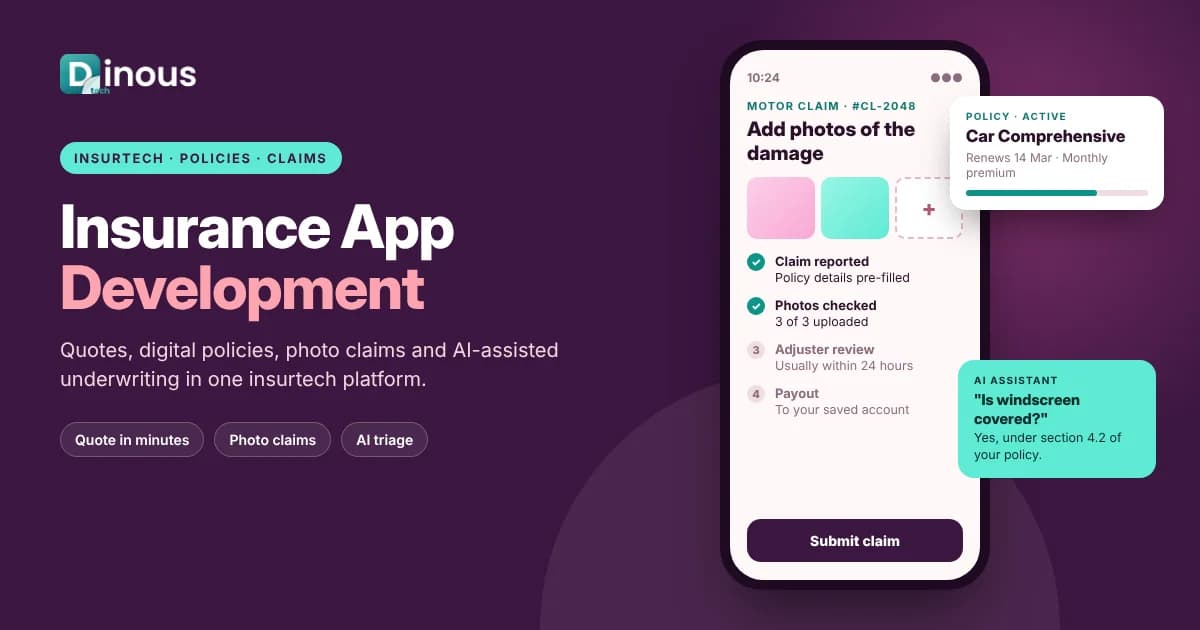
Insurance app development is the process of building a mobile app and web platform that lets people compare, buy, manage and claim on insurance policies without paperwork or long phone calls. In 2026, customers expect to get a quote in minutes, pay premiums like any other subscription, and file a claim with a few photos from their phone. Insurers, MGAs, brokers and insurtech startups that cannot offer this lose customers to those that can. This guide explains how to build an insurtech app step by step: the types of insurance apps, customer, agent and admin features, the claims flow, tech stack, how AI fits into underwriting and claims, compliance, cost factors and a realistic timeline. It is written for insurance businesses worldwide, from the USA, UK and Europe to the UAE, Southeast Asia and Australia.
Dinoustech is a fintech app development company that builds payment, lending, banking and insurance products. The guidance below comes from the questions insurance teams ask us when they plan a new digital product or replace an old customer portal.
Key Takeaways
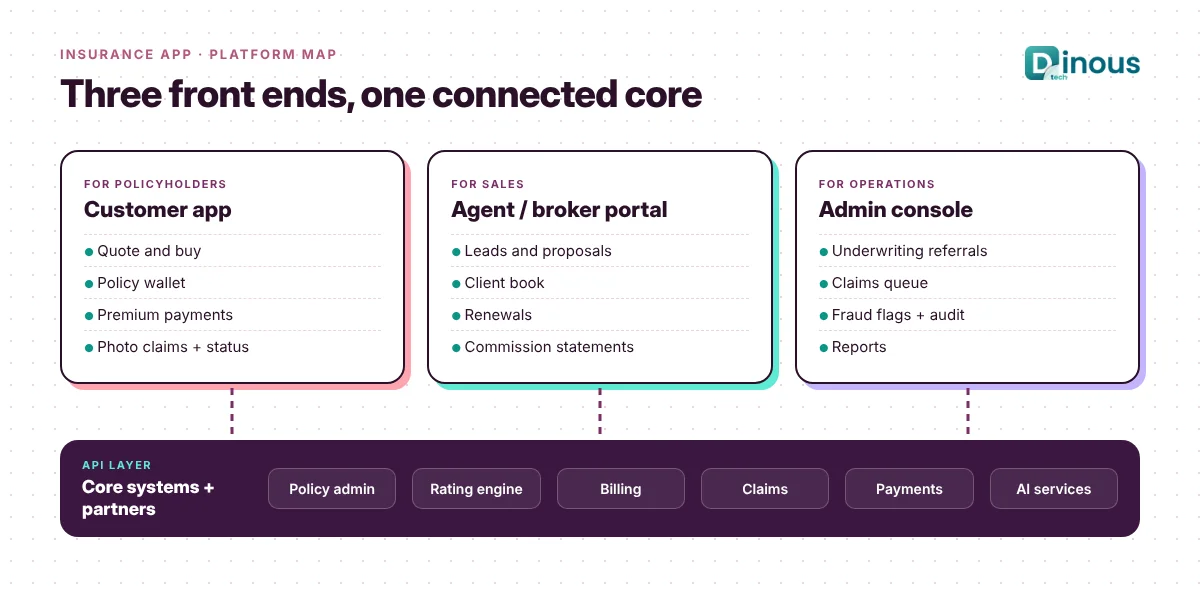
- An insurance app usually has three parts: a customer app, a portal for agents or brokers, and an admin console for underwriting, claims and policy operations.
- The most valued features are fast quotes, digital policy documents, easy premium payments and photo-based claim filing with live status.
- Most insurance apps do not replace the core policy system; they connect to it through APIs, so integration planning matters as much as screen design.
- AI helps with document reading, claim triage, fraud signals, quote pre-fill and customer support, but final decisions on pricing and claims should stay reviewable by people.
- Data privacy, insurance distribution rules and AI regulation differ by country, so plan compliance from the first sprint.
- A focused first release usually takes four to seven months; a multi-line platform with many integrations takes longer.
In this guide
Table of Contents
- What Is an Insurance App?
- Why Insurers Are Investing in Apps
- Types of Insurance Apps
- Customer App Features
- Agent, Broker and Admin Features
- How a Digital Claims Flow Works
- Development Process Step by Step
- Recommended Tech Stack
- How Dinoustech Uses AI
- Business Models
- Compliance and Data Security
- Cost Factors
- Development Timeline
- Common Challenges
- Why Choose Dinoustech
What Is an Insurance App?
An insurance app is a digital product that handles the main moments of an insurance relationship: getting a quote, buying a policy, paying premiums, updating details, renewing and making a claim. For the insurer, the same platform gives underwriters, claims handlers, agents and support teams the tools to serve customers faster.
Most insurers already have a core system for policy administration, billing and claims. A modern insurance app sits on top of that core. It gives customers and agents a clean, mobile-first experience while APIs move data to and from the systems of record. Insurtech startups and managing general agents (MGAs) sometimes build the full stack themselves, including the rating engine and policy database, especially for one focused product such as pet, travel, gadget or rental insurance.
Why Insurers Are Investing in Apps
Insurance has traditionally been sold through agents, call centres and long forms. That still works for complex commercial cover, but personal lines customers now compare insurance the way they compare flights or phone plans. A well-built app helps in four ways:
- Faster sales: short, guided quote journeys with pre-filled data reduce drop-offs.
- Lower servicing cost: customers download documents, change addresses and add drivers or devices themselves instead of calling.
- Better claims experience: a claim is the moment a customer decides whether to renew. Photo upload, live status and quick payouts build trust.
- Richer data: with consent, apps can collect telematics, device or wearable data that supports fairer, usage-based pricing.
The same shift is happening across financial services, from open banking apps to digital lending, so insurance customers now expect the same speed they get from their bank.
Types of Insurance Apps
Before you plan features, decide which kind of product you are building. Each type has a different user, revenue model and integration list.
| Type | Who uses it | Main job |
|---|---|---|
| Direct-to-customer insurer app | Policyholders | Quote, buy, pay, manage policies and claim |
| Comparison or marketplace app | Shoppers, partner insurers | Compare quotes from many insurers and route the sale |
| Agent and broker app | Agents, brokers, sales teams | Leads, quotes, proposals, commissions and client servicing |
| Claims app | Policyholders, adjusters, garages, hospitals | First notice of loss, evidence, assessment and settlement |
| Usage-based insurance app | Drivers, device owners | Telematics or sensor data for pay-as-you-drive or pay-how-you-drive pricing |
| Embedded insurance platform | Partner apps and stores | APIs that add cover at checkout, such as travel, gadget or shipping protection |
| Health and life insurance app | Members, providers | Cards, provider search, cashless claims, wellness rewards |
Health insurance apps often overlap with patient apps, so teams building them can borrow ideas from healthcare app development, such as appointment and provider workflows.
Customer App Features
- Onboarding and identity: sign-up with email, phone or social login, ID verification where needed, and secure login with passkeys or biometric authentication.
- Quote engine: short question flows, smart defaults, instant or near-instant prices, and the option to save and resume.
- Plan comparison: side-by-side cover, limits, excess or deductible and add-ons in plain language.
- Purchase and payments: cards, wallets, bank transfers and direct debits, with monthly or annual premiums and automatic retries for failed payments.
- Digital policy wallet: policy documents, ID cards and certificates available offline.
- Self-service changes: update address, vehicle, beneficiaries or devices, with a clear price change before confirming.
- Claims: guided first notice of loss, photo and video upload, document scanning, live claim status and payout tracking.
- Renewals and reminders: renewal offers, payment reminders and expiry alerts by push, email or SMS.
- Support: help centre, chat with an assistant and handover to a human agent, call-back requests.
- Rewards and engagement: safe-driving scores, wellness challenges or no-claim rewards where the product supports them.
Agent, Broker and Admin Features
The customer app is only the visible part. Insurance teams spend their day in the back office, so these tools decide whether the platform actually saves time.
Agent and broker portal
- Lead management, quote creation for clients, e-signature and proposal sharing.
- Client book with policies, renewals and open claims.
- Commission statements and performance dashboards.
Underwriting and product console
- Product and rating rules managed through configuration rather than code, with version history.
- Referral queue for cases outside automatic rules, with the full application and data sources in one view.
- Document requests, notes and audit trail for every decision.
Claims console
- Claim queue with priority, assignment and service-level timers.
- Evidence viewer for photos, videos, invoices and reports.
- Partner network management for garages, repairers, hospitals and assessors.
- Reserve updates, payment approval with limits, and fraud flags for investigation.
Operations and reporting
- Policy, billing and refund management, role-based access and maker-checker approvals.
- Dashboards for quote conversion, loss ratio inputs, claim cycle time and customer satisfaction.
- Exports and APIs for finance, actuarial and regulatory reporting.
How a Digital Claims Flow Works
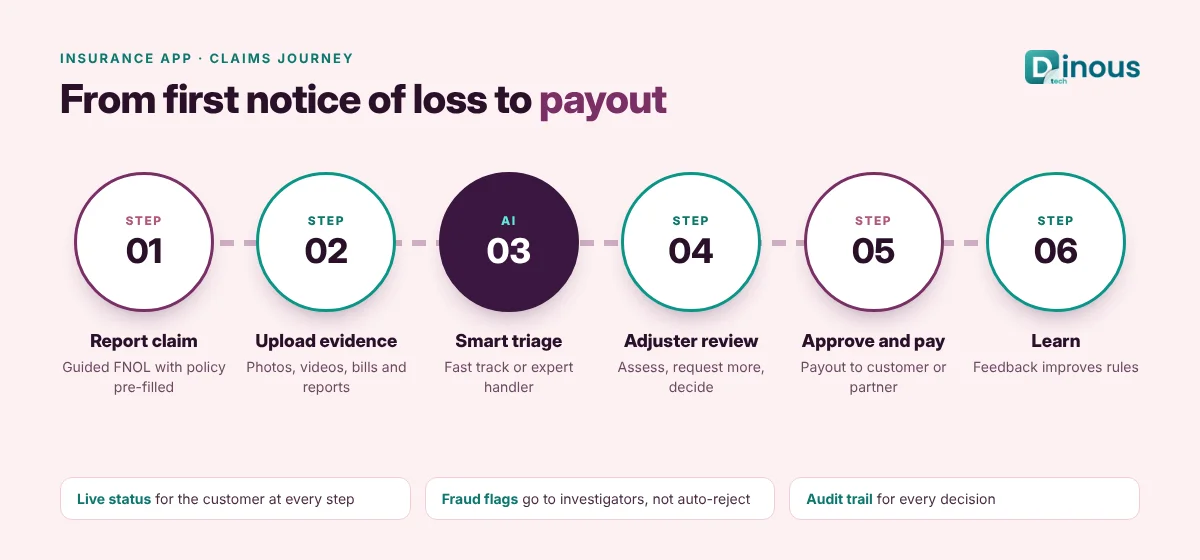
Claims is where good insurance apps stand out. A typical digital flow looks like this:
- First notice of loss (FNOL): the customer opens the app, picks the policy and answers a short guided form. Location, date and policy details are pre-filled.
- Evidence capture: photos, videos, receipts and reports are uploaded from the phone, with guidance on which angles or documents are needed.
- Triage: rules and models sort the claim by type, value and complexity. Simple, low-value claims can go to a fast track; complex or unusual claims go to an experienced handler.
- Assessment: an adjuster or partner reviews evidence, requests anything missing through the app and records the decision.
- Approval and settlement: the approved amount is paid to the customer or partner, and the customer sees each step in the timeline.
- Feedback and learning: a short survey and closed-claim data feed back into product, pricing and fraud rules.
Payouts need the same reliability as any payment product. If you are new to this, our guide on integrating a payment gateway into a mobile app covers the basics.
Insurance App Development Process Step by Step
- Discovery: pick the line of business, markets, target users and the one or two journeys that matter most, usually quote-and-buy or claims. Map the current core systems and data owners.
- Compliance and product rules: confirm licensing, distribution and disclosure rules with your compliance or legal team, and list the documents customers must see before buying.
- UX and prototypes: design short, plain-language flows and test them with real customers and agents.
- Architecture and integrations: define APIs to the policy, billing and claims systems, payment providers, identity checks, document services and any data partners.
- Build in sprints: deliver the customer app, agent portal and admin console in small releases, starting with an MVP for one product.
- Security and testing: functional, performance and security testing, plus accessibility checks and test cases for every rating and claims rule.
- Pilot: launch to a small group or one region, compare conversion, claim cycle time and support load with the old process.
- Launch and improve: roll out wider, monitor, and add new products, languages and partners.
Recommended Tech Stack
| Layer | Common choices |
|---|---|
| Mobile apps | Flutter or React Native for cross-platform; Swift and Kotlin for native |
| Web portals | React or Next.js for customer, agent and admin portals |
| Backend | Node.js, Java or .NET services; event queues for claims and billing events |
| Database | PostgreSQL for policy and claims data; Redis for caching; object storage for documents and photos |
| Rules and rating | Configurable rules engine or a dedicated rating service with versioned tables |
| Documents | PDF generation, e-signature, OCR for invoices, IDs and medical bills |
| Payments | Card, wallet and direct debit providers for premiums; payout providers for claims |
| Cloud and security | AWS, Azure or Google Cloud, encryption at rest and in transit, key management, audit logs |
| AI | Document AI, image analysis, LLM assistants with retrieval over policy wording, fraud scoring models |
For more detail on choosing technologies for regulated financial products, see which technologies are used in fintech software development.
How Dinoustech Uses AI in Insurance App Development
AI is now common in insurance, so the question is not whether to use it but where it actually helps and how to keep it fair and explainable. We use AI in three places.
1. AI-assisted development
Our engineers use AI coding assistants to draft boilerplate, write test cases for rating and claims rules, review pull requests and generate API documentation. Every change is still reviewed by a developer. This shortens delivery time and gives insurers more test coverage on rules that must be exactly right.
2. AI features inside the insurance app
- Document reading: OCR and document AI pull data from IDs, vehicle papers, invoices and medical bills to pre-fill quotes and claims.
- Claim triage: models score claims by complexity so simple ones move fast and complex ones reach the right handler.
- Photo damage estimation: image models can suggest damage areas and severity for motor or property claims, as input for the adjuster.
- Fraud signals: unusual patterns, duplicate images or linked identities are flagged for human investigation, not automatically rejected.
- Underwriting support: AI summarises applications and external data so underwriters decide faster on referred cases.
- Policy assistant: an in-app assistant answers "Am I covered for this?" questions from the customer's own policy wording, with links to the exact clause and a handover to a human.
Decisions that affect price or claim outcomes should be explainable and open to human review. Our article on AI features every fintech app should have and the guide to generative AI in fintech cover more use cases.
3. AI support agent for our clients
After launch, our clients can use an AI support agent trained on their own app documentation. It answers questions from operations staff, explains how features work and drafts tickets for our team, so issues are reported clearly and resolved faster.
Business Models
- Insurer or MGA: earns premium income and builds the app to grow direct sales and lower servicing cost.
- Broker or comparison platform: earns commission or lead fees from partner insurers.
- Embedded insurance provider: shares revenue with partner apps that offer cover at checkout.
- Software provider: licenses a white-label insurance platform to insurers and brokers on a subscription.
Compliance and Data Security
Insurance is one of the most regulated industries. The exact rules depend on your country, licence and line of business, but most projects need to plan for:
- Licensing and distribution rules: who may sell, advise and display which products, and what must be disclosed before purchase. Examples include the EU Insurance Distribution Directive, the UK FCA rules including Consumer Duty, state insurance regulators in the USA, and the regulators in the UAE, Australia and other markets.
- Data privacy: GDPR in the UK and EU, state privacy laws in the USA, and local data protection laws elsewhere. Health data in health insurance may bring extra rules such as HIPAA in the USA.
- AI regulation: the EU AI Act treats AI used for risk assessment and pricing in life and health insurance as high-risk, which brings duties around data quality, documentation and human oversight.
- Identity and financial crime: identity checks and sanctions screening where required, similar to the controls described in our KYC and AML compliance guide.
- Payments: PCI DSS scope reduction by using a certified payment provider so card data never touches your servers.
- Security: encryption, strong authentication, role-based access, audit logs, penetration testing and incident response plans.
This section is general information, not legal advice. Please confirm requirements with your compliance team or legal adviser for each market.
Insurance App Development Cost Factors
There is no single price for an insurance app. The budget depends on scope and integrations more than on the number of screens. The main cost drivers are:
- Number of products and lines of business at launch.
- Platforms: iOS, Android, web, agent portal and admin console.
- Whether you integrate with an existing core system or build policy, billing and claims modules yourself.
- Rating complexity and the number of external data sources.
- Claims depth: simple forms or full partner networks, assessments and payouts.
- AI features such as document reading, triage, damage estimation and assistants.
- Number of countries, languages and regulatory requirements.
- Security testing, audits and ongoing maintenance.
For a wider view of budgets across financial products, read what it costs to build a fintech app in 2026. For an estimate based on your own scope, talk to our team.
Development Timeline
| Phase | Typical duration |
|---|---|
| Discovery, compliance mapping and UX | 3 to 6 weeks |
| Architecture and integration design | 2 to 4 weeks |
| MVP build: customer app, admin console, one product | 10 to 16 weeks |
| Testing, security review and pilot | 4 to 6 weeks |
| Agent portal, more products, advanced AI | Ongoing releases after launch |
A focused first release usually lands in four to seven months. Integration with older core systems is the most common reason for delays, which is why we start integration work early. Our article on how long it takes to build a fintech app explains what speeds up or slows down delivery.
Common Challenges
- Legacy core systems: old systems may have limited APIs. An integration layer or middleware keeps the app fast while the core stays as it is.
- Long forms: every extra question reduces conversion. Pre-fill data, ask only what pricing needs, and explain why each question matters.
- Trust in automation: customers and regulators want to know how decisions are made. Keep clear reasons, human review and appeal paths.
- Fraud: digital channels attract organised fraud. Combine device checks, image checks and behaviour signals with investigator review.
- Multi-market rules: design products, documents and disclosures to be configurable per country from the start.
Why Choose Dinoustech for Insurance App Development
Dinoustech builds secure financial products, including payment, wallet, lending and insurance apps, for clients around the world. We combine fintech experience with strong mobile app development, so your customers get a smooth app and your teams get practical back-office tools.
- Experience with payments, identity checks and regulated financial workflows.
- Integration-first architecture that works with your existing core systems.
- Responsible AI features with human review, audit logs and clear explanations.
- Cross-platform apps, web portals and admin consoles from one team.
- Support after launch, including our AI support agent for client teams.
You can see examples of our work in our portfolio.
Conclusion
Insurance customers now expect the same speed and clarity from their insurer that they get from their bank or favourite shopping app. A successful insurance app makes quotes simple, puts policies in the customer's pocket and turns claims into a clear, trackable process, while giving agents and claims teams tools that save time. Start with one product and one core journey, connect cleanly to your existing systems, use AI where it helps people decide faster, and plan compliance from day one.
Planning an insurtech app or modernising your customer portal? Contact Dinoustech to discuss your product, markets and timeline.