Dinoustech Private Limited
Open Banking App Development: How to Build an App on Bank APIs with Consent, Payments and AI
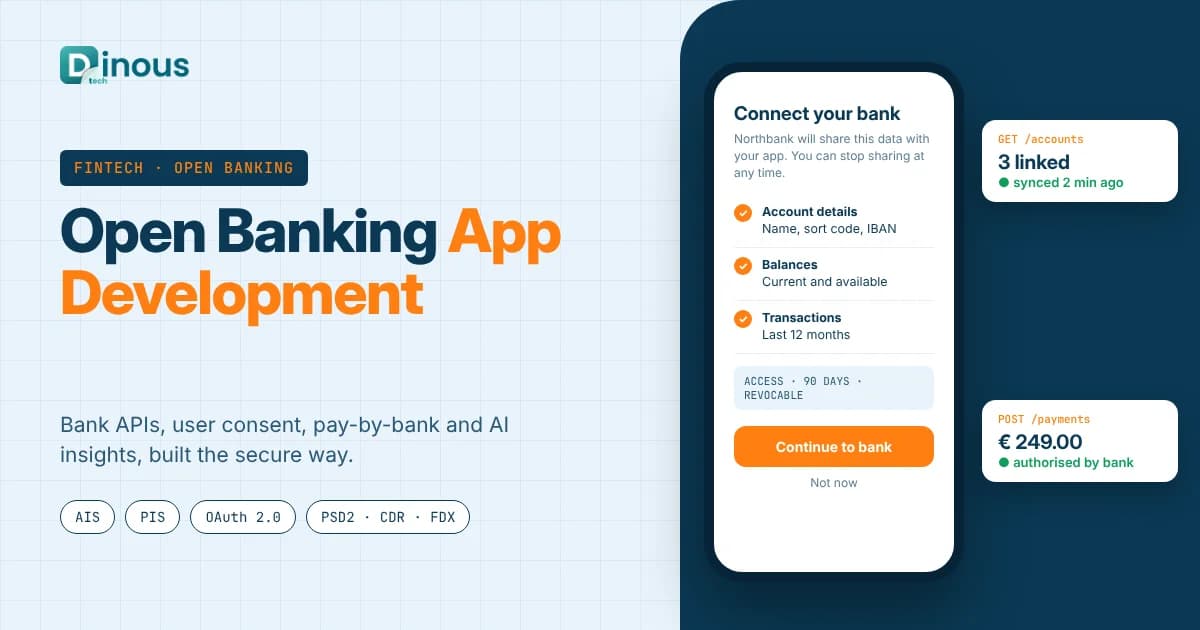
Open banking lets people share their bank data and start payments from inside apps they trust, with their clear permission and without handing over passwords. For fintech founders, banks and software companies, it is the base layer behind budgeting tools, instant affordability checks, pay-by-bank checkout, account switching and smarter lending. Open banking app development is the work of building that product: connecting to bank APIs through a licensed provider or your own licence, designing a consent journey users understand, and turning raw transactions into features people pay for. This guide explains how open banking works in different markets, which app types you can build, the features and architecture you need, how AI fits in, and the main cost and timeline factors.
Dinoustech is a fintech app development company that builds payment, wallet, lending and banking apps for clients around the world. The guidance below comes from the questions founders ask us before they connect their product to bank accounts for the first time.
Key Takeaways
- Open banking apps use secure bank APIs to read account data (account information) or start payments (payment initiation), always with the user's explicit consent.
- Most startups launch through a regulated aggregator such as TrueLayer, Tink, Plaid or Yapily instead of getting their own licence on day one.
- Rules differ by market: PSD2 in the EU, the UK open banking framework, the Consumer Data Right in Australia, and a market-led model in the USA where the federal rule is still being reconsidered.
- Consent, re-consent and clear data use explanations decide conversion more than any other screen.
- AI is most useful for transaction categorisation, cash-flow insights and affordability checks, with humans and rules in control of credit decisions.
- A focused MVP on top of an aggregator usually takes about three to five months.
In this guide
Table of Contents
- What Is Open Banking?
- How an Open Banking App Works
- Open Banking Rules by Market
- Types of Open Banking Apps
- Licence or Aggregator?
- Key Features
- Development Process
- Recommended Tech Stack
- How Dinoustech Uses AI
- Security and Compliance
- How Open Banking Apps Make Money
- Cost Factors
- Development Timeline
- Common Challenges
- Why Choose Dinoustech
- Conclusion
What Is Open Banking?
Open banking is a system in which banks give licensed third parties secure access to a customer's account data or payment functions through APIs, but only when the customer agrees. Before open banking, many apps asked users for their online banking username and password and then "screen scraped" the bank website. That was fragile and risky. Open banking replaces it with tokens, scoped permissions and consent that the user can see and withdraw.
Two services sit at the heart of almost every open banking app:
- Account information services (AIS): reading balances, transactions, account holder names and other data so the app can show insights, verify income or check affordability.
- Payment initiation services (PIS): starting a payment directly from the user's bank account, for example a pay-by-bank checkout, a bill payment or a top-up of a wallet.
Many markets are now moving from open banking to open finance, which extends the same idea to savings, pensions, investments, insurance and mortgages. If you are planning a broader fintech product, our fintech app development guide explains the wider landscape.
How an Open Banking App Works
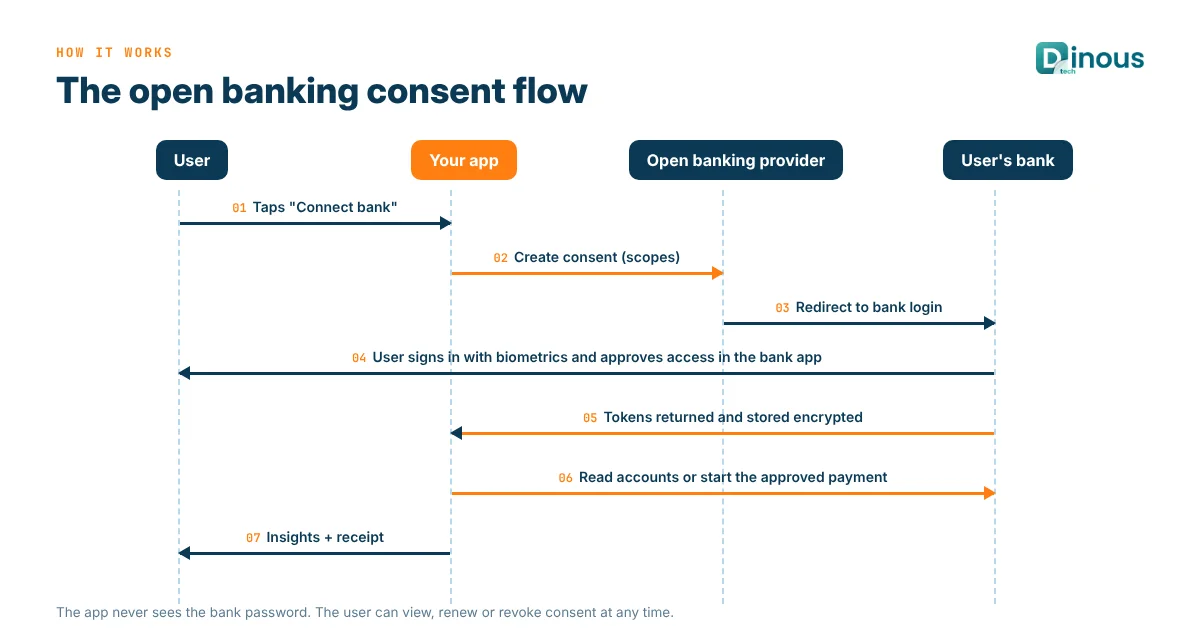
From the user's side the journey takes less than a minute. Behind the screens, four parties work together: the user, your app, the open banking provider (your own licence or an aggregator) and the user's bank.
- The user chooses to connect: your app explains what data it needs, why and for how long.
- Consent is created: your backend asks the provider to create a consent with exact permissions, such as "read transactions for the last 12 months".
- The bank authenticates the user: the user is redirected to their bank app or website, signs in with biometrics or a one-time code and approves the request. Your app never sees their bank password.
- Tokens come back: the provider returns access tokens to your backend, which are stored encrypted and linked to the consent.
- Data or payment flows: your app reads accounts and transactions, or initiates the payment the user approved, and shows the result.
- Consent is managed: the user can see active connections, renew them before they expire or revoke them at any time.
Open Banking Rules by Market
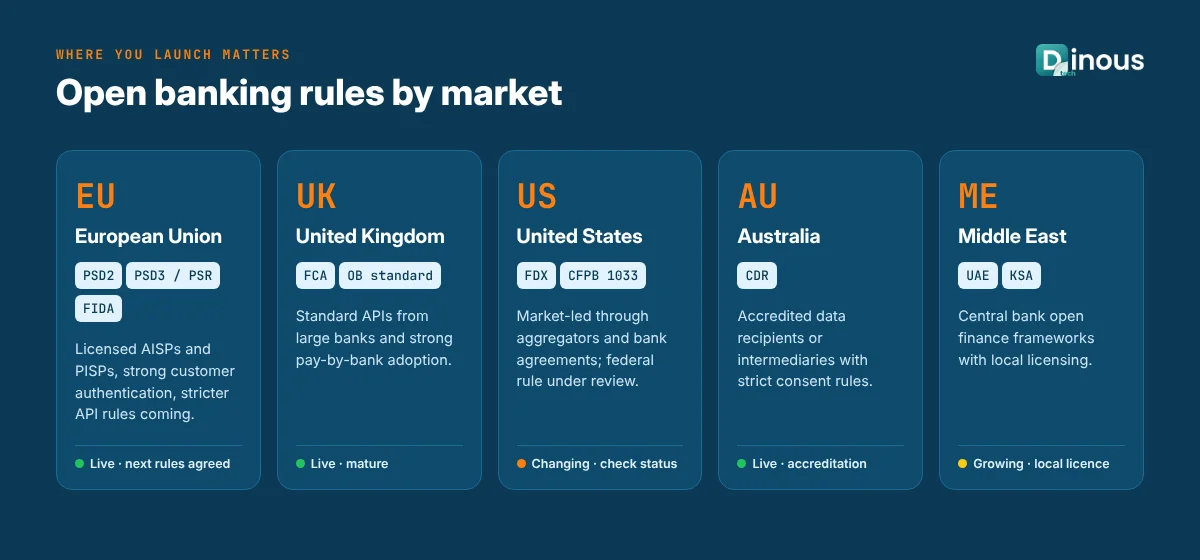
Open banking is global, but the rules are local. Your launch market decides which licences, standards and consent rules apply. The table below is a short overview, not a complete legal summary, and rules in several markets are still changing.
| Market | Framework | What it means for your app |
|---|---|---|
| European Union | PSD2, with PSD3 and the Payment Services Regulation agreed politically in late 2025; FIDA proposed for open finance | Banks must offer access to licensed AISPs and PISPs; strong customer authentication applies; API rules are set to become more prescriptive. |
| United Kingdom | UK open banking framework, regulated by the FCA | Standardised APIs from large banks, a mature ecosystem of providers and strong uptake of payment initiation. |
| United States | Market-led, with industry standards such as FDX; the CFPB Section 1033 rule finalised in 2024 is being reconsidered | Access mostly through aggregators and bank agreements; plan for rule changes and check the current status before launch. |
| Australia | Consumer Data Right (CDR) | Accredited data recipients only, or access through an accredited intermediary; strict consent rules. |
| Middle East | Central bank open finance frameworks, for example in the UAE and Saudi Arabia | Growing API access with local licensing; often a good fit for regional fintech and e-commerce players. |
Because rules change, we always confirm the current position with the client's legal advisers before architecture is finalised.
Types of Open Banking Apps
- Personal finance and budgeting apps: connect several bank accounts, categorise spending and show goals. Our article on budgeting app development covers this model in more depth.
- Pay-by-bank checkout: merchants accept payments straight from bank accounts, usually with lower fees than cards and instant settlement in many markets.
- Lending and affordability apps: lenders read verified income and spending to make faster, fairer decisions.
- Account verification and onboarding: confirm account ownership and balance during sign-up, often next to KYC and AML checks.
- SME finance and accounting tools: sync business bank feeds, reconcile invoices and forecast cash flow.
- Wallet top-ups and transfers: fund a digital wallet or investment account by bank transfer instead of card.
- Recurring payments and subscriptions: variable recurring payments where the market supports them, for example sweeping between a user's own accounts.
Licence or Aggregator? The First Big Decision
There are three common routes to bank connectivity:
- Use an aggregator under their licence: providers such as TrueLayer, Tink, Plaid, Yapily or GoCardless Bank Account Data connect to thousands of banks through one API. You can often launch as their agent or customer without your own authorisation. This is the fastest route for most startups.
- Get your own licence and use an aggregator for connectivity: you hold the AISP/PISP permission (or accreditation) and the customer relationship, while the aggregator handles bank integrations.
- Get your own licence and connect directly to bank APIs: maximum control and lower per-call costs at scale, but much more integration and certification work. This usually suits banks and large fintechs.
We usually recommend starting with an aggregator and designing your backend with an adapter layer, so you can add a second provider or direct connections later without rewriting the app.
Key Features of an Open Banking App
User app
- Bank search with logos, popular banks first and country filters
- Clear consent screen: data requested, purpose, duration and how to revoke
- Connected accounts list with balances and last sync time
- Categorised transactions, search and merchant names
- Insights: spending trends, upcoming bills, cash-flow forecast
- Pay-by-bank with payment status tracking and receipts
- Re-consent reminders before access expires, and one-tap revoke
- Biometric login and device binding (see our post on biometric authentication)
Admin and operations panel
- Consent and connection monitoring by bank, with error rates
- Payment monitoring, refunds and reconciliation reports
- User support view with audit trail and masked data
- Rules for categorisation, affordability and alerts
- Provider health dashboard and webhook logs
- Data retention and deletion controls
Open Banking App Development Process
- Discovery and regulation check: confirm target markets, use cases, licence route and which data you really need. Collect only what supports the purpose.
- Provider selection: compare bank coverage in your markets, AIS and PIS support, pricing, sandbox quality and uptime.
- UX and consent design: prototype the connect journey, bank selection, redirect, success and failure states. Test it with real users.
- Architecture: design the adapter layer, token vault, webhook handling, transaction storage and the data model for categories.
- Build: mobile apps, backend, admin panel and provider integration in short sprints, starting with an MVP that proves one core use case.
- Testing: sandbox tests, then live tests with real accounts at your main banks; test expired consent, bank downtime, duplicate webhooks and partial data.
- Security review and launch: penetration testing, store submission, monitoring and support playbooks.
- Grow: add banks, markets, payment features and AI insights based on real usage.
Recommended Tech Stack
| Layer | Common choices |
|---|---|
| Mobile apps | Flutter or React Native for cross-platform; Swift and Kotlin for native-heavy apps |
| Web and admin | React or Next.js |
| Backend | Node.js (NestJS), Java (Spring Boot) or Go |
| Bank connectivity | Aggregator SDKs and APIs, OAuth 2.0 / OpenID Connect, FAPI security profile where required |
| Data | PostgreSQL for core data, Redis for caching, a queue such as Kafka or RabbitMQ for sync jobs and webhooks |
| Security | Cloud KMS or HSM for keys, secrets manager, field-level encryption, WAF |
| Cloud and monitoring | AWS, Google Cloud or Azure; logging, tracing and alerting per bank and per provider |
How Dinoustech Uses AI in Open Banking Apps
AI-assisted development
Our developers use AI coding assistants to draft integration code, write test cases for edge cases such as expired consents or duplicate transactions, and review code for common security mistakes. Every change is reviewed by a senior engineer, so AI makes delivery faster without lowering quality or security.
AI features inside the app
- Transaction categorisation: machine learning cleans merchant names and assigns categories, and learns from user corrections.
- Cash-flow forecasting: predicts upcoming bills and low-balance days so users can act early.
- Affordability and income insights: detects regular income and committed spending to support lending decisions, with clear rules and human review for final credit decisions.
- Fraud and anomaly signals: flags unusual payment patterns for review.
- AI money assistant: users ask "How much did I spend on travel this year?" and get answers from their own data, inside clear guardrails.
Find more ideas in our article on AI features every fintech app should have.
AI support agent for our clients
After launch, our clients can use an AI support agent trained on their project documents. It answers questions about the admin panel, reports and provider settings at any time, and passes complex issues to the Dinoustech support team.
Security, Privacy and Compliance
- Never store bank passwords: use redirect or decoupled authentication through the bank.
- Protect tokens: encrypt access and refresh tokens, rotate keys and restrict who can read them.
- Data minimisation: request only the permissions you need and delete data when the purpose ends.
- Privacy laws: GDPR and UK GDPR in Europe, state privacy laws and the Gramm-Leach-Bliley Act in the USA, and local rules elsewhere.
- Strong customer authentication: follow SCA rules for payments where they apply.
- Payment security: if you also take cards, plan for PCI DSS scope.
- Audit trail: log consent creation, renewal, use and revocation.
This section is general information, not legal advice. Please confirm licensing and compliance with a qualified adviser in each market.
How Open Banking Apps Make Money
- Subscriptions: premium insights, multi-account views and forecasting.
- Transaction fees: a fee per pay-by-bank payment, usually lower than card fees for merchants.
- Lending margin or referral fees: better-matched loans, credit cards or savings products.
- B2B APIs and SaaS: sell verification, categorisation or affordability data (with consent) to other businesses.
- Interchange and float: when combined with cards or wallets, where regulation allows.
Open Banking App Development Cost Factors
There is no single price, because the cost depends on scope and route. The main factors are:
- Use cases: AIS only is simpler than AIS plus payment initiation and recurring payments.
- Licence route: aggregator-led builds are faster; own licence and direct bank APIs add significant work.
- Number of markets and banks: each market adds rules, languages, currencies and testing.
- Platforms: iOS, Android, web and the admin panel.
- Data features: categorisation, forecasting and AI insights add data engineering work.
- Security and audits: penetration tests, certifications and compliance documentation.
- Running costs: provider fees per connection or call, cloud, monitoring and support.
For broader budgeting, see our guide on what it costs to build a fintech app, or ask us for an estimate based on your scope.
Development Timeline
| Phase | Typical duration |
|---|---|
| Discovery, regulation check and provider selection | 2-4 weeks |
| UX/UI and consent journey design | 3-4 weeks |
| Apps, backend, admin and provider integration | 8-14 weeks |
| Testing, security review and launch | 3-4 weeks |
A focused MVP on top of an aggregator is usually about three to five months. Your own licence, several markets or direct bank connections can take much longer. These are honest ranges, not promises. Our post on how long a fintech app takes to build has more detail.
Common Challenges
- Uneven bank API quality: some banks return partial data or have downtime. Show clear messages and retry in the background.
- Consent drop-off: users leave during the bank redirect. Explain each step and keep your screens short.
- Re-consent: access expires in many markets. Remind users early and make renewal one tap.
- Messy transaction data: merchant names are inconsistent, so invest in cleaning and categorisation.
- Changing regulation: design with an adapter layer and feature flags so rule changes do not force a rebuild.
Why Choose Dinoustech for Open Banking App Development
- Experience building payment, wallet, lending and banking apps for clients worldwide.
- Provider-agnostic architecture, so you can switch or add aggregators later.
- Security-first engineering with encryption, audit trails and penetration testing.
- AI-assisted delivery with human code review, and practical AI features with clear guardrails.
- Cross-platform mobile app development and support after launch.
See examples of our work in our portfolio.
Conclusion
Open banking gives fintech products a safer, faster way to use bank data and payments, but success depends on choosing the right licence route, designing a consent journey users trust and turning raw transactions into useful insights. Start with one strong use case on a reliable aggregator, measure conversion and data quality, then grow into more banks, markets and AI features.
Planning an open banking app? Contact Dinoustech for a free consultation and a project plan built around your market, use case and budget.