Dinoustech Private Limited
Crypto Payment Gateway Development: How to Build a Platform for Merchants to Accept Crypto and Stablecoins
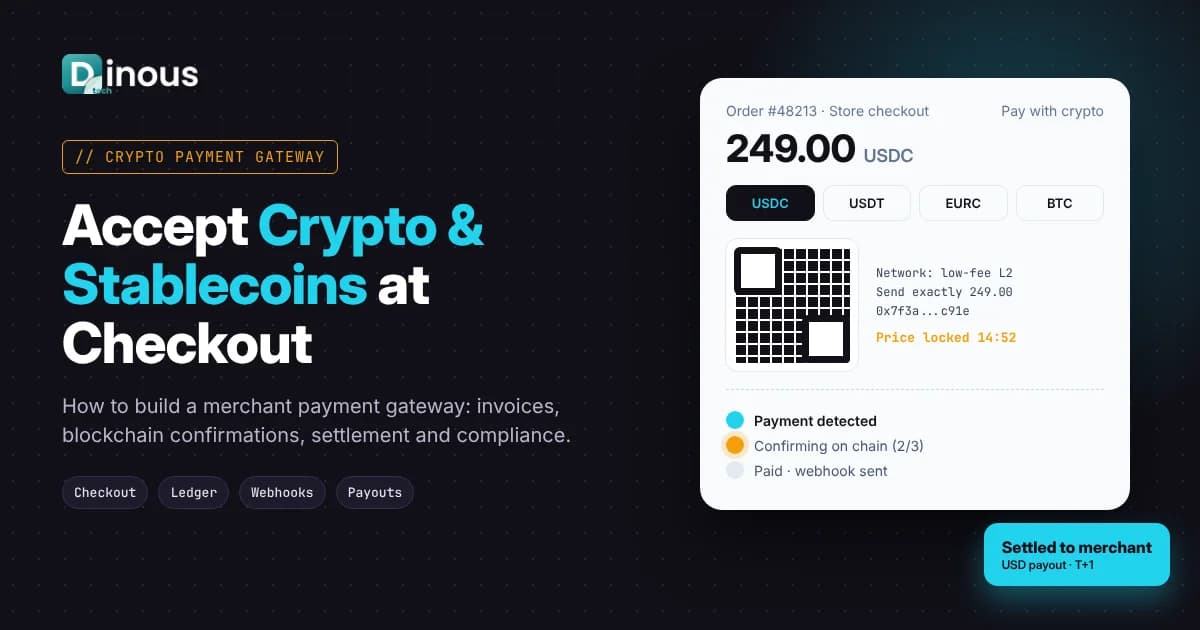
More online businesses now want to accept crypto, and most of them really mean stablecoins: digital dollars and euros that settle in minutes, work across borders and do not swing in price like Bitcoin. Crypto payment gateway development is the work of building the system that makes this possible: a checkout that creates a payment request, wallets that receive the funds, blockchain monitoring that confirms each payment, and settlement that pays the merchant in crypto or local currency. This guide explains how a crypto payment gateway works, the main types, the features merchants and admins need, compliance, how AI fits in, and the key cost and timeline factors.
Dinoustech is a cryptocurrency app development company that builds wallets, exchanges and payment products for clients worldwide. The guidance below comes from the questions payment startups, fintech teams and merchants ask us before they add crypto to their checkout.
Key Takeaways
- A crypto payment gateway lets merchants accept crypto at checkout and get paid in crypto, stablecoins or fiat.
- Stablecoin payments are the main use case for most merchants, because the amount the customer pays is the amount the merchant expects.
- The hard parts are not the checkout button but the ledger, blockchain monitoring, refunds, reconciliation and compliance.
- You can build on a white-label platform, a provider's API, or a fully custom stack, depending on licensing plans and control.
- Licensing, KYC/KYB, transaction screening and the Travel Rule shape the product as much as the technology does.
- A focused gateway MVP usually takes about four to seven months, plus time for licensing and banking partners.
In this guide
Table of Contents
- What Is a Crypto Payment Gateway?
- How a Crypto Payment Works
- Types of Crypto Payment Gateways
- Key Features
- Settlement Options
- Development Process
- Recommended Tech Stack
- How Dinoustech Uses AI
- Security and Compliance
- Revenue Model
- Cost Factors
- Development Timeline
- Common Challenges
- Why Choose Dinoustech
- Conclusion
What Is a Crypto Payment Gateway?
A crypto payment gateway is a service that sits between a customer's crypto wallet and a merchant's store. When a customer chooses to pay with crypto, the gateway creates an invoice with an exact amount, a network and a receiving address, shows it as a QR code or a wallet connect button, watches the blockchain for the payment, and tells the merchant's system when the payment is confirmed. It then settles the money to the merchant in the asset they choose.
For the merchant, the goal is simple: accept a new payment method without holding volatile assets, without learning how blockchains work and without manual checks. For the gateway owner, the goal is a reliable, compliant platform that many merchants can plug into through plugins, payment links and APIs.
A gateway is different from a wallet or an exchange. A crypto wallet app is built for a person to store and send assets, and a crypto exchange is built for trading. A payment gateway is built for merchants: invoices, checkout, confirmations, refunds, reports and payouts.
How a Crypto Payment Works, Step by Step
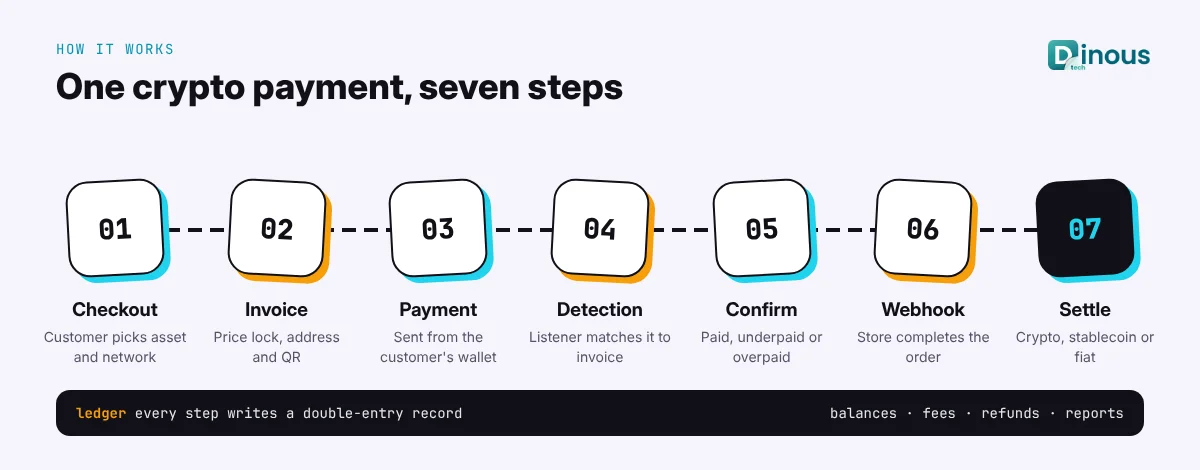
- Checkout: the customer picks "Pay with crypto" and chooses an asset and network, for example a dollar stablecoin on a low-fee network.
- Invoice: the gateway locks a price for a short time, creates a unique deposit address or payment request and shows a QR code with a countdown.
- Payment: the customer pays from their own wallet or an exchange account.
- Detection: blockchain listeners spot the transaction and match it to the invoice by address, amount and memo.
- Confirmation: after the required number of confirmations for that network, the payment is marked paid, underpaid or overpaid.
- Notification: a signed webhook tells the merchant's store to complete the order, and the customer sees a receipt.
- Settlement: funds move to the merchant's balance and are paid out in crypto, stablecoin or fiat on the agreed schedule.
Every step writes to an internal ledger. That ledger, not the blockchain, is the source of truth for merchant balances, fees, refunds and reports.
Types of Crypto Payment Gateways
| Type | How it works | Best for |
|---|---|---|
| Custodial gateway | The gateway holds funds in its own wallets and pays merchants out | Merchants who want fiat payouts and zero crypto handling |
| Non-custodial gateway | Payments go straight to the merchant's own wallet; the gateway only tracks and confirms | Crypto-native merchants and lighter licensing needs |
| Stablecoin-first gateway | Focuses on dollar and euro stablecoins across a few networks | Cross-border eCommerce, SaaS, marketplaces and payouts |
| White-label gateway | A licensed platform rebranded under your name | Banks, PSPs and fintechs that want a fast launch |
| Crypto POS | In-store tablet or terminal app with QR payments | Retail, hospitality and events |
Key Features of a Crypto Payment Gateway
Customer checkout
- Hosted checkout page and embeddable widget with QR code, copy address and wallet connect
- Choice of asset and network with clear fees and a price lock timer
- Live status: waiting, detected, confirming, paid
- Handling for underpayments, overpayments and expired invoices
- Email receipt and simple refund request
Merchant dashboard
- Merchant onboarding with KYB checks and business verification
- Payment links, invoices and subscription billing
- Plugins for popular store platforms and a REST API with sandbox
- Signed webhooks with retries, plus an event log
- Balances by asset, settlement preferences and payout history
- Refunds, reports and CSV export for accounting
- Team roles, API key management and two-factor login
Admin panel
- Merchant approval, risk levels and limits
- Hot and cold wallet balances, sweeps and treasury view
- Transaction screening alerts and case management
- Fee plans per merchant, network and asset
- Reconciliation between ledger, blockchain and bank records
- Network status, confirmation rules and asset enable or disable switches
If you also plan a consumer app for paying in stores or sending money, read our guide on scalable payment and wallet platforms.
Settlement Options: Crypto, Stablecoin or Fiat
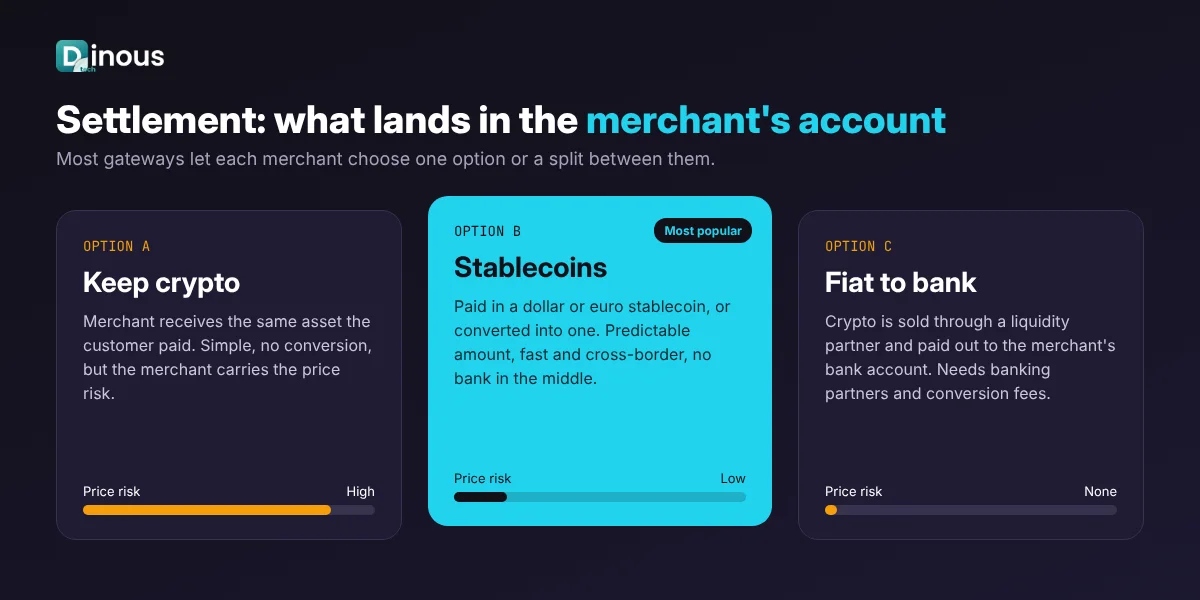
Settlement is the feature merchants care about most, because it decides what lands in their account.
- Keep crypto: the merchant receives the same asset the customer paid. Simple, but the merchant carries the price risk.
- Settle in stablecoins: the gateway converts other assets into a stablecoin, or the customer pays in a stablecoin directly. The merchant gets a predictable dollar or euro amount without a bank in the middle.
- Convert to fiat: the gateway sells the crypto through a liquidity partner and pays the merchant to a bank account. This suits most traditional businesses but needs banking partners and adds conversion costs.
Many gateways offer all three and let each merchant pick a split, for example 80% fiat and 20% stablecoin. Fiat payouts often reuse the same rails as card and bank payments; our guide on integrating a payment gateway into a mobile app covers that side.
Crypto Payment Gateway Development Process
- Discovery and licensing plan: define target markets, merchant types, custody model and the licences or partners you need. This step often decides the architecture.
- Asset and network choice: start with a short list of stablecoins and networks with low fees and good wallet support, then add more later.
- Architecture and ledger design: design the double-entry ledger, invoice states, wallet structure and settlement flows before writing UI.
- Wallet infrastructure: set up address generation, hot and cold wallets, sweeping and key management using MPC or hardware security modules.
- Blockchain listeners: build reliable nodes or provider connections that detect payments, handle chain reorganisations and track confirmations.
- Checkout, API and plugins: build the hosted checkout, REST API, webhooks, sandbox and the first store plugins.
- Compliance layer: add merchant KYB, transaction screening, Travel Rule data exchange where needed, limits and case tools.
- Testing and audit: test on testnets, run load and failure tests, and get an external security review of wallets and APIs.
- Pilot and launch: launch with a small group of merchants, watch reconciliation daily and then open up.
Starting small is the safest way to launch. Our MVP app development guide explains how to choose the first scope.
Recommended Tech Stack
| Layer | Common choices |
|---|---|
| Backend services | Node.js (NestJS), Go or Java for invoice, ledger and settlement services |
| Database | PostgreSQL for the ledger, Redis for price locks and queues |
| Messaging | Kafka or RabbitMQ for payment events and webhooks |
| Blockchain access | Own nodes or node providers, ethers.js / web3 libraries, chain indexers |
| Key management | MPC wallet infrastructure or HSM-based signing |
| Checkout and dashboard | React or Next.js; Flutter or React Native for merchant and POS apps |
| Compliance tools | KYB/KYC provider, blockchain analytics for screening, Travel Rule solution |
| Cloud and monitoring | AWS, GCP or Azure with containers, alerts and audit logs |
How Dinoustech Uses AI in Crypto Payment Projects
- AI-assisted development: our engineers use AI coding assistants to write chain adapters, API tests and ledger test cases faster, with every change reviewed by a senior developer. Wallet and signing code always gets extra human review.
- AI features inside the gateway: fraud and risk scoring on merchants and payments, smart matching of underpaid or wrongly sent payments to the right invoice, alerts on unusual payment patterns, help for compliance teams to summarise screening cases, and plain-language reports for merchants.
- AI support agent for clients: an AI assistant in the merchant dashboard can answer questions such as "Why is this payment still pending?" or "When is my next payout?" from your own data and docs, and pass complex issues to your support team.
AI supports people; it does not approve merchants, release funds or close compliance cases on its own.
Security and Compliance
Rules for crypto payments differ by country and change often. In the EU, crypto-asset service providers fall under MiCA, and many regions apply Travel Rule requirements to transfers between providers. In the USA, the UK, the UAE, Australia and other markets, money transmission, e-money or virtual asset licences may apply depending on whether you hold customer funds. Plan these points early:
- Decide custody: holding funds usually means stronger licensing and capital requirements.
- Run KYB on merchants and keep clear lists of prohibited business types.
- Screen incoming and outgoing transactions with blockchain analytics. Our KYC and AML compliance guide explains the basics.
- Protect keys with MPC or HSMs, split hot and cold wallets and set withdrawal limits.
- Use signed webhooks, idempotent APIs, rate limits and full audit logs.
- Get regular penetration tests and wallet security reviews.
This section is general information, not legal advice. Please confirm requirements with a licensed adviser in each market you serve.
Revenue Model for a Crypto Payment Gateway
- A percentage fee per payment, often lower than card fees to attract merchants
- Conversion spread or fee when settling to stablecoins or fiat
- Payout fees for bank or on-chain withdrawals
- Monthly plans for advanced features, higher limits or POS devices
- White-label licence fees for banks and PSPs
Cost Factors
The cost of crypto payment gateway development depends on scope and on what you build versus license. The main factors are:
- Custody model: custodial platforms need treasury, wallet and payout systems
- Number of assets and networks at launch
- Settlement options, especially fiat payouts and banking integrations
- Own nodes versus node providers, and MPC or HSM key management
- Compliance tools: KYB, screening and Travel Rule providers
- Number of plugins, SDKs and apps such as POS or a merchant mobile app
- Security audits, penetration testing and ongoing monitoring
Licensing, legal advice and partner fees are separate from development and can be large. Dinoustech shares a written estimate after a short discovery call.
Development Timeline
| Phase | Typical duration |
|---|---|
| Discovery, licensing plan and architecture | 3-5 weeks |
| Ledger, wallets and blockchain listeners | 6-10 weeks |
| Checkout, API, webhooks and dashboard | 6-9 weeks |
| Compliance layer and admin tools | 3-6 weeks |
| Testing, security review and pilot | 4-6 weeks |
Many of these phases overlap, so a focused MVP usually takes about four to seven months. Fiat settlement, many networks or a white-label platform for other businesses can take longer.
Common Challenges
- Wrong network or token: customers send funds on the wrong chain. Clear checkout design and recovery processes reduce support load.
- Underpayments and late payments: exchange withdrawal fees and expired price locks create mismatches that need clear rules.
- Reconciliation: ledger, chain and bank records must always match; daily automated checks are a must.
- Refunds: crypto has no chargebacks, so refunds need a proper flow with address verification.
- Banking partners: fiat payouts depend on banks that are comfortable with crypto businesses.
- Changing rules: regulations move quickly, so keep compliance logic configurable.
Why Choose Dinoustech for Crypto Payment Gateway Development
- Experience building crypto wallets, exchanges and payment products for clients worldwide.
- Ledger-first architecture that keeps balances, fees and payouts accurate.
- Honest advice on custodial versus non-custodial and build versus white-label.
- AI-assisted delivery with human review, plus practical AI features with clear guardrails.
- Related fintech app development skills for banking, payouts and compliance, and support after launch.
See examples of our work in our portfolio.
Conclusion
A crypto payment gateway gives merchants a fast, low-cost way to accept payments from customers anywhere, especially with stablecoins. The technology is well understood, but success depends on careful work behind the checkout: a solid ledger, reliable blockchain monitoring, safe key management, clear settlement and compliance built in from day one. Start with a few assets, networks and merchant types, prove the flow with a pilot, then grow.
Planning a crypto or stablecoin payment gateway? Contact Dinoustech for a free consultation and a project plan built around your markets, merchants and budget.