Dinoustech Private Limited
B2B eCommerce Platform Development: How to Build a Wholesale Ordering Portal with ERP Integration and AI
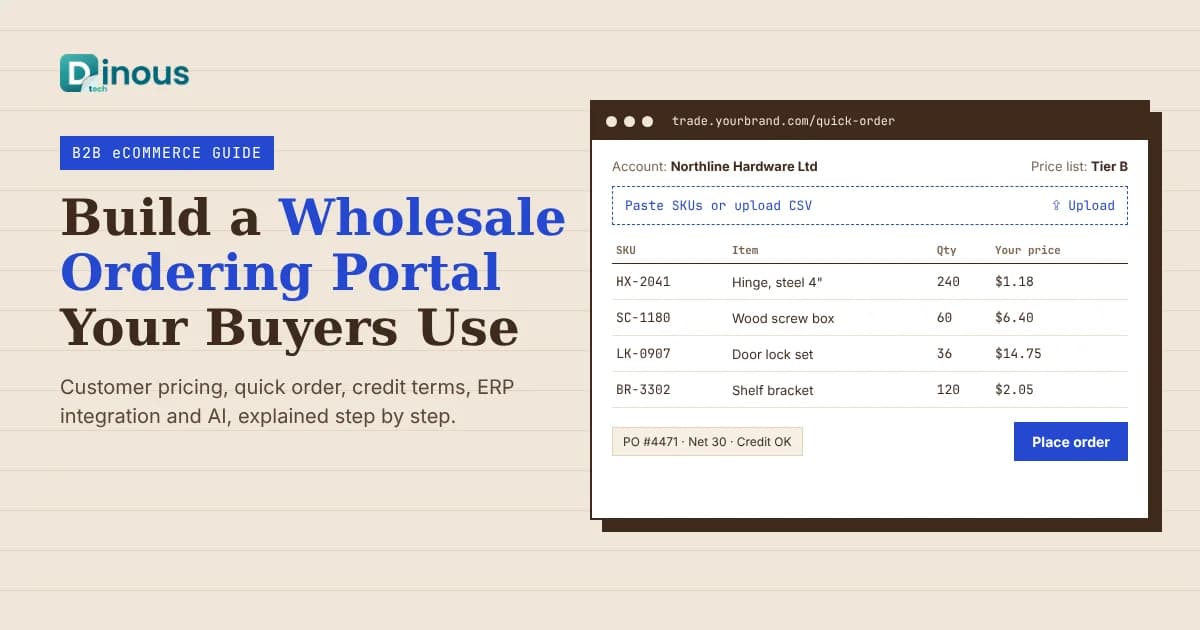
Wholesale buyers no longer want to email spreadsheets, call a sales rep for prices or wait days for an order confirmation. They expect the same easy online ordering they get as consumers, plus the things only business buying needs: their own price list, credit terms, bulk ordering, approvals and invoices. B2B eCommerce platform development is the work of building that experience: a secure ordering portal for your trade customers, connected to your ERP, inventory and accounting systems. This guide explains how B2B eCommerce differs from retail, which features matter most, when to use an off-the-shelf platform or build custom, how AI fits in, and the main cost and timeline factors.
Dinoustech is an eCommerce app development company that builds web stores, mobile shopping apps and ordering portals for clients worldwide. The guidance below comes from the questions manufacturers, distributors and wholesalers ask us before moving their trade sales online.
Key Takeaways
- A B2B eCommerce platform lets business customers log in, see their own prices and terms, and place large or repeat orders online.
- B2B buyers reorder more than they browse, so quick order, CSV upload and saved lists matter more than fancy product pages.
- Customer-specific pricing, company accounts with buyer roles, credit terms and ERP integration are the core of most projects.
- Off-the-shelf B2B editions fit standard needs; custom development fits complex pricing, approval and integration rules.
- AI is most useful for reorder suggestions, search, order capture from emails and PDFs, and sales rep insights.
- A focused B2B portal MVP usually takes about four to six months, depending mostly on integrations.
In this guide
Table of Contents
- What Is a B2B eCommerce Platform?
- B2B vs B2C eCommerce
- Types of B2B eCommerce Platforms
- Key Features
- ERP and System Integrations
- Off-the-Shelf or Custom?
- Development Process
- Recommended Tech Stack
- How Dinoustech Uses AI
- Security and Compliance
- Cost Factors
- Development Timeline
- Common Challenges
- Why Choose Dinoustech
- Conclusion
What Is a B2B eCommerce Platform?
A B2B eCommerce platform is an online store built for business customers instead of consumers. Retailers, contractors, clinics, restaurants and other companies log in to buy from a manufacturer, distributor or wholesaler. After login they see their own catalog, prices, stock, credit limit and order history, and they can place orders that flow straight into the seller's back-office systems.
For the seller, the goal is to take routine orders off the sales team's desk, reduce errors from manual entry and let customers order at any time. Sales reps then spend more time on new accounts and larger deals.
B2B vs B2C eCommerce: What Is Different?
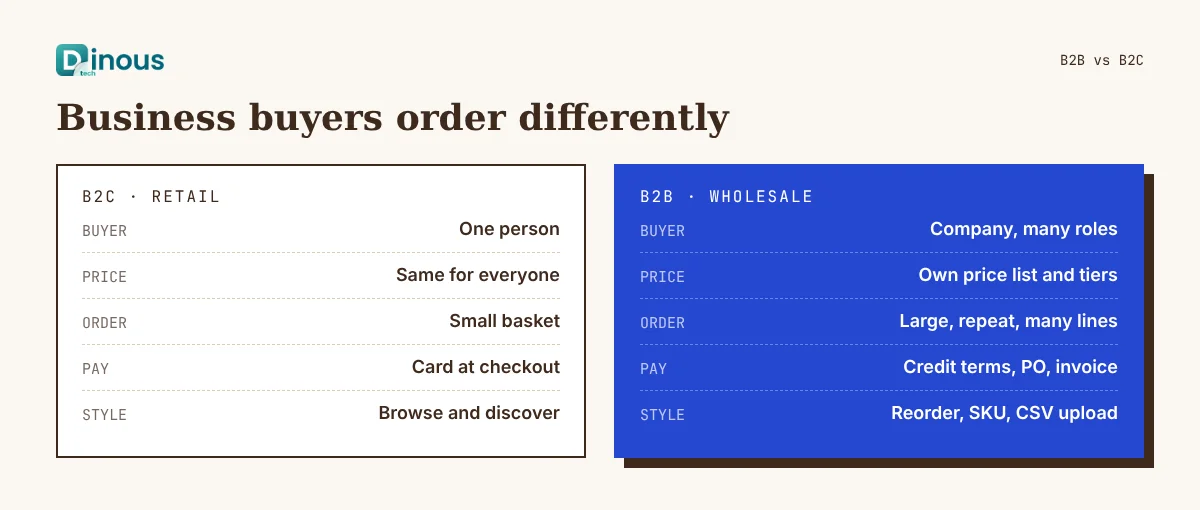
| Area | B2C eCommerce | B2B eCommerce |
|---|---|---|
| Buyer | One person | A company with several users and roles |
| Pricing | Same public price for everyone | Customer-specific price lists, tiers and contracts |
| Order size | Small baskets | Large, repeat orders with many lines |
| Payment | Card or wallet at checkout | Credit terms, invoices, purchase orders, bank transfer |
| Approval | None | Spending limits and manager approval |
| Buying style | Browse and discover | Reorder, search by SKU, upload lists |
| Back office | Simple order management | Deep ERP, warehouse and accounting integration |
If you also sell to consumers, read our custom eCommerce website guide for the B2C side.
Types of B2B eCommerce Platforms
- Wholesale ordering portal: a login-only store for existing trade customers of one manufacturer or distributor.
- Hybrid B2B and B2C store: one catalog with public consumer prices and private trade prices after login.
- Dealer and distributor portal: ordering plus marketing assets, warranty claims and stock visibility for a dealer network.
- B2B marketplace: many suppliers selling to many business buyers, with vendor onboarding and commission. Our post on launching an online marketplace app covers the marketplace basics.
- Sales rep app: a tablet or mobile app that field reps use to take orders at a customer's site, often offline.
Key Features of a B2B eCommerce Platform
Buyer features
- Company accounts with multiple users, roles and shipping addresses.
- Customer-specific catalogs, price lists, volume tiers and contract pricing.
- Quick order by SKU, CSV or spreadsheet upload, saved lists and one-click reorder.
- Minimum order quantities, pack sizes and case quantities.
- Request for quote (RFQ) and negotiated quotes that turn into orders.
- Purchase order numbers, spending limits and approval workflows.
- Payment on credit terms, invoices, statements and online card or bank payments.
- Real-time stock, lead times and order tracking.
- Mobile access through a responsive site or a custom eCommerce mobile app.
Seller and admin features
- Customer onboarding and approval of new trade accounts.
- Price list and promotion management by customer group.
- Credit limit checks and overdue account blocks.
- Sales rep dashboard to place orders on behalf of customers.
- Reports on sales by customer, product, region and rep.
- Product information management for specs, documents and certificates.
ERP and System Integrations
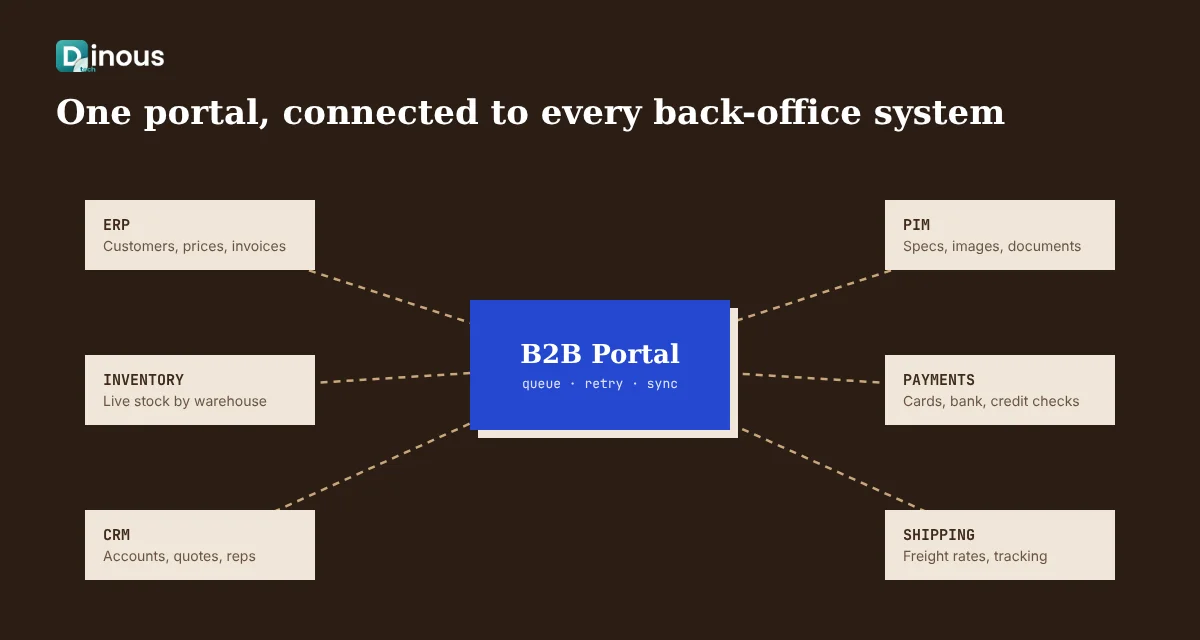
Integration is where most of the effort in B2B eCommerce goes. The portal is only useful if prices, stock, customers and orders match the systems your finance and warehouse teams already use.
- ERP: SAP, Microsoft Dynamics, Oracle NetSuite, Odoo and others for customers, prices, orders and invoices.
- Inventory and warehouse: live stock by location and expected delivery dates.
- CRM: account owners, quotes and sales activity.
- PIM: product data, images, specifications and documents.
- Payments: card and bank payments, invoice payments and credit checks. See how to integrate a payment gateway.
- Shipping: freight rates, carrier labels and tracking.
We usually build an integration layer with queues and retries, so the portal keeps working even when an ERP is slow or offline for maintenance.
Off-the-Shelf B2B Platform or Custom Development?
Platforms such as Shopify Plus B2B, Adobe Commerce, BigCommerce B2B Edition and OroCommerce cover many standard wholesale needs. They are a good fit when your pricing is simple, your ERP has a ready connector and you can follow the platform's way of working.
Custom development makes sense when:
- Your pricing rules are complex, such as contract prices, rebates, region-based pricing or configure-to-order products.
- Approval flows, credit control or order rules are specific to your business.
- Your ERP is older or customized and has no reliable connector.
- You need a dealer portal, sales rep app and customer portal on one shared backend.
- Licence and app fees on a platform are growing faster than your margins.
Our comparison of Shopify vs custom eCommerce development explains the trade-offs in more detail.
B2B eCommerce Development Process
- Discovery: map customer types, pricing rules, order flows and every system the portal must talk to.
- Data audit: clean product data, customer records and price lists before they go online.
- UX design: design for speed of reordering, not just browsing, and test with real buyers.
- Integration first: build and test ERP and inventory sync early, since it carries the most risk.
- Core build: accounts, catalog, pricing, cart, checkout, approvals and admin.
- Pilot: launch with a small group of friendly customers and fix issues.
- Rollout and adoption: invite all customers, train sales reps and track online order share.
Starting with a focused first release follows the same idea as an MVP app: launch the features that remove the most manual orders, then grow.
Recommended Tech Stack
| Layer | Common Choices |
|---|---|
| Frontend | Next.js or React for fast, SEO-friendly pages |
| Mobile | Flutter or React Native for buyer and sales rep apps |
| Backend | Node.js, Java or .NET with REST or GraphQL APIs |
| Commerce engine | Headless platform or a custom order and pricing service |
| Database | PostgreSQL, Redis for cache, Elasticsearch or OpenSearch for search |
| Integration | Message queues, scheduled sync jobs and ERP APIs |
| Cloud | AWS, Google Cloud or Azure with auto-scaling and backups |
How Dinoustech Uses AI in B2B eCommerce Projects
- AI-assisted development: our engineers use AI coding assistants to write integration mappings, tests and boilerplate faster, with every change reviewed by a senior developer.
- AI features inside the platform: reorder suggestions based on each customer's buying cycle, smart search that understands part numbers and synonyms, order capture that turns emailed purchase orders and PDFs into draft carts, product description and attribute cleanup, and sales insights such as customers who are buying less than usual.
- AI support agent for clients: an AI assistant on the portal can answer questions about order status, invoices, stock and delivery times from your own data, and pass complex requests to your sales or support team.
Pricing, credit and approval decisions stay with clear rules and people. AI suggests; your team stays in control.
Security and Compliance
- Role-based access so each buyer only sees their own company's prices, orders and invoices.
- Single sign-on (SSO) and multi-factor authentication for larger customers.
- Encryption in transit and at rest, audit logs and regular penetration tests.
- PCI DSS scope kept small by using a certified payment provider for card data.
- Data protection rules such as GDPR in Europe and the UK, and e-invoicing or tax rules in the markets you sell to.
This section is general guidance, not legal or tax advice. Check the rules for your markets with a qualified adviser.
Cost Factors
- Number and type of integrations, especially the ERP.
- Complexity of pricing, quoting and approval rules.
- Catalog size and product data quality.
- Platforms: web portal only, or also buyer and sales rep mobile apps.
- Off-the-shelf licence fees versus custom build cost.
- Number of countries, languages, currencies and tax rules.
- Hosting, support and ongoing improvements.
For general budgets, see how much it costs to build an eCommerce app and how to optimize eCommerce development costs. Dinoustech shares a written estimate after a short discovery call.
Development Timeline
| Phase | Typical Duration |
|---|---|
| Discovery and data audit | 2 to 4 weeks |
| UX and UI design | 3 to 5 weeks |
| ERP and system integration | 6 to 12 weeks (runs alongside the build) |
| Core portal build | 8 to 14 weeks |
| Testing and pilot | 3 to 6 weeks |
A focused MVP portal usually takes about four to six months in total. Several ERPs, many markets or a marketplace model can take longer. These are honest ranges, not promises.
Common Challenges
- Messy data: duplicate SKUs, missing images and old price lists slow launch. Clean data early.
- ERP limits: some systems cannot handle real-time calls. Use caching and scheduled sync.
- Customer adoption: buyers used to calling need a reason to switch. Offer saved lists, faster reorders and clear order tracking.
- Sales team concerns: reps may fear losing commission. Credit them for online orders from their accounts.
- Scope creep: every department wants features. Start with the flows that remove the most manual work.
Why Choose Dinoustech for B2B eCommerce Development
- Experience building eCommerce stores, marketplaces and ordering apps for clients worldwide.
- Integration-first approach that protects your ERP and keeps data in sync.
- Honest advice on off-the-shelf versus custom, based on your rules and budget.
- AI-assisted delivery with human review, plus practical AI features with clear guardrails.
- Buyer and sales rep apps through our mobile app development team, with support after launch.
See examples of our work in our portfolio.
Conclusion
A good B2B eCommerce platform makes ordering faster for your customers and cheaper for your team. Success depends less on design trends and more on getting pricing, reordering and ERP integration right. Start with the customers and order types that create the most manual work, launch a focused portal, measure the share of orders that move online, then add apps, AI and new markets.
Planning a wholesale or B2B ordering portal? Contact Dinoustech for a free consultation and a project plan built around your systems, customers and budget.