Dinoustech Private Limited
Multi-Vendor Marketplace Development: Features, Split Payments, Tech Stack, AI and Cost Factors
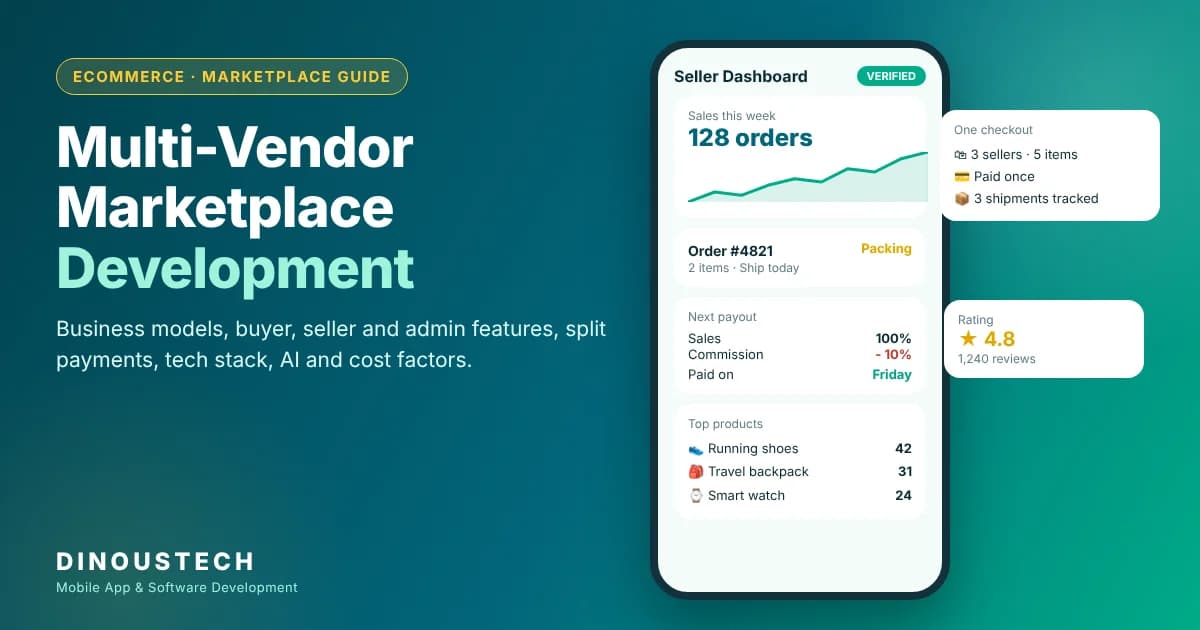
Multi-vendor marketplace development is the process of building an online platform where many independent sellers list and sell their products to buyers, while you, the marketplace owner, manage the storefront, payments, commissions and trust. Think of how Amazon, Etsy or Noon work: one website or app, thousands of sellers, one checkout. This guide explains how a multi-vendor marketplace works, the business models, the features buyers, sellers and admins need, the build process, tech stack, payments and compliance, cost factors and realistic timelines.
Key Takeaways
- A multi-vendor marketplace has three sides to serve: buyers, sellers (vendors) and the platform admin. Each needs its own app or panel.
- Split payments are the heart of the system: one buyer checkout, separate orders per seller, an automatic commission for you and scheduled payouts to sellers.
- Seller onboarding, identity checks and product moderation protect buyers and your brand.
- Search, reviews and fast delivery tracking decide whether buyers come back.
- AI helps with product search, recommendations, listing quality, fraud checks and seller support.
- Cost depends on the number of seller tools, payment and logistics integrations, platforms (web, Android, iOS) and how much automation you want at launch.
Table of Contents
- What Is a Multi-Vendor Marketplace?
- Marketplace Business Models
- How a Multi-Vendor Marketplace Works
- Must-Have Features
- Split Payments and Seller Payouts
- Step-by-Step Development Process
- Recommended Tech Stack
- How Dinoustech Uses AI
- Monetization Models
- Compliance and Trust
- Cost Factors
- Development Timeline
- Challenges and Solutions
- Why Choose Dinoustech
What Is a Multi-Vendor Marketplace?
A single-vendor online store sells one company's own products. A multi-vendor marketplace is different: many sellers set up their own shop inside your platform. They upload products, set prices, manage stock and ship orders. You provide the platform, bring buyers, handle the checkout and take a commission or fee on each sale.
For buyers, a marketplace means more choice in one place. For sellers, it means access to customers without building their own store. For you, it means you can grow the catalogue without holding inventory. That is why marketplaces are popular for fashion, handmade goods, electronics, B2B supplies, food, services and local commerce in every region.
If you are still deciding between a ready-made platform and a custom build, read our comparison of Shopify vs custom ecommerce development.
Marketplace Business Models
1. B2C Product Marketplace
Many sellers sell to consumers, like Amazon, Etsy or Flipkart. This is the most common model and needs strong search, reviews and delivery tracking.
2. Niche or Vertical Marketplace
The marketplace focuses on one category, such as handmade jewellery, organic food, auto parts or luxury resale. A narrow focus makes it easier to attract both sellers and buyers at the start.
3. B2B Marketplace
Businesses buy from other businesses, often with bulk pricing, quotes, credit terms and invoices. Our guide on B2B ecommerce platform development covers these extra needs.
4. Hyperlocal Marketplace
Local stores, restaurants or pharmacies sell to nearby customers with fast delivery. These platforms need location-based search, delivery partner apps and real-time tracking.
5. C2C and Resale Marketplace
Individuals sell to other individuals, as on eBay or Vinted. Trust features such as identity checks, ratings, buyer protection and dispute handling matter most here. For classified-style platforms, see how to launch a marketplace app like OLX and Quikr.
How a Multi-Vendor Marketplace Works
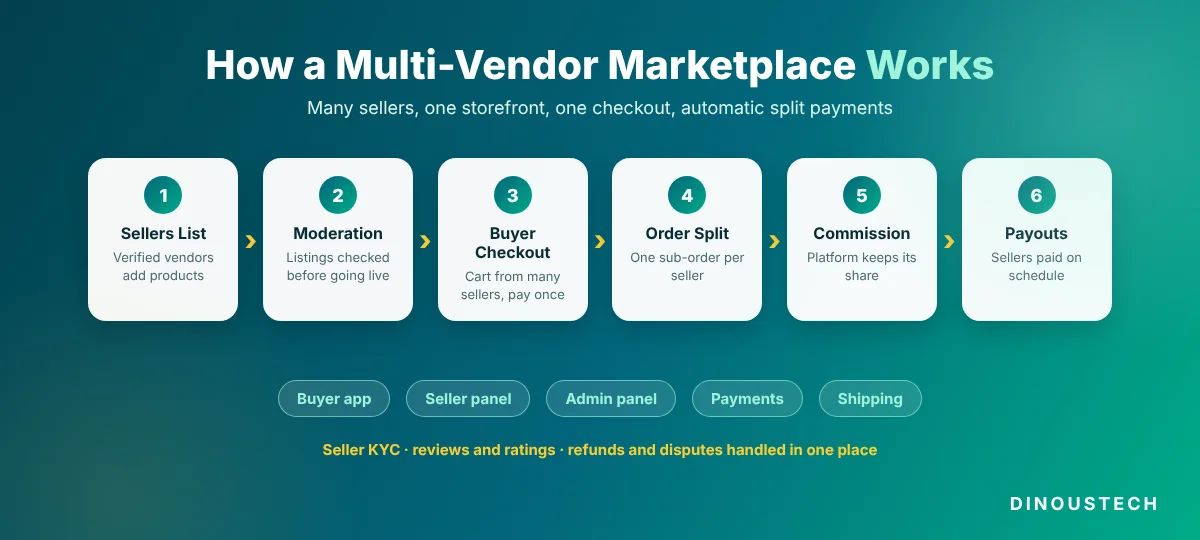
- Sellers sign up and pass verification, then add products, prices, stock and shipping rules.
- The admin approves sellers and listings, or automated checks do it for low-risk categories.
- Buyers search and add items from several sellers to one cart.
- One checkout collects the full payment from the buyer.
- The order splits into one sub-order per seller, each with its own shipping and status.
- The platform keeps its commission and holds the seller's share until delivery or the return window ends.
- Sellers get paid out on a schedule, with a clear statement of sales, fees and refunds.
Must-Have Features of a Multi-Vendor Marketplace
Buyer Features
- Fast search with filters, sorting and typo tolerance
- Product pages with images, video, variants, seller info and reviews
- One cart for products from many sellers
- Multiple payment methods: cards, wallets, local payment options and cash on delivery where relevant
- Order tracking per seller shipment
- Returns, refunds and dispute requests
- Wishlist, saved addresses and order history
- Ratings and reviews for products and sellers
- Chat with sellers about products and orders
Seller (Vendor) Panel Features
- Self-service onboarding with business and bank details
- Product upload, bulk import by CSV and variant management
- Inventory and price management
- Order management, packing slips and shipping labels
- Payout statements, commission details and tax invoices
- Sales analytics and customer reviews
- Coupons and promotions
Admin Features
- Seller approval, verification status and performance scores
- Product and category management, with listing moderation
- Commission rules by category, seller or plan
- Payment, payout and refund control
- Dispute and return management
- CMS for banners, landing pages and SEO content
- Reports on GMV, orders, commissions, top sellers and fraud flags
- Role-based access for your operations team
Split Payments and Seller Payouts
Payments are the hardest part of a marketplace to get right. When a buyer pays once for items from three sellers, the platform must split that money correctly, keep its commission, handle refunds and pay each seller on time.
Payment providers built for platforms, such as Stripe Connect, PayPal for Marketplaces, Adyen for Platforms and Razorpay Route, are designed for this. They support connected seller accounts, seller identity checks, split payments and scheduled payouts. The right provider depends on the countries you serve and the payment methods your buyers prefer.
Key design decisions include:
- Who is the merchant of record: the platform or each seller. This affects liability, refunds and taxes.
- When sellers are paid: after delivery, after the return window, or on a fixed weekly cycle.
- Who pays fees, refunds and chargebacks: the platform, the seller or both.
- How commissions are calculated: flat percentage, category-based, tiered by sales volume or a mix.
Step-by-Step Multi-Vendor Marketplace Development Process
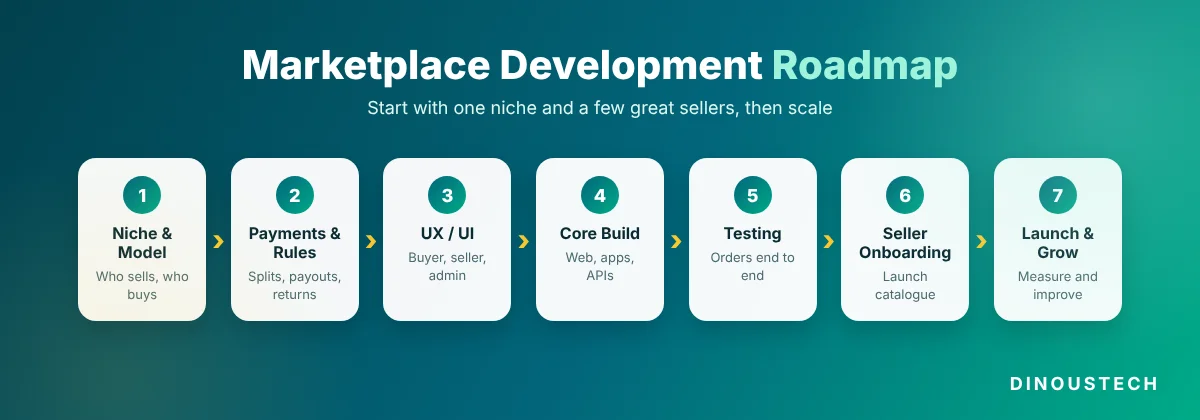
Step 1: Choose Your Niche and Model
Define who your sellers and buyers are, which categories you start with, and how you earn. A focused niche is easier to launch than a general store.
Step 2: Plan Payments, Logistics and Rules
Pick the payment provider, shipping partners, commission rules, return policy and seller requirements before design starts. These decisions shape the whole system.
Step 3: UX and UI Design
Design the buyer app, seller panel and admin panel. Keep the buyer journey short and the seller onboarding simple, because seller drop-off at signup is a common problem.
Step 4: Build the Core Platform
Developers build catalogue, search, cart, checkout, order splitting, seller panel, admin panel and integrations. Mobile apps follow or run in parallel.
Step 5: Test End to End
Test real scenarios: mixed carts, partial refunds, cancelled sub-orders, failed payouts and high traffic during sales.
Step 6: Onboard Launch Sellers
A marketplace with empty shelves does not convert. Onboard your first sellers and products before opening to buyers.
Step 7: Launch, Measure and Grow
Launch in one region or category, track conversion, seller activity and repeat purchases, and add features based on data. Our MVP app development guide explains how to keep the first release lean.
Recommended Tech Stack
| Layer | Common Choices | Purpose |
|---|---|---|
| Web storefront | Next.js, React | Fast, SEO-friendly product and category pages |
| Mobile apps | Flutter, React Native, Swift, Kotlin | Buyer and seller apps for Android and iOS |
| Backend | Node.js, Python, Java, or headless commerce engines | Catalogue, orders, commissions and APIs |
| Search | Elasticsearch, OpenSearch, Algolia, Meilisearch | Fast product search with filters |
| Database and cache | PostgreSQL, MongoDB, Redis | Products, orders, sessions and caching |
| Payments | Stripe Connect, PayPal for Marketplaces, Adyen for Platforms, Razorpay Route | Split payments, seller verification and payouts |
| Shipping | Carrier and aggregator APIs | Rates, labels and tracking |
| Media | Cloud storage with a CDN and image optimisation | Fast product images and videos |
| Cloud and DevOps | AWS, Google Cloud, Azure, Docker, Kubernetes | Scaling for sale days and high traffic |
How Dinoustech Uses AI in Marketplace Projects
AI-Assisted Development
Our developers use AI coding assistants for boilerplate, test cases and code reviews. Every change is still reviewed by an engineer. This saves time on routine work, so more of your budget goes into the features that make your marketplace different.
AI Features Inside the Marketplace
- Smarter search: semantic search that understands what a buyer means, not just exact words.
- Recommendations: "similar items" and "frequently bought together" based on browsing and purchase data.
- Listing assistant: AI writes clear product titles and descriptions from a few details or a photo, so sellers list faster and listings look consistent.
- Image checks: automatic detection of low-quality or prohibited product images.
- Fraud and risk signals: flags unusual orders, fake reviews or risky new sellers for review.
- Review summaries: short AI summaries of what buyers like and dislike about a product.
Learn more about our AI app development services.
AI Support Agent for Buyers and Sellers
An AI support agent can answer common questions such as "Where is my order?", "How do I return this?" or "When is my next payout?" using your policies and live order data. Complex cases go to your support team with full context.
Monetization Models
- Commission per sale: a percentage of each order, often different by category.
- Seller subscriptions: monthly plans with lower commissions or extra tools.
- Listing fees: a small fee per product listing.
- Sponsored products and ads: sellers pay to appear higher in search and category pages.
- Fulfilment services: storage, packing and delivery handled by the platform for a fee.
- Buyer memberships: paid plans with free shipping or member-only deals.
Compliance and Trust
This section is general information, not legal advice. Please check the rules for every country you sell in with a qualified advisor.
- Seller verification: payment providers and many regulators expect marketplaces to verify seller identity and bank details.
- Consumer protection: clear prices, seller identity, return rights and complaint handling. In the EU, the Digital Services Act adds duties for online marketplaces, such as tracing who traders are.
- Taxes: many countries make marketplaces responsible for collecting sales tax, VAT or GST on some sales, so the tax setup must be planned per market.
- Payment security: use PCI DSS compliant payment providers and never store raw card data.
- Data protection: follow GDPR and similar privacy laws for buyer and seller data.
- Prohibited items: clear policies and moderation to keep counterfeit and banned products off the platform.
Multi-Vendor Marketplace Development Cost Factors
Costs vary widely with scope. The biggest factors are:
- Platforms: web only, or web plus Android and iOS apps for buyers and sellers.
- Seller tools: basic product and order management, or advanced analytics, bulk tools and promotions.
- Payments: one provider in one country, or several providers, currencies and payout methods.
- Logistics: seller-managed shipping, or integrated carriers, delivery apps and tracking.
- Search and AI: standard search, or semantic search, recommendations and AI listing tools.
- Languages and regions: multi-language, multi-currency and regional tax rules.
- Integrations: ERP, accounting, CRM and marketing tools.
- Ongoing costs: hosting, payment fees, maintenance and new features.
Our article on how much it costs to build an ecommerce app explains general ecommerce cost drivers. For a quote for your marketplace, share your model, target countries and must-have features with our team.
Development Timeline
| Scope | What It Includes | Typical Timeline |
|---|---|---|
| MVP marketplace | Web storefront, seller panel, admin panel, one payment provider, basic search | 10-14 weeks |
| Full marketplace | Web plus Android and iOS apps, advanced search, reviews, shipping integrations | 4-6 months |
| Large-scale platform | Multi-country, multi-currency, AI features, ads, fulfilment, ERP integrations | 6-10 months or more |
Challenges and Solutions
- The chicken-and-egg problem: onboard sellers first with low or zero commission for a launch period, then market to buyers.
- Inconsistent listings: use listing templates, required fields and AI listing help.
- Refunds across sellers: design order splitting and partial refunds from day one.
- Fake reviews and fraud: verified-purchase reviews, risk scoring and manual review queues.
- Traffic spikes on sale days: caching, CDN, auto-scaling and load testing before big campaigns.
Why Choose Dinoustech for Multi-Vendor Marketplace Development
Dinoustech is a software development company based in Jaipur, India, working with clients around the world. We have delivered more than 450 projects across mobile apps, web platforms and custom software.
- A dedicated ecommerce web and app development team
- Buyer apps, seller panels and admin panels built by one team
- Experience integrating payment gateways, shipping APIs and search engines
- Mobile app development for Android and iOS
- Developers available for calls in US, UK, EU and Middle East time zones
- Post-launch support as your seller base grows
See examples of our work in our portfolio, or read how we build custom ecommerce websites.
Start Your Multi-Vendor Marketplace
Whether you are launching a niche marketplace for local sellers or a large B2C platform across countries, we can help you plan the model, payments and features, and build it end to end. Contact Dinoustech today for a free consultation.