Dinoustech Private Limited
KYC and AML Compliance in Fintech App Development: A Practical Guide for 2026
Every fintech app that moves money has to answer two questions about each user: who are you, and is your money clean? Those questions are the heart of KYC and AML compliance in fintech app development. Know Your Customer (KYC) checks confirm a user's identity. Anti-Money Laundering (AML) controls watch for financial crime before and after onboarding. Get them right and you launch faster, keep banking partners happy and stop fraud early. Get them wrong and you risk fines, frozen accounts and lost trust. This guide explains how to build KYC and AML into a fintech app: the requirements in major markets, the onboarding flow, transaction monitoring, the tech stack, how AI helps, cost factors and a realistic timeline. It is written for fintech founders, product teams and financial businesses worldwide, from the USA, UK and Europe to the UAE and Australia.
Dinoustech is a fintech app development company that builds payment apps, digital wallets, lending platforms and banking apps with compliance built in from the first sprint. The guidance below reflects the questions our fintech clients raise most often before launch.
Key Takeaways
- KYC verifies who a user is; AML is the wider programme that detects and reports suspicious financial activity.
- Most regulated fintech apps need identity verification, sanctions and PEP screening, risk scoring, transaction monitoring and record keeping.
- Rules differ by country, so design a flexible compliance layer that can apply different checks per market and risk level.
- Build compliance as a product feature, not a last-minute add-on. Good onboarding UX and strong controls can go together.
- Specialist providers for ID checks, liveness and screening save months compared with building everything in-house.
- AI improves document checks, fraud detection and alert triage, while human analysts stay in charge of final decisions.
Table of Contents
- What Are KYC and AML?
- Which Fintech Apps Need KYC and AML?
- Regulatory Landscape in Key Markets
- Core Components of a KYC/AML System
- Designing the KYC Onboarding Flow
- Transaction Monitoring and Reporting
- Admin and Compliance Dashboard Features
- Build vs Buy: Choosing KYC and AML Providers
- Recommended Tech Stack
- How Dinoustech Uses AI in Fintech Compliance
- Data Security and Privacy
- Cost Factors
- Development Timeline
- Common Challenges and How to Solve Them
- Why Choose Dinoustech
- FAQs
What Are KYC and AML?
Know Your Customer (KYC) is the process of identifying and verifying a customer before and during a business relationship. In a fintech app it usually means collecting personal details, checking an identity document, confirming the person is real and present, and assessing the risk the customer brings.
Anti-Money Laundering (AML) is the broader set of laws, policies and controls that stop criminals from using financial services to hide the source of money or fund illegal activity. KYC is one part of an AML programme. Others include sanctions screening, ongoing monitoring of transactions, reporting suspicious activity to the authorities, staff training and keeping records for audits.
Many teams also use the terms CDD (Customer Due Diligence), the standard checks for most users, and EDD (Enhanced Due Diligence), deeper checks for higher-risk customers such as politically exposed persons or users from high-risk countries.
Which Fintech Apps Need KYC and AML?
If your app holds, moves, lends or exchanges money, expect KYC and AML duties, either directly or through your licensed banking or payment partner. Common examples:
- Digital wallets and peer-to-peer payment apps
- Neobanks and mobile banking apps
- Lending, buy now pay later and microfinance apps
- Cross-border remittance and money transfer apps
- Investment, stock trading and robo-advisory apps
- Cryptocurrency exchanges and crypto wallets
- Prepaid card and expense management platforms
Even when a partner bank holds the licence, it will usually expect your app to run the checks to its standard and share the results. Planning this early avoids painful rework later, as we discuss in the challenges of developing banking software.
Regulatory Landscape in Key Markets
International standards come from the Financial Action Task Force (FATF), whose recommendations shape national laws around the world. Each country then sets its own rules. The table below is a simplified overview of where the main requirements come from; always confirm the current rules for your licence and markets with qualified legal counsel.
| Market | Main framework and regulators | What it means for your app |
|---|---|---|
| USA | Bank Secrecy Act, USA PATRIOT Act (Customer Identification Program), FinCEN rules, OFAC sanctions, plus state money transmitter licences | Verify identity at sign-up, screen against OFAC lists, monitor and file suspicious activity reports |
| UK | Money Laundering Regulations 2017, FCA supervision, UK sanctions regime | Risk-based CDD and EDD, ongoing monitoring, strong record keeping |
| European Union | EU Anti-Money Laundering Directives, the newer AML Regulation and the AML Authority (AMLA), GDPR for data | Harmonised CDD rules across member states, privacy-by-design for personal data |
| UAE | Federal AML/CFT law, Central Bank of the UAE, DFSA and FSRA in the financial free zones | Customer due diligence, sanctions screening, reporting through the national financial intelligence unit |
| Australia | AML/CTF Act, AUSTRAC | Customer identification, transaction reporting and an AML/CTF programme |
This section is general information, not legal advice.
Core Components of a KYC/AML System
- Customer data collection: name, date of birth, address, nationality and, where required, tax ID or occupation.
- Identity document verification: passport, national ID or driving licence capture with authenticity checks (fonts, holograms, MRZ, tampering).
- Biometric liveness and face match: a selfie or short video that proves a real person is present and matches the document photo.
- Address and database checks: proof of address or electronic checks against trusted data sources, depending on the market.
- Sanctions, PEP and adverse media screening: matching users against global sanctions lists, politically exposed person lists and negative news.
- Risk scoring: each customer gets a low, medium or high risk rating that decides which checks and limits apply.
- Business verification (KYB): for business accounts, checking company registration, directors and ultimate beneficial owners.
- Transaction monitoring: rules and models that flag unusual activity after onboarding.
- Case management and reporting: tools for analysts to review alerts, document decisions and file reports with regulators.
- Audit trail and record keeping: secure, time-stamped records of every check and decision for the retention period your rules require.
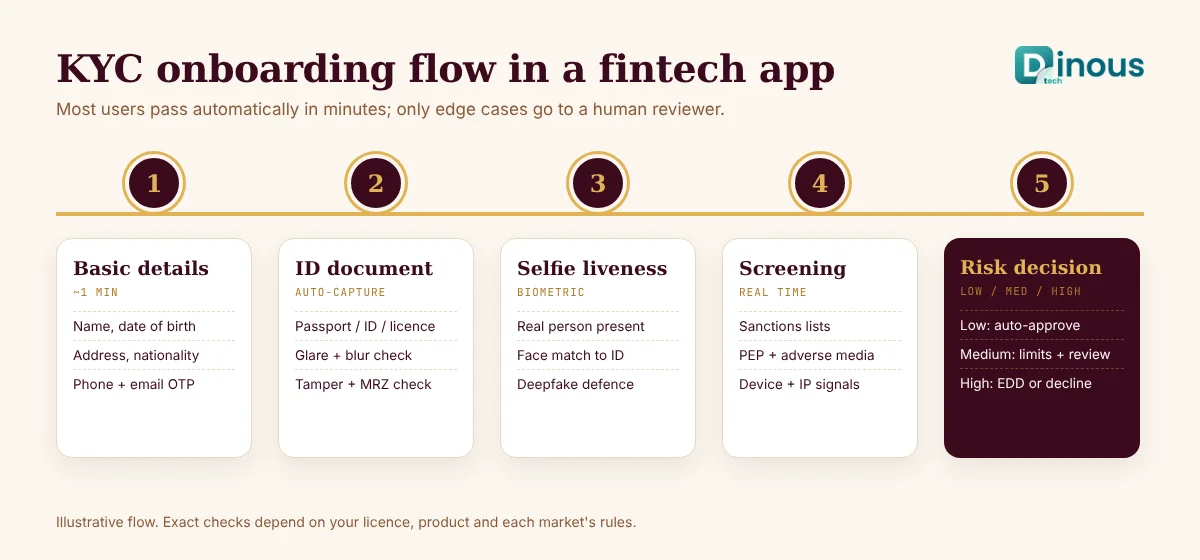
Designing the KYC Onboarding Flow
Onboarding is where compliance and conversion meet. A slow or confusing KYC flow loses users before their first transaction. These practices help:
- Tiered KYC: let users start with light checks and low limits, then ask for more information only when they want higher limits or riskier products, where your rules allow it.
- Smart document capture: auto-detect the document edges, warn about glare or blur and auto-fill fields from the document to avoid typing.
- Clear progress: show steps (details, ID, selfie, review) so users know how long it will take.
- Instant decisions where possible: most users should be approved automatically in minutes, with only edge cases sent to manual review.
- Helpful failure messages: tell users exactly what to fix ("photo too dark", "document expired") instead of a generic error.
- Accessibility and localisation: support local ID types, languages and right-to-left scripts in markets such as the UAE.
- Re-verification: trigger periodic or event-based reviews when documents expire or risk changes.
Secure login matters as much as sign-up. Adding biometric authentication and device binding makes account takeover much harder.
Transaction Monitoring and Reporting
KYC confirms who joins your platform; transaction monitoring watches what they do next. A typical setup combines rules and analytics:
- Threshold rules: large single payments or many payments just below a limit (structuring).
- Velocity rules: unusual numbers of transactions in a short period.
- Behaviour changes: activity that does not match the user's profile, such as a student account suddenly receiving large business payments.
- Geography rules: payments to or from high-risk countries or sanctioned regions.
- Network patterns: many accounts sending money to the same destination, a common sign of mule activity.
- Real-time screening: checking payees and counterparties against sanctions lists before money moves.
When an alert fires, it goes into a case queue. An analyst reviews the activity, requests more information if needed and decides whether to close the case or escalate it. Where the law requires, the compliance team files a suspicious activity report with the relevant financial intelligence unit. The app must keep a complete record of each step. For payment-specific features, see our guide to key features of a successful payment app.
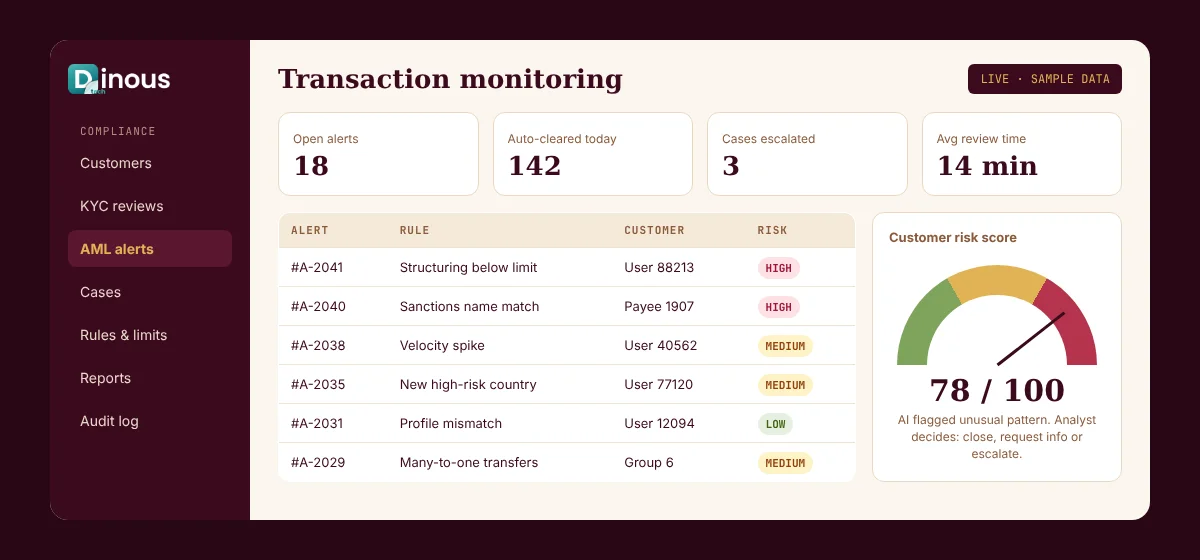
Admin and Compliance Dashboard Features
- Customer profiles with KYC status, documents, risk score and full history
- Manual review queue for failed or borderline verifications
- Alert and case management with assignment, notes, attachments and deadlines
- Configurable rules, limits and risk thresholds per country or product, without new code releases
- Sanctions list update logs and re-screening of existing customers when lists change
- Role-based access, maker-checker approvals and a tamper-evident audit log
- Regulatory and management reports, with export for auditors
Build vs Buy: Choosing KYC and AML Providers
Very few fintechs build document verification or sanctions data from scratch. The usual approach is to integrate specialist providers through APIs and build your own orchestration layer, rules and dashboards around them. When comparing providers, check:
- Coverage of the countries and ID document types you need
- Liveness quality and resistance to deepfakes and presentation attacks
- Pass rates, speed and the share of cases that go to manual review
- Sanctions, PEP and adverse media data sources and update frequency
- Data residency options and certifications such as ISO 27001 or SOC 2
- Pricing per check and minimum commitments
A provider-agnostic design lets you switch or add vendors per region without rebuilding your app. Our article on technologies used in modern fintech software development covers the wider architecture.
Recommended Tech Stack
| Layer | Common choices |
|---|---|
| Mobile app | Flutter, React Native, or native Swift and Kotlin with provider SDKs for document capture and liveness |
| Backend | Node.js, Java (Spring Boot), Python or Go, built as services with clear APIs |
| Database | PostgreSQL for customer and case data; encrypted object storage for documents |
| Event streaming | Kafka or a cloud equivalent for real-time transaction monitoring |
| Rules and analytics | A rules engine plus machine learning models for risk scoring and anomaly detection |
| Security | Cloud key management, encryption at rest and in transit, secrets management, web application firewall |
| Cloud | AWS, Google Cloud or Azure, using regions that meet your data residency rules |
How Dinoustech Uses AI in Fintech Compliance
AI makes compliance faster and smarter, but it must be explainable and supervised by people. We use it in three ways.
AI-assisted development
Our engineers use AI coding assistants to speed up routine work such as API integrations with KYC providers, data validation code and automated tests for onboarding and monitoring flows. AI also helps us generate edge-case test data, for example unusual names, scripts and document formats. Senior developers review every change, so speed never comes at the cost of control.
AI features inside the app
- Document and face analysis: computer vision checks for tampering, screen replays and deepfake attempts during verification.
- Smarter name matching: AI models reduce false positives in sanctions screening by understanding transliteration, nicknames and spelling variants.
- Anomaly detection: machine learning spots unusual behaviour that fixed rules miss and helps rank alerts by risk.
- Alert summaries: generative AI can draft a short summary of a case for the analyst, who then checks and decides.
Read more in AI features every fintech app should have and generative AI in fintech.
AI support agent for clients
Many support tickets in fintech are about onboarding: "Why was my ID rejected?" or "How long does verification take?". We can build an AI support agent that answers these questions in the app or on your website at any hour, guides users through re-submission and hands sensitive cases to your human team. It reduces drop-off during KYC and lowers support load.
Data Security and Privacy
KYC data is some of the most sensitive data a company can hold. Protect it with encryption in transit and at rest, strict role-based access, masking of document numbers in the admin panel, separate storage for documents and biometric data, and automatic deletion once retention periods end. Follow the privacy laws of each market, such as GDPR in the EU and UK and state privacy laws in the USA, and get clear consent for biometric processing where the law requires it. If you process card data, PCI DSS also applies. Regular penetration tests and security reviews should be part of every release cycle.
Cost Factors
The cost of adding KYC and AML to a fintech app depends on:
- Number of markets: each country can add document types, data sources and rule sets.
- Customer types: individuals only (KYC) or businesses too (KYB with beneficial owner checks).
- Verification depth: basic ID checks versus liveness, address checks, EDD and ongoing screening.
- Monitoring complexity: simple rules versus real-time streaming and machine learning models.
- Provider fees: most KYC and screening vendors charge per check or per active user.
- Dashboard and case management scope: off-the-shelf tools versus a custom compliance back office.
- Security and audit requirements: penetration testing, certifications and documentation for partners and regulators.
For broader budgeting, see what it costs to build a fintech app in 2026, or contact Dinoustech for a scoped estimate.
Development Timeline
| Phase | Typical duration |
|---|---|
| Compliance requirements and provider selection | 2 to 4 weeks |
| Onboarding UX design and prototype | 2 to 3 weeks |
| KYC integration (ID, liveness, screening, risk scoring) | 4 to 6 weeks |
| Transaction monitoring rules and case management | 4 to 8 weeks |
| Security testing, audit preparation and partner review | 2 to 4 weeks |
Some phases run in parallel, so adding KYC and AML to a new fintech app typically takes about three to five months, depending on markets and scope. Our article on how long it takes to build a fintech app shows how this fits into the full project.
Common Challenges and How to Solve Them
- High onboarding drop-off: use tiered KYC, auto-capture and clear guidance; measure each step's completion rate.
- Too many false positives: tune matching thresholds, use better name-matching models and review rules regularly.
- Changing regulations: keep rules and limits configurable in the admin panel instead of hard-coded.
- Deepfakes and synthetic identities: use strong liveness checks, device signals and cross-checks between data sources.
- Multi-country complexity: design a provider-agnostic layer and country-specific rule sets from the start.
- Audit readiness: log every decision with who, what, when and why, and make reports easy to export.
Why Choose Dinoustech
- Fintech focus: experience with wallets, payments, lending and banking apps where compliance is part of the core product.
- Compliance by design: we plan KYC, AML, security and audit needs in discovery, not after launch.
- Provider-agnostic integrations: we connect the KYC, screening and payment providers that fit your markets.
- Configurable back office: compliance teams can change rules, limits and workflows without waiting for developers.
- AI-ready: smarter fraud detection, alert triage and an AI support agent for your users.
- Global delivery: apps for clients in the USA, UK, Europe, the UAE, Australia and beyond.
Explore our portfolio and our fintech app development services to see how we work.
Conclusion
KYC and AML compliance is not just a legal box to tick. It protects your users, your banking partners and your brand, and it is a requirement for growth in every serious fintech market. The best fintech apps treat compliance as part of the product: smooth onboarding, smart risk-based checks, real-time monitoring and clear records. Plan it early, choose the right providers and keep your rules flexible as regulations change. Ready to build a compliant fintech app? Talk to Dinoustech today for a free consultation.