Dinoustech Private Limited
Crypto Trading Bot Development: Types, Features, Tech Stack, AI and Cost Factors
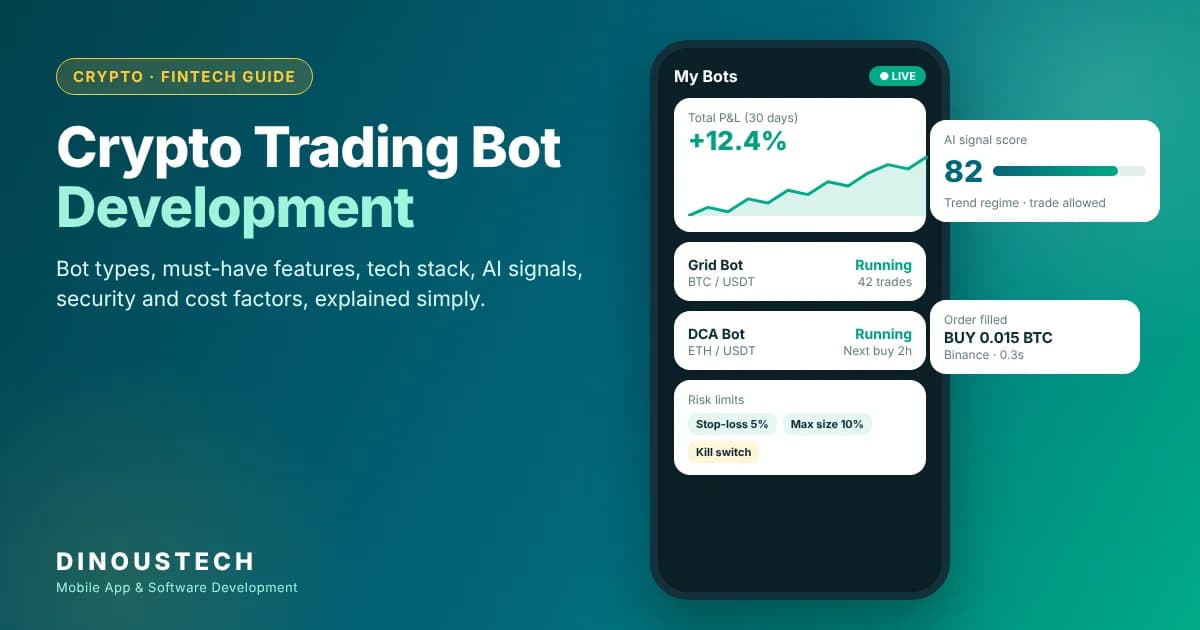
Crypto trading bot development means building software that connects to crypto exchanges through their APIs and places buy and sell orders on its own, following rules or models that you define. A good bot reads market data in real time, runs a strategy such as grid, DCA, arbitrage or market making, manages risk with stop-losses and position limits, and keeps a clear record of every trade. This guide explains how such a bot works, the features traders and businesses expect, the tech stack, the build process, compliance points, cost factors and realistic timelines.
Key Takeaways
- A crypto trading bot is three systems working together: a market data engine, a strategy engine and an order execution engine, all wrapped in risk controls.
- The most common strategies are grid trading, dollar-cost averaging (DCA), arbitrage, market making, trend following and signal-based trading.
- Backtesting and paper trading are not optional. A strategy should prove itself on historical and live-simulated data before it touches real money.
- Security matters as much as speed: API keys must be encrypted, withdrawal permissions must stay off, and every action should be logged.
- AI can help with signal scoring, anomaly detection and plain-language trade reports, but it should sit inside hard risk limits, not replace them.
- Cost depends mainly on the number of exchanges, the number of strategies, whether you build a single-user tool or a multi-user SaaS platform, and how much AI you add.
Table of Contents
- What Is a Crypto Trading Bot?
- Why Businesses Invest in Crypto Trading Bot Development
- Types of Crypto Trading Bots
- How a Crypto Trading Bot Works
- Must-Have Features
- Step-by-Step Development Process
- Recommended Tech Stack
- How Dinoustech Uses AI in Trading Bot Projects
- Monetization Models
- Security and Compliance
- Cost Factors
- Development Timeline
- Common Challenges and How to Handle Them
- Why Choose Dinoustech
What Is a Crypto Trading Bot?
A crypto trading bot is a program that trades digital assets for you. It connects to one or more exchanges, such as Binance, Coinbase, Kraken, OKX or Bybit, using API keys that you create in your exchange account. The bot watches prices, order books and volumes, checks them against a set of rules, and sends orders when the rules say so.
Crypto markets run 24 hours a day, 7 days a week. No human can watch every chart all night, react in milliseconds, or stick to a plan without emotion. A bot can. That is the main reason traders, funds, exchanges and fintech startups ask for crypto trading bot development instead of trading by hand.
A bot is not a money machine. It executes a strategy faster and more consistently than a person, but if the strategy is weak, the bot will lose money faster and more consistently too. Good development work therefore focuses as much on testing, risk control and monitoring as on placing orders.
Why Businesses Invest in Crypto Trading Bot Development
Different businesses build bots for different reasons:
- Crypto exchanges add built-in bots (grid, DCA, copy trading) to keep users active on their platform and increase trading volume.
- Trading desks and prop firms automate strategies they already run manually, so they can trade more pairs on more venues with the same team.
- Fintech and wealth apps offer automated crypto investing, such as weekly DCA plans or rebalancing baskets, as a feature inside a larger product.
- Startups build bot platforms as SaaS products and charge users a subscription to run strategies on their own exchange accounts.
- Market makers and token projects need liquidity bots that keep tight spreads on the pairs they support.
If you are planning a wider crypto product, such as an exchange or a wallet, a trading bot module can be added to it. Our guides on building a cryptocurrency exchange app like Binance or Coinbase and crypto wallet app development explain those parts in detail.
Types of Crypto Trading Bots
The strategy decides most of the design. These are the bot types we are asked about most often.
1. Grid Trading Bots
A grid bot places a ladder of buy orders below the current price and sell orders above it. Each time the price moves through a level, the bot buys low and sells a little higher. Grid bots work best in sideways markets and need clear upper and lower limits so they do not keep buying in a crash.
2. DCA (Dollar-Cost Averaging) Bots
A DCA bot buys a fixed amount at fixed intervals, or adds to a position each time the price drops by a set percentage. It then sells when the average entry price is beaten by a target profit. DCA is popular with long-term investors and in consumer fintech apps because it is easy to explain.
3. Arbitrage Bots
Arbitrage bots look for price differences for the same asset across exchanges (cross-exchange arbitrage) or across three pairs on one exchange (triangular arbitrage). The gaps are small and close quickly, so these bots need fast connections, pre-funded balances on each venue and careful fee calculations.
4. Market Making Bots
A market maker keeps buy and sell orders on both sides of the order book and earns the spread. Token projects and exchanges use them to provide liquidity. Inventory management is the hard part: the bot must avoid ending up with too much of one asset when the market moves.
5. Trend-Following and Indicator Bots
These bots trade on technical signals such as moving average crossovers, RSI, MACD or breakouts. They are flexible and easy to backtest, which makes them a good first strategy for many clients.
6. Signal and Copy Trading Bots
Signal bots take trade ideas from an external source, such as a TradingView alert, a Telegram channel or an in-house analyst, and execute them automatically. Copy trading bots mirror the trades of a lead trader across many follower accounts, with position sizes scaled to each follower's balance.
7. Portfolio Rebalancing Bots
Rebalancing bots keep a basket of coins at target weights, for example 50% BTC, 30% ETH and 20% stablecoins. When prices move the weights away from target, the bot trades back to them on a schedule or when a threshold is crossed.
How a Crypto Trading Bot Works
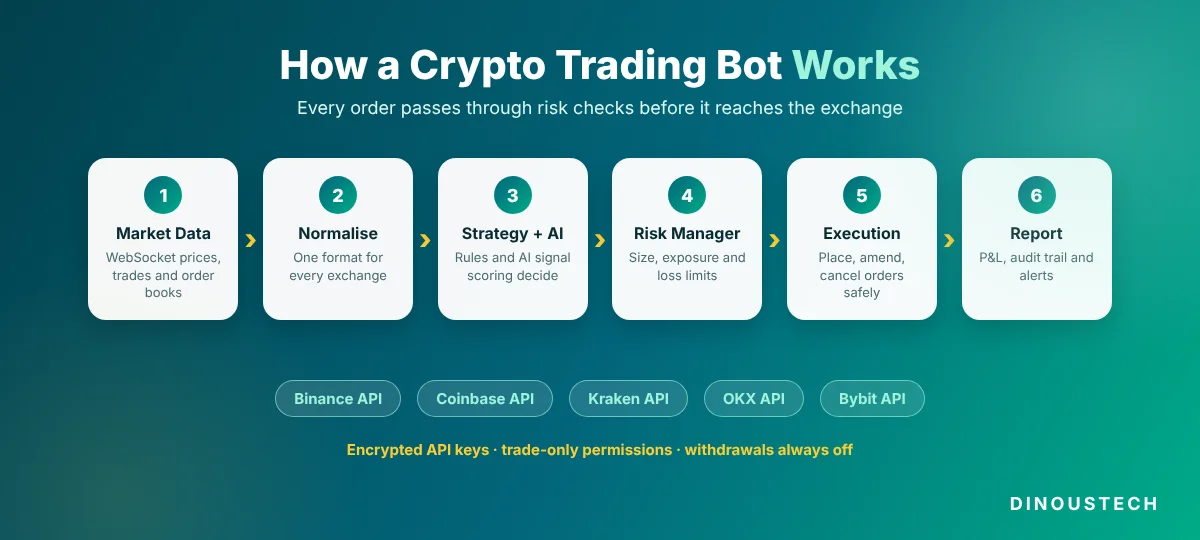
Under the hood, almost every bot follows the same loop:
- Collect market data. The bot subscribes to exchange WebSocket streams for prices, trades and order book updates, and uses REST APIs for account balances and historical candles.
- Normalise the data. Each exchange formats symbols, fees and order types differently. A data layer converts everything into one internal format.
- Generate a signal. The strategy engine applies its rules or model and decides whether to buy, sell, hold or adjust orders.
- Check risk. Before any order goes out, a risk manager checks position size, exposure, daily loss limits, available balance and any kill-switch settings.
- Execute the order. The execution engine places, amends or cancels orders, handles partial fills and retries safely when an API call fails.
- Record and report. Every signal, order, fill and fee is stored, so profit and loss, audit trails and tax reports are accurate.
Must-Have Features of a Crypto Trading Bot
User-Side Features
- Exchange connection: secure API key setup for multiple exchanges, with trade-only permission checks.
- Strategy builder: ready-made templates (grid, DCA, rebalancing) plus custom rules for advanced users.
- Backtesting: run a strategy on historical data with fees and slippage included, and see results before going live.
- Paper trading: run the bot on live prices with virtual funds to check behaviour in real conditions.
- Risk settings: stop-loss, take-profit, trailing stops, maximum position size and daily loss limits.
- Dashboard: open positions, running bots, profit and loss, trade history and balance across exchanges.
- Alerts: push, email or Telegram notifications for fills, errors and risk events.
- Kill switch: one tap to stop all bots and cancel open orders.
- Reports: downloadable trade history for accounting and tax purposes.
Admin-Side Features (for SaaS or Exchange Platforms)
- User management, KYC status and subscription plans
- Strategy template management and feature flags per plan
- System health monitoring: exchange connectivity, API rate limits, queue delays and error rates
- Global risk controls, such as pausing a pair or an exchange for all users
- Revenue, usage and churn analytics
- Audit logs for every admin and user action
- Support tools and ticket handling
Step-by-Step Crypto Trading Bot Development Process
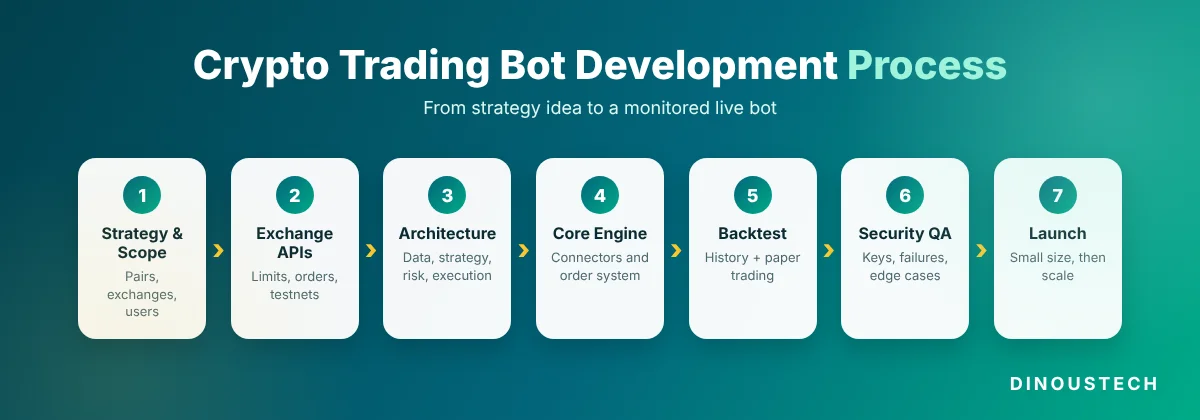
Step 1: Define the Strategy and Scope
We start by writing down exactly what the bot should do: which strategies, which exchanges, which pairs, which order types, and who will use it. A bot for one trading desk is a very different product from a SaaS platform for thousands of retail users.
Step 2: Choose Exchanges and Check Their APIs
Each exchange has its own API limits, order types, fee rules and testnet options. We review the documentation and terms of each target exchange early, because rate limits and missing order types can change the design.
Step 3: Design the Architecture
We split the system into independent services for market data, strategy, risk, execution and reporting. This makes it easier to add exchanges or strategies later and to keep one failure from taking the whole bot down.
Step 4: Build the Core Engine
Developers build the exchange connectors, the order management system, the strategy engine and the risk manager first. The user interface comes after the engine behaves correctly.
Step 5: Backtest and Paper Trade
Strategies are tested on historical data with realistic fees and slippage, then run in paper trading mode on live prices. This is where most logic errors and unrealistic expectations are caught.
Step 6: Security Review and QA
We test key storage, permissions, failure handling, reconnection logic, duplicate order protection and edge cases such as exchange downtime or sudden price gaps.
Step 7: Launch, Monitor and Improve
The bot goes live with small position sizes first. Monitoring dashboards and alerts track performance and errors, and the strategy is tuned based on real results. If you want to validate the idea quickly, our MVP app development guide explains how to launch a smaller first version.
Recommended Tech Stack for Crypto Trading Bot Development
| Layer | Common Choices | Why It Matters |
|---|---|---|
| Core engine | Python, Node.js, Go or Rust | Python is quick for strategy research; Go and Rust suit low-latency execution |
| Exchange connectivity | Official exchange APIs, WebSockets, open-source libraries such as CCXT | Unified access to many exchanges with fewer custom connectors |
| Data and analytics | Pandas, NumPy, TA libraries | Indicators, backtesting and performance analysis |
| Machine learning | scikit-learn, PyTorch, TensorFlow | Signal scoring, forecasting and anomaly detection |
| Databases | PostgreSQL, TimescaleDB, MongoDB | Trades, orders, users and time-series market data |
| Cache and queues | Redis, Kafka, RabbitMQ | Fast state, event streams and reliable order queues |
| Frontend and mobile | React, Next.js, Flutter, React Native | Web dashboard and iOS/Android apps |
| Security | AWS KMS, HashiCorp Vault, 2FA, IP allowlists | Encrypted API keys and protected accounts |
| Cloud and DevOps | AWS, Google Cloud, Docker, Kubernetes, Grafana, Prometheus | Uptime, scaling and real-time monitoring |
How Dinoustech Uses AI in Trading Bot Projects
AI is useful in trading software when it supports clear rules instead of replacing them. At Dinoustech, we use AI in three places.
AI-Assisted Development
Our developers use AI coding assistants to write exchange connector boilerplate, generate unit tests for order handling, and review code for common security mistakes. Every line still goes through human review and testing, but routine work moves faster, so more of the budget goes to strategy logic and risk controls.
AI Features Inside the Bot
- Signal scoring: machine learning models rank signals from technical indicators, so the bot trades only the strongest setups.
- Market regime detection: models classify the market as trending, ranging or highly volatile, and the bot switches strategy or reduces size to match.
- Sentiment analysis: language models can read news headlines and social posts and turn them into a sentiment score that the strategy can use as one input.
- Anomaly detection: AI flags unusual behaviour, such as a sudden spike in failed orders or slippage, and can pause trading automatically.
- Plain-language reports: a generative AI assistant explains in simple words why the bot opened or closed a trade and how the week went.
All AI outputs pass through the same risk manager as any other signal. A model can suggest a trade, but position limits and loss limits always decide. Learn more about our AI app development and machine learning development services.
AI Support Agent for Your Users
For bot platforms with many users, we can add an AI support agent that answers common questions, such as how to connect an exchange, why a bot paused or how a strategy works, using your own help content. Complex or account-specific issues are handed to your human support team.
Monetization Models for Trading Bot Platforms
- Subscriptions: monthly or yearly plans with limits on the number of bots, exchanges or strategies.
- Performance fees: a share of profits, where local regulations allow it.
- Strategy marketplace: creators sell or rent strategies and the platform takes a commission.
- Exchange partnerships: referral or broker programmes that some exchanges offer to platforms that bring trading volume.
- White-label licensing: selling the bot engine to exchanges, brokers or fintech apps under their own brand.
- Premium data and signals: paid add-ons such as advanced analytics or AI signal packs.
Security and Compliance Considerations
This section is general information, not legal advice. Please speak to a qualified lawyer in each market you plan to serve.
- API key safety: store keys encrypted, use trade-only permissions, never enable withdrawals, and support IP allowlisting where the exchange offers it.
- Account security: two-factor authentication, device management, session limits and login alerts.
- KYC and AML: if your platform holds user funds or acts as an exchange or broker, identity checks and transaction monitoring are usually required. Our guide on KYC and AML compliance in fintech app development covers the basics.
- Regional rules: rules differ by country. For example, the EU's Markets in Crypto-Assets Regulation (MiCA) covers crypto-asset service providers, and in the United States, platforms that manage other people's money or give investment advice may face financial regulators' rules. Requirements change, so check them before launch.
- Exchange terms: each exchange has API terms and rate limits. Breaking them can get keys or accounts blocked.
- Data protection: follow GDPR and similar privacy laws for user data, and keep audit logs of every trade and admin action.
- Clear risk disclosures: users should understand that automated trading can lose money and that past backtest results do not guarantee future returns.
Crypto Trading Bot Development Cost Factors
There is no single price for a trading bot, because the scope varies so much. These are the factors that move the budget most:
- Number of exchanges: each new exchange connector adds development and testing time.
- Number and complexity of strategies: a single DCA bot is far simpler than arbitrage or market making across several venues.
- Single user vs. SaaS platform: multi-user platforms need subscriptions, user isolation, admin panels and much stronger security.
- Latency needs: high-frequency and arbitrage bots need optimised code and infrastructure close to the exchanges.
- AI and machine learning: data pipelines, model training and monitoring add work.
- Platforms: web dashboard only, or also iOS and Android apps.
- Compliance and security reviews: KYC, audits and penetration testing.
- Ongoing costs: cloud hosting, market data, monitoring and updates when exchanges change their APIs.
The fastest way to get a reliable estimate is to share your strategy, target exchanges and user type with our team. We will turn that into a feature list and a fixed scope.
Development Timeline
| Scope | What It Includes | Typical Timeline |
|---|---|---|
| Single-strategy bot (MVP) | 1-2 exchanges, one strategy, basic dashboard, backtesting | 6-10 weeks |
| Multi-strategy bot | Several exchanges and strategies, paper trading, alerts, reports | 3-5 months |
| SaaS bot platform | Multi-user, subscriptions, admin panel, mobile apps, AI features | 5-8 months or more |
These ranges assume a clear scope at the start. New exchanges or strategies added mid-project extend the timeline.
Common Challenges and How to Handle Them
- Overfitted strategies: a strategy that looks perfect in backtests may fail live. Use out-of-sample testing, walk-forward testing and paper trading before going live.
- Exchange downtime and API changes: build reconnect logic, health checks and alerts, and keep connectors easy to update.
- Rate limits: batch requests, use WebSockets for data and queue orders carefully.
- Slippage and fees: include real fees and spreads in every calculation, or small edges disappear.
- Duplicate or stuck orders: use client order IDs and reconciliation jobs that compare the bot's records with the exchange.
- Security threats: encrypted keys, no withdrawal permissions, 2FA and regular security reviews.
Why Choose Dinoustech for Crypto Trading Bot Development
Dinoustech is a software development company based in Jaipur, India, working with clients around the world. We have delivered more than 450 projects across mobile apps, web platforms and custom software, including fintech products.
- A dedicated cryptocurrency app development team for exchanges, wallets, payment gateways and trading bots
- Experience in fintech app development, including payments, KYC flows and secure dashboards
- Strategy-first approach: we test before we trade
- Web, iOS and Android delivery from one team
- Developers available for calls in US, UK, EU and Middle East time zones
- Support after launch for monitoring, updates and new exchange integrations
You can see examples of our work in our portfolio. If you also need crypto payments, read our guide on crypto payment gateway development.
Ready to Build Your Crypto Trading Bot?
Whether you need a simple DCA bot for your fintech app or a full SaaS trading platform with AI signals, we can help you plan, build and launch it safely. Share your strategy and target exchanges with us, and our team will suggest the right architecture, timeline and scope. Contact Dinoustech today to book a free consultation.