Dinoustech Private Limited
Palm Reading App Development: How to Build an AI Palmistry App with Hand Scanning and Live Readers
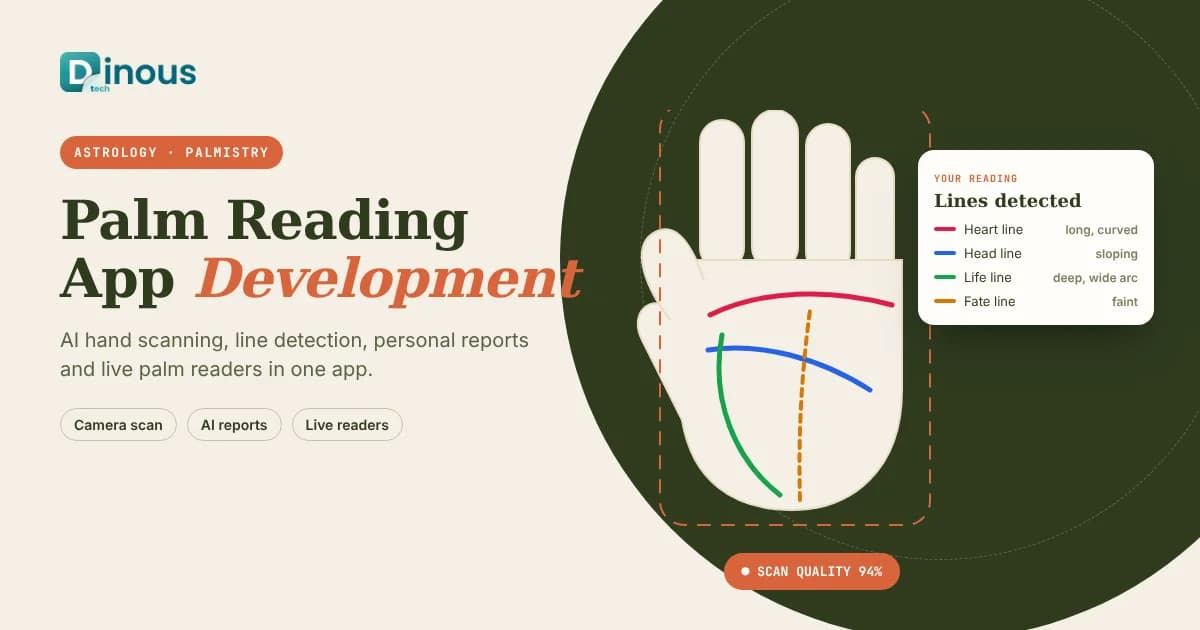
Palmistry has moved from fairs and private sessions onto the phone. People now scan their hand with a camera, get a reading in seconds, and book a live palm reader when they want a deeper session. Palm reading app development brings this together in one product: camera-based hand scanning, computer vision that finds the main palm lines, an interpretation engine, AI-written reports, live consultations and subscriptions. This guide explains how to build a palm reading app in 2026, covering app types, user and admin features, how AI hand scanning works, the step-by-step process, tech stack, monetization, privacy and app store rules, cost factors and timeline. It is written for astrology startups, spiritual wellness brands, content creators and existing astrology platforms worldwide, from the USA, UK and Europe to the UAE, Southeast Asia and Australia.
Dinoustech is an astrology app development company that builds horoscope, tarot, numerology and live consultation apps. The guidance below comes from what our clients ask for when they add palmistry to their product or launch a palm reading app on its own.
Key Takeaways
- A palm reading app combines a guided hand scan, line detection, an interpretation engine and clear, friendly reports.
- The scan experience decides retention: good guidance on lighting, hand position and focus gives better results and fewer complaints.
- Readings should come from a rules and content library written with expert palmists, with AI used to personalise the language, not to invent meanings.
- Live palm readers through chat, voice or video add high-value revenue on top of subscriptions.
- Hand photos are personal data. Process them carefully, store as little as possible and be transparent.
- Present readings as entertainment and self-reflection, and never as medical, financial or legal advice.
In this guide
Table of Contents
- What Is a Palm Reading App?
- Why Build a Palmistry App Now
- Types of Palm Reading Apps
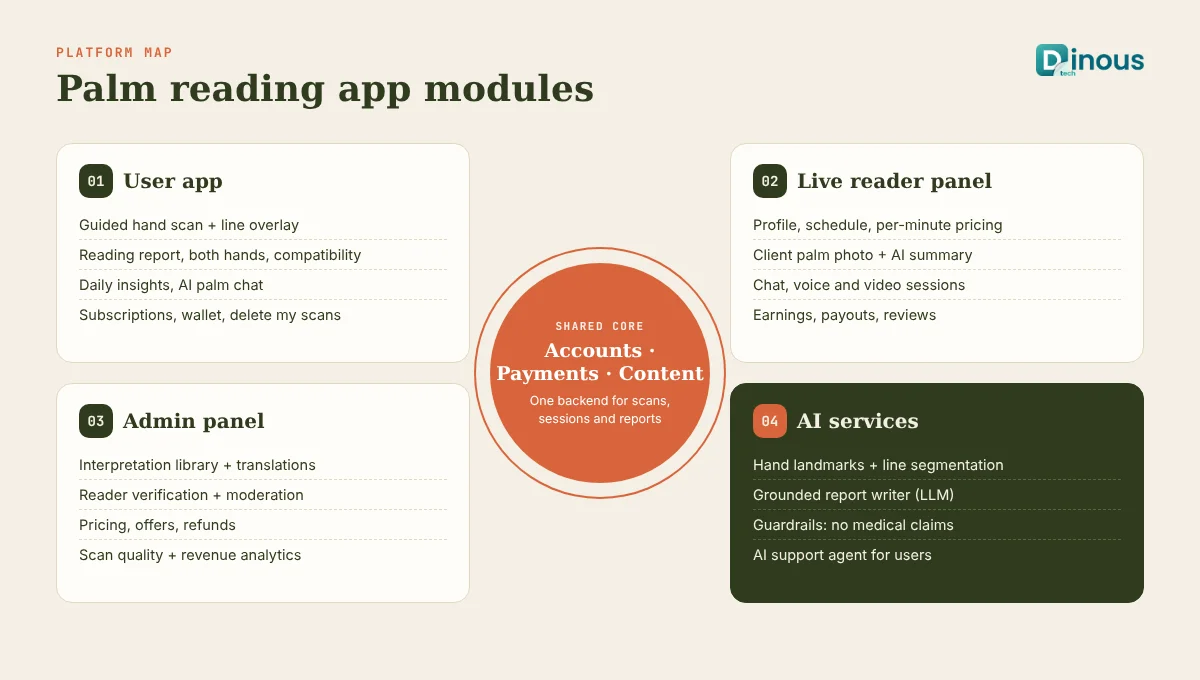
- User App Features
- Reader and Admin Features
- How AI Hand Scanning Works
- Building the Interpretation Library
- Development Process Step by Step
- Recommended Tech Stack
- How Dinoustech Uses AI
- Monetization Models
- Privacy and App Store Rules
- Cost Factors
- Development Timeline
- Common Challenges
- Why Choose Dinoustech
What Is a Palm Reading App?
A palm reading app is a mobile app that gives palmistry readings from a photo or live camera view of the user's hand. The app guides the user to hold the palm in the right position, detects the main lines (heart, head, life and fate lines), measures features such as length, depth, curve and breaks, looks at hand shape and mounts, and turns these signals into a written reading. Many apps add daily insights, compatibility checks with a partner's palm and live sessions with professional readers.
Palmistry often sits alongside other spiritual services. If you already run a horoscope or tarot product, a palm reading module can share the same user accounts, wallet and reader marketplace. Our guide to tarot reading app development shows how these features fit together in a related app.
Why Build a Palmistry App Now
- Better phone cameras and on-device AI make fast hand scanning possible on mid-range phones.
- Large language models can turn structured palm data into warm, readable reports in many languages.
- Interest in self-discovery content keeps astrology, tarot and numerology apps popular across many countries. Read why astrology apps are gaining popularity for more background.
- Clear differentiation: palmistry is a smaller niche than daily horoscopes, so a well-made app can stand out.
- Cross-sell: palm readings pair naturally with birth charts, numerology and live consultations.
Types of Palm Reading Apps
| Type | What it offers | Best for |
|---|---|---|
| AI scan-and-read app | Camera scan, automatic line detection and instant AI report. | Consumer startups targeting mass downloads |
| Live palmist marketplace | Users upload palm photos and talk to verified readers by chat, call or video. | Brands with a network of readers |
| Hybrid app | Free AI reading first, then paid deep reading or live session. | Most new launches |
| Palmistry module in an astrology super app | Palm reading next to horoscope, kundli, tarot and numerology. | Existing astrology platforms |
| Learning app | Lessons, quizzes and practice scans for people who want to learn palmistry. | Educators and content creators |
User App Features
- Simple onboarding: sign up with email, phone, Apple or Google, choose dominant hand and preferred tradition.
- Guided hand scan: on-screen outline, live feedback on light, blur and distance, and auto-capture when the image is good.
- Line overlay: the app draws the detected lines on the user's own palm so the reading feels personal and clear.
- Reading report: sections for personality, love, career, health habits (wellbeing tone only) and life path, with a short summary at the top.
- Both hands comparison: dominant versus non-dominant hand, a popular deep-reading feature.
- Compatibility: compare palms with a partner, with consent from both people.
- Daily insights and push notifications based on the user's reading.
- Live readers: browse profiles, ratings and prices, then chat, call or video with screen sharing of the palm photo.
- AI chat: ask follow-up questions about the reading in natural language.
- Wallet and subscriptions: in-app purchases, coins for live minutes, gift readings.
- Privacy controls: delete scans, download data and manage consent.
Reader and Admin Features
Reader app or panel
- Profile, skills, languages, schedule and per-minute or per-session pricing.
- Session queue with the client's palm photos and AI line overlay as a starting point.
- Chat, voice and video sessions with notes and follow-up offers.
- Earnings, payouts and reviews.
Admin panel
- Reader onboarding, verification and quality monitoring.
- Content management for line meanings, report templates and translations.
- Pricing, coins, subscriptions, offers and refunds.
- Scan quality and model performance dashboards.
- Moderation of chats and AI responses, with reports and blocks.
- Analytics on downloads, conversion, retention and revenue.
Many of these are the same building blocks as other astrology products. See our list of must-have astrology app features for the shared modules.
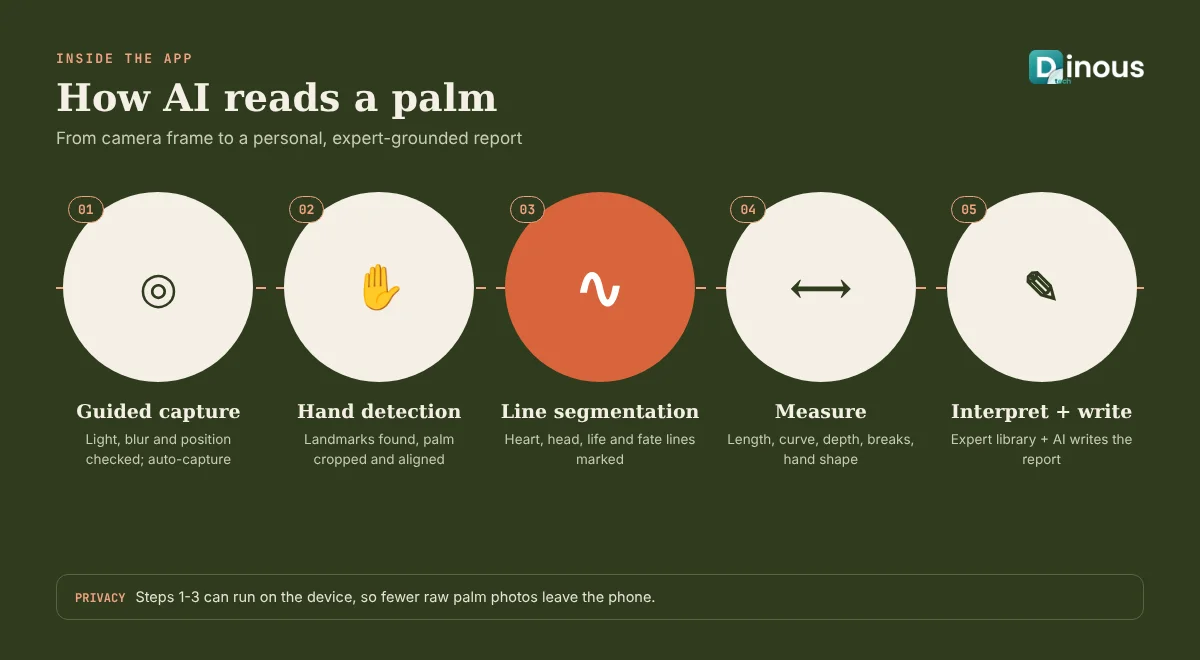
How AI Hand Scanning Works in a Palm Reading App
- Guided capture: the camera view checks lighting, blur and palm position in real time and captures the best frame automatically.
- Hand detection: a hand landmark model finds the palm and fingers, then crops and straightens the image so every scan has the same orientation.
- Line segmentation: a computer vision model, trained on labelled palm images, marks the pixels that belong to the heart, head, life and fate lines and to minor lines.
- Feature measurement: the system calculates line length, curve, depth score, start and end points, breaks, forks and crossings, plus hand shape and finger ratios.
- Interpretation: these features are matched to rules in the interpretation library, which was written with expert palmists for each tradition you support.
- Report writing: a large language model turns the matched meanings into a natural, personalised report, using only the approved content as its source.
Running the first steps on the device keeps the app fast and reduces how many raw photos need to leave the phone. Heavier models can run in the cloud when needed.
Building the Interpretation Library
The quality of a palm reading app depends as much on its content as on its code. A good interpretation library:
- Is written or reviewed by experienced palmists, with clear rules for each line feature and combination.
- Supports more than one tradition where needed, for example Western and Indian palmistry, without mixing them.
- Uses positive, respectful language and avoids fear-based or fatalistic predictions.
- Keeps health topics general and wellness-focused, never diagnostic.
- Is translated and culturally reviewed for each market, not only machine-translated.
We use the same approach for calculation-based products. Our numerology app development guide explains how a rules engine and AI writing work together.
Palm Reading App Development Process Step by Step
- Discovery: define your audience, markets, traditions, business model and whether you will have live readers.
- Data and content plan: collect and label palm images with consent, and write the interpretation library with expert palmists.
- UX design: design the scan flow, line overlay, report layout and reader marketplace, and test them with real users.
- Model development: train and test hand detection and line segmentation, then optimise them for mobile.
- App and backend build: user app, reader panel, admin panel, payments, chat and video. Keep the first version focused, as in our MVP app development guide.
- Testing: test scans on many hand types, skin tones, ages, lighting conditions and phones, plus security and payment tests.
- Launch: app store submission, store listing, onboarding offers and analytics.
- Improve: use scan quality data and user feedback to retrain models and refine content.
Recommended Tech Stack
| Layer | Common choices |
|---|---|
| Mobile apps | Flutter or React Native, with native camera modules; Swift and Kotlin where deep camera control is needed |
| On-device vision | MediaPipe hand landmarks, TensorFlow Lite or Core ML for line segmentation |
| Model training | PyTorch or TensorFlow, OpenCV for image processing |
| Backend | Node.js or Python (FastAPI or Django) with REST APIs |
| Report generation | A large language model API with retrieval from your approved interpretation library |
| Live sessions | WebRTC-based video and voice SDKs, real-time chat with WebSockets |
| Database and storage | PostgreSQL or MongoDB, encrypted object storage for scans |
| Payments | Apple and Google in-app purchases, Stripe or regional gateways for web |
| Cloud | AWS, Google Cloud or Azure with CI/CD and monitoring |
How Dinoustech Uses AI in Palm Reading Apps
AI-assisted development
Our team uses AI coding assistants for boilerplate, tests, code review and documentation, which speeds up standard parts of the build. Senior engineers review every change, and the vision models are tested against labelled data before release.
AI features inside the app
- Smart scan guidance that tells users how to fix light, angle or blur before capture.
- Line detection and measurement with computer vision, shown as an overlay on the user's palm.
- Grounded AI reports written from your expert-approved library, with guardrails that block medical claims and harmful predictions.
- AI palm chat so users can ask "what does a forked head line mean?" and get answers based on the same content.
- Reader assistant that prepares a summary of the client's scan for live palmists, who give the final reading.
- Personalised offers that suggest the right deep reading or reader based on user interests.
AI support agent for our clients
After launch, Dinoustech can set up an AI support agent trained on your app's help content and policies. It answers common questions about scans, payments and sessions around the clock and passes complex cases to your team. For more ideas on AI in this niche, read how to build an AI-powered astrology app.
Monetization Models
- Freemium: a short free reading, with full reports behind a paywall.
- Subscriptions: weekly, monthly or yearly plans for unlimited scans, daily insights and AI chat.
- Pay per report: one-time purchases for both-hands, love or career deep readings.
- Live consultation commission: per-minute or per-session pricing for readers, with a platform share.
- Coins and gifts: wallets for live sessions and gift readings for friends.
- Courses: paid palmistry lessons inside the app.
Our article on how astrology apps make money compares these models in more detail.
Privacy and App Store Rules
- Treat hand photos as personal data. Under laws such as GDPR, images processed to uniquely identify a person can count as biometric data, so avoid using palm scans for identification and get clear consent.
- Process on the device where possible, store scans encrypted, set short retention periods and let users delete them.
- Follow privacy rules in your markets, such as GDPR in the EU and UK, US state privacy and biometric laws, and the UAE and Australian privacy rules.
- Follow Apple App Store and Google Play rules on subscriptions, in-app purchases, user-generated content and apps in the astrology category, which reviewers check for originality and quality.
- Show a clear entertainment and self-reflection notice, and do not give medical, financial or legal predictions.
- Verify live readers and have clear refund and complaint policies.
This section is general information, not legal advice. Please confirm the rules for your markets with a qualified lawyer.
Palm Reading App Development Cost Factors
The cost of a palm reading app depends on scope rather than a fixed price. The main factors are:
- Scan quality goals: a simple photo upload versus real-time guided capture with on-device models.
- Model work: using existing hand landmark models only, or training custom line segmentation with your own labelled dataset.
- Content: size of the interpretation library, number of traditions and languages.
- Live readers: chat only, or chat plus voice and video with payouts.
- Platforms: iOS, Android, web and an admin panel.
- Integrations with an existing astrology platform, wallet or CRM.
- Ongoing costs: AI API usage, video minutes, cloud hosting, content updates and support.
For a wider view of budgets in this category, see our guide on AI astrology app development cost, then contact Dinoustech for an estimate based on your feature list.
Development Timeline
| Phase | Typical duration |
|---|---|
| Discovery and content planning | 2-4 weeks |
| UX and UI design | 3-5 weeks |
| Data labelling and model training | 6-10 weeks, in parallel with design and build |
| App, backend and admin development | 10-14 weeks |
| Live reader module | 3-6 weeks, if included |
| Testing and store launch | 3-5 weeks |
A focused AI palm reading app usually takes about four to six months. Adding a full reader marketplace or many languages extends the plan.
Common Challenges
- Poor photos: bad light and blur break line detection. Invest in scan guidance and auto-capture.
- Bias in data: train and test on a wide range of hands and skin tones so results work for everyone.
- Generic readings: users notice copy-paste reports. Use real measured features and a rich content library.
- AI going off-script: ground the language model in approved content and filter risky topics.
- App store review: astrology-style apps need clear originality and value to pass review.
- Reader quality: verification, ratings and monitoring keep live sessions trustworthy.
Why Choose Dinoustech for Palm Reading App Development
- Experience building astrology, tarot, numerology and live consultation apps, so the core modules are proven ground for our team.
- Skills across mobile apps, computer vision, AI integration and real-time chat and video.
- A content-first approach: we help you plan the interpretation library with experts, not just the code.
- Privacy by design for sensitive images and data.
- Clients in many countries. See our portfolio and our wider mobile app development services.
Conclusion
A successful palm reading app feels personal, quick and trustworthy. Get the scan experience right, build an expert interpretation library, use AI to measure lines and write clear reports from approved content, and add live readers for users who want more. Treat privacy and honest positioning as part of the product.
Planning a palmistry app or a palm reading feature for your astrology platform? Talk to Dinoustech about your idea, markets and budget, and we will help you plan the right first release.