Dinoustech Private Limited
Crypto Wallet App Development: How to Build a Secure Wallet with MPC, Smart Accounts and AI
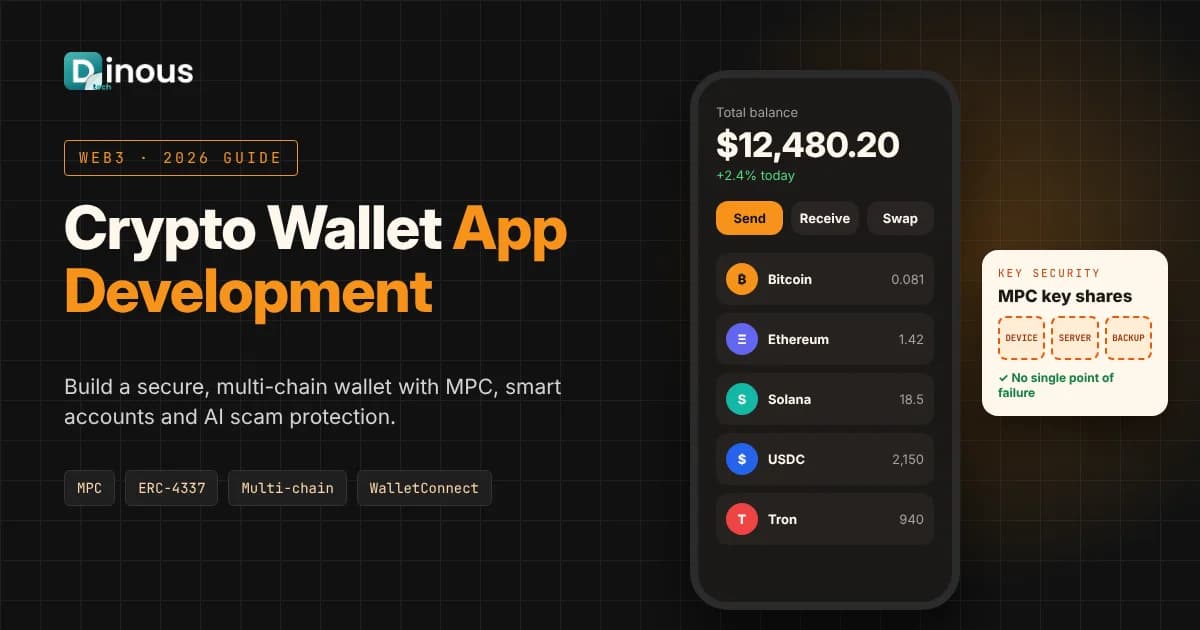
A crypto wallet is the front door to everything in Web3. Before a user can trade, pay, stake, mint or simply hold a coin, they need a wallet they trust. Crypto wallet app development is the process of building that front door: secure key management, a clean way to send and receive assets, multi-chain support, swaps, dApp connections and recovery that does not depend on a scrap of paper in a drawer. This guide explains how to build a crypto wallet app in 2026, from wallet types and security models (including MPC and smart accounts) to features, the step-by-step process, tech stack, AI, compliance, cost factors and timeline. It is written for founders, exchanges, fintech companies and Web3 projects worldwide, from the USA, UK and Europe to the UAE, Singapore and Australia.
Dinoustech is a cryptocurrency app development company that builds wallets, exchanges and blockchain-based fintech products for clients around the world. The guidance below comes from the questions crypto founders ask us before they start a project.
Key Takeaways
- The first decision is who holds the keys: the user (non-custodial), your company (custodial), or a split between both (MPC). It shapes your security design, your compliance duties and your user experience.
- Smart accounts (account abstraction) make wallets feel like normal apps, with gas sponsorship, batched transactions, spending limits and social recovery.
- A wallet is more than a signing screen. It needs node and indexer access, price data, transaction history, notifications and a strong backend.
- Security is the product. Secure enclaves, transaction simulation, phishing warnings and independent audits matter more than a long feature list.
- AI is useful for plain-language transaction explanations, scam detection and 24/7 support, but it must never touch private keys.
- Start with a focused MVP on a small set of chains, then add swaps, staking, NFTs and cards as real usage grows.
In this guide
Table of Contents
- What Is a Crypto Wallet App?
- Why Build a Crypto Wallet App in 2026
- Types of Crypto Wallets
- Key Management: Seed Phrase, MPC and Smart Accounts
- Key Features: User and Admin
- Crypto Wallet App Development Process
- Recommended Tech Stack
- How Dinoustech Uses AI in Wallet Apps
- Monetization Models
- Security and Compliance
- Crypto Wallet App Development Cost Factors
- Development Timeline
- Common Challenges
- Why Choose Dinoustech
- Conclusion
What Is a Crypto Wallet App?
A crypto wallet app does not actually store coins. The coins live on the blockchain. What the wallet stores, or helps the user control, is the private key that proves ownership of an address and signs transactions. Whoever controls that key controls the funds.
On top of that core job, a modern wallet app shows balances across chains, displays transaction history, lets users send and receive with QR codes and readable names, swaps one token for another, connects to decentralised apps (dApps) through protocols such as WalletConnect, and protects users from mistakes and scams. The best wallets make all of this feel as simple as a banking app, without hiding what is really happening.
Why Build a Crypto Wallet App in 2026
Wallets are where users spend their time in crypto. Exchanges, payment companies, games and loyalty programmes all need a wallet layer, and many now prefer to own that experience instead of sending users to a third-party app. Owning the wallet means owning the relationship: onboarding, swaps, staking, payments and support all happen inside your brand.
The technology has also matured. Smart accounts, made possible on Ethereum by the ERC-4337 standard (live on mainnet since 2023) and extended by EIP-7702 in the 2025 Pectra upgrade, let wallets offer features that used to be impossible, such as paying gas fees for users or recovering an account without a seed phrase. MPC (multi-party computation) has made institutional-grade key security available to consumer apps. Together, these make it realistic to build a wallet that a non-technical user can actually use safely.
If you are also planning a trading product, our guide on how to build a cryptocurrency exchange app like Binance or Coinbase explains how a wallet fits into an exchange.
Types of Crypto Wallets
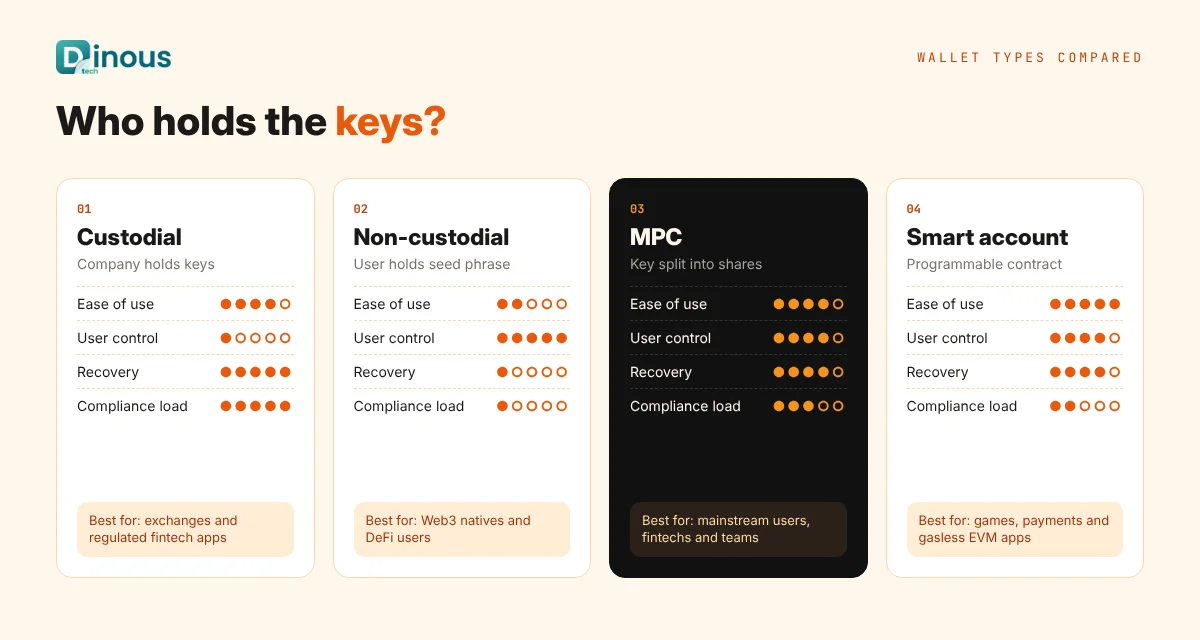
Custodial wallets
Your company holds the keys on behalf of users, usually in secure infrastructure with hot and cold storage. Users log in with email and password, and you can reset access if they forget it. This is the simplest experience, and it is common in exchanges, but it brings heavy security and regulatory responsibility because you are holding customer assets.
Non-custodial wallets
The user holds the keys, typically protected by a 12 or 24-word recovery phrase. You never see or store the key. This gives users full control and reduces your custody burden, but lost phrases mean lost funds, so onboarding and backup design are critical.
MPC wallets
The key is never created in one place. Instead, it is split into shares held by different parties (for example the user's device, your server and a backup), and transactions are signed jointly without ever rebuilding the full key. MPC removes the single point of failure of a seed phrase and is popular with fintechs and institutions.
Smart contract (account abstraction) wallets
The account itself is a smart contract with programmable rules. It can allow passkey login, daily spending limits, trusted-contact recovery, session keys for games and gas paid in stablecoins or by the app. These wallets are mainly used on Ethereum and EVM-compatible chains.
Hardware and multi-signature wallets
Hardware wallets keep keys on a dedicated device; your app can connect to them over Bluetooth or USB for signing. Multi-signature wallets need approval from several keys, which suits company treasuries and DAOs.
Key Management: Seed Phrase, MPC and Smart Accounts
Key management is the heart of any wallet, and it is where most of the engineering effort and risk sits. A practical way to decide is to ask three questions: Who will use the wallet? How much value will an average user hold? And who will they call if something goes wrong?
- Retail Web3 users who want full control usually expect a classic non-custodial wallet with a recovery phrase, plus optional hardware wallet support.
- Mainstream users coming from fintech or games are better served by MPC or a smart account with passkeys and social recovery, so there is no phrase to lose.
- Businesses and treasuries need multi-signature or MPC with role-based approvals, spending policies and audit logs.
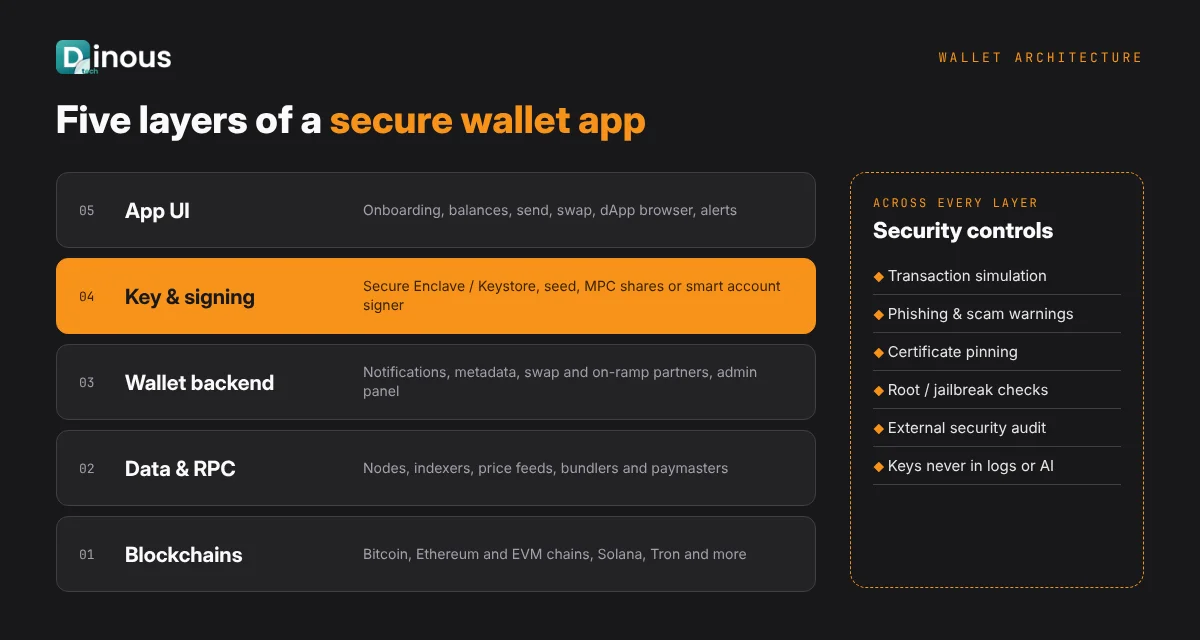
Whatever you choose, keys or key shares on the device should be stored in the phone's secure hardware (Secure Enclave on iOS, StrongBox or the Android Keystore on Android), protected by biometrics, and never written to logs, analytics or crash reports. Many successful wallets combine approaches, for example an MPC wallet that also lets advanced users export a standard key.
Key Features: User and Admin
User app features
- Fast onboarding: create or import a wallet, passkey or biometric login, guided backup
- Multi-chain, multi-token balances with fiat values and price charts
- Send and receive with QR codes, address book and readable names (such as ENS)
- Clear transaction preview with fee estimate and a simulation of what will happen
- In-app swaps and cross-chain bridges through trusted aggregators
- Buy and sell crypto with cards or bank transfer through on-ramp and off-ramp partners
- Staking and earning views with honest risk explanations
- NFT gallery and token approvals manager (see and revoke what dApps can spend)
- dApp browser and WalletConnect support
- Push notifications for incoming funds, confirmations and security alerts
- Phishing and scam warnings for suspicious addresses, tokens and sites
- Multi-language support and dark mode
Admin panel features
- Dashboard for users, active wallets, volumes and fee revenue
- Chain, token and network configuration without app releases
- Partner management for swaps, on-ramps and staking providers
- KYC review and risk flags (for custodial or fiat-linked products)
- Support tools and ticket history (with no access to user keys)
- Announcements, banners and in-app content management
- Audit logs and role-based access for the internal team
Crypto Wallet App Development Process
- Discovery and model choice. Define your audience, target countries, chains, custody model and the one or two things your wallet will do better than others.
- Security architecture. Design key generation, storage, signing, backup and recovery before any screen is drawn. Write a threat model.
- UX and UI design. Design onboarding, backup, send, receive, swap and approval screens with special care for warnings and confirmations. Test them with real users.
- Blockchain integration. Connect to nodes or RPC providers, indexers for history and balances, price feeds and, if needed, account abstraction infrastructure such as bundlers and paymasters.
- App and backend development. Build the mobile apps, the backend services (notifications, metadata, partner integrations) and the admin panel in short sprints.
- Testing on testnets. Test every chain and flow on testnets, then with small real amounts. Include failed transactions, network switching and poor connectivity.
- Independent security audit. Have smart contracts and the key management layer reviewed by an external security firm, and fix every finding before launch.
- Launch and app store review. Prepare store listings, crypto-related disclosures and region settings. Launch gradually.
- Monitor and improve. Track errors, support tickets and on-chain events, add chains and features in small releases, and repeat security reviews.
If you want to validate the idea quickly first, our guide on MVP app development shows how to pick a small, testable first version.
Recommended Tech Stack
| Layer | Common choices |
|---|---|
| Mobile app | Flutter, React Native, or native Swift and Kotlin for maximum security control |
| Key storage | iOS Secure Enclave and Keychain, Android Keystore and StrongBox, biometric prompts |
| Key management | BIP-39 / BIP-32 / BIP-44 for seed wallets; MPC-TSS libraries or providers for MPC wallets |
| EVM integration | ethers.js or viem, ERC-4337 bundlers and paymasters for smart accounts |
| Other chains | Bitcoin libraries, Solana web3.js, TronWeb and chain-specific SDKs |
| Node and data access | Managed RPC providers or own nodes, indexers for balances, history and NFTs |
| Backend | Node.js or Go, PostgreSQL, Redis, message queues for notifications |
| dApp connection | WalletConnect protocol, in-app dApp browser |
| Security | Certificate pinning, jailbreak and root detection, transaction simulation, external audits |
Our article on technologies used in fintech software development covers the wider fintech stack in more detail.
How Dinoustech Uses AI in Wallet Apps
AI is becoming a real advantage in crypto wallets, as long as it is used carefully. At Dinoustech we use AI in three ways.
AI-assisted development
Our engineers use AI coding assistants to speed up repetitive work such as API clients, screen scaffolding, test cases and documentation. Every line of security-sensitive code, especially key handling and signing, is still written and reviewed by senior developers, and AI tools never get access to real keys or production secrets.
AI features inside the wallet
- Plain-language transaction explanations: before signing, the wallet can explain in simple words what a transaction will do, such as "You are giving this app permission to spend all your USDC".
- Scam and phishing detection: models can flag risky addresses, fake tokens, address-poisoning attempts and suspicious dApps based on on-chain patterns.
- Portfolio insights: summaries of holdings, fees paid and activity, written for humans rather than traders.
- Smart search: users can ask "show my staking rewards from last month" instead of digging through menus.
AI features read public on-chain data and wallet activity; they must never see private keys or recovery phrases, and they should support, not replace, the user's final decision.
AI support agent for your users
We can add an AI support agent trained on your help centre that answers common questions 24/7, such as why a transaction is pending or how to add a network, and hands over to a human agent when needed. It is built to never ask users for their recovery phrase, which is one of the most common scam tactics in crypto. Read more in our post on AI features every fintech app should have.
Monetization Models
- Swap fees: a small fee on in-app swaps and bridges, shown clearly to the user.
- On-ramp and off-ramp revenue share: commission from partners when users buy or sell crypto.
- Staking commission: a share of rewards for staking services offered through the wallet.
- Premium tiers: advanced security, multi-device MPC, priority support or business features.
- Crypto cards and payments: interchange revenue from card programmes, where licensed partners allow it.
- White-label licensing: offering your wallet technology to other brands.
Hidden or confusing fees destroy trust quickly in crypto, so always show fees before the user confirms.
Security and Compliance
Rules depend heavily on your custody model and where you operate. Custodial wallets and services that exchange crypto for money are often treated as regulated virtual asset service providers. Examples include MiCA in the European Union, FCA registration in the UK, FinCEN money services rules in the USA, VARA in Dubai and AUSTRAC registration in Australia. These usually bring KYC, AML monitoring and, in many places, the FATF "travel rule" for transfers. Non-custodial wallets usually have lighter duties, but on-ramp, swap and card partners will still have their own requirements. Our guide to KYC and AML compliance in fintech app development explains these checks in detail.
On the security side, plan for secure key storage, encrypted communication, certificate pinning, root and jailbreak detection, rate limiting, transaction simulation, approval warnings, bug bounty programmes and regular external audits. App stores also have specific policies for crypto apps, so check Apple and Google rules for your target countries early.
Note: this section is general information, not legal advice. Please confirm requirements with a qualified lawyer in each market you plan to serve.
Crypto Wallet App Development Cost Factors
There is no single price for a crypto wallet, because the scope can range from a simple single-chain wallet to a full multi-chain MPC platform with cards and staking. The main factors are:
- Custody and key model: a standard seed-phrase wallet costs far less than MPC or smart account infrastructure.
- Number of chains: each new chain family (EVM, Bitcoin, Solana, Tron and others) adds integration and testing work.
- Feature depth: swaps, bridges, staking, NFTs, dApp browser, fiat ramps and cards each add scope.
- Platforms: iOS, Android, web app and browser extension.
- Security audits: independent audits are a separate, essential budget line.
- Compliance: KYC, AML monitoring and licensing work for custodial products.
- Infrastructure: RPC providers, indexers, MPC services and monitoring are ongoing monthly costs.
- Design quality: custom UX research and motion design versus a simpler design system.
The best way to get a reliable figure is a short discovery session where we fix the chains, custody model and MVP scope. For broader numbers, see our article on fintech app development cost.
Development Timeline
| Scope | Typical timeline |
|---|---|
| Discovery, threat model and UX design | 3 to 5 weeks |
| Non-custodial MVP (1 to 3 chains, send, receive, history) | 3 to 4 months |
| Add swaps, on-ramp, NFTs and WalletConnect | 1 to 2 more months |
| MPC or smart account wallet with recovery | 5 to 8 months |
| Security audit and fixes | 3 to 6 weeks, often in parallel with final testing |
These are honest ranges based on typical scopes; your timeline depends on the final feature list and partner integrations.
Common Challenges
- Balancing security and simplicity: every extra step protects users but also loses some. Good design finds the right warnings for the right moments.
- Lost access: users lose phones and phrases. Plan recovery from day one, not after launch.
- Scams and phishing: fake tokens, address poisoning and malicious approvals are common. Build protections into the core flows.
- Chain differences: fees, confirmation times and address formats vary by network, and the app must handle each one gracefully.
- Infrastructure reliability: a slow RPC node makes the whole wallet look broken. Use fallbacks and monitoring.
- Changing regulation: rules evolve, so keep compliance features configurable by country.
Why Choose Dinoustech for Crypto Wallet App Development
Dinoustech builds crypto, fintech and payment products alongside apps for healthcare, dating, eCommerce and other industries. With us you get:
- Experience with wallets, exchanges, payment gateways and fintech dashboards
- Security-first architecture with secure key storage and external audit support
- Multi-chain integration across EVM networks, Bitcoin, Solana and more
- Practical AI features with clear safety rules
- Cross-platform builds for iOS, Android and web, plus admin panels
- Support and maintenance after launch
See examples of our work in our portfolio, explore our fintech app development services, or read how a fiat digital wallet app differs from a crypto wallet.
Conclusion
A successful crypto wallet earns trust before it earns revenue. Choose your custody model carefully, design key management and recovery first, keep the core flows simple and honest, and add swaps, staking and AI features as your users grow. If you want to build a crypto wallet app for users worldwide, contact Dinoustech to discuss your idea, or explore our cryptocurrency app development services.