Dinoustech Private Limited
RWA Tokenization Platform Development: How to Tokenize Real Estate, Private Credit and Funds with Compliant Smart Contracts
RWA tokenization platform development means building the software that turns real-world assets, such as real estate, private credit, bonds, funds, commodities or invoices, into digital tokens on a blockchain, and then manages who can buy, hold and transfer them. A good tokenization platform combines investor onboarding, KYC, compliant smart contracts, a primary issuance flow, a secondary transfer or trading flow, and automated payouts such as rent, interest or dividends. This guide explains how real-world asset tokenization works, the main asset types, platform features, token standards, the build process, tech stack, AI features, regulation, cost factors and timelines.
Key Takeaways
- Tokenization creates a digital record of ownership or economic rights in an asset on a blockchain, but the legal structure behind the token is what gives it real value.
- Most RWA tokens are permissioned: only verified, eligible investors can hold and transfer them.
- Standards such as ERC-3643 and ERC-7943 add identity checks, transfer rules, freezing and recovery to tokens.
- A complete platform covers issuer tools, investor onboarding, a compliance engine, smart contracts, custody, payments, payouts and reporting.
- Securities, investment and anti-money laundering rules apply in most countries, so legal advice and licensed partners are essential.
- Cost depends on asset types, chains, custody model, secondary trading, integrations and the number of jurisdictions.
Table of Contents
- What Is RWA Tokenization?
- Tokenized vs Traditional Platforms
- Assets You Can Tokenize
- How an RWA Tokenization Platform Works
- Token Standards for Real-World Assets
- Key Platform Features
- Step-by-Step Development Process
- Recommended Tech Stack
- How Dinoustech Uses AI
- Regulation and Compliance
- Business Models
- Cost Factors
- Development Timeline
- Challenges and Solutions
- Why Choose Dinoustech
What Is RWA Tokenization?
Real-world asset (RWA) tokenization is the process of representing rights in a physical or financial asset as tokens on a blockchain. For example, a building can be held by a legal entity, and shares in that entity can be issued as tokens. Investors who hold the tokens receive their share of rental income and any sale proceeds, according to the legal documents.
The main benefits are fractional ownership (smaller ticket sizes), faster settlement, automated record-keeping and payouts, programmable compliance, and the possibility of wider distribution and secondary trading. The token itself does not replace the legal agreements: the platform must connect on-chain records with off-chain legal ownership, custody and reporting.
Tokenized Assets vs Traditional Investment Platforms
| Point | Traditional Platform | Tokenization Platform |
|---|---|---|
| Ownership record | Spreadsheets, transfer agents or central registers | Blockchain ledger linked to the legal register |
| Minimum investment | Often high for private assets | Lower, thanks to fractional tokens |
| Settlement | Days, with manual reconciliation | Near real-time on-chain settlement |
| Compliance checks | Manual reviews before transfers | Automated rules checked on every transfer |
| Payouts | Manual bank batches | Automated distributions to verified holders |
Tokenization does not remove the need for regulated partners, custodians and legal agreements. It makes the processes around them faster, more transparent and easier to automate. If you are building a broader investing product, see our guide to robo-advisor app development.
Assets You Can Tokenize
1. Real Estate
Residential, commercial and hospitality properties, usually through a special purpose vehicle (SPV) whose shares or debt are tokenized.
2. Private Credit and Loans
Loan pools, trade finance and invoice financing, where tokens represent a share of repayments and interest.
3. Bonds and Treasury Products
Tokenized bonds and money market fund units that settle faster and can be used in digital asset ecosystems.
4. Funds and Private Equity
Fund units or private company shares, with automated cap tables and investor reporting.
5. Commodities and Other Assets
Gold and other commodities held by custodians, carbon credits, art, collectibles and revenue-sharing agreements.
How an RWA Tokenization Platform Works
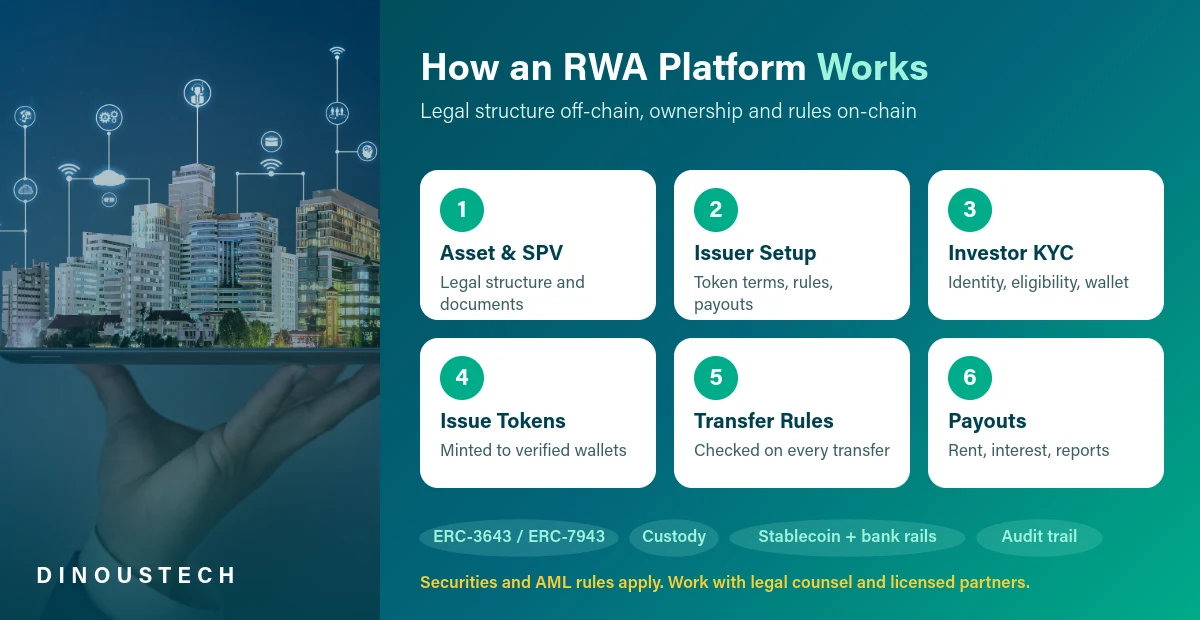
- Asset and legal structure: the issuer places the asset in a legal structure, such as an SPV or fund, and prepares offering documents with lawyers.
- Issuer setup: the issuer creates the offering on the platform, defines token terms, investor eligibility rules, limits and payout schedules.
- Investor onboarding: investors complete KYC, AML and eligibility checks, then connect a custodial or self-custody wallet. See our KYC and AML compliance guide.
- Subscription and issuance: investors subscribe and pay by bank transfer, card or stablecoin. Once funds clear, the smart contract mints tokens to their verified wallets.
- Transfers and trading: every transfer is checked against compliance rules (identity, country, investor type, holding limits, lock-up periods) before it is allowed.
- Payouts and reporting: rent, interest or dividends are distributed automatically, and issuers, investors and regulators get reports.
Token Standards for Real-World Assets
A simple ERC-20 token lets anyone transfer to anyone, which does not work for regulated assets. RWA platforms usually use permissioned token standards:
- ERC-3643 (T-REX): an open standard for permissioned tokens on Ethereum-compatible chains. It links wallets to on-chain identities and checks a compliance contract before each transfer, with features such as freezing, forced transfers and recovery of lost wallets.
- ERC-7943 (uRWA): a minimal interface that adds compliance functions such as transfer checks, freezing and forced transfers to ERC-20, ERC-721 and ERC-1155 tokens.
- Chain-specific options: some public and permissioned blockchains offer their own token frameworks for regulated assets.
The right choice depends on your target investors, chains, custody partners and the systems you need to connect to.
Key Features of an RWA Tokenization Platform
Issuer Features
- Offering creation with asset details, documents, token terms and eligibility rules
- Cap table and investor register synced with on-chain balances
- Subscription management, allocation and closing
- Automated payouts of rent, interest or dividends
- Corporate actions: redemptions, buy-backs, votes and notices
- Investor communications and reporting
Investor Features
- Digital onboarding with KYC, accreditation or suitability checks
- Marketplace of offerings with clear documents and risk information
- Custodial wallet or self-custody wallet connection
- Payments by bank transfer, card or stablecoin, depending on the offering
- Portfolio view with holdings, payouts and tax documents
- Secondary transfers or trading where permitted
Admin and Compliance Features
- Identity registry and compliance rule management
- Transaction monitoring and sanctions screening
- Freeze, force transfer and wallet recovery tools with approvals
- Audit trails and regulator reporting
- Role-based access and multi-signature controls for sensitive actions
For wallet design, read our guide to crypto wallet app development.
Step-by-Step RWA Tokenization Platform Development Process
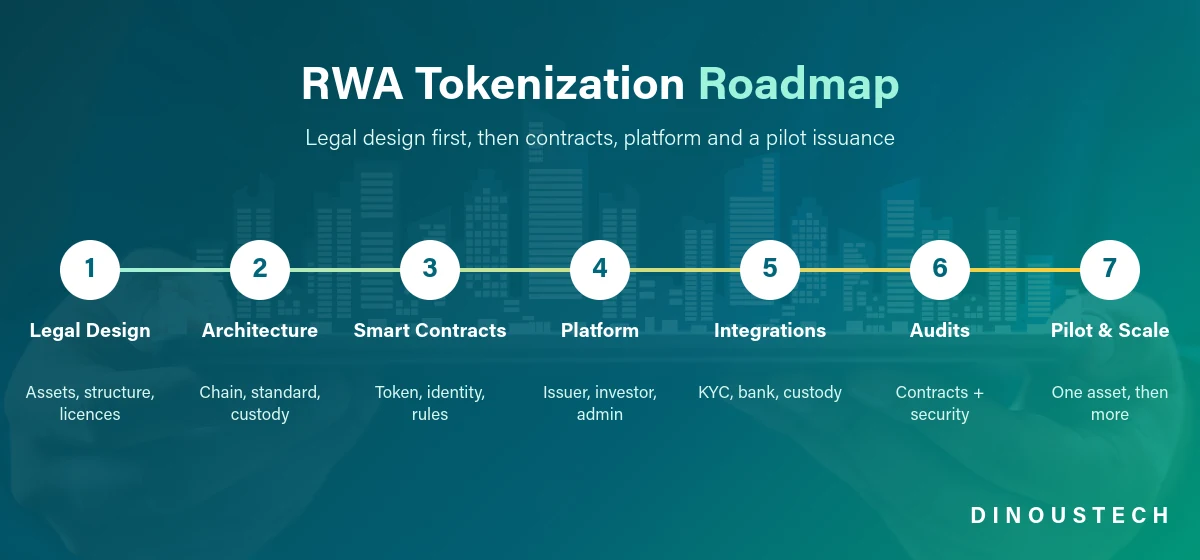
Step 1: Legal and Business Design
With your legal advisers, decide the asset types, legal structures, target investors, jurisdictions and licences. Technology follows these decisions.
Step 2: Architecture and Standards
Choose the blockchain, token standard, custody model, payment rails and how on-chain records link to off-chain registers.
Step 3: Smart Contract Development
Develop token, identity and compliance contracts, plus payout and corporate action logic.
Step 4: Platform and Apps
Build the issuer portal, investor web and mobile apps, admin and compliance consoles, and APIs.
Step 5: Integrations
Connect KYC, sanctions screening, custody, banking and stablecoin payments, document signing and accounting.
Step 6: Audits and Testing
Run independent smart contract audits, penetration testing and end-to-end tests of issuance, transfers and payouts.
Step 7: Pilot Issuance and Scale
Launch with one asset and a limited investor group, then add assets, secondary trading and new markets.
Recommended Tech Stack for RWA Tokenization Platforms
| Layer | Options |
|---|---|
| Blockchain | Ethereum and EVM networks (for example Polygon, Arbitrum, Base, Avalanche), or permissioned networks where required |
| Smart contracts | Solidity with OpenZeppelin libraries, ERC-3643 or ERC-7943 based token and compliance contracts |
| Development tools | Hardhat or Foundry, testnets, static analysis and fuzz testing tools |
| Backend | Node.js (NestJS), Go or Java with event indexing and job queues |
| Front end | React or Next.js for web, Flutter or React Native for mobile |
| Wallets and custody | Qualified custodians, MPC wallet providers or self-custody wallets with on-chain identity |
| Compliance services | KYC and KYB providers, sanctions screening and blockchain analytics |
| Data | PostgreSQL, blockchain indexers, secure document storage |
How Dinoustech Uses AI in Tokenization Projects
AI-Assisted Development
Our developers use AI coding assistants for routine work such as API boilerplate, tests and documentation. Smart contracts are always reviewed by engineers, tested thoroughly and independently audited before launch.
AI Features Inside the Platform
- Document processing: extract key terms from leases, loan agreements and valuation reports to speed up asset onboarding, with human review.
- Risk and monitoring: flag unusual transfers, wallet behaviour or payment patterns for the compliance team.
- Investor Q&A: answer investor questions from approved offering documents, with clear links to the source.
- Reporting: draft periodic investor updates from on-chain and off-chain data for issuers to approve.
AI Support Agent
A support assistant can help investors with onboarding steps, wallet questions and payout schedules, and route anything that looks like investment advice to licensed staff.
Regulation and Compliance
- Securities laws: many tokenized assets are securities or investment products. Offerings usually need a prospectus, an exemption or a licensed partner, for example under SEC rules in the US.
- Europe: tokenized financial instruments generally fall under existing financial regulation such as MiFID II, while MiCA covers other crypto-assets. The EU DLT Pilot Regime supports market infrastructure for tokenized securities.
- Other hubs: regulators in the UAE, Singapore, Hong Kong, the UK and other markets have frameworks or sandboxes for tokenized assets and virtual asset service providers.
- AML and sanctions: KYC, KYB, sanctions screening and transaction monitoring are required in most markets.
- Data privacy: keep personal data off-chain and follow GDPR and other privacy laws.
This is general information, not legal or investment advice. Please work with qualified legal counsel in every jurisdiction you target.
Business Models
- Issuance fees: a fee for structuring and launching each tokenized offering.
- Platform or SaaS fees: subscriptions for issuers using white-label tokenization software.
- Asset management fees: annual fees on assets under management for platforms that manage the assets.
- Transaction fees: fees on subscriptions, redemptions and secondary transfers.
- Servicing fees: payouts, reporting and corporate action services.
RWA Tokenization Platform Development Cost Factors
- Asset types: one asset class or several, each with its own workflows.
- Smart contracts: standard-based contracts or heavily customised logic, plus audit costs.
- Custody model: custodial, self-custody or both.
- Secondary market: simple peer-to-peer transfers or a full trading venue with a licensed partner.
- Integrations: KYC, banking, stablecoins, custody, accounting and registrars.
- Jurisdictions: the number of countries and their specific rules.
We share a clear estimate once your legal structure and scope are defined.
Development Timeline
| Scope | What It Includes | Typical Timeline |
|---|---|---|
| Pilot platform | One asset type, permissioned token, investor onboarding, primary issuance, payouts | 4-6 months |
| Full platform | Multiple offerings, issuer portal, mobile apps, compliance console, transfers | 6-9 months |
| Multi-asset marketplace | Several asset classes and chains, secondary trading with partners, AI features, multi-jurisdiction | 9-12 months or more |
Legal structuring, licensing and smart contract audits often run alongside development and can affect the launch date.
Challenges and Solutions
- Link between token and asset: clear legal documents, trusted custodians and regular reconciliation between on-chain and off-chain records.
- Liquidity: start with a focused investor base and add secondary transfers or trading partners when there is demand.
- Smart contract risk: proven standards, extensive testing, audits and upgrade and pause controls.
- Lost keys: identity-based recovery and custodial options for less technical investors.
- Changing regulation: modular compliance rules that can be updated without redeploying everything.
Why Choose Dinoustech for RWA Tokenization Platform Development
Dinoustech is a software development company based in Jaipur, India, building software for clients in India and around the world. Our cryptocurrency app development team builds wallets, exchanges, payment gateways and blockchain platforms.
- Experience with crypto wallets, exchanges and payment flows
- Smart contract development with testing and audit support
- Fintech onboarding, KYC and payment integrations
- Developers available for calls in US, UK, EU and Middle East time zones
- Long-term support as you add assets and markets
Also read our guides to building a cryptocurrency exchange app and crypto payment gateway development, or see our portfolio.
Build Your RWA Tokenization Platform With Dinoustech
Whether you want to tokenize real estate, private credit or fund units, we can help you plan the architecture, smart contracts, compliance flows and integrations with your legal team, and build the platform end to end. Contact Dinoustech today for a free consultation.