Dinoustech Private Limited
MLM Replicated Website Development: How to Build Distributor Websites with Shop, Enrolment and Referral Tracking
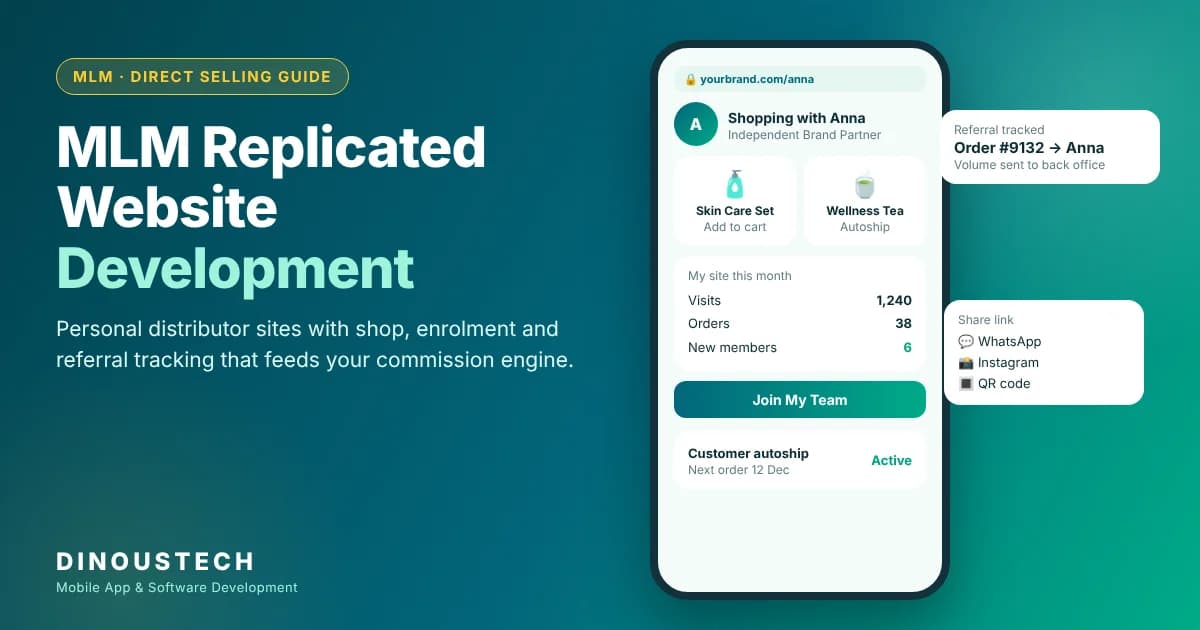
MLM replicated website development means building a system that gives every distributor in a direct selling company their own personal copy of the company website, with their name, photo and contact details, a unique link, and a built-in shop and sign-up flow. Every order or new member that comes through that link is tracked back to the right distributor, so commissions are paid correctly. This guide explains how replicated websites work, the features distributors and admins need, the build process, tech stack, compliance, cost factors and timelines.
Key Takeaways
- A replicated website is a personalised copy of the main company site for each distributor, usually at a subdomain or a path such as yourbrand.com/anna.
- The most important job of a replicated site is accurate tracking: every visit, order and enrolment must be credited to the right distributor and flow into the commission engine.
- The company controls products, prices, pages and compliance text centrally, while distributors only edit approved fields like their photo, bio and social links.
- Replicated sites must connect cleanly with MLM back-office software, the shop, payments, shipping and taxes.
- Earnings claims, product claims and data privacy rules apply to distributor sites, so compliance controls should be built in from day one.
- Cost depends on how many site templates, languages and countries you support, the shop features, and integrations with your existing MLM software.
Table of Contents
- What Is an MLM Replicated Website?
- Why Direct Selling Companies Need Replicated Websites
- How Replicated Websites Work
- Types of Replicated Website Setups
- Key Features
- Step-by-Step Development Process
- Recommended Tech Stack
- How Dinoustech Uses AI
- Compliance and Trust
- Cost Factors
- Development Timeline
- Challenges and Solutions
- Why Choose Dinoustech
What Is an MLM Replicated Website?
In network marketing and direct selling, a replicated website is a copy of the company's main website that is created automatically for each distributor (also called an affiliate, consultant, member or brand partner). The design, products and most of the content are the same for everyone. What changes is the web address and a small set of personal details, such as the distributor's name, photo, short story, phone number and social media links.
When a customer visits a distributor's site and buys a product, or when a new person joins the business through that site, the system records the distributor as the referrer. That sale or sign-up then counts toward the distributor's volume and commissions in the MLM back office. In short, a replicated website is a personal storefront and recruiting page that is fully connected to the company's commission system.
Why Direct Selling Companies Need Replicated Websites
Most distributors are not web designers. Asking them to build their own websites leads to off-brand pages, wrong prices and risky claims. Replicated sites solve this while giving each person a professional online presence in minutes. The main benefits are:
- Fast onboarding: a new distributor gets a working website the moment enrolment is complete.
- Consistent brand: every site uses the company's design, approved product information and legal text.
- Accurate attribution: online orders and sign-ups are credited to the right person automatically, which reduces commission disputes.
- Social selling: distributors can share one link on WhatsApp, Instagram, Facebook or TikTok and every click is tracked.
- Central updates: when the company changes a product, price or promotion, every replicated site updates at once.
- Better data: the company can see which distributors drive traffic and sales, and support them with training.
How MLM Replicated Websites Work
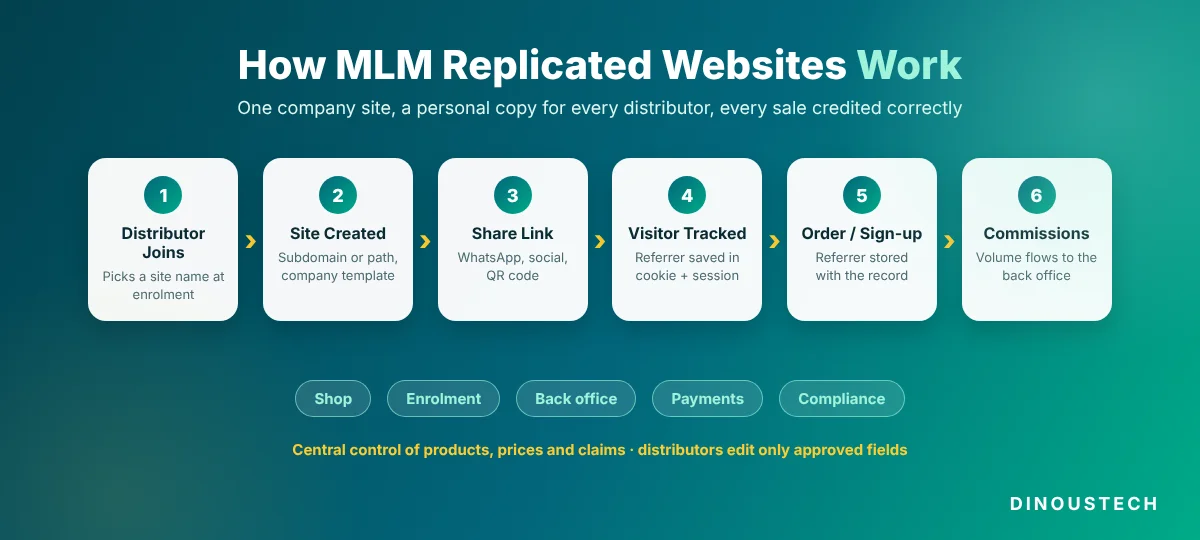
Behind the scenes, a replicated website system follows a simple flow:
- Enrolment: a new distributor joins and picks a site name, or the system creates one from their username.
- Site creation: the platform instantly publishes a personal site at a subdomain (anna.yourbrand.com) or a path (yourbrand.com/anna), using the company's template.
- Personalisation: the distributor adds a photo, bio and contact details from their back office, within the limits the company sets.
- Visitor tracking: when someone opens the link, the system stores the referring distributor in a cookie and in the shopping session, so the credit is kept even if the visitor browses other pages.
- Order or enrolment: the customer buys or signs up, and the referrer is saved with the order or new member record.
- Commission sync: the order volume flows into the MLM back office, where the compensation plan rules calculate commissions and bonuses.
If you are new to the commission side, read our guide to MLM compensation plans.
Types of Replicated Website Setups
1. Subdomain Sites
Each distributor gets an address such as anna.yourbrand.com. It looks personal and is easy to share. It needs wildcard DNS and SSL certificates, which modern cloud platforms handle well.
2. Path-Based Sites
Each distributor gets an address such as yourbrand.com/anna. This is simpler to host and keeps all pages under the main domain.
3. Referral Link Only
Instead of a full personal site, the distributor shares the main shop with a referral code in the link. It is quick to build but gives distributors less of a personal presence.
4. Custom Domain Sites
Senior leaders may connect their own domain to their replicated site. This needs extra controls so the company still owns the content and compliance text.
5. Landing Pages and Funnels
Besides the main site, distributors can share approved landing pages for a product launch, an event or recruiting, each with its own tracking.
Key Features of MLM Replicated Website Software
Distributor Features
- Personal site created automatically at enrolment
- Profile editor for photo, bio, phone, WhatsApp and social links, with admin approval if needed
- Shareable links and QR codes for each product and landing page
- Dashboard showing visits, orders, sign-ups and conversion rate from their site
- Customer list and order history for their personal customers
- Approved social media posts and images to share
- Mobile-friendly management through the back office or a distributor mobile app
Customer Features
- Fast, mobile-friendly shop with product search and filters
- "Shopping with Anna" banner so customers know who referred them
- Retail, preferred customer and subscription (autoship) pricing
- Secure checkout with local payment methods, taxes and shipping
- Option to join as a distributor from the same site
Admin Features
- Central template, page and product management for all sites at once
- Control over which fields distributors can edit
- Rules for referral cookies, credit when a customer switches distributors, and orphan customers
- Blocking or suspending sites for distributors who leave or break policy
- Multi-country, multi-language and multi-currency settings
- Compliance review of profile text, with banned words and earnings claim filters
- Reports on traffic, sales and sign-ups by distributor, rank and country
For the wider back-office feature set, see what features MLM software should have.
Step-by-Step MLM Replicated Website Development Process
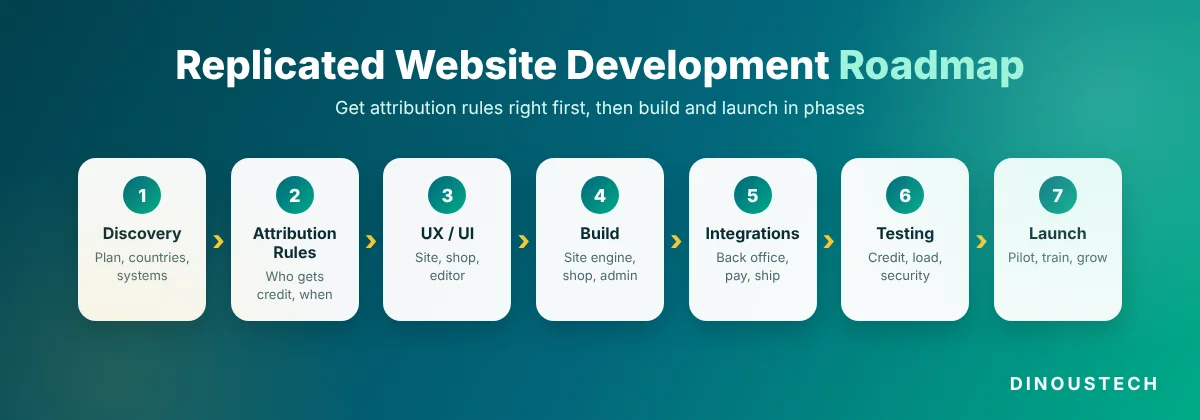
Step 1: Discovery
We map your compensation plan, countries, product catalogue, existing MLM software and current website, and agree whether sites will use subdomains or paths.
Step 2: Attribution Rules
We write down exactly who gets credit in every case: first click or last click, cookie length, customers who already have a sponsor, and what happens when a distributor leaves. Clear rules here prevent most future disputes.
Step 3: UX and UI Design
We design the site template, the "shopping with" experience, checkout and the distributor's site editor, mobile first.
Step 4: Build the Platform
We develop the multi-tenant site engine, shop, checkout, profile editor, admin tools and the APIs that connect to your back office.
Step 5: Integrations
We connect payments, tax, shipping, email and SMS, and your MLM software for genealogy, volume and commissions. If you are moving to a new platform, our MLM software migration guide explains how to move data safely.
Step 6: Testing
We test attribution with real scenarios, load test for launch-day traffic, and run security checks on logins, payments and personal data.
Step 7: Launch and Training
We launch in phases, starting with a pilot group of distributors, then train the field team and monitor conversion and support requests.
Recommended Tech Stack for Replicated Websites
| Layer | Options |
|---|---|
| Front end | Next.js or Nuxt for fast, SEO-friendly pages; React or Vue for the editor |
| Backend | Node.js, Python (Django or FastAPI) or PHP (Laravel) with REST or GraphQL APIs |
| Database | PostgreSQL or MySQL, with Redis for sessions and caching |
| eCommerce | Custom shop, or headless commerce such as Shopify, BigCommerce or commercetools connected by API |
| Hosting and domains | AWS, Google Cloud or Azure, wildcard DNS, automatic SSL, CDN such as Cloudflare or CloudFront |
| Payments and tax | Stripe, PayPal, Adyen or Razorpay; tax tools such as Avalara or Stripe Tax |
| Messaging | Email (SendGrid, Amazon SES), SMS and WhatsApp Business API |
| Analytics | Server-side event tracking, Google Analytics 4 and a reporting dashboard |
How Dinoustech Uses AI in Replicated Website Projects
AI-Assisted Development
Our developers use AI coding assistants for routine work such as API boilerplate, test cases and documentation, and every change is reviewed by an engineer. This speeds up delivery without lowering quality.
AI Features for Distributors and Admins
- Bio and post writer: AI helps distributors write a short bio and social posts, using only approved product facts.
- Compliance checker: AI flags risky income or health claims in profile text before it goes live.
- Product recommendations: personalised suggestions on each site based on browsing and orders.
- Translation: faster, reviewed translations of pages for new countries.
- Insights: plain-language tips such as "your link got 120 visits but few orders, try sharing the starter bundle".
AI Support Agent
A support assistant trained on your policies and FAQs can answer common questions from distributors and customers, such as order status, how to edit a site, or how autoship works, and hand off to a human when needed. Learn more about our approach in how AI can automate MLM business management.
Compliance and Trust
Replicated sites are public marketing pages, so the rules that apply to the company's marketing also apply to them. Areas to plan for include:
- Earnings claims: in the US, the Federal Trade Commission (FTC) warns against misleading income claims in multi-level marketing. Many companies only allow approved income disclosure statements.
- Product claims: health and beauty claims must match what regulators allow in each country.
- Direct selling laws: many countries regulate direct selling and ban pyramid schemes, for example the EU Unfair Commercial Practices Directive and India's Consumer Protection (Direct Selling) Rules, 2021.
- Privacy: customer and distributor data is covered by laws such as GDPR in Europe and state privacy laws in the US, including cookie consent for referral tracking.
- Payments: use PCI DSS compliant payment providers so card data never touches your servers.
This is general information, not legal advice. Please confirm your exact duties with a lawyer in each market.
MLM Replicated Website Development Cost Factors
We share an estimate after understanding your scope. The main cost factors are:
- Site setup: subdomains, paths or custom domains, and the number of templates.
- Shop depth: retail and member pricing, autoship, bundles, coupons and inventory.
- Countries: languages, currencies, taxes, payment methods and shipping rules.
- Integrations: your existing MLM software, ERP, warehouse and CRM.
- AI features: bio writer, compliance checker, recommendations and support agent.
- Scale: number of distributors and expected launch-day traffic.
For full platform budgets, read our post on the cost of MLM software development.
Development Timeline
| Scope | What It Includes | Typical Timeline |
|---|---|---|
| Replicated sites add-on | Personal sites, referral tracking and profile editor connected to an existing shop and back office | 6-10 weeks |
| Sites with a new shop | Replicated sites, custom shop, autoship, payments and one country | 3-5 months |
| Global platform | Multi-country shop, languages, AI features, full MLM back office integration | 5-9 months or more |
Challenges and Solutions
- Lost referral credit: store the referrer in the session, the cookie and the customer record, and let customers confirm their distributor at checkout.
- Off-brand or risky content: limit editable fields and use approval queues and automated claim filters.
- Slow sites at launch: CDN caching, shared templates and load testing before big events.
- SEO duplicates: point canonical tags to the main pages so thousands of copies do not compete in search.
- Distributors leaving: clear rules to redirect or reassign their sites and customers.
Why Choose Dinoustech for MLM Replicated Website Development
Dinoustech is a software development company based in Jaipur, India, working with clients in India and around the world. Our MLM software development team builds back offices, distributor apps and replicated websites that work together.
- Experience with genealogy, compensation plans and commission engines
- Custom eCommerce and payment integrations
- Privacy-first design and compliance controls
- Developers available for calls in US, UK, EU and Middle East time zones
- Post-launch support as your field team grows
Read more about building MLM software with distributor management, or see examples of our work in our portfolio.
Launch Replicated Websites for Your Distributors
Whether you need replicated sites for an existing MLM platform or a complete new shop and back office, we can help you plan the attribution rules, design and integrations, and build it end to end. Contact Dinoustech today for a free consultation.