Dinoustech Private Limited
Robo-Advisor App Development: How to Build an Automated Investing App with Risk Profiling, Rebalancing and AI
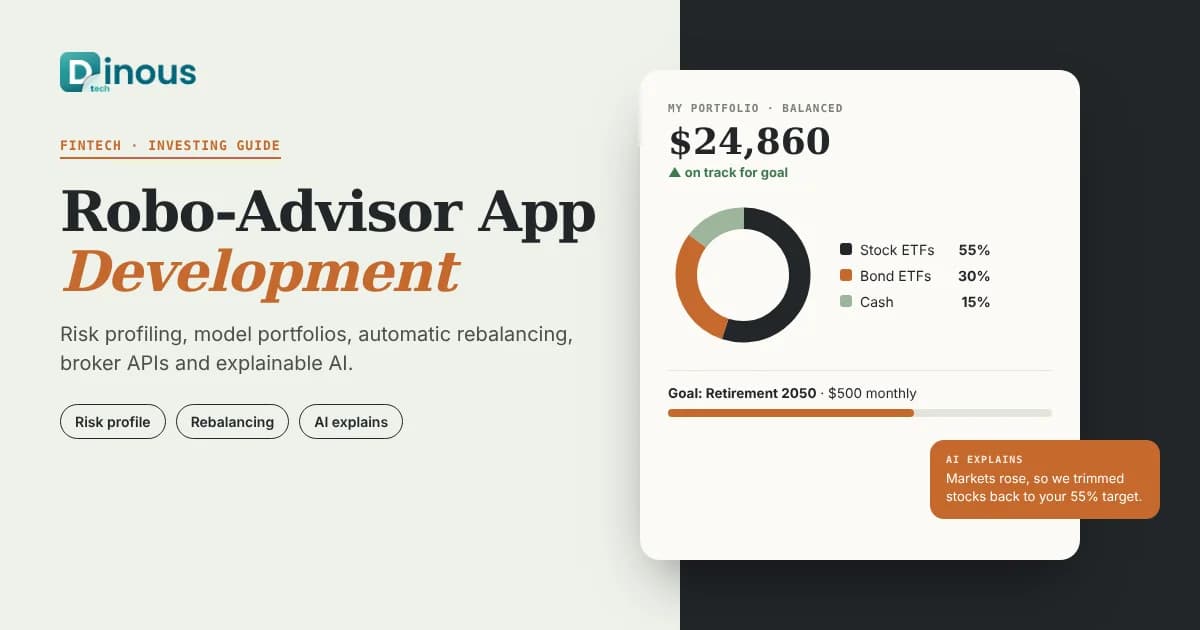
Robo-advisor app development means building a digital investment platform that asks users about their goals, time horizon and risk tolerance, recommends a suitable portfolio, invests their money automatically and keeps it on track with rebalancing, all through a simple mobile or web app. Robo-advisors make professional-style portfolio management affordable for everyday investors, and banks, wealth managers and fintech startups use them to serve more clients at lower cost. This guide explains how a robo-advisor works, the business models, key features, the build process, tech stack, AI features, regulation, cost factors and timelines.
Key Takeaways
- A robo-advisor combines a risk questionnaire, a portfolio engine, a broker or custodian connection and automatic rebalancing in one app.
- The onboarding questionnaire is the heart of suitability: regulators expect you to explain how answers lead to recommendations.
- Most robo-advisors invest in low-cost ETFs or funds and charge a percentage of assets under management (AUM) or a flat subscription.
- You will usually partner with a regulated broker or custodian through APIs rather than holding client assets yourself.
- Regulation such as SEC adviser rules in the US, FCA rules in the UK, MiFID II in the EU and SEBI rules in India shapes the product from day one.
- Cost depends on markets, asset classes, broker integrations, goal planning depth, AI features and compliance tooling.
Table of Contents
- What Is a Robo-Advisor?
- Robo-Advisor vs Human Adviser vs Trading App
- Robo-Advisor Business Models
- How a Robo-Advisor App Works
- Key Features
- Step-by-Step Development Process
- Recommended Tech Stack
- How Dinoustech Uses AI
- Regulation and Compliance
- Monetization Models
- Cost Factors
- Development Timeline
- Challenges and Solutions
- Why Choose Dinoustech
What Is a Robo-Advisor?
A robo-advisor is an automated investment service. Instead of meeting a financial adviser, the user answers an online questionnaire about their age, income, goals, investment horizon and how they would react to market falls. Based on these answers, an algorithm places them in a model portfolio, usually a mix of stock and bond ETFs or index funds. The platform invests their deposits, reinvests dividends and rebalances the portfolio when it drifts from its target.
Robo-advisors became popular because they offer low fees, low minimum investments and a simple experience. Today many also offer goal planning, tax-aware investing, thematic portfolios and access to a human adviser for more complex questions.
Robo-Advisor vs Human Adviser vs Trading App
It helps to be clear about what a robo-advisor is and is not, because this shapes features, licences and marketing.
| Point | Robo-Advisor | Human Adviser | Trading App |
|---|---|---|---|
| Who decides what to buy | Algorithm, based on the user's profile | Adviser, with the client | The user, trade by trade |
| Typical cost | Low fee or subscription | Higher fees for personal service | Brokerage or spreads per trade |
| Minimum investment | Low | Often higher | Low |
| Best for | Long-term, hands-off investors | Complex planning needs | Active, self-directed investors |
| Key product focus | Suitability, rebalancing, goals | Relationship and advice | Speed, charts, order types |
Many modern platforms blend these models, for example a trading app with an automated portfolio option, or a robo-advisor with on-demand human advice. Being clear about your core model makes regulation, design and pricing decisions much easier.
Robo-Advisor Business Models
1. Direct-to-Consumer Robo-Advisor
A fintech brand offers automated investing directly to retail investors through its own app.
2. Hybrid Robo-Advisor
Automation handles portfolios and rebalancing, while human advisers are available by chat, call or video for planning and reassurance.
3. Bank or Broker Robo Feature
A bank, broker or neobank adds automated portfolios inside its existing app to give customers an easy way to invest.
4. White-Label Robo for Advisers
Wealth managers and independent advisers use a branded robo platform to onboard and manage smaller clients efficiently.
5. Goal-Based or Niche Robo
Platforms focused on a specific goal or audience, such as retirement savings, children's education, ethical (ESG) investing or Islamic finance.
How a Robo-Advisor App Works
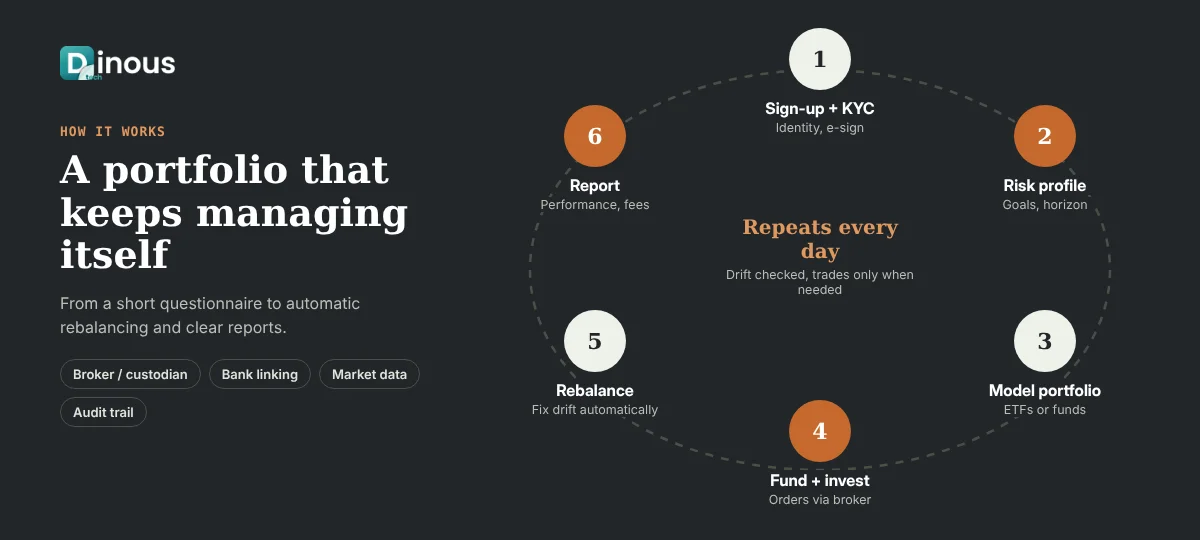
- Sign-up and KYC: the user creates an account and completes identity checks. See our guide to KYC and AML compliance in fintech apps.
- Risk profiling: a questionnaire captures goals, horizon, income, existing savings and risk tolerance, and produces a risk score.
- Portfolio recommendation: the engine maps the risk score to a model portfolio and explains why it fits.
- Funding and investing: the user links a bank account, sets one-time or recurring deposits, and the platform places orders through a broker or custodian API.
- Rebalancing: the system checks portfolios regularly and rebalances when allocations drift or when the user's profile changes.
- Reporting: users see performance, fees, goal progress and statements; the firm keeps records for compliance.
Key Features of a Robo-Advisor App
Investor Features
- Fast digital onboarding with KYC and e-signatures
- Clear risk questionnaire with simple explanations
- Recommended portfolio with allocation charts and plain-language reasons
- Goal planning: retirement, house, education, emergency fund
- One-time and recurring deposits, withdrawals and round-ups
- Performance, fees and goal progress dashboards
- Thematic or ESG portfolio options
- Notifications for deposits, rebalancing and market updates
- Chat or call with a human adviser in hybrid models
- Documents, statements and tax reports
Admin and Adviser Features
- Model portfolio management and version history
- Rebalancing rules, thresholds and schedules
- Client management, suitability records and notes
- Order monitoring, reconciliation with the custodian and exception handling
- Compliance dashboards, audit trails and disclosure management
- Fee calculation and billing
- Reports on assets, flows, client segments and churn
Step-by-Step Robo-Advisor App Development Process
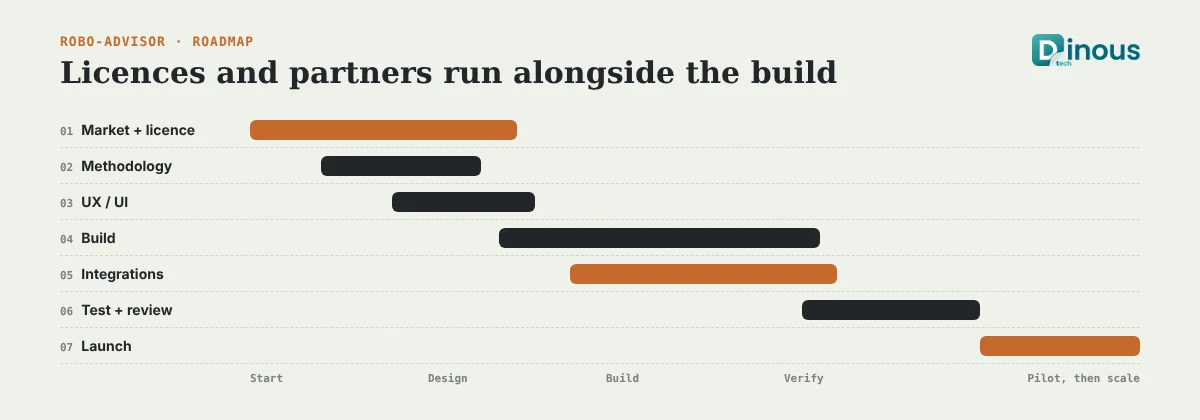
Step 1: Market, Licence and Partners
We help you define your target investors and markets, and map which licences you or your partners need. We shortlist brokers or custodians with APIs for account opening, funding and trading.
Step 2: Investment Methodology
With your investment team, we document the questionnaire, risk scoring, model portfolios and rebalancing rules. This becomes the specification for the engine and the basis for regulatory disclosures.
Step 3: UX and UI Design
We design a calm, trustworthy onboarding flow, simple portfolio views and clear fee and risk information that works well on mobile screens.
Step 4: Build the Platform
We build the mobile and web apps, the backend, the portfolio and rebalancing engine, and the admin panel.
Step 5: Integrations
We connect KYC providers, bank linking, the broker or custodian, market data, payments and messaging.
Step 6: Testing and Compliance Review
We test calculations against independent spreadsheets, run back-tests and edge cases, complete security testing and support your compliance team's review. Our mobile app security checklist covers the security side.
Step 7: Launch and Improve
We launch with a limited group, monitor onboarding drop-off, deposits and support questions, then expand features and markets.
Recommended Tech Stack for Robo-Advisor Development
| Layer | Options |
|---|---|
| Mobile apps | Flutter or React Native, or native Kotlin and Swift |
| Web app and admin | React or Next.js |
| Backend | Java or Kotlin (Spring Boot), Python (FastAPI) or Node.js |
| Portfolio engine | Python with NumPy and pandas for allocation, drift and rebalancing logic |
| Database | PostgreSQL with strong audit tables, Redis for caching |
| Brokerage and custody | Broker and custodian APIs for account opening, funding and orders (choice depends on country) |
| KYC and bank linking | Identity verification providers and open banking or account aggregation APIs |
| Market data | Licensed price and fund data feeds |
| Cloud and security | AWS, Google Cloud or Azure with encryption, key management, monitoring and backups |
If you plan to use bank account data, see our guide to open banking app development.
How Dinoustech Uses AI in Robo-Advisor Projects
AI-Assisted Development
Our developers use AI coding assistants for routine work such as API boilerplate, tests and documentation, with every change reviewed by an engineer. Financial calculations are always verified with independent tests.
AI Features Inside the Platform
- Plain-language explanations: AI explains portfolio changes, fees and market moves in simple words, within approved compliance wording.
- Goal coaching: nudges that help users save regularly and stay invested during volatility.
- Spending and cash insights: suggestions for how much to invest based on linked account data, with user consent.
- Anomaly detection: alerts for unusual account activity, failed orders or reconciliation gaps.
- Adviser assist: meeting summaries and client briefs for human advisers in hybrid models.
AI should support the regulated investment process, not replace it. Recommendations must still follow the documented methodology. Learn more in our post on AI-based fintech app development.
AI Support Agent
A support assistant can answer common questions about deposits, withdrawals, statements and app features, and route anything that sounds like personal financial advice to licensed staff.
Regulation and Compliance
- United States: robo-advisers are generally registered investment advisers under the Investment Advisers Act and owe fiduciary duties. SEC staff guidance highlights clear disclosures, a well-designed questionnaire for suitability and an effective compliance programme.
- United Kingdom: automated advice and discretionary management are regulated by the FCA, including suitability and Consumer Duty expectations.
- European Union: MiFID II suitability and disclosure rules apply to investment advice and portfolio management.
- India: SEBI regulates investment advisers and portfolio managers.
- Data and security: GDPR and other privacy laws, plus strong security and record-keeping for financial data.
This is general information, not legal or investment advice. Please confirm your licensing and obligations with qualified advisers in each market.
Monetization Models
- AUM fee: an annual percentage of assets managed, charged monthly or quarterly.
- Subscription: a flat monthly fee, popular for simpler products.
- Premium tiers: human adviser access, tax features or advanced planning for a higher fee.
- B2B licensing: white-label platform fees from banks, brokers and advisers.
- Cash management: interest-bearing cash accounts through partner banks, where allowed.
Robo-Advisor App Development Cost Factors
- Markets and licences: one country or several, each with its own rules and partners.
- Asset classes: ETFs only, or also mutual funds, stocks, bonds and cash products.
- Integrations: broker, custodian, KYC, bank linking and market data.
- Planning depth: simple portfolios, or full goal planning and tax features.
- Hybrid features: adviser tools, scheduling and video calls.
- AI and compliance tooling: explanations, monitoring, audit trails and reporting.
For broader numbers, read our post on the cost of building a fintech app.
Development Timeline
| Scope | What It Includes | Typical Timeline |
|---|---|---|
| MVP | One market, onboarding and KYC, questionnaire, model portfolios, one broker integration, basic dashboards | 4-6 months |
| Full platform | Goal planning, recurring deposits, automated rebalancing, admin and compliance tools, mobile and web | 6-9 months |
| Hybrid or multi-market | Adviser tools, multiple markets and asset classes, AI features, white-label options | 9-12 months or more |
Licensing and partner onboarding can run in parallel with development and often decide the real launch date.
Challenges and Solutions
- Explaining recommendations: show the reasons behind each portfolio and keep a record of the inputs.
- Calculation errors: independent test suites, reconciliation with the custodian and maker-checker controls for model changes.
- User drop-off during onboarding: short questionnaires, progress indicators and save-and-continue.
- Market volatility and panic selling: timely, calm communication and goal-based views.
- Partner dependency: clean integration layers so you can add or switch brokers later.
Why Choose Dinoustech for Robo-Advisor App Development
Dinoustech is a software development company based in Jaipur, India, building apps for clients in India and around the world. Our fintech app development team builds secure investing, payments and banking products.
- Experience with fintech onboarding, KYC and payment integrations
- Portfolio, rebalancing and reporting logic built with strong testing
- Security-first architecture with audit trails
- Developers available for calls in US, UK, EU and Middle East time zones
- Post-launch support as your assets and users grow
Also read about stock trading app development, or see examples of our work in our portfolio.
Build Your Robo-Advisor With Dinoustech
Whether you are a fintech startup launching automated investing, a bank adding portfolios to its app or an adviser going digital, we can help you plan the methodology, integrations and compliance, and build it end to end. Contact Dinoustech today for a free consultation.