Dinoustech Private Limited
AI Medical Scribe App Development: How to Build an Ambient Clinical Documentation Tool with EHR Integration
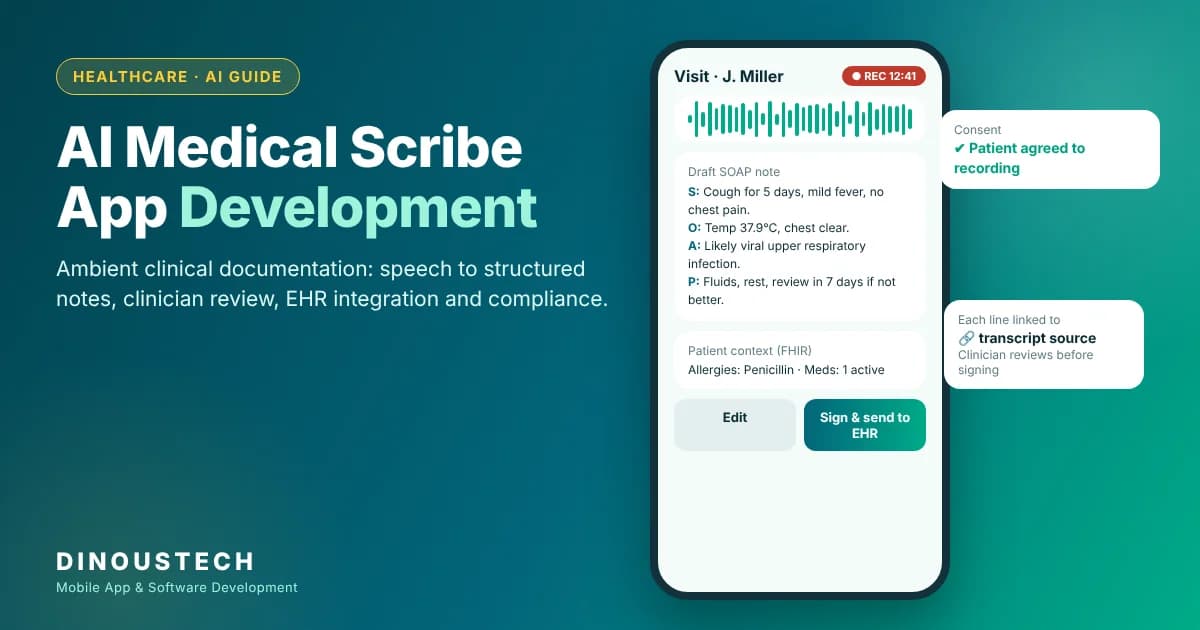
AI medical scribe app development means building software that listens to a doctor-patient visit (with consent), turns the conversation into text, and drafts a structured clinical note such as a SOAP note that the clinician reviews, edits and signs in the electronic health record (EHR). These tools, often called ambient AI scribes, aim to cut the hours clinicians spend on documentation so they can focus on patients. This guide explains how an AI medical scribe works, key features, the build process, tech stack, EHR integration, privacy and compliance, cost factors and timelines.
Key Takeaways
- An AI medical scribe combines audio capture, medical speech recognition, speaker separation and a large language model (LLM) that writes a structured note.
- The clinician always reviews and signs the note. The AI drafts; the human decides.
- EHR integration through standards such as HL7 FHIR is what turns a transcription tool into a real workflow product.
- Patient consent, HIPAA (US), GDPR (EU) and other privacy rules shape how audio is recorded, processed and stored.
- Accuracy depends on specialty-specific templates, medical vocabulary, good audio and continuous quality checks.
- Cost depends on specialties covered, EHR integrations, platforms, languages and how much of the AI pipeline is customised.
Table of Contents
- What Is an AI Medical Scribe?
- Why Clinics and Health Startups Want AI Scribes
- How an AI Medical Scribe Works
- Types of AI Scribe Products
- Key Features
- EHR Integration
- Step-by-Step Development Process
- Recommended Tech Stack
- How Dinoustech Uses AI
- Privacy, Security and Compliance
- Business Models
- Cost Factors
- Development Timeline
- Challenges and Solutions
- Why Choose Dinoustech
What Is an AI Medical Scribe?
A medical scribe is someone who writes up clinical notes while the doctor sees the patient. An AI medical scribe does the same job with software. It records the visit on a phone, tablet or computer, works out who is speaking, understands medical terms, and produces a draft note in the format the clinician uses, such as SOAP (Subjective, Objective, Assessment, Plan), a progress note, a referral letter or a patient summary.
The clinician then checks the draft, makes changes and signs it. Good AI scribes also suggest billing codes, orders or follow-up tasks for review, and create a plain-language summary for the patient.
Why Clinics and Health Startups Want AI Scribes
- Less time on paperwork: clinicians spend a large share of their day on documentation, often after clinic hours. AI scribes aim to reduce that time.
- Better patient attention: doctors can look at the patient instead of the keyboard.
- More complete notes: structured templates help capture history, findings and plans consistently.
- Specialty products: large EHR vendors now offer general ambient tools, which creates room for focused products for specialties such as mental health, physiotherapy, dentistry, veterinary care or home health.
- Telehealth fit: AI scribes work well inside virtual consultation apps, where audio is already digital.
How an AI Medical Scribe Works
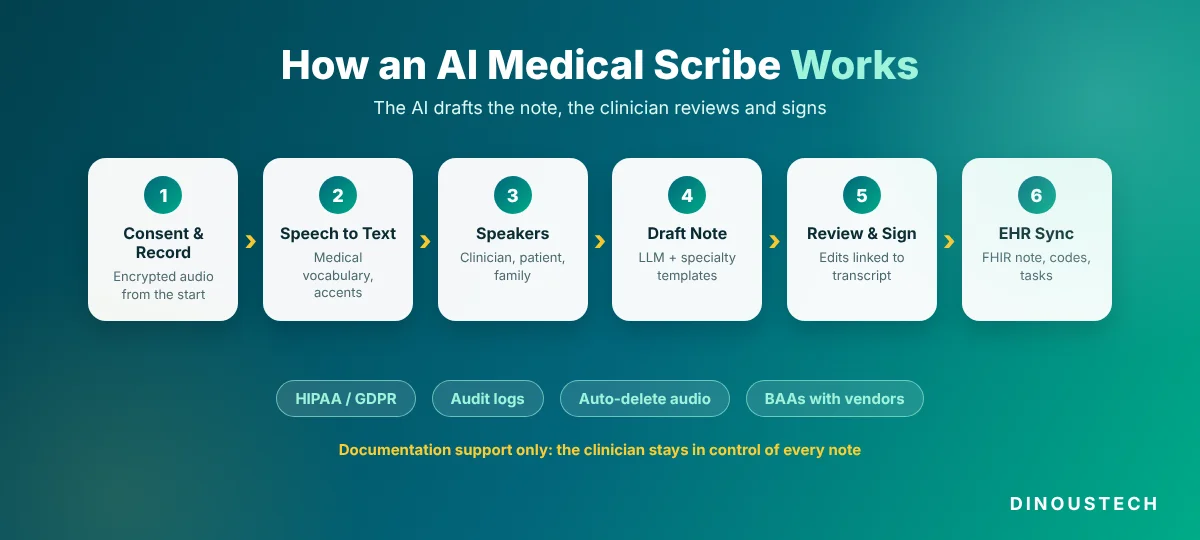
- Consent and capture: the clinician confirms patient consent and starts recording in the app. Audio is encrypted from the start.
- Speech recognition: a medical speech-to-text model converts audio into a transcript, handling drug names, conditions and abbreviations.
- Speaker separation: the system labels who said what (clinician, patient, family member), which is vital for an accurate history.
- Note drafting: an LLM, guided by specialty templates and strict instructions, extracts the clinically relevant facts and writes a structured note. It should not add facts that were not said.
- Review and sign: the clinician edits the draft, with each sentence linked back to the transcript so it is easy to verify.
- EHR sync: the signed note, and optionally codes and orders, are sent to the EHR.
Types of AI Scribe Products
1. Standalone Ambient Scribe App
A mobile or desktop app for independent clinicians and small clinics. Notes are copied or exported into any EHR.
2. EHR-Integrated Scribe
A scribe that connects directly to one or more EHRs, reads patient context and writes notes back into the chart.
3. Specialty Scribe
A product tuned to one field, such as behavioural health, physiotherapy, dentistry or veterinary medicine, with its own templates and terms.
4. Telehealth Scribe
A scribe built into a video consultation platform. See our guide to building an AI doctor consultation app.
5. Dictation Plus AI
Instead of recording the whole visit, the clinician dictates a short summary after the visit and the AI expands it into a full, structured note.
Key Features of an AI Medical Scribe App
Clinician Features
- One-tap recording on phone, tablet, desktop or inside a telehealth call
- Patient consent capture and visible recording status
- Specialty templates: SOAP, progress notes, H&P, referral letters, discharge summaries
- Editable draft notes with links back to the transcript
- Custom phrases, preferred style and personal templates
- Suggested diagnosis and procedure codes for review
- Patient-friendly visit summaries and instructions
- Multi-language support for visits in more than one language
- Offline recording with secure upload when connected
Admin and Organisation Features
- User, clinic and role management with single sign-on
- Template library management per specialty
- Audit logs for every access and edit
- Data retention settings, for example deleting audio after the note is signed
- Quality dashboards: edit rates, time saved, usage by clinician
- Billing and subscription management
EHR Integration
Integration decides whether clinicians will use the scribe every day. Common approaches include:
- HL7 FHIR APIs: read patient demographics, problems, medications and allergies, and write back notes as documents.
- SMART on FHIR apps: launch the scribe from inside the EHR with the right patient already selected.
- HL7 v2 interfaces: still common in hospitals for sending documents and results.
- Copy and export: the simplest option for an MVP, where the clinician pastes the note into any EHR.
Read our detailed guide to EHR integration for healthcare apps to plan this part.
Step-by-Step AI Medical Scribe App Development Process
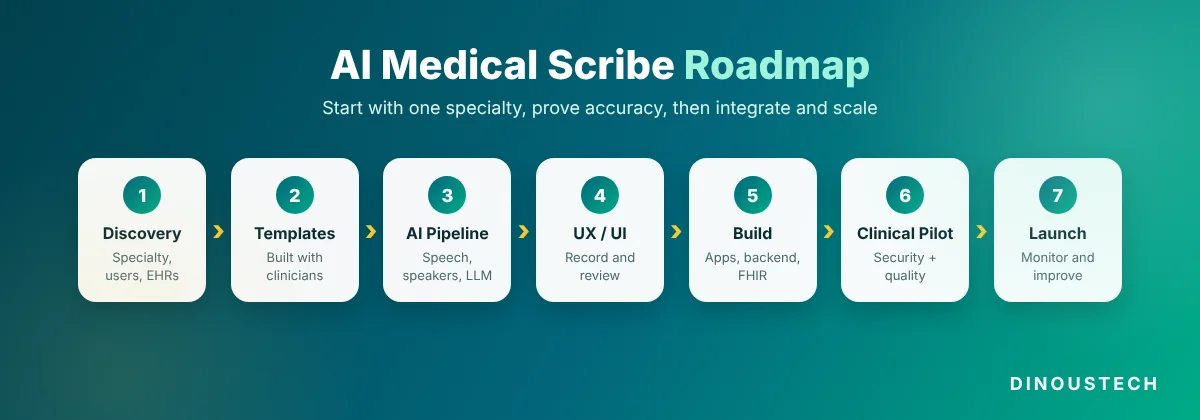
Step 1: Discovery
We define the specialties, users, care settings (clinic, hospital, telehealth), countries and EHRs you need to support.
Step 2: Templates and Clinical Rules
With clinicians, we design note templates, required sections and rules for what the AI may and may not write.
Step 3: AI Pipeline
We select and test speech recognition, speaker separation and LLM options on sample, consented or synthetic recordings, and measure accuracy against clinician-written notes.
Step 4: UX and UI Design
We design a fast recording flow and a review screen that makes checking and editing quick.
Step 5: Build Apps, Backend and Integrations
We build the apps, secure backend, admin panel and EHR connectors.
Step 6: Security and Clinical Testing
We run security testing, privacy reviews and a clinical pilot where clinicians score note quality.
Step 7: Launch and Monitor
We launch to more users, monitor edit rates and errors, and keep improving templates and prompts.
Recommended Tech Stack for AI Medical Scribe Development
| Layer | Options |
|---|---|
| Apps | Flutter or React Native for mobile, React or Electron for desktop, browser extension for web EHRs |
| Backend | Python (FastAPI) or Node.js, with job queues for audio processing |
| Speech recognition | Medical speech-to-text services from major cloud providers, or self-hosted models such as Whisper variants |
| Speaker separation | Speaker diarization models or cloud diarization features |
| Note generation | LLMs through HIPAA-eligible cloud services under a business associate agreement (BAA), with templates and guardrails |
| EHR integration | HL7 FHIR R4, SMART on FHIR, HL7 v2, integration engines |
| Database and storage | PostgreSQL, encrypted object storage with retention policies |
| Cloud and security | AWS, Google Cloud or Azure with encryption, audit logging, SSO and monitoring |
How Dinoustech Uses AI in Healthcare Projects
AI-Assisted Development
Our developers use AI coding assistants for routine work such as API boilerplate, tests and documentation, with every change reviewed by an engineer. Production health data is never used in these tools.
AI Features We Build
- Ambient note drafting with specialty templates and source-linked sentences
- Coding suggestions for diagnosis and procedure codes, always reviewed by humans
- Patient summaries in plain language and other languages
- Quality checks that flag missing sections, contradictions or uncertain terms
AI Support Agent
A support assistant can answer clinic staff questions about the product, such as templates, settings and exports, and route technical or privacy issues to the right team. For more ideas, read how AI makes healthcare apps smarter.
Privacy, Security and Compliance
- HIPAA (US): visit audio and notes are protected health information. You need safeguards, audit logs and business associate agreements with vendors that handle the data. See our HIPAA-compliant app development guide.
- GDPR and UK GDPR: health data is a special category that needs a clear legal basis, data minimisation and strong security.
- Recording consent: some jurisdictions require all parties to agree before a conversation is recorded, so consent capture should be built in.
- Medical device rules: documentation-only tools are usually treated differently from software that makes diagnostic or treatment decisions, but regulators such as the FDA in the US and the EU MDR may apply depending on features.
- Data retention: decide how long audio and transcripts are kept, and delete them when no longer needed.
This is general information, not legal or regulatory advice. Please confirm your exact duties with healthcare compliance experts in each market.
Business Models for AI Scribe Products
- Per-clinician subscription: a monthly or yearly fee per user, the most common model for independent clinicians and small clinics.
- Usage-based pricing: a fee per visit or per hour of audio, which suits clinics with changing volumes.
- Enterprise licences: organisation-wide contracts with SSO, integrations, support and service levels.
- Feature inside a larger platform: telehealth, practice management or clinic appointment products add an AI scribe as a premium add-on.
- Bundles with care programmes: products such as remote patient monitoring platforms can use AI to draft review notes for monitored patients.
Pick the model that matches how your buyers already pay for software, and track usage costs per visit from the start so pricing stays healthy as you grow.
AI Medical Scribe App Development Cost Factors
- Scope of specialties: one specialty or many, with their own templates.
- Platforms: mobile, desktop, web extension or telehealth integration.
- AI pipeline: cloud APIs or self-hosted models, languages and accuracy targets.
- EHR integrations: export only, or direct connections to one or more EHRs.
- Compliance work: security testing, audits and documentation.
- Usage costs: speech recognition and LLM costs per visit at your expected volume.
We share a clear estimate once we understand your scope and target users.
Development Timeline
| Scope | What It Includes | Typical Timeline |
|---|---|---|
| MVP | One specialty, mobile or web app, consent, transcription, note drafting, copy and export | 10-14 weeks |
| Integrated product | Multiple templates, admin panel, FHIR integration with one EHR, quality dashboard | 4-6 months |
| Enterprise platform | Several specialties and EHRs, SSO, coding suggestions, multi-language, advanced analytics | 6-12 months or more |
Challenges and Solutions
- AI adding facts that were not said: strict prompts, source-linked sentences and clinician review before signing.
- Noisy rooms and accents: audio quality checks, better microphones and testing with diverse speakers.
- Specialty language: custom vocabularies and templates built with clinicians.
- Trust and adoption: clear consent flows, fast review screens and visible time savings.
- Competition from EHR vendors: focus on a specialty, care setting or workflow that general tools do not serve well.
Why Choose Dinoustech for AI Medical Scribe App Development
Dinoustech is a software development company based in Jaipur, India, building apps for clients in India and around the world. Our healthcare app development team works on telehealth, patient and clinic apps with privacy built in.
- Experience with speech, LLM and healthcare app integrations
- FHIR-based EHR integration planning
- Security-first architecture with audit logs and encryption
- Developers available for calls in US, UK, EU and Middle East time zones
- Post-launch support and continuous AI quality improvement
See examples of our work in our portfolio.
Build Your AI Medical Scribe With Dinoustech
Whether you want a specialty scribe for independent clinicians or an AI documentation feature inside your telehealth platform, we can help you plan the AI pipeline, templates, integrations and compliance, and build it end to end. Contact Dinoustech today for a free consultation.