Dinoustech Private Limited
AI Fraud Detection Software Development: How to Build a Real-Time Risk Engine for Fintech
AI fraud detection software development means building a system that scores every payment, login, account change and loan application for risk in real time, using machine learning alongside clear business rules. Instead of waiting for chargebacks or customer complaints, the software spots unusual patterns as they happen and decides whether to approve, challenge or block an action. For fintech apps, payment gateways, digital lenders, wallets and online marketplaces, it has become a core part of the product, not an add-on.
This guide explains how AI fraud detection works, the types of fraud it can catch, the features to plan, the tech stack, the step-by-step development process, compliance points, cost factors and realistic timelines. If you are planning a fintech product, our fintech app development team can help you scope it.
Key Takeaways
- AI fraud detection combines rules, machine learning models and human review. Rules alone are easy for fraudsters to learn and generate many false alarms.
- The best systems score events in milliseconds and use the score to approve, add friction (like OTP or selfie checks) or block.
- Good data matters more than a complex model: labelled fraud cases, device data and transaction history are the foundation.
- Explainability, audit trails and privacy controls are essential for banks, regulators and your own analysts.
- Most teams start with a focused MVP for one fraud type (for example payment fraud or account takeover) and expand from there.
Table of Contents
- What Is AI Fraud Detection Software?
- Why Rule-Only Systems Are Not Enough
- Types of Fraud AI Can Detect
- How AI Fraud Detection Works
- Key Features to Build
- Machine Learning Models Used
- Tech Stack
- Step-by-Step Development Process
- How Dinoustech Uses AI
- Compliance and Privacy
- Cost Factors
- Development Timeline
- Challenges and How to Solve Them
- Why Choose Dinoustech
What Is AI Fraud Detection Software?
AI fraud detection software is a risk engine that sits between your users and your money flows. Each time something important happens, such as a card payment, a bank transfer, a new device login, a password reset, a payout request or a loan application, the app sends that event to the engine. The engine looks at the event, the user's history, the device, the location and the wider network of accounts, then returns a risk score and a recommended action within a fraction of a second.
Behind the score are three layers working together:
- Rules for known, clear-cut cases (for example, block payouts to a bank account already linked to confirmed fraud).
- Machine learning models that learn from past genuine and fraudulent activity and catch patterns no one wrote a rule for.
- Human review through a case management dashboard, where analysts check borderline cases and their decisions feed back into the models.
The software can be built as a standalone platform, as a module inside an existing payment app or wallet, or as an internal service shared by several products.
Why Rule-Only Systems Are Not Enough
Many fintech products launch with a handful of hard-coded rules: block transactions above a limit, flag logins from new countries, restrict new accounts for a few days. These help early, but they run into three problems as the business grows.
- Fraudsters adapt. Once they learn your thresholds, they split payments, use local proxies and age accounts before attacking.
- False positives hurt revenue. Strict rules decline good customers, which means lost sales, support tickets and churn.
- Rules do not scale. Hundreds of overlapping rules become hard to maintain, and nobody remembers why a rule was added.
Machine learning helps because it weighs hundreds of signals together and updates as patterns change. The goal is not to remove rules, but to let models handle the grey area while rules handle policy and known bad actors.
Types of Fraud AI Can Detect
| Fraud type | What it looks like | Useful signals |
|---|---|---|
| Payment and card fraud | Stolen cards or credentials used to buy goods or top up wallets | Amount, merchant, velocity, device, billing vs IP location |
| Account takeover | A fraudster logs in to a real customer's account | New device, impossible travel, password reset then payout, typing behaviour |
| New account and identity fraud | Fake or synthetic identities used to open accounts or get credit | KYC results, document checks, email and phone age, shared devices |
| Loan and BNPL fraud | Borrowers who never intend to repay, or stacked applications | Application data consistency, bureau data, links to other applicants |
| Promo and referral abuse | Many accounts created to farm sign-up bonuses or cashback | Device clusters, emulators, shared payment instruments |
| Money mule activity | Accounts used to receive and quickly move stolen funds | Fast in-and-out flows, many new payers, network links |
| Marketplace and merchant fraud | Fake sellers, triangulation fraud, refund abuse | Seller history, dispute rates, buyer-seller links |
How AI Fraud Detection Works
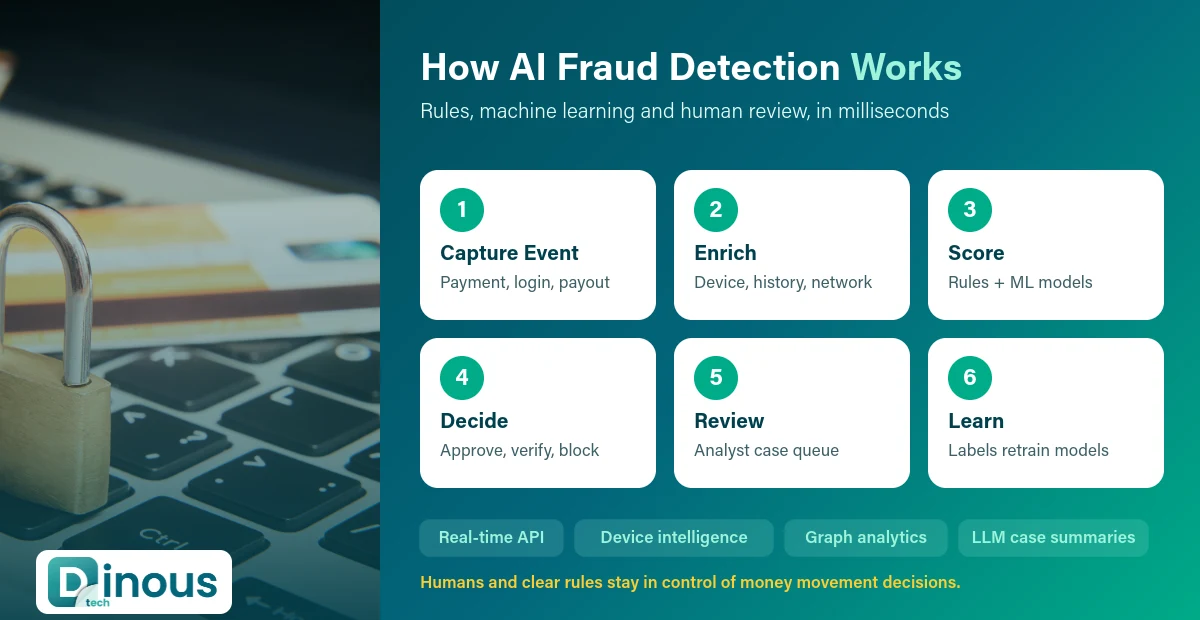
Every serious fraud platform follows a similar flow, whatever the industry.
- Capture the event. The app or backend sends the event (payment, login, payout) with user, device and context data through an API or event stream.
- Enrich it. The engine adds features such as how many payments this card made in the last hour, how old the device is, whether the IP is a known proxy and whether the account shares details with flagged accounts.
- Score it. Rules and models run in parallel. The models return a probability of fraud and the main reasons behind it.
- Decide. A decision policy turns the score into an action: approve, step-up verification (OTP, 3-D Secure, selfie), hold for review or decline.
- Review. Borderline and high-value cases land in an analyst queue with all the evidence on one screen.
- Learn. Chargebacks, confirmed fraud and analyst decisions become new labels, and the models are retrained on a regular schedule.
This loop is what makes the system smarter over time. Without reliable feedback labels, even the best model slowly loses accuracy.
Key Features to Build
Core risk engine
- Real-time scoring API with low latency and high availability
- Rule builder so risk teams can add or change rules without a code release
- Model serving with versioning, A/B tests and safe rollback
- Decision policies per product, country, customer segment and amount band
- Velocity counters (per user, card, device, IP, bank account)
Identity and device intelligence
- Device fingerprinting and emulator or rooted-device detection
- IP reputation, VPN and proxy checks
- Integration with KYC, document verification and liveness checks (see our guide on KYC and AML compliance for fintech apps)
- Behavioural signals such as session patterns and navigation speed
Analyst and admin tools
- Case management queue with priorities, assignment and SLAs
- Customer 360 view: profile, devices, transactions, linked accounts
- Graph view to see networks of linked accounts and mule rings
- Bulk actions, notes and a full audit log of every decision
- Dashboards for fraud rate, approval rate, false positives and losses
Customer-facing pieces
- Smooth step-up flows (OTP, biometric confirmation, selfie) instead of hard declines
- Clear messages and in-app dispute or "this was not me" reporting
- Real-time alerts for unusual account activity
Machine Learning Models Used
There is no single "fraud model". Most platforms use a mix, chosen by the data available and the fraud type.
| Approach | Best for | Notes |
|---|---|---|
| Gradient boosted trees (XGBoost, LightGBM) | Payment and transaction scoring with labelled data | Strong accuracy on tabular data, fast to serve, explainable with feature importance |
| Anomaly detection (isolation forest, autoencoders) | New products with few fraud labels | Finds unusual behaviour; needs tuning to avoid noisy alerts |
| Graph analytics and graph neural networks | Mule networks, promo abuse, synthetic identities | Uses links between accounts, devices, cards and bank accounts |
| Sequence models | Account takeover and session behaviour | Looks at the order of actions in a session |
| Large language models (LLMs) | Analyst support, case summaries, reading documents | Helps humans work faster; should not be the only decision maker for money movement |
For most first versions, a well-engineered gradient boosted model plus strong rules beats a complex deep learning setup. Accuracy comes mainly from good features and clean labels.
Tech Stack
| Layer | Common choices |
|---|---|
| Event streaming | Apache Kafka, AWS Kinesis, Google Pub/Sub |
| Real-time features | Redis, Apache Flink, a feature store such as Feast |
| Scoring service | Python (FastAPI) or Go/Java microservices, Docker, Kubernetes |
| ML training | Python, scikit-learn, XGBoost, LightGBM, PyTorch, MLflow |
| Data storage | PostgreSQL, a data warehouse (BigQuery, Snowflake, Redshift), object storage |
| Graph analysis | Neo4j, Amazon Neptune or graph libraries in Python |
| Analyst dashboard | React or Angular web app, Node.js or Python backend |
| Monitoring | Prometheus, Grafana, model drift and data quality checks |
| Security | Encryption at rest and in transit, secrets manager, role-based access, audit logs |
Step-by-Step Development Process
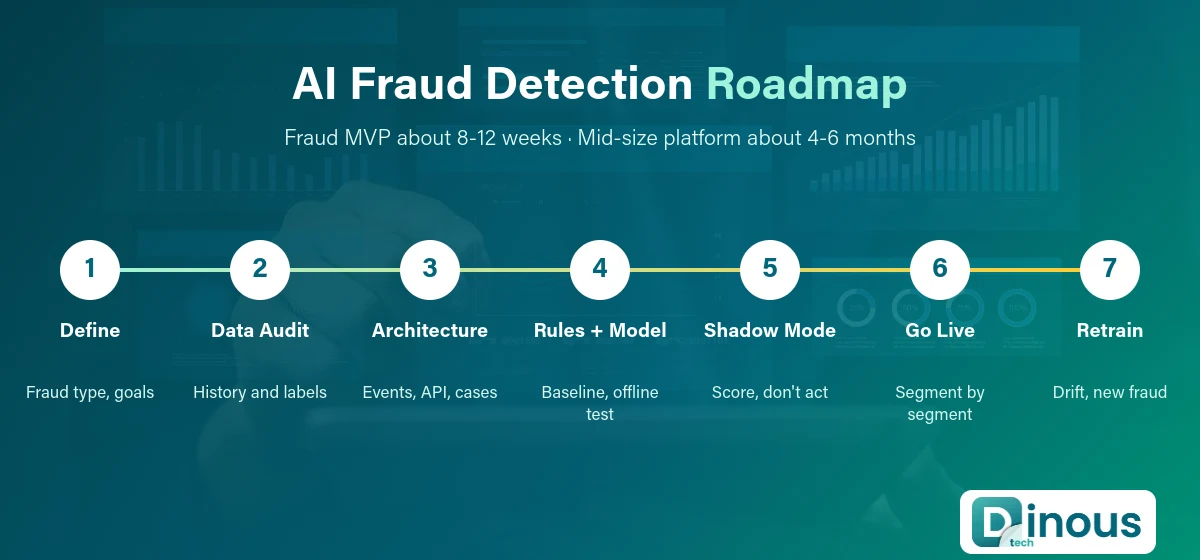
- Define the fraud problem. Pick the first fraud type, the events to score, current losses and the business goals (for example fewer chargebacks without hurting approval rates).
- Audit your data. Check what transaction, device and outcome data exists, how it is labelled and where it lives.
- Design the architecture. Event flow, scoring API, feature store, decision engine, case management and integrations with your payment provider and KYC partners.
- Build rules and baseline model. Start with proven rules and a first model trained on historical data. Measure it offline against past fraud.
- Run in shadow mode. Score live traffic without acting on it, compare the model's view with what really happened and tune thresholds.
- Launch the analyst tools. Case queues, customer view and feedback buttons so every decision becomes a label.
- Go live gradually. Turn on decisions for a segment first, watch approval and fraud rates, then expand.
- Monitor and retrain. Track drift, retrain on fresh labels, review rules monthly and add new fraud types over time.
How Dinoustech Uses AI
AI shows up in three places in our fraud projects:
- AI-assisted development. Our engineers use AI coding assistants to speed up boilerplate, write test cases and review code, which leaves more time for the parts that need careful human design: features, thresholds and security.
- AI features in your product. Beyond the core scoring models, we can add LLM-powered case summaries for analysts, automatic reading of uploaded documents, smart alert grouping and natural-language search across cases.
- AI support for your team and customers. An AI support agent can answer "why was my payment held?" questions, collect missing information and hand over to a human when needed, so genuine customers are not left waiting.
Every AI feature is built with human oversight. Final decisions on blocking accounts or money movement stay with your rules, models and analysts, and every decision is logged.
Compliance and Privacy
Fraud systems handle sensitive personal and financial data, so compliance must be part of the design from day one. Depending on your markets and products, consider:
- PCI DSS if you store, process or transmit card data.
- Data protection laws such as GDPR (EU and UK), CCPA/CPRA (California) and India's DPDP Act: lawful basis, data minimisation, retention limits and user rights.
- Strong customer authentication rules like PSD2 SCA in Europe, which shape when you can use risk-based exemptions.
- AML and sanctions screening obligations for regulated money movement.
- Explainability and fairness: be able to show why a decision was made, and test models for bias against protected groups, especially in lending.
This is general guidance, not legal advice. Work with your compliance team or legal counsel for your specific licences and markets.
Cost Factors
The cost of AI fraud detection software depends far more on scope and data than on the model itself. The main factors are:
- Number of fraud types and events covered in the first release.
- Latency and volume: scoring a few thousand events a day is very different from thousands per second.
- Data readiness: clean, labelled history shortens the project; scattered or unlabelled data adds data engineering work.
- Integrations: payment gateways, core banking, KYC, device intelligence and credit bureau APIs.
- Analyst tooling: a simple review queue vs a full case management and graph investigation suite.
- Compliance and security requirements, audits and penetration tests.
- Third-party costs: cloud hosting, data providers and any paid AI APIs.
- Ongoing work: model monitoring, retraining and rule tuning after launch.
For a quick first estimate of the app side, try our free app cost calculator, then share your fraud use case with us for a detailed quote. You can also read our guide to fintech app development cost.
Development Timeline
| Scope | What is included | Typical timeline |
|---|---|---|
| Fraud MVP | One fraud type, rules + one model, scoring API, basic review queue | About 8-12 weeks |
| Mid-size platform | Several event types, device intelligence, case management, dashboards | About 4-6 months |
| Enterprise platform | Multiple products and countries, graph analytics, high-volume streaming, full audit and compliance tooling | 6-12 months or more |
Shadow mode and gradual rollout add a few weeks but are worth it: they prevent good customers from being blocked on day one.
Challenges and How to Solve Them
- Imbalanced data. Fraud is rare compared with genuine activity. Use sampling techniques, cost-sensitive training and the right metrics (precision, recall, false positive rate), not just accuracy.
- Delayed labels. Chargebacks can arrive weeks later. Combine fast signals (analyst decisions, customer reports) with slow ones.
- Concept drift. Fraud patterns change quickly. Monitor model performance and retrain on a schedule.
- Customer friction. Use step-up verification instead of hard declines for medium-risk events.
- Explainability. Show the top reasons behind each score so analysts and auditors trust the system.
- Latency. Pre-compute features and keep the scoring path lean so checkout and login stay fast.
Why Choose Dinoustech
Dinoustech is a software development company with a team that has 7+ years of experience and 450+ delivered projects across fintech, e-commerce, healthcare and on-demand platforms. We build secure payment, wallet and lending products, and we design fraud controls as part of the product rather than as an afterthought.
- End-to-end delivery: discovery, data engineering, ML, backend, apps and analyst dashboards
- Experience with open banking, wallets, UPI and payment integrations
- Machine learning development and AI app development under one roof
- Clear communication with clients in the USA, UK, UAE, Australia and India
Explore our portfolio or read more about AI features every fintech app should have.
Plan Your AI Fraud Detection System
If fraud losses, chargebacks or false declines are holding back your fintech product, let us help you design a risk engine that fits your data and your users. Contact Dinoustech for a free consultation and a clear plan for your first release.